On 25 November 2026, inside the dinosaur hall of Berlin's Museum für Naturkunde, the European Space Agency (ESA) showed the first close-up images of Dimorphos. Hera sees a stadium-sized crater, a flattened face and an asteroid tumbling on its orbit. Since NASA's deliberate impact in 2022, the first planetary defence test has finally delivered a field report.
A crater as wide as the asteroid
Dimorphos is a small asteroid, 151 m across. It circles Didymos, a 730 m body. The pair orbits the Sun some 193.5 million km from Earth. On 26 September 2022, NASA's DART (Double Asteroid Redirection Test) spacecraft slammed into it on purpose. The goal was to test a kinetic impact, meaning a heavy probe flown fast enough to nudge an asteroid and change its path. Dimorphos's orbit around Didymos shrank by 33 minutes, far more than predicted.
One question remained open. What had happened to the asteroid itself? Telescopes had measured the orbital change, not the state of the surface. Hera travelled for two years to answer that. Its cameras show that the face hit by DART was flattened into a crater the size of a sports stadium. The crater reaches across the entire width of Dimorphos.
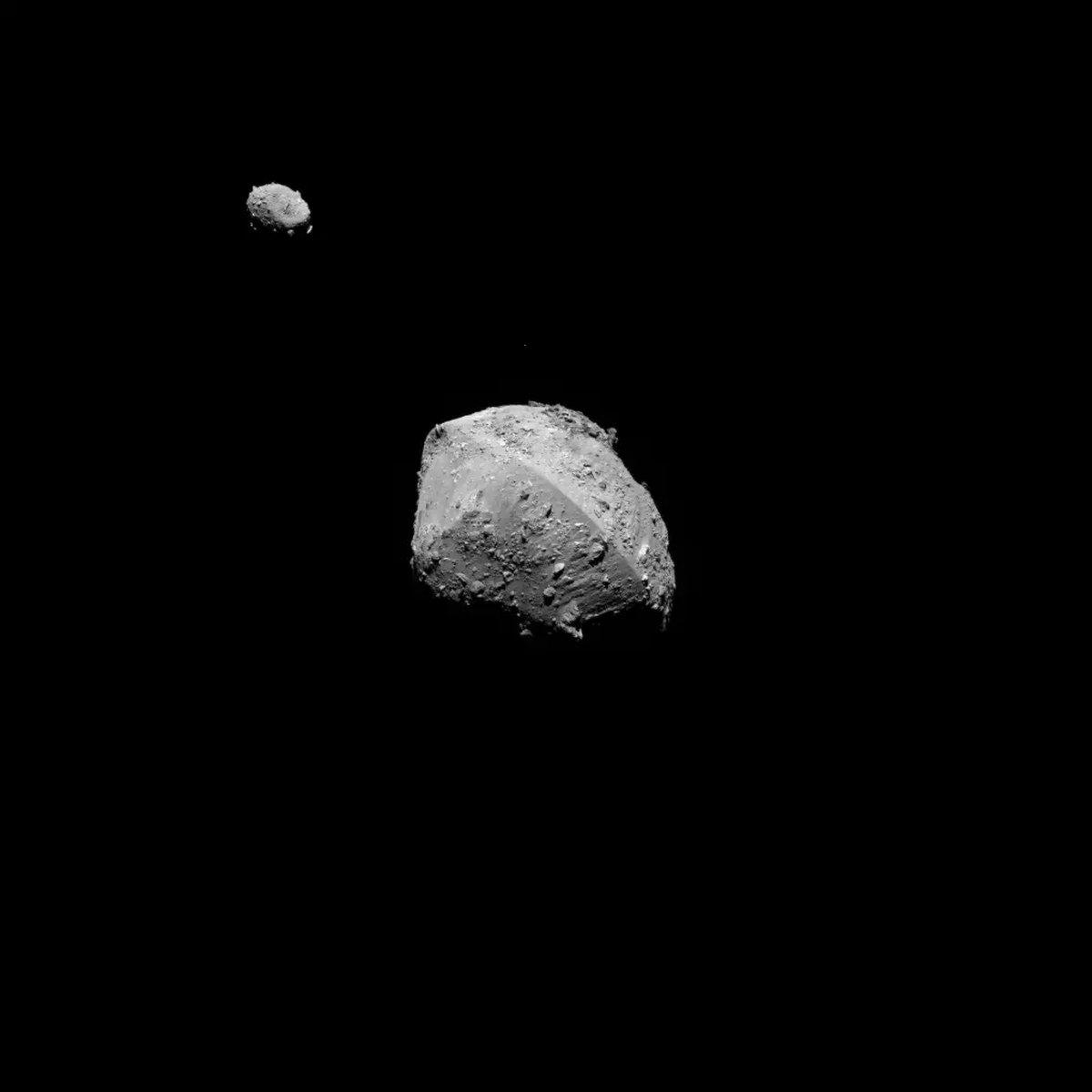
The comparison is striking. A crater that runs across the whole asteroid is about 151 m wide. The impact did not simply dig a hole. It crushed an entire face. Patrick Michel, Hera's principal investigator, summed up the surprise: scientists had debated whether Dimorphos kept a crater, changed shape or stayed the same. The answer is all three at once.
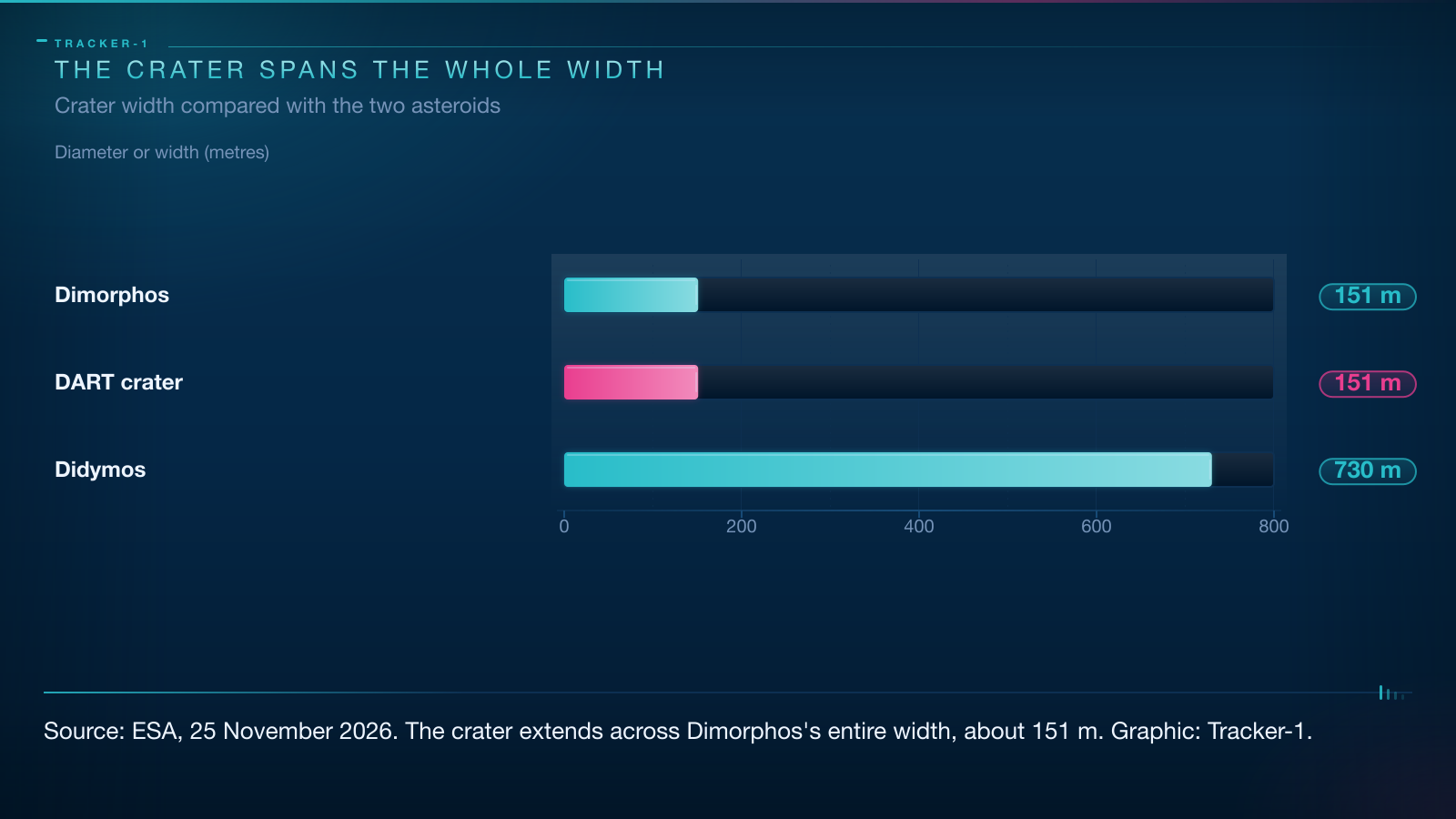
The shape of the crater says a lot about how the asteroid absorbed the blow. A narrow bowl would point to a local strike. A face flattened across its entire width means the deformation reached well beyond the point of impact. Hera's images now let scientists measure that deformation on site for the first time.
Why Dimorphos is tumbling
The second surprise is that Dimorphos no longer spins steadily. The impact left it tumbling on its orbit. A tumbling asteroid is one whose rotation axis tips and changes direction over time, like a badly thrown stone that rolls and wobbles. It no longer behaves like a stable spinning top.
The motion does not show up in a single image. Scientists have to track surface features from one frame to the next. As Hera returned more views, the team saw Dimorphos present angles that did not fit a calm rotation. That is why ESA describes the asteroid as tumbling wildly.
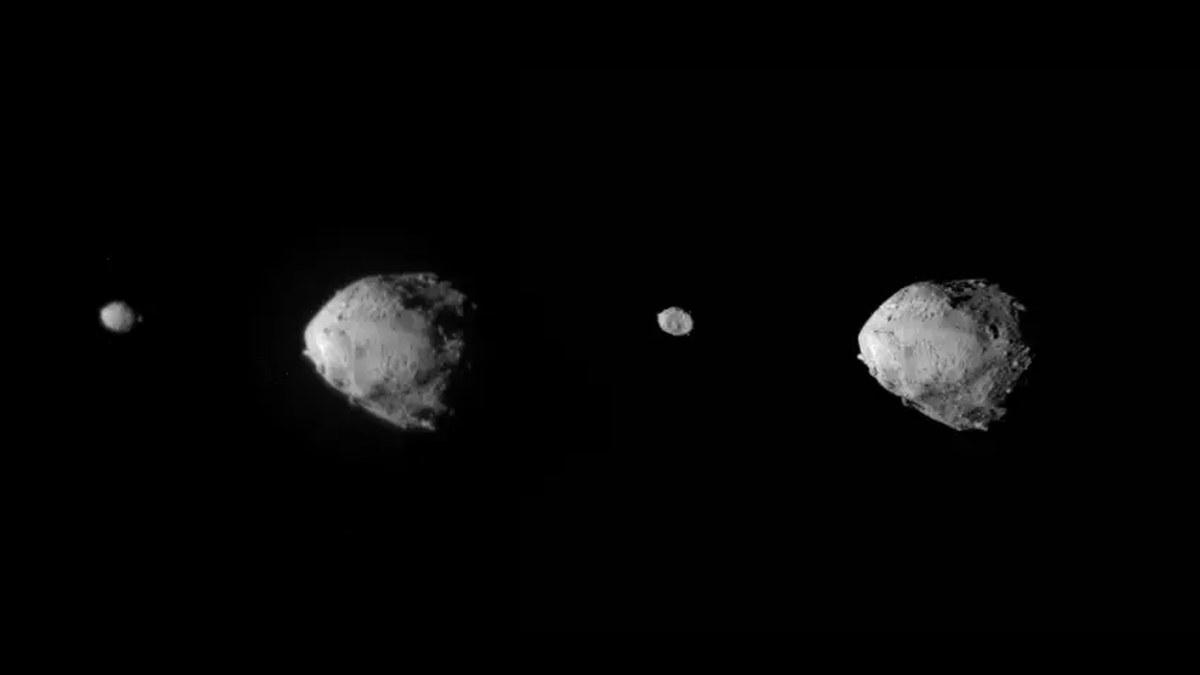
The rest of Dimorphos shows no sign of major change. Boulder fields in the regions spared by the impact look much as they did in DART's 2022 images. That relative stability is good news for science. It means Hera can compare two states of the same landscape, before and after, and separate what the impact really changed.
Hundreds of boulders in orbit
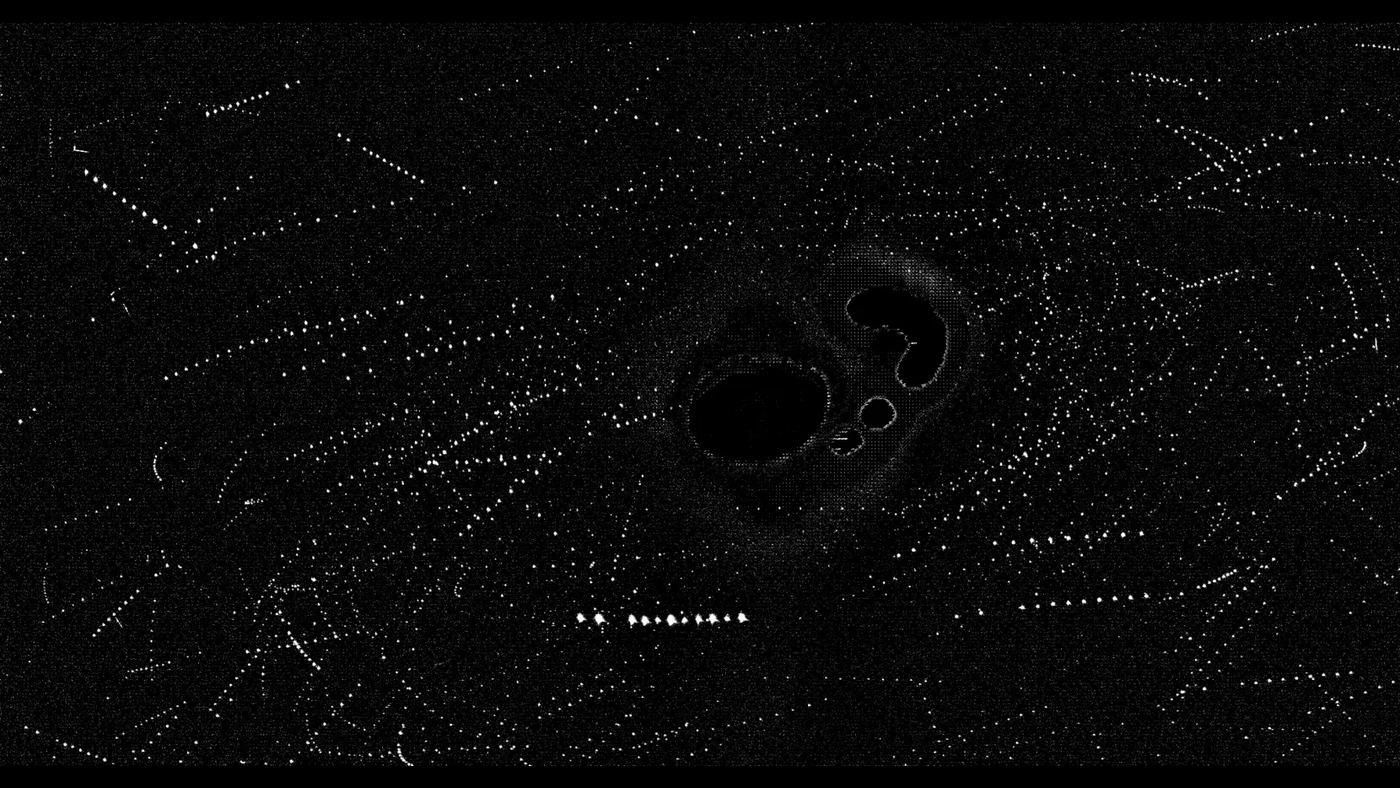
The third surprise is a swarm. Hundreds of boulders, just a few metres across, orbit the pair. Hera spotted them in a long exposure, a frame kept open long enough to catch the faint light of small objects moving past. In the image they appear as points and streaks around Didymos and Dimorphos.
These boulders probably come from material knocked loose by the impact. Some pieces were thrown fast enough to escape the system. Others stayed bound by the pair's gravity and keep circling. Their presence complicates Hera's navigation, and the team will have to account for them as the mission moves closer for sharper images.
Their value goes beyond the picture. The boulders are fragments torn from the system, exposed to sunlight and separated from their original surface. Studying them is like examining samples that the impact set loose for us. Hera and its future CubeSats can examine them without ever landing.
What Hera measures next
For now, Hera flies about 25 to 30 km from Didymos and Dimorphos. Its thrusters hold rectangular orbits at an average speed of just 12 cm/s, barely faster than a turtle. The slow dance keeps the spacecraft safe while letting it view the system from several angles.
In December 2026, it is due to close in to about 13 km. The images will gain resolution, and surface details will sharpen. In January 2027, Hera plans to release two shoebox-sized CubeSats. Juventas, led by Luxembourg, will use low-frequency radar to probe an asteroid's interior for the first time, then attempt a landing. Milani, led by Italy, will survey the system's materials and dust.
Hera carries three instruments. The Asteroid Framing Camera works in black and white. The Hyperscout H instrument looks at 25 colours at once. The TIRI (Thermal Infrared Imager) instrument, supplied by the Japan Aerospace Exploration Agency (JAXA), measures surface temperature. Together they must answer a precise question: what is the mass of Dimorphos, and which of its properties explain how it responded to the impact?
The answer matters for what comes next. A successful strike is not enough to turn asteroid deflection into a reliable tool. Scientists need to know why the object reacted as it did, and under which conditions the same method would work elsewhere. DART proved that humanity can change an asteroid's orbit. Hera is now revealing what happened to the asteroid itself.
Sixty-six million years ago, an asteroid impact changed the course of life on Earth and ended the age of the dinosaurs. That is the scenario Hera is meant to help prevent. It is also why ESA chose the dinosaur hall in Berlin to unveil the images.
Keep exploring
- The Hera mission page, to follow the spacecraft and its rendezvous with Didymos.
- The basics: asteroid and the Solar System in our glossary.
- To spot small bodies from home, try Tracker-1's sky map.
- ESA's release: Hera reveals stadium-sized asteroid crater from spacecraft impact.