- Science1B galaxies over 5 years
100× Hubble's field for dark energy
The WFI (300 MP, 18 H4RG detectors) will deliver cosmic surveys 500 to 3,200× faster than current wide-field cameras, measuring light from a billion galaxies.
science.nasa.gov ↗ - Technology
NRO mirror and breakthrough coronagraph
2.4-meter mirror donated by the NRO (4× lighter than Hubble's) and the first active high-contrast coronagraph able to image planets a billion times fainter than their star.
roman.gsfc.nasa.gov ↗ - Economic$4.3B over full lifecycle
A cost-controlled flagship observatory
Full lifecycle (development, launch, 5-year operations) for about $4.3 billion, made possible by the reused NRO mirror — a model for future flagships.
oig.nasa.gov ↗
Space, an earthly lever
Why explore? All figures and earthly applications below are aggregated exclusively from the missions tracked in this catalog: budgets, returns, spin-offs and discoveries documented mission by mission.
★ Notable figure
22
Documented Earth applications
Technology transfers linked to 7 catalog mission(s): health, climate, materials, everyday life…
Source: NASA Spinoff + Tracker catalog ↗
01
Key figures
$201 B↗
Cumulative budget of tracked missions
Sum of public budgets reported for each spacecraft in the catalog (missions without explicit budget excluded from the total).
34
Tracked space missions
24 in operations, 10 in transit. All returns on this page come from this scope.
29
Qualitative returns cataloged
Science, technology, culture, economy and cooperation, one entry per fact attributed to a tracked mission.
68
Catalog discoveries and milestones
Images, measurements, observations and samples listed on mission sheets.
13
Agencies and operators represented
CNES · CNSA · CSA · DLR · ESA · ISRO · JAXA · LASP/ASU · NASA · Rocket Lab · Roscosmos · UAE Space Agency · UC Berkeley
02
Everyday spin-offs (22)
Technologies that moved from the space lab to daily life, each tied to a catalog mission. Sources: NASA Spinoff, ESA, documented programs.
03
Returns by mission (11)
Each catalog mission leaves a specific footprint: scientific, technological, cultural, economic or diplomatic.
Tianwen-2 ↗CNSA
3 returns- Technology3 sampling methods
Three sampling methods on a single asteroid
Tianwen-2 tests touch-and-go, hover sampling and anchor-and-attach drilling — an unprecedented combination validating China's approach to small-body sample return.
link.springer.com ↗ - Science≥ 100 g of samples
China's first asteroid sample return mission
Returns at least 100 g of regolith from Kamoʻoalewa in 2027 — joining the exclusive asteroid sample-return club (JAXA Hayabusa2, NASA OSIRIS-REx).
spacenews.com ↗ - Cooperation11 instruments
11 scientific instruments open to the international community
CNSA has encouraged international contributions to Tianwen-2 payloads, broadening scientific cooperation on small-body exploration.
link.springer.com ↗
JUICE ↗ESA
2 returns- Science
Paving the way for icy-moon missions
JUICE lays the scientific groundwork for Europa Clipper and future missions targeting subsurface ocean habitability.
esa.int ↗ - Cooperation23 industrial partners
23 European industrial partners
ESA's largest planetary mission — Airbus DS, Thales Alenia, OHB and 20+ industrial partners co-develop the spacecraft.
esa.int ↗
James Webb ↗NASA · ESA · CSA
3 returns- Science> 100 atmospheres analyzed in 2 years
Routine exoplanet atmospheric characterization
JWST turned exoplanet atmospheric characterization into routine practice: H₂O, CO₂, CH₄, SO₂ detected as early as 2022.
science.nasa.gov ↗ - Cultural1.5B views — July 2022
Iconic cosmic imagery
The Cosmic Cliffs (NGC 3324) and Stephan's Quintet images were seen by more than 1.5 billion people in under a week.
science.nasa.gov ↗ - Cooperation
A model NASA-ESA-CSA program
The longest-running trilateral space collaboration ever brought to completion — a benchmark for future flagship observatories.
esa.int ↗
Perseverance ↗NASA
3 returns- Technology~10 g O₂/h demonstrated
MOXIE — in-situ O₂ production
First demonstration of oxygen production from the Martian atmosphere (CO₂ → O₂). A building block for future crewed missions.
science.nasa.gov ↗ - Technology72 successful flights
Ingenuity — first powered extraterrestrial flight
72 flights between 2021 and 2024 proved that a drone can operate on Mars — reshaping exploration doctrine.
mars.nasa.gov ↗ - Science
Sample caching for Mars Sample Return
24 sealed tubes hold rocks selected for their astrobiological potential, awaiting return to Earth.
science.nasa.gov ↗
BepiColombo ↗ESA · JAXA
2 returns- Cooperation
First large-scale joint ESA-JAXA program
A dual mission (MPO + MIO) co-funded and co-developed — a blueprint for future Europe-Asia partnerships in planetary science.
esa.int ↗ - Technology
High-power solar-electric propulsion
The first European spacecraft to run 4 ion thrusters in parallel for more than 7 years — expertise transferable to deep-space missions.
esa.int ↗
Curiosity ↗NASA
2 returns- Technology
Sky Crane — precision landing
The Sky Crane redefined planetary landing capabilities. Reused for Perseverance and considered for future ESA missions.
mars.nasa.gov ↗ - Science
Detection of organic molecules on Mars
The SAM instrument confirmed the presence of organic molecules preserved in sedimentary rocks more than 3 billion years old.
nasa.gov ↗
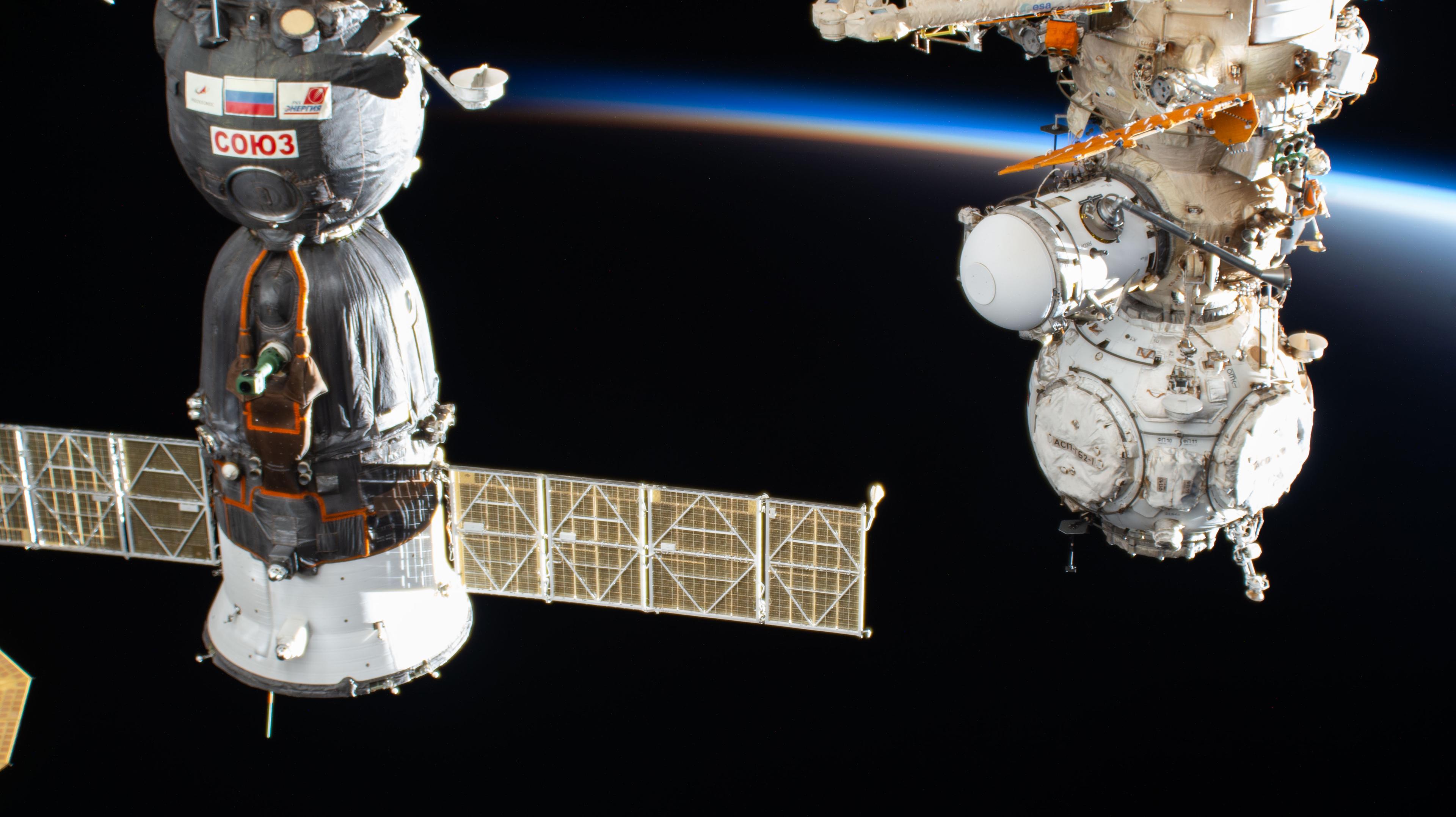
Station ISS ↗NASA · ESA · JAXA · Roscosmos · CSA
3 returns- Cooperation25 years, 25 nations
25 nations and 25 years in orbit
The largest multilateral science program in history — a symbol of cooperation that has survived geopolitical crises.
nasa.gov ↗ - Science3,000+ experiments
More than 3,000 scientific experiments
Microgravity, protein crystallization, pharmaceutical research, cell biology — the ISS is the largest orbital laboratory ever operated.
nasa.gov ↗ - Economic
Catalyst of the commercial NewSpace
The COTS / Commercial Crew program — the ISS forced NASA to outsource cargo and crew transport, giving rise to SpaceX, Northrop Grumman, Sierra Space.
nasa.gov ↗
Hubble ↗NASA · ESA
3 returns- Science34 years of observations
Precise measurement of the Hubble constant
The SH0ES program (Riess team) reduced the uncertainty on H₀ to less than 1 km/s/Mpc, fueling the 'Hubble tension.'
hubblesite.org ↗ - Cultural
Hubble Deep Field — the depth of time
The Deep Field and Ultra Deep Field images made tangible the idea that the universe contains hundreds of billions of galaxies.
hubblesite.org ↗ - Economic
A blueprint for orbital servicing
Five EVA servicing missions (1993–2009) proved the technical and economic viability of maintaining a large satellite.
science.nasa.gov ↗
Voyager 2 ↗NASA
2 returns- Science
Only Uranus + Neptune flyby
Still in 2026 the only close-up data we have on these two ice giants — the foundation for any future Ice Giant mission preparation.
science.nasa.gov ↗ - Cooperation
Global Deep Space Network
Operating a signal received from 20 billion km away forced the DSN to expand to its three sites: Goldstone, Madrid, Canberra.
nasa.gov ↗
Voyager 1 ↗NASA
3 returns- Cultural
Pale Blue Dot
The photo taken from 6 billion km away in 1990 — Earth as a single pixel — remains one of the most widely shared images in human history.
science.nasa.gov ↗ - Cultural
Golden Record — a message to humanity
116 images, 55 languages, sounds of Earth. A cultural testimony projected over billions of years into the interstellar medium.
science.nasa.gov ↗ - Science
First human object in interstellar space
Crossing of the heliopause in August 2012 — the first in-situ measurement of the interstellar medium.
science.nasa.gov ↗