
Nancy Grace Roman
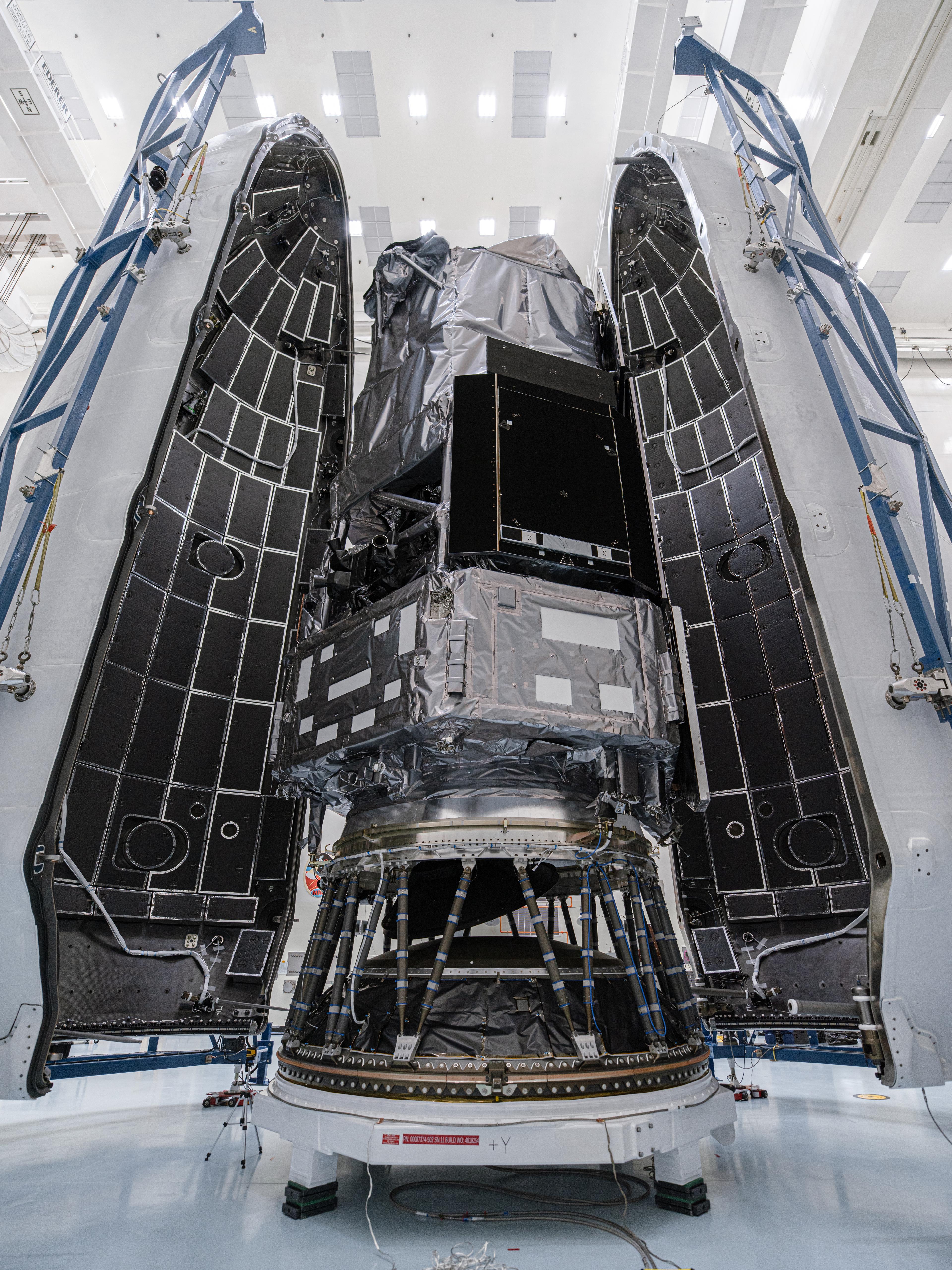
NASA's new flagship infrared observatory. With a field of view 100× wider than Hubble's, it will map the universe at scale, probe the mysteries of dark energy, and uncover thousands of exoplanets via microlensing.
- Unravel dark energy through ultra-wide cosmological surveys.
- Find thousands of exoplanets via gravitational microlensing (galactic bulge survey).
- Demonstrate direct exoplanet coronagraph imaging with the CGI (technology to view Earth-like worlds).
Its 2.4-meter mirror — the same size as Hubble's — is four times lighter. It was donated to NASA by the National Reconnaissance Office in 2012.
Timeline
Two surplus reconnaissance satellites are handed to NASA — one becomes the heart of Roman.
The mission enters formulation, renamed Nancy Grace Roman in 2020 after the "mother of Hubble".
Key tech-demo instrument handed over at Goddard: a next-generation high-contrast imager.
Launch Readiness Review passed: Falcon Heavy, observatory and teams declared ready.
Liftoff from Kennedy pad 39A at 7:26 a.m. EDT (11:26 UTC) bound for L2.
End of the ~100-day transit and observatory commissioning.
Instruments
[02]Specifications
Discoveries
[02]Mission milestones
[01]Scientists on this mission
[01]The scientists behind this spacecraft: their role on the mission, their institution and their primary sources.
