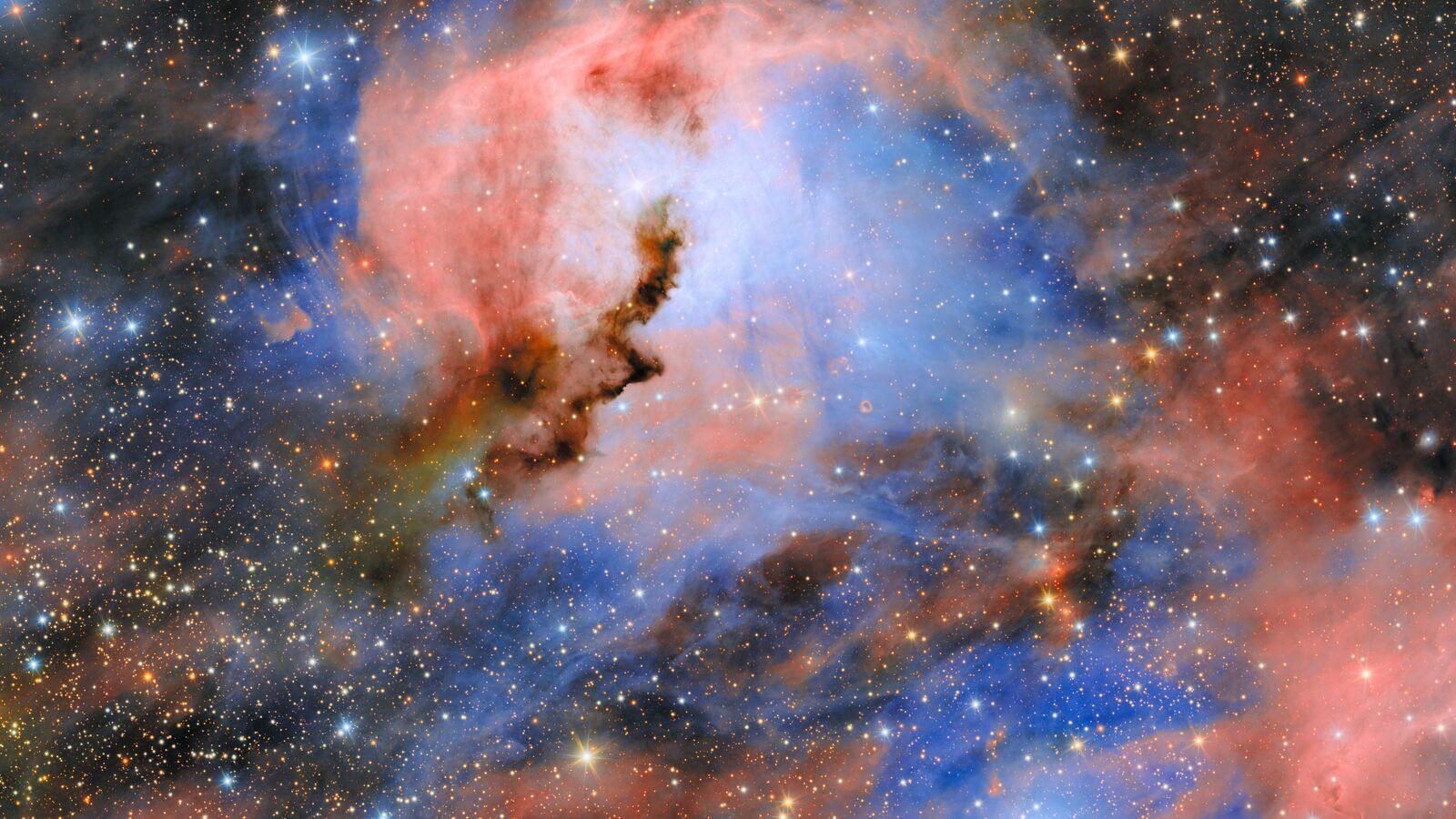
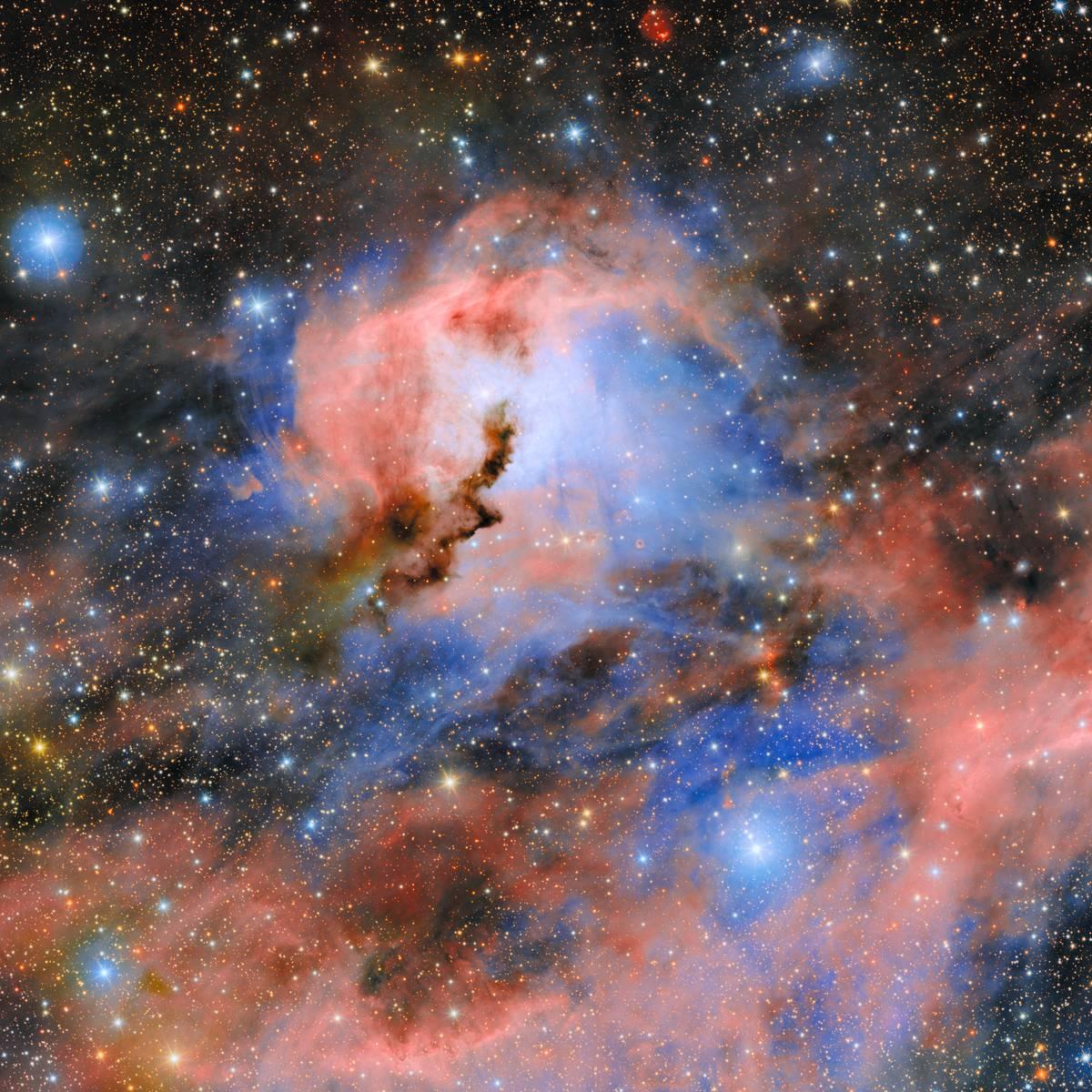
A test run does not usually leave a keepsake. This one left a pink and blue one. On 22 October 2026, two years after testing began, the Vera C. Rubin Observatory released an image of the head of the Seagull Nebula taken by ComCam, its engineering test camera. The light had been traveling for 3,700 years. The camera itself was a dress rehearsal for the 3,200-megapixel instrument now on the telescope.
A bird's head 3,700 light-years away
The image shows a cloud of gas crossed by a dark ridge, with pink curls and a blue veil. This is not a painting. It is the head of the Seagull Nebula, a complex catalogued as IC 2177, between the constellations Monoceros and Canis Major. At 3,700 light-years, the light ComCam caught left its source 3,700 years before reaching the sensors.
A nebula is a cloud of gas and dust between the stars. This one is a nursery. Massive stars have recently formed there, and their ultraviolet radiation strips electrons from the hydrogen atoms around them. That ionized gas glows pink. The blue comes from something else: dust grains reflecting light from nearby young stars. The dark ridge is a wall of dust blocking the light.
Three clouds make up the Seagull, Sharpless 2-292, Sharpless 2-296 and Sharpless 2-297. Together they trace a bird in flight. ComCam's frame shows only the first, the head, which astronomers call Sharpless 2-292, or Sh2-292. At the top of the ridge, a triple system of massive stars, HD 53367, marks the bird's blue eye. These stars light up the region.
ComCam, a 144-megapixel rehearsal
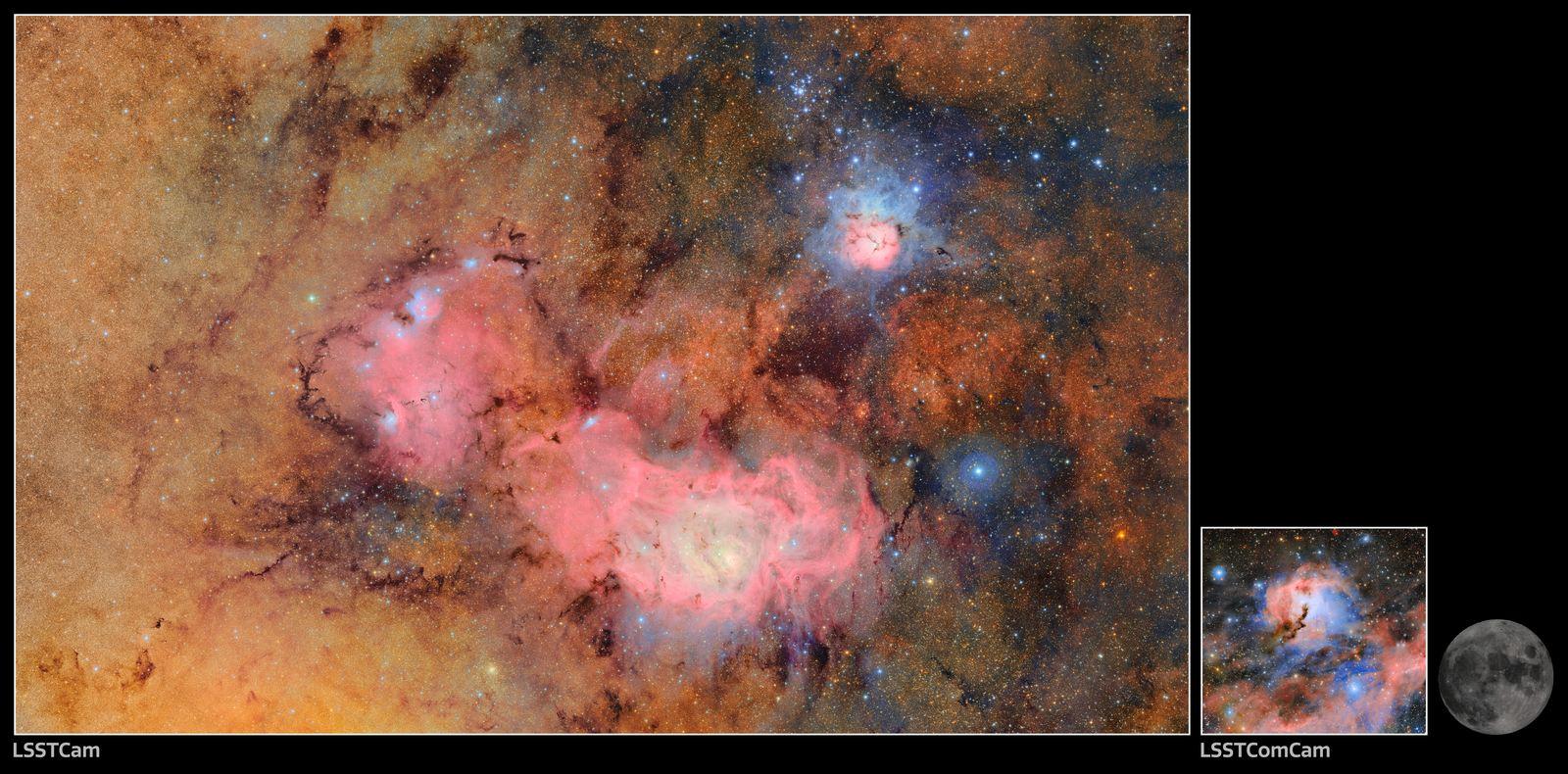
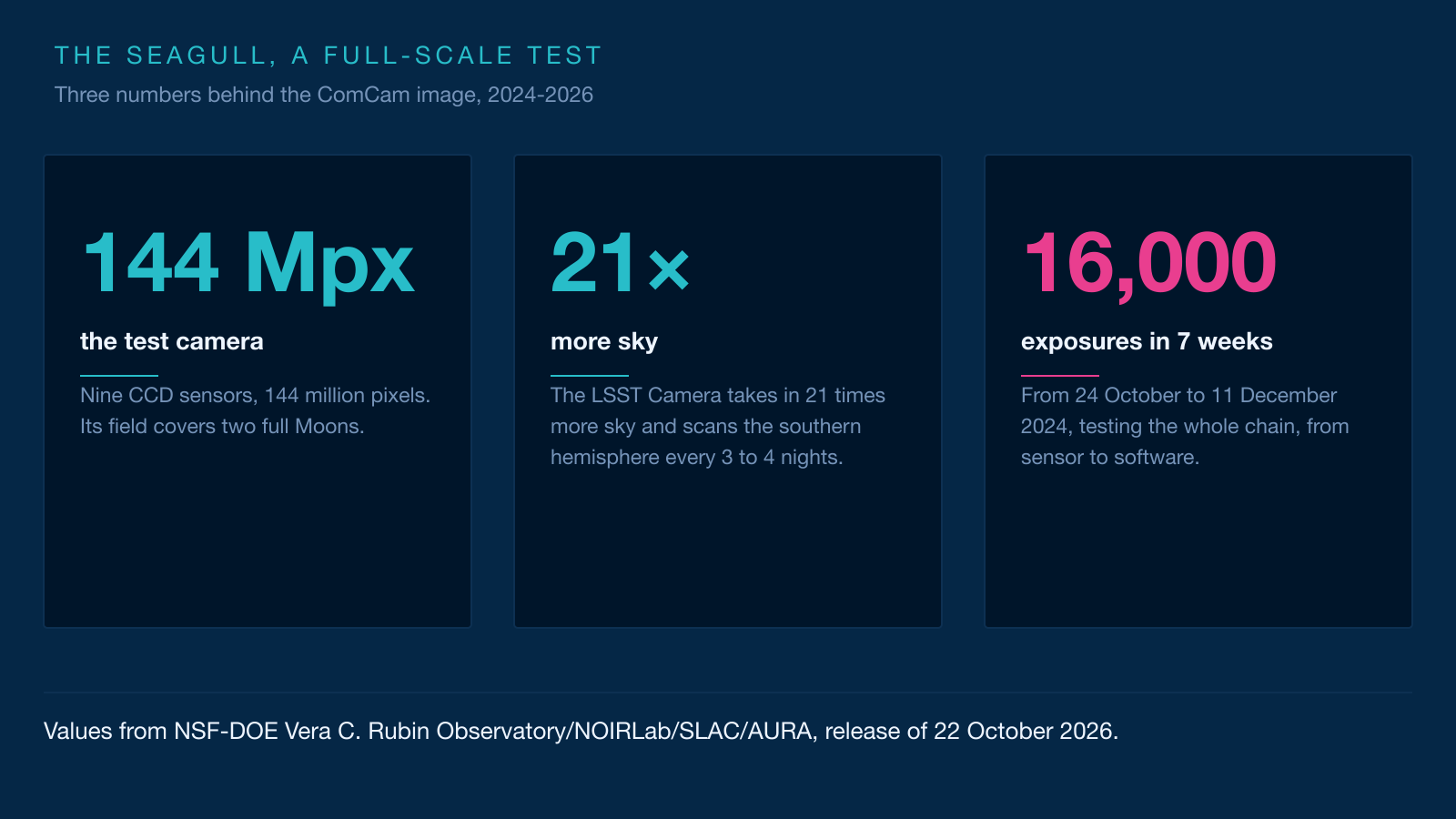
ComCam is a scaled-down version of the LSST Camera. Nine CCD sensors, the chips that turn light into an electrical signal, for 144 megapixels in total. Its field covers two full Moons. For a camera described as a test, the instrument is already serious.
Its job was not science but proof that everything works. Over seven weeks, from 24 October to 11 December 2024, ComCam took about 16,000 exposures. It put the Simonyi Survey Telescope, the pointing software, the electronics and the image pipeline through their paces. Each exposure was one more test with different settings.
The comparison with the LSST Camera shows the scale of the jump. LSST reaches 3,200 megapixels against ComCam's 144, and its field is 21 times wider. A single frame covers the equivalent of about 40 full Moons. From Chile, it images the entire southern sky every three to four nights.
What the Seagull taught the software
A nebula image is not an easy test. Star-forming regions mix very bright areas, thin filaments and slabs of dust that block the light. The software has to stitch nine sensors together, correct defects in every pixel and keep those structures without smoothing them away.
The James-Webb Space Telescope observes these cradles in infrared, where dust lets light through. Rubin works mostly in visible light, with an enormous field. The Seagull became a test case for the processing team. The lessons came back months later with the Trifid and Lagoon Nebulae, two images from First Look, the observatory's public debut of its first images in June 2025.
According to the observatory, ComCam's image remains the deepest and sharpest view of this region until LSST has gathered more data. A test camera, then, that currently beats the big camera on this patch of sky.
ComCam steps aside, LSST takes over
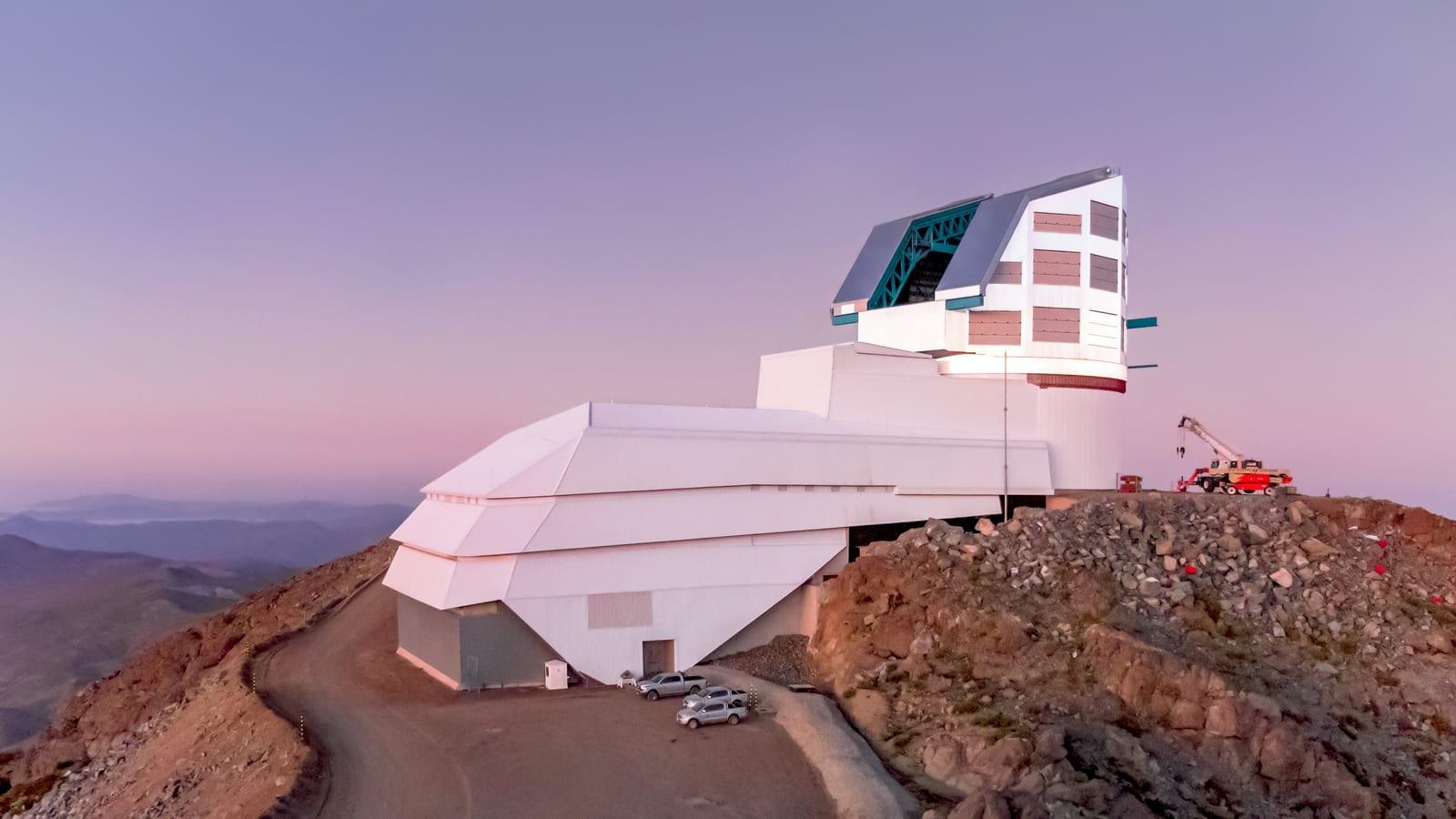
With the campaign over, ComCam was removed from the telescope in December 2024. Its working life did not end there. It now serves as a test stand in the summit clean room, where it supports software tests for the LSST Camera and cycles spare vacuum pumps and refrigeration compressors to keep them in working order.
Meanwhile, LSST has begun. The survey is meant to run for ten years and produce a movie of the southern sky, with alerts sent to telescopes around the world whenever an object changes brightness. ComCam's images show what that movie has in store. They also show that the dress rehearsal was worth watching on its own.
Going further
- The Rubin Observatory release: Seagull Nebula through the eyes of the Rubin Commissioning Camera.
- The LSST:UK analysis of star formation in the Seagull: Capturing the birth of stars in the Seagull Nebula.
- On the site: our telescopes page to place Rubin among the great instruments, and our sky map to find Monoceros and Canis Major.