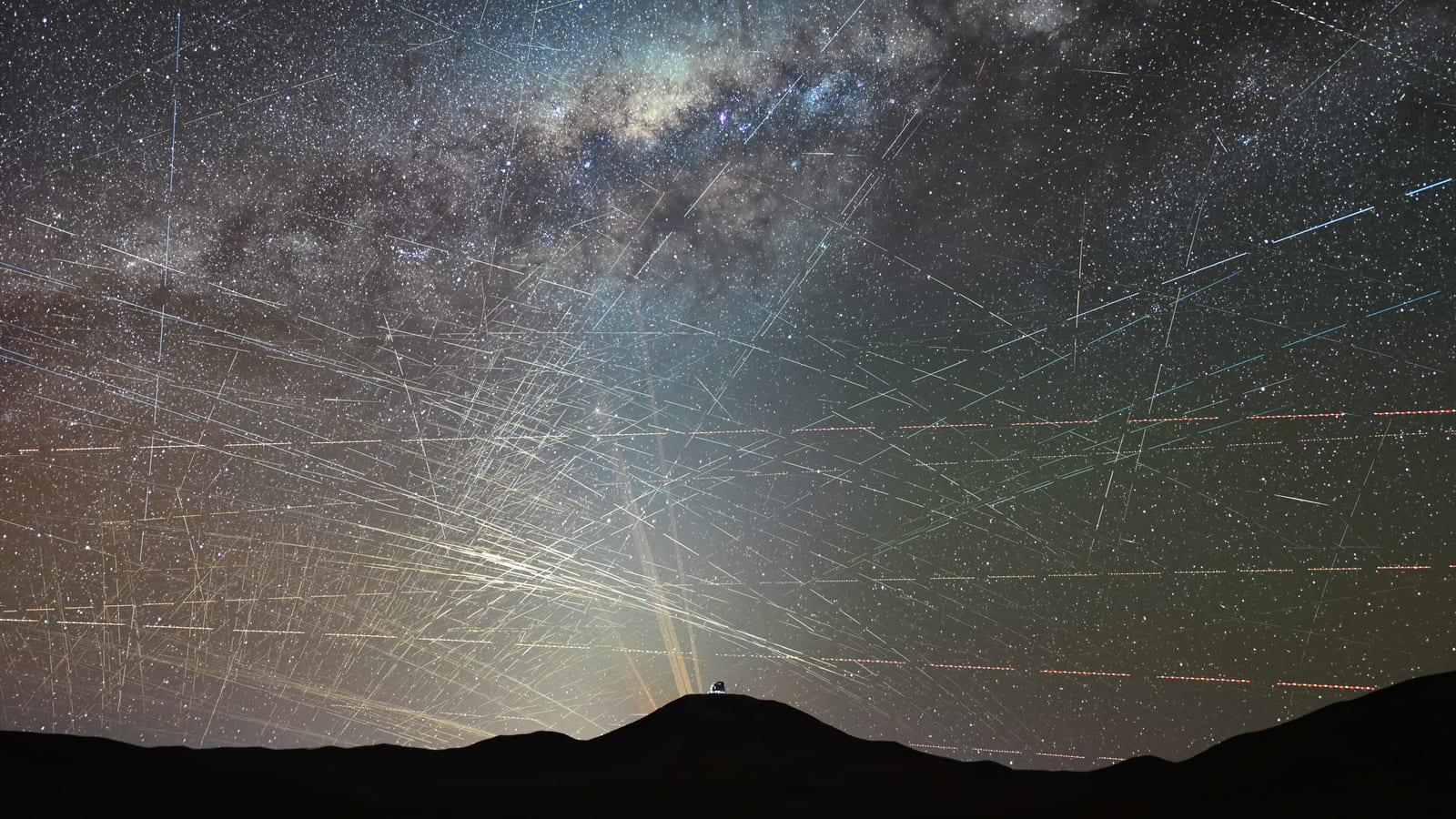
In late 2024, six cameras pointed at the sky over Ontario, Canada, recorded 24,812 passes from 5,118 individual satellites. A team led by Jack Rayworth of Western University compared each of those passes with the brightness limit recommended by the International Astronomical Union (IAU). The verdict is blunt: the rule is broken far more often than expected. Guowang, the Chinese constellation, goes over the limit on more than half of its passes, Starlink on roughly one in four, and OneWeb shows that better is possible.
More than half of Guowang's passes are too bright
Start with the rule. Since 2019 and the first Starlink launches, the night sky has been filling up with satellites. Astronomers responded quickly by setting a threshold not to be crossed. The IAU's Centre for the Protection of the Dark and Quiet Sky recommends that a low-Earth-orbit satellite stay fainter than magnitude 7, a measure of brightness that puts the craft beyond the reach of the naked eye under a dark sky. Above 550 km of altitude the bar gets stricter still, because a higher satellite moves more slowly across the sky and leaves a denser streak in a tracked exposure.
Whether that limit is respected is another matter. Earlier studies either tracked a modest set of pre-selected targets or relied on visual estimates. Rayworth's team did the opposite. Their instrument, the Luciole system, points at no satellite in particular. It throws an optical net over much of the sky and records everything that moves at 25 frames per second, much like a security camera filming shooting stars. The hardware descends from the Global Meteor Network, a worldwide array of cameras built to watch meteors.
The campaign ran for 36 nights, from October 7 to November 11, 2024, from Elginfield Observatory in southwestern Ontario, at 43.19° north. Six narrow-field cameras ran continuously, each sensitive down to magnitude 9. Of the 407 possible hours of darkness, 230 were usable, the rest lost to cloud.
The count comes to 24,812 streaks from 5,118 distinct satellites. Each streak is matched against the IAU limit computed at the object's altitude. Then the astronomers shift the frame. Instead of counting over-bright satellites in absolute terms, which mostly measures how big a constellation is, they compare the number of non-compliant passes with the number of geometrically possible ones, accounting for clouds, camera downtime and Earth's shadow. That percentage no longer depends on constellation size, and it shows what an operator would have to fix.
- Guowang / Hulianwang, the Chinese constellation: more than 50% of possible passes above the limit. On passes actually observed, the share climbs to 100%.
- Starlink: about 25% of possible passes. In absolute numbers, the constellation supplies two thirds of all over-bright streaks.
- Rocket bodies: about 21% of possible passes. BREEZE and Long March upper stages were non-compliant on 99% and 97% of observed passes.
- OneWeb: about 6% of possible passes, the best of the major constellations.
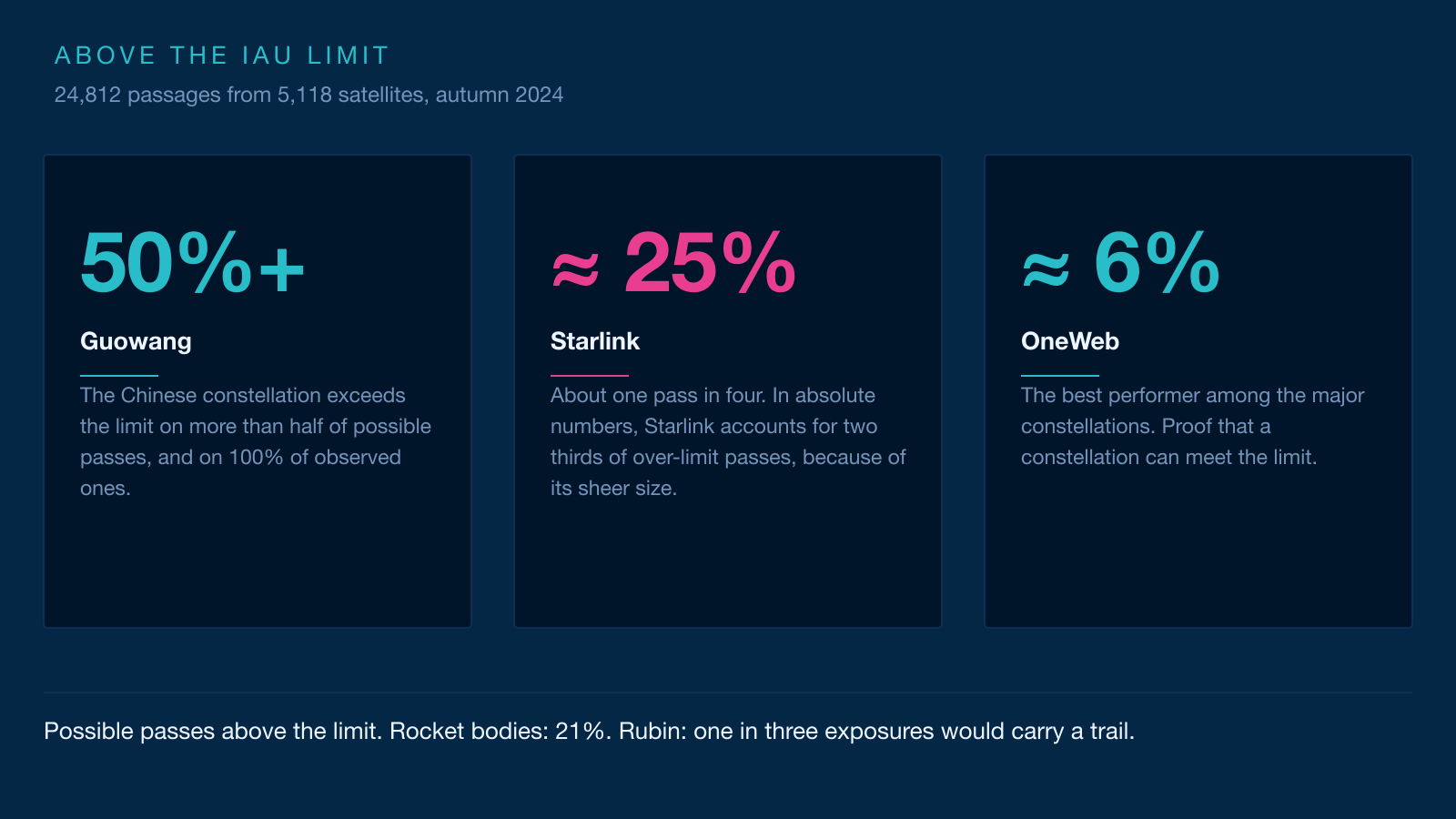
Guowang is the most worrying case precisely because the constellation is still small. If the Chinese plan for roughly 13,000 satellites goes ahead, every added satellite will keep breaking the limit at the same rate. The study calls it a future dominant source of optical sky pollution unless mitigation is put in place.
Why one satellite outshines another
A satellite emits no light of its own. It only returns sunlight, like a pocket mirror angled towards your eye. How much light reaches us depends on the angle between the satellite, the Sun and the observer. That angle has a name: the phase angle.
The study plots it for every recorded pass, and a clear pattern emerges. The satellites do not spread out at random. They fall into three families. Around 30°, one group comes from light bounced backwards off the solar panels. Between 60° and 100°, a broad cloud of streaks comes from sunlight scattered off the body of the craft, the way a pale wall brightens a street. And near 115°, a tight spike betrays a specular reflection, the same glare you get from a windscreen when the Sun lines up with it.
That distinction is not a detail. A modern satellite carries large flat surfaces: solar arrays and phased-array antennas. A flat surface sends light in one precise direction, which creates brief but intense flashes. A matte surface scatters it every way, with no spikes. Starlink satellites crowd into the specular spike far more heavily than other craft. Their large flat phased-array antenna, a panel that both transmits and receives, is the most likely cause, though the study cannot fully separate it from attitude effects.
There is a second finding, more awkward for the industry. Brightness has not fallen steadily from one generation to the next. The V2 Mini Direct-to-Cell satellites have reversed the dimming trend set between 2020 and early 2024, drifting back close to the brightness of the original V1.0 craft. A new satellite is therefore not automatically easier on the sky than an old one.
Twilight, the hours astronomy cannot give up
Now consider when the interference lands. The study finds an unexpected answer: almost always at the same time. The vast majority of streaks were recorded in the first two hours after sunset and the last two hours before sunrise. In between, satellites cross Earth's shadow and vanish from the sky.
The team extended that result with a model that treats a constellation as a shell at 550 km and asks, at every moment, whether any part of the shell is simultaneously above the horizon, lit by the Sun and seen against a dark sky. The outcome is strikingly steady. Between 35° south and 35° north, where most of the world's population lives and most of the great observatories sit, satellites stay visible for about 3.3 hours a night, all year round, with little seasonal variation. Higher constellations such as OneWeb and Guowang, near 1,200 km, escape that window altogether and can stay lit for much of the night.
The problem is not just the duration, it is the timing. That twilight window is precious to astronomy. It is when telescopes take the calibration frames that bench-test them for the whole night, and a single trail can spoil them. It is also when near-Earth asteroids and inner Solar System bodies are hunted, since they are easiest to spot opposite the Sun in the sky. So the loss is not a tidy slice of observing time, it targets specific science goals, planetary defence among them.
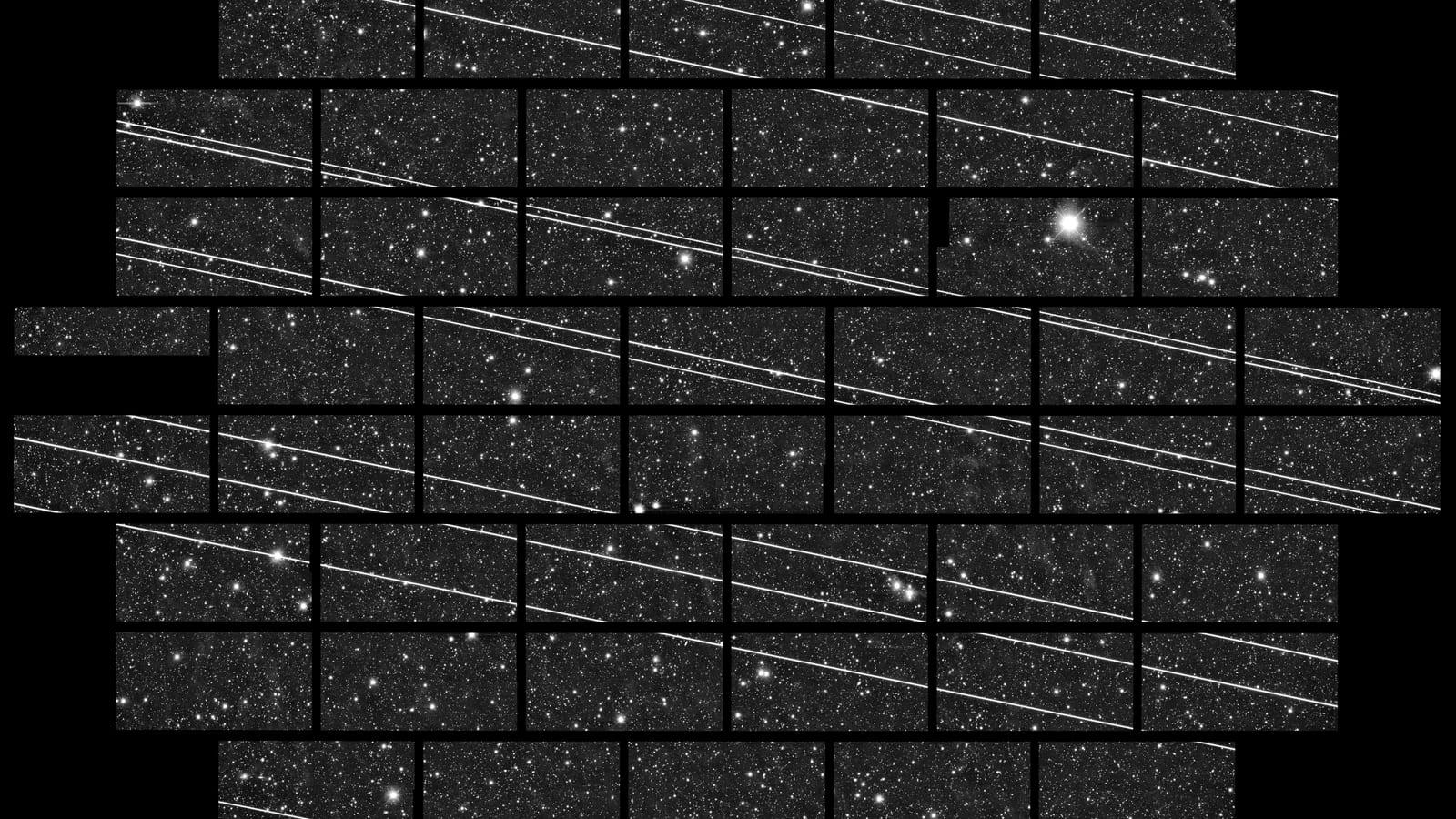
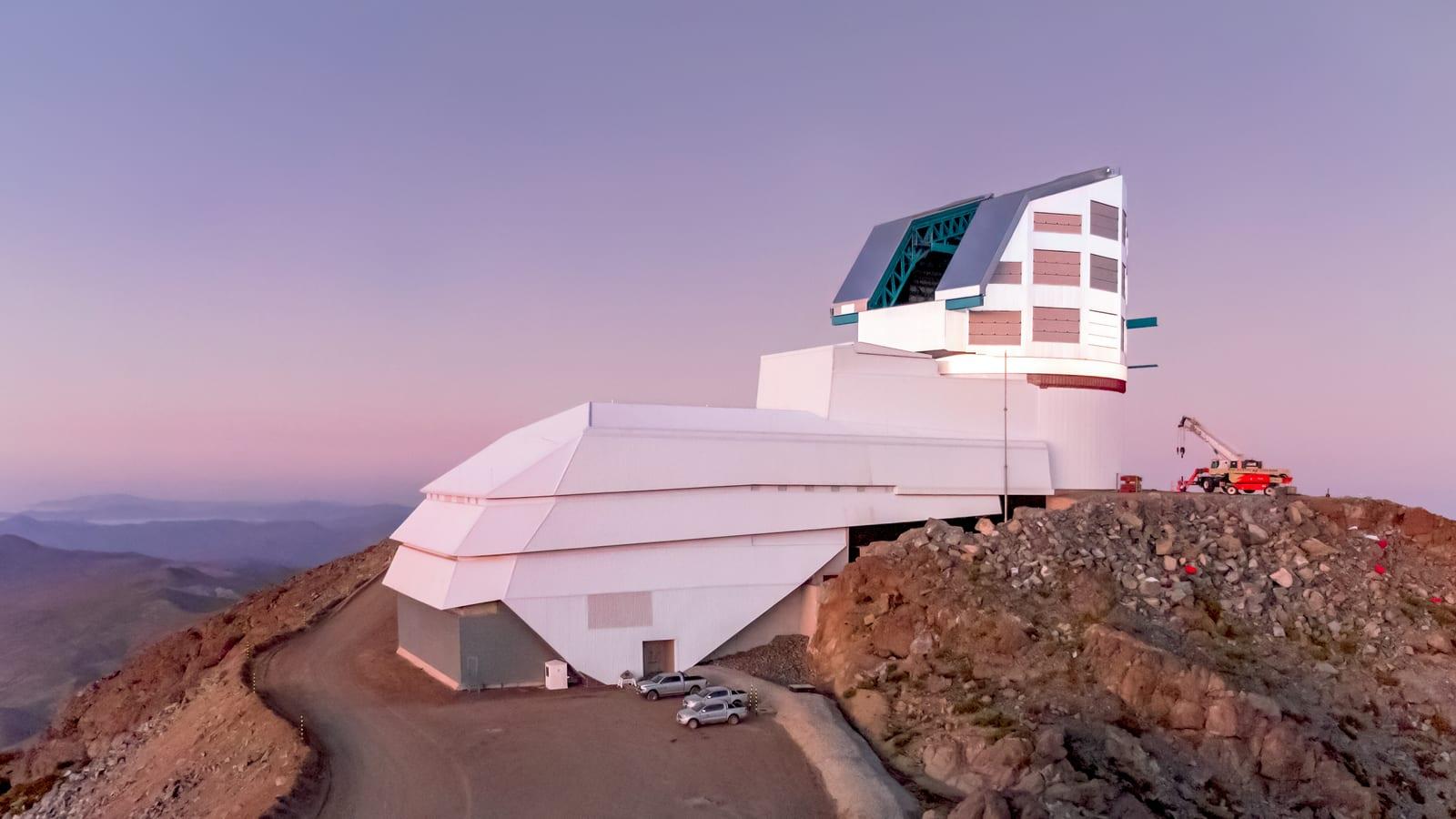
The most telling figure concerns the big survey now coming online. For the Vera C. Rubin Observatory, whose camera is built to image the entire southern sky every few nights, the authors calculate that about 0.34 trails would fall into each 30-second exposure taken during the twilight window. In other words, roughly one exposure in three would carry a satellite mark.
For amateur astronomers, the same study offers a concrete benchmark. A naked-eye observer under a dark sky would see about 44 satellites in their field of view at any given moment during the twilight window. Across the whole sky, the figure rises to roughly 140.
What changes: the baseline brightness, not the rare flash
The study's deeper message shifts the focus. Until now, mitigation efforts went after the exceptional glints, the brief flashes that can blind an image. The survey shows the trouble runs deeper. Most major constellations are, on average, brighter than the limit for their altitude. It is not an occasional accident, it is a baseline property of today's orbital population.
The consequence for industry is direct. What needs fixing is not just the odd unlucky reflection, it is the everyday reflectivity of the craft's body, antennas and solar arrays. Those choices are frozen at design and manufacturing, not in orbit, so the problem has to be tackled upstream, in the material of the satellites themselves.
The study offers a valuable counter-example. OneWeb, orbiting near 1,200 km, exceeds the limit on only about 6% of its passes, with a median magnitude of 7.3. That is not merely a matter of altitude, since other constellations at similar heights, such as Gonets and Globalstar, come out noticeably brighter. Careful design is enough to cut the interference several times over with current technology. Not all constellations are equal, and comparing operators becomes a lever for pressure.
The problem does not stop at ground-based telescopes. Before 2021, about 3% of images from the Hubble space telescope already showed a satellite trail, a reminder that low orbit is crowded through its whole depth.
To follow the topic closely, our light pollution map tracks low-Earth-orbit satellites and their positions almost in real time, refreshed every five minutes from public NORAD and Celestrak data.
Going further
- Key concepts: low Earth orbit in our glossary, where most of these satellites fly.
- Our tools: the light pollution map to follow satellites live, the sky map to see what remains observable and the observing guide to pick a site under a preserved sky.
- The study: Systematic non-compliance of satellite megaconstellations with IAU brightness limits, Rayworth et al., published on arXiv.
- The reference frame: the brightness recommendation from the IAU Centre for the Protection of the Dark and Quiet Sky and recommendation 5 of the SATCON1 report, which set the magnitude 7 limit.
- The images: NOIRLab's Starlink trail image and the dawn view of the Vera C. Rubin Observatory.