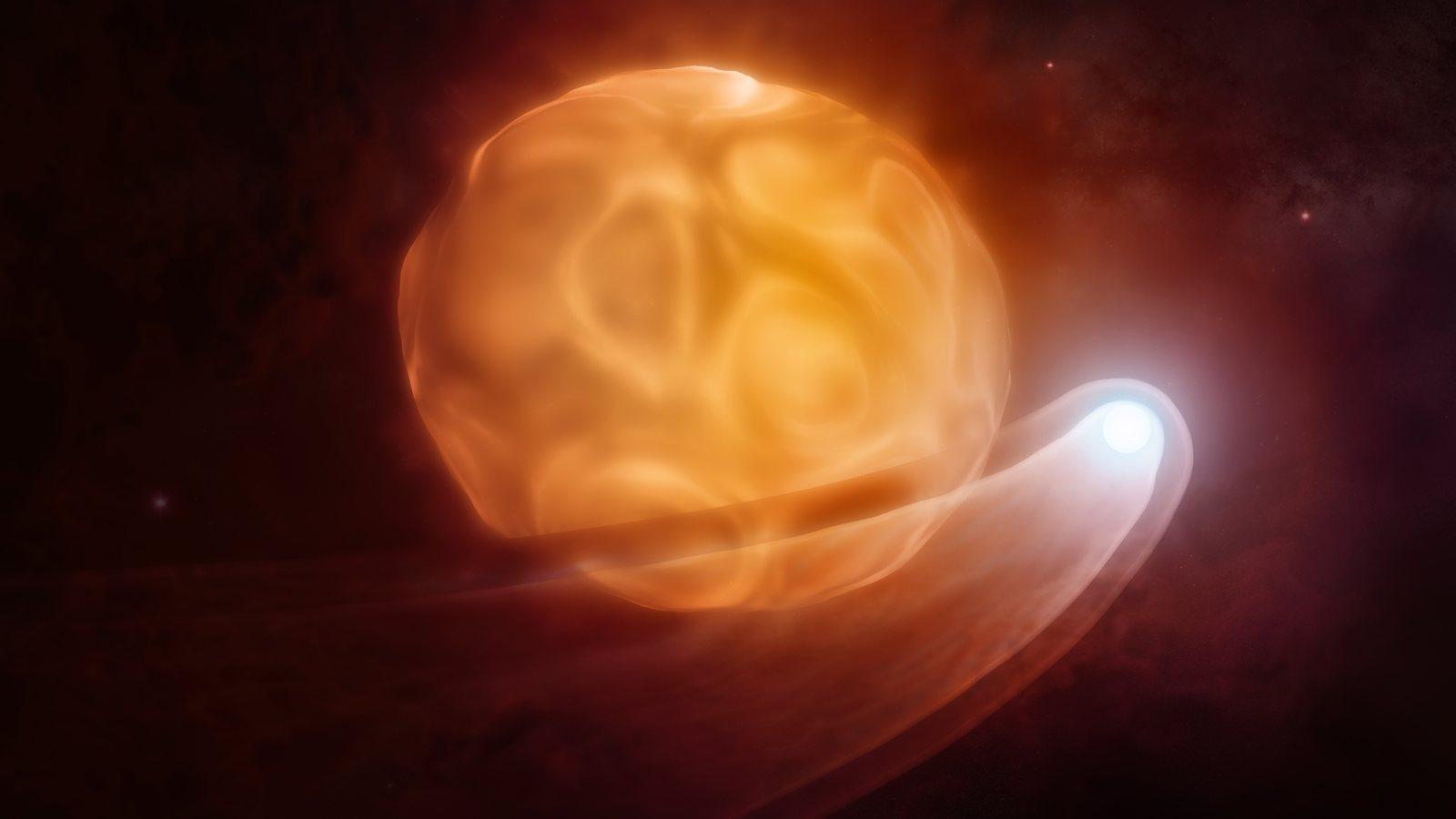
Betelgeuse is no quiet sphere. Between 2021 and 2026, the Very Large Array (VLA) and the Atacama Large Millimeter/submillimeter Array (ALMA) imaged its atmosphere at seven radio wavelengths. The result: the star sometimes stretches into an egg shape, then turns almost round again. That rhythm matches the orbit of a companion, Siwarha, and Betelgeuse's brightness cycle of about 5.9 years. To the team publishing the work in The Astronomical Journal, it is the strongest evidence yet that Betelgeuse is a binary star.
A star that stretches to the beat of an unseen companion
An ellipse is a stretched circle. Astronomers measure the stretch with a single number, the ellipticity: the difference between the longest and shortest diameters, divided by the longest. Zero for a perfect circle. Around 0.1 for a shape whose long axis is 10% longer than its short one.
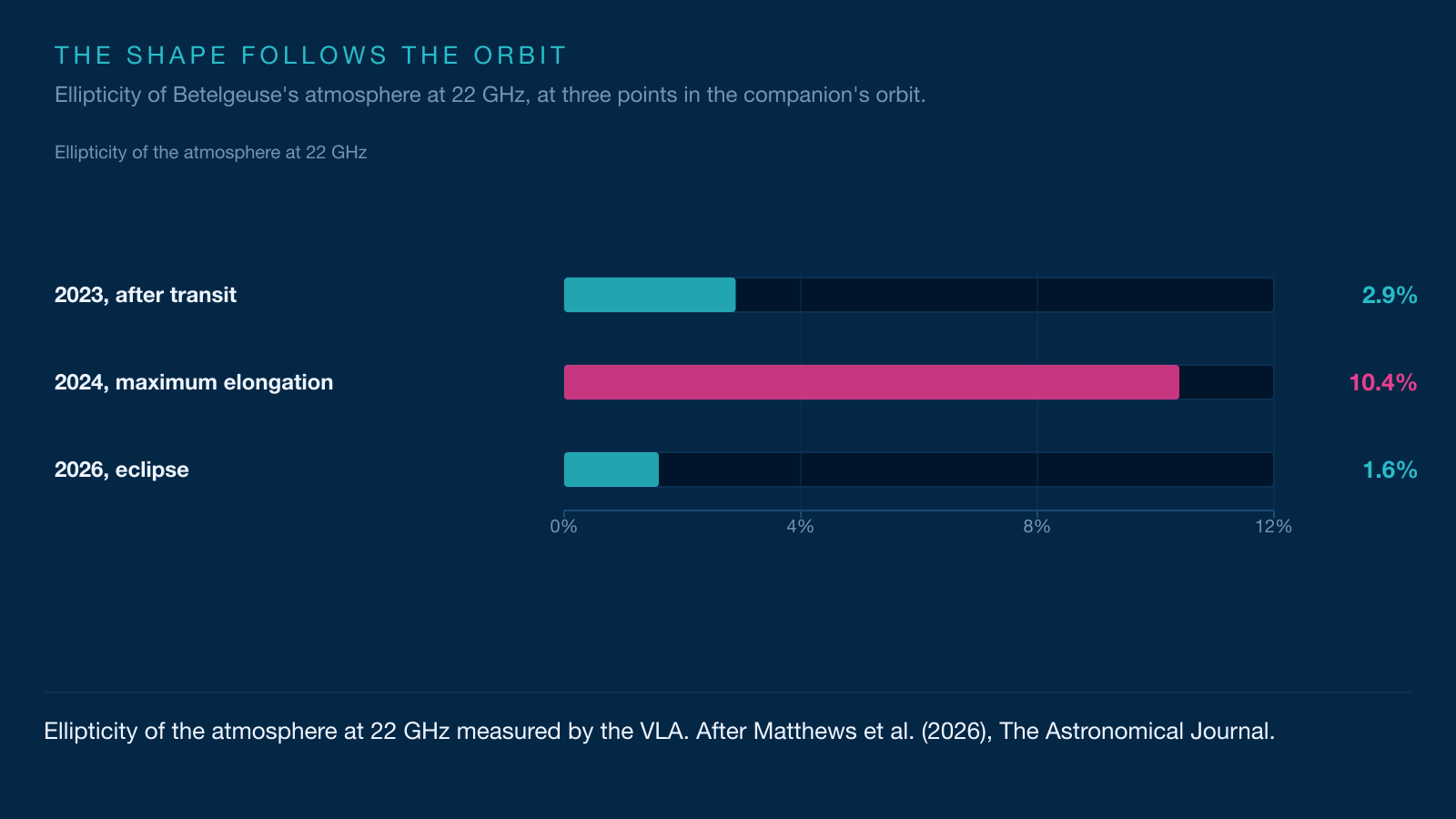
At 22 GHz, Betelgeuse's atmosphere shows 2.9% ellipticity in September 2023, 10.4% in October 2024 and 1.6% in April 2026. The three measurements do not fall at random. In 2023 the companion had just passed in front of the star. In October 2024 it sat at its greatest apparent separation. In April 2026 it passed behind. The wider it swings, the more the atmosphere stretches. When it lines up, the star turns almost round again.
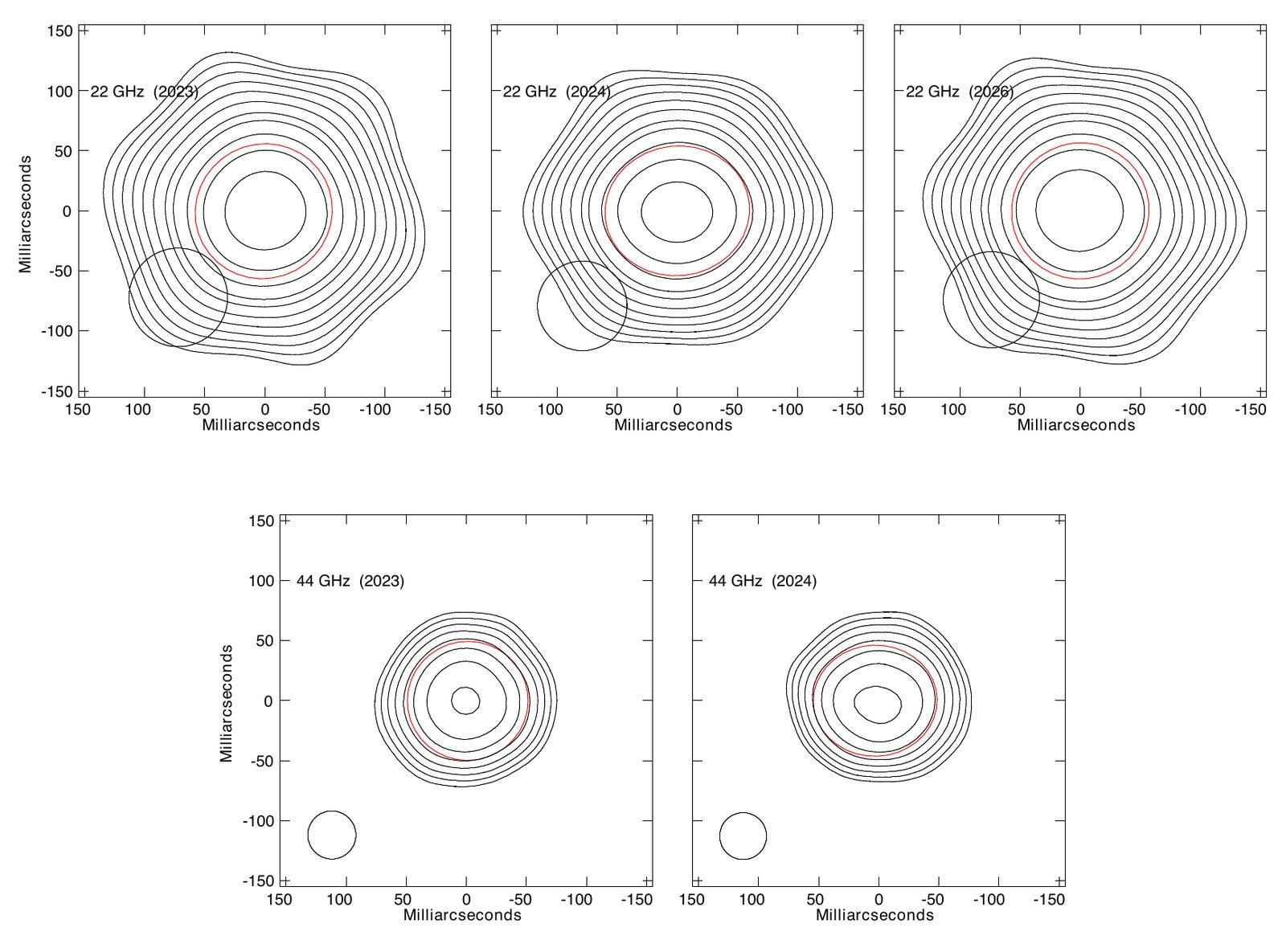
The picture is striking. In 2024 the ellipse is clearly stretched, with a long axis of 120.7 milliarcseconds against 108.1 on the short one. In 2023 and 2026 it is nearly circular again. The effect shows up at 44 GHz too, where ellipticity climbs from 3.4% in 2023 to 10.4% in 2024.
The analogy that works best is a speedboat on a lake. The boat races past, the water piles up behind it and leaves a wake. Here the boat is a star ploughing through a giant's atmosphere. "This companion is orbiting so close to the star that it actually passes through its extended atmosphere," explains Lynn Matthews, an astronomer at MIT Haystack Observatory and the study's lead author.
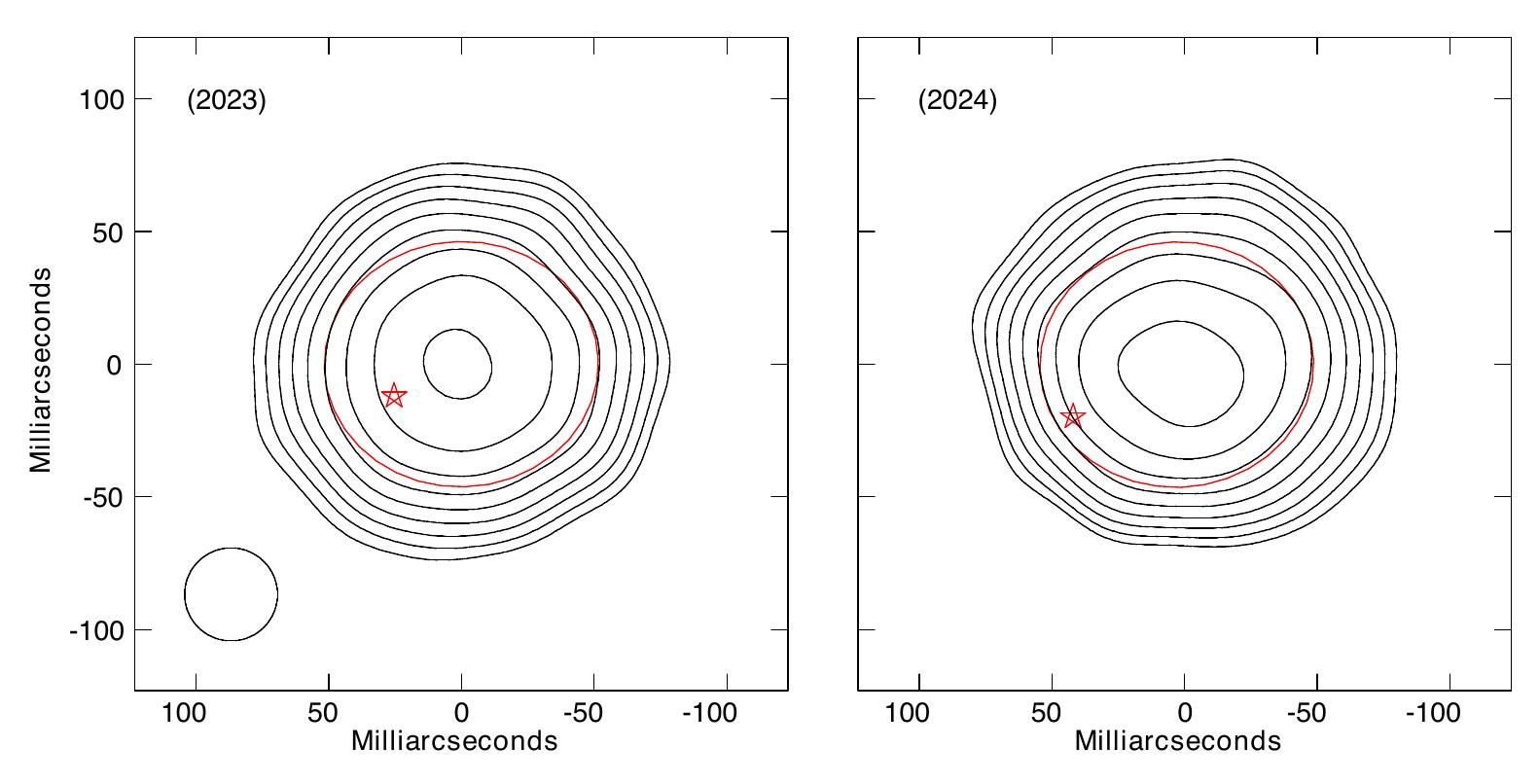
The exact mechanism is still open. The companion's gravity can distort the envelope of gas. Its passage may also carve a hot wake, a region where gas is compressed and ionised. The researchers looked for a bright spot at the companion's predicted position in the 2023 and 2024 images. They found none. The distortion, however, is there.
How to weigh the shape of a star
Betelgeuse is huge and nearby, two rare advantages. In visible light, its apparent diameter reaches about 40 milliarcseconds, a tiny angle on the scale of the sky. For a sense of scale, one milliarcsecond is the size of a one-euro coin seen from 4,800 kilometres away. No ordinary telescope can resolve a disc that small. Astronomers have to cheat.
The trick is called interferometry. Instead of one giant mirror, dozens of antennas spread over kilometres are combined. The VLA in New Mexico and ALMA in Chile's Atacama Desert work this way. Their antennas act like pieces of a puzzle: each pair samples a different spatial frequency, and a computer rebuilds the image. The farther apart the antennas, the finer the detail.
The team then fits a simple model to those data: a uniform, slightly elliptical disc. That gives the diameter, orientation and flattening. The method does not assume anything about the physics of the atmosphere, which makes it robust. It is what produces the 10.4% figure for October 2024.
The seven frequencies, from 22 to 485 GHz, add a third dimension. In radio, the longer the wavelength, the higher in the atmosphere the emission comes from. At 485 GHz, the data probe the layer at 1.2 stellar radii. At 22 GHz, they reach out to 2.7 radii. The team could therefore reconstruct a vertical slice through the envelope.
That slice confirms a temperature dip that had long been suspected. The gas falls from about 3,500 kelvins, or 5,840 °F, at 2.7 stellar radii to 2,220 kelvins, about 3,536 °F, at 1.2 radii. This cool layer coincides with the MOLsphere, a cocoon of molecules already known from infrared observations. Finding gas colder than the surface mixed with hotter chromospheric gas complicates models of the stellar wind.
Siwarha, the star ploughing through the atmosphere
The companion is called Siwarha, Arabic for "her bracelet", an echo of Betelgeuse, "the hand of the giant". The measurements put it at about 2.3 stellar radii, or 50 milliarcseconds. It completes an orbit in a little under six years, a period estimated at 2,100 days. At that distance it sits inside the giant's atmosphere, right where the stellar wind is launched.
Its existence took time to establish. Between 2024 and 2025, two independent studies proposed a companion to explain the 2,100-day brightness cycle. In 2025, one team reported a tentative detection through speckle interferometry. In 2026, the Very Large Telescope and its SPHERE-ZIMPOL instrument obtained a 6-sigma direct detection at the predicted position. That same year, ultraviolet spectra from Hubble revealed velocity and density changes that follow the orbital phase, as a wake would.
Its exact nature remains debated. Models give it about two solar radii and a surface temperature near 12,000 kelvins, about 21,140 °F, which would make it a B-type star hotter than the Sun. Other scenarios exist. That uncertainty does not prevent astronomers from testing its effect on the atmosphere.
Strong evidence, not yet a closed case
Caution is still warranted. The link between ellipticity and orbital phase rests on a handful of epochs, spread across the orbit but few in number. The orientation of the ellipse also changes with frequency, from 31 to 47 degrees in the highest ALMA bands to around 140 degrees in Bands 3 and 4. The researchers attribute this to a three-dimensional wake, with each frequency revealing a different layer. More epochs will be needed to settle it.
Yet the agreement between three independent signatures is hard to dismiss: the shape following the phase, the direct detection of the companion, and the ultraviolet wake. The 2026 detection had already convinced most astronomers that Siwarha exists. What the new study adds is the physical link between the companion and the atmosphere. It shows that the star is not merely accompanied. It is actively disturbed.
What this changes for Betelgeuse
Betelgeuse is nearing the end of its life. It has burnt most of its fuel and is shedding matter through its wind. Understanding where that wind is launched, and what distorts it, amounts to understanding how a red supergiant empties itself before it explodes. If a close companion churns the atmosphere all the time, mass loss is not a steady flow. It depends on where the companion sits in its orbit. That is why the result reaches beyond Betelgeuse.
The study says nothing, however, about the timetable of its supernova. The companion never reaches the core, where the final collapse is prepared. It sculpts the envelope, not the fate.
The next step is more epochs and more frequencies. The Next Generation Very Large Array, now in development in the United States, promises sharper images and more regular campaigns. Until then, Betelgeuse remains an accessible laboratory. It shines in Orion, on the hunter's shoulder, and its changes can be followed with the naked eye or close to it. Our sky map helps you find it, and our observing guide gives the landmarks to track its brightness through the year.
Further reading
- The NSF NRAO release: What Lurks Within the Shadows of Betelgeuse?.
- The study in The Astronomical Journal: New Spatially Resolved Observations of Betelgeuse from the VLA and ALMA, preprint on arXiv.
- The STScI release on the wake detected by Hubble: NASA Hubble Helps Detect 'Wake' of Betelgeuse's Elusive Companion Star.
- On this site: our article on Betelgeuse's hot spots seen by ALMA, and the Hubble mission page.