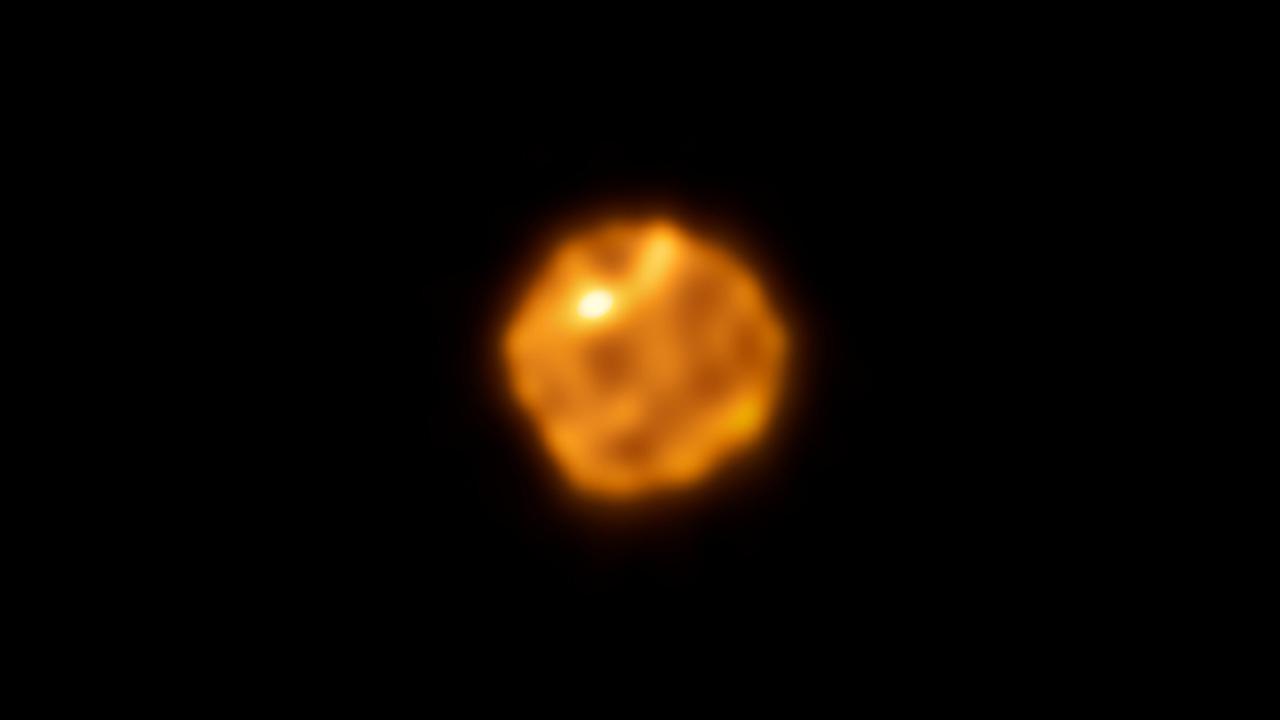
Not a smooth ball of fire: a star's surface at full boil. On August 24, 2026, the ALMA observatory released the most detailed map ever made of Betelgeuse's atmosphere, the red supergiant in the constellation Orion. On the menu: two blazing patches, a lumpy outline, and one bright spot planted in the same place for at least seven years. A real headache for convection models.
One image, two blazing patches
Betelgeuse sits about 560 light-years away in Orion. One number puts its bulk in perspective: its radius is roughly 800 times that of the Sun. Dropped into our star's place, it would swallow the orbit of Mars, wrap around the entire asteroid belt and still stop well short of Jupiter. That enormous size has a perk: from Earth, the star covers a patch of sky large enough to be photographed in detail. Few stars share the privilege.
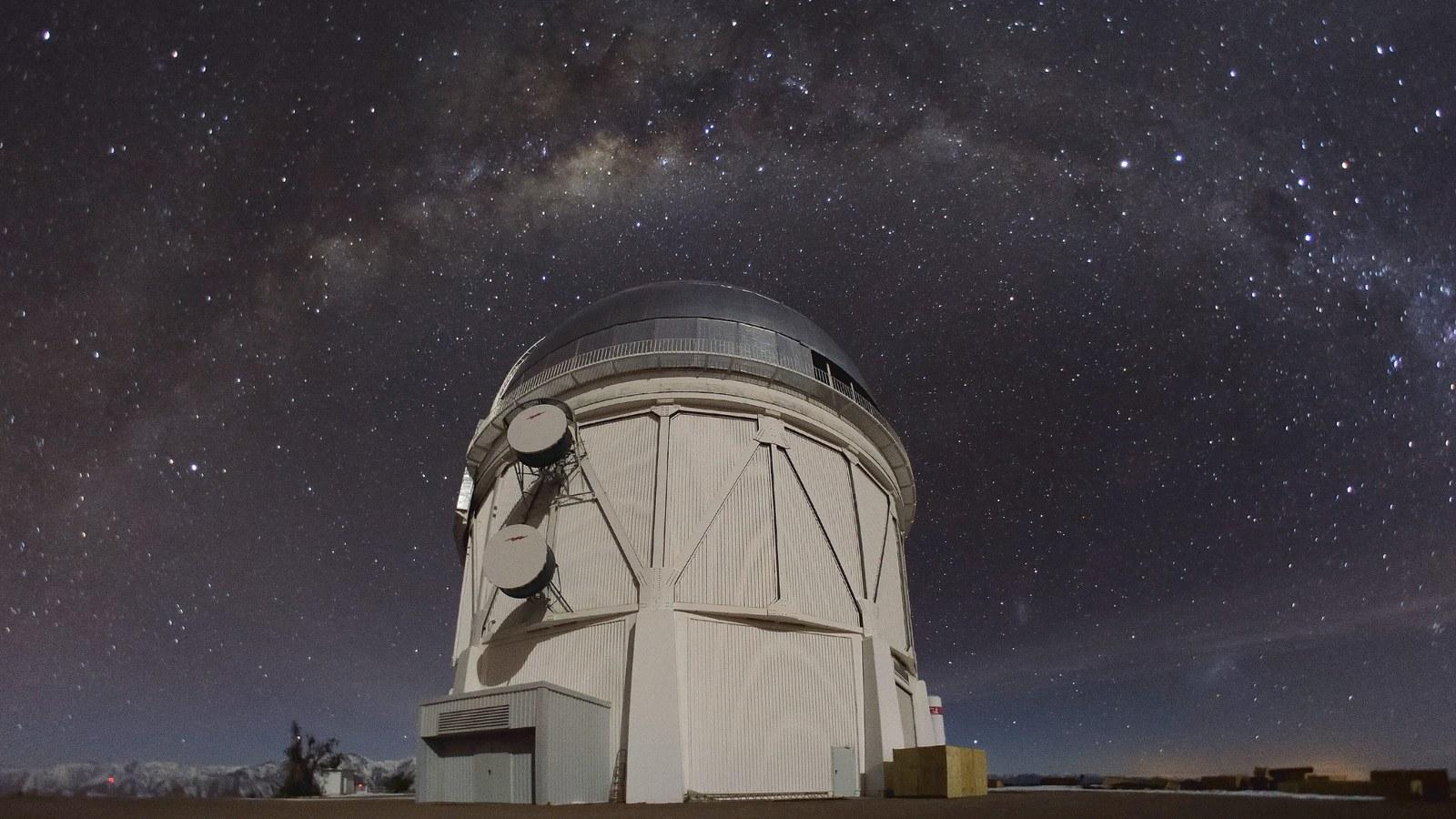
In August 2023, ALMA photographed it with its most extended configuration: antennas spread up to 16 km across the Atacama Desert in Chile. The resolution reached, 7 milliarcseconds, amounts to separating details the size of Earth's orbit around the Sun, on a star 560 light-years away. No other instrument does better on a star of this kind.
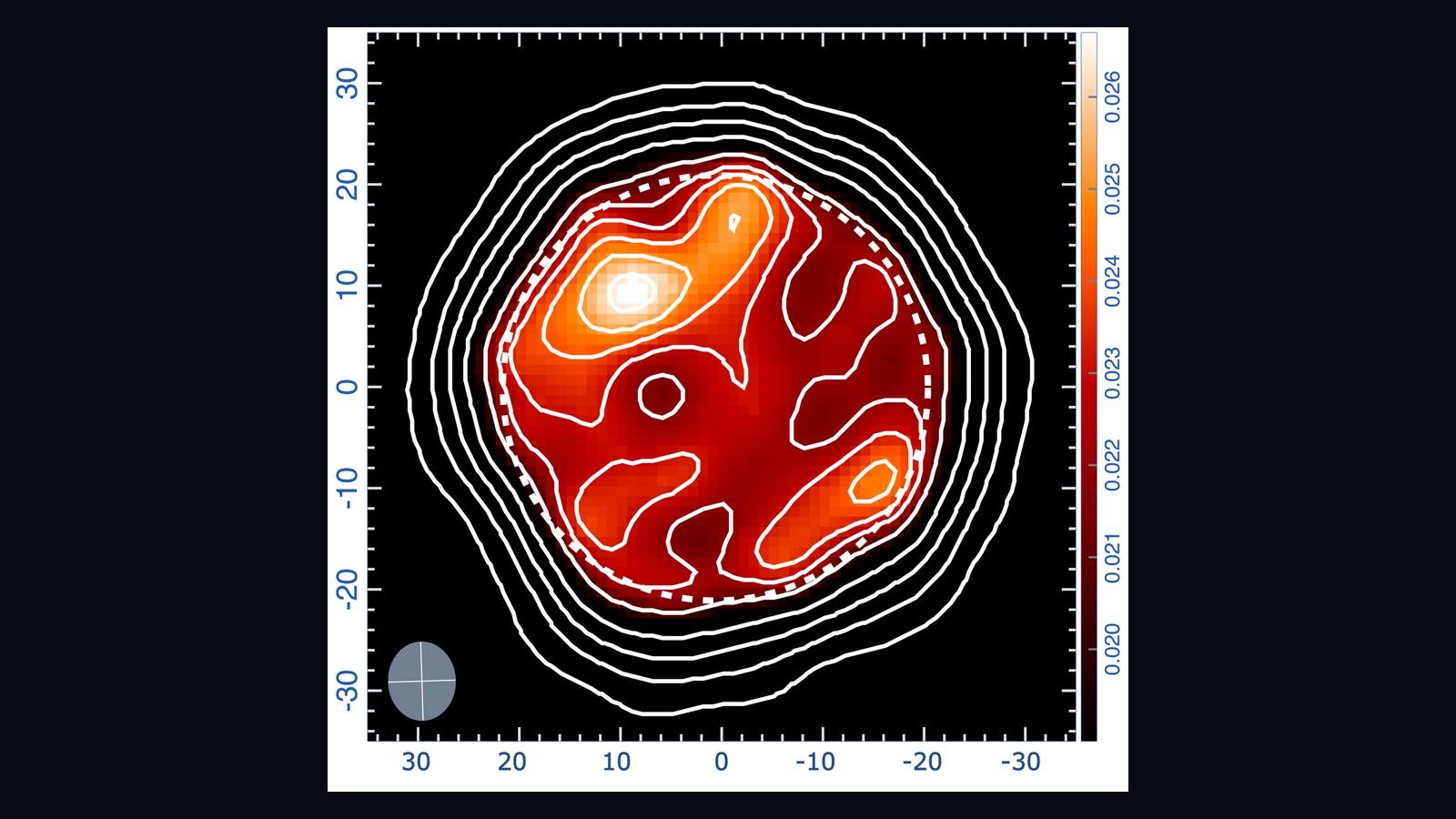
The disk ALMA sees averages 2,300 K, about 2,000 °C. Two regions burn noticeably hotter: one to the northeast, one to the southwest of the disk. The brightest runs 800 K above the average, a third higher. At this scale we are no longer talking blemishes: this is the signature of a colossal energy release.
How to photograph a surface 560 light-years away
Three useful clarifications before going further.
First, ALMA does not see visible light. Its antennas pick up millimeter waves, between radio and infrared. On a star, those waves escape from a layer of gas a little above the surface our eyes see: researchers call it the "millimeter photosphere". For Betelgeuse, it lies 15 to 20% above the visible radius.
Second, that layer is surprisingly cool. The star's effective surface temperature is around 3,650 K. At 1.2 stellar radii, the gas passes through a temperature dip, near 2,300 K, before warming up again higher out. This dip is molecule country: silicon monoxide, carbon monoxide. ALMA mapped them and found them clumpy, far more uneven than the disk itself.
Third, the sharpness comes from interferometry: instead of one big mirror, dozens of antennas combine their signals to mimic a single giant instrument. The result behaves like one 16 km dish. That trick is what makes the detail visible on a star.
Seven years apart, the same patch
Here is the number that made the team raise an eyebrow: seven years, at minimum. ALMA had already photographed Betelgeuse in November 2015, in a comparable configuration. Placing the two campaigns side by side, the bright patch in the northeast reappears almost in the same spot, with a similar intensity. Between the two dates: 7.3 years.
Yet convection models predict structures that live from a few months to a few years. Betelgeuse's patch survived at least seven years without moving or fading. It may have lasted far longer: bright zones at the same locations already show up in 2009 infrared images, and Hubble had spotted a bright zone in ultraviolet light back in 1996. If all of these trace the same regions, the lifetime climbs toward twenty years.
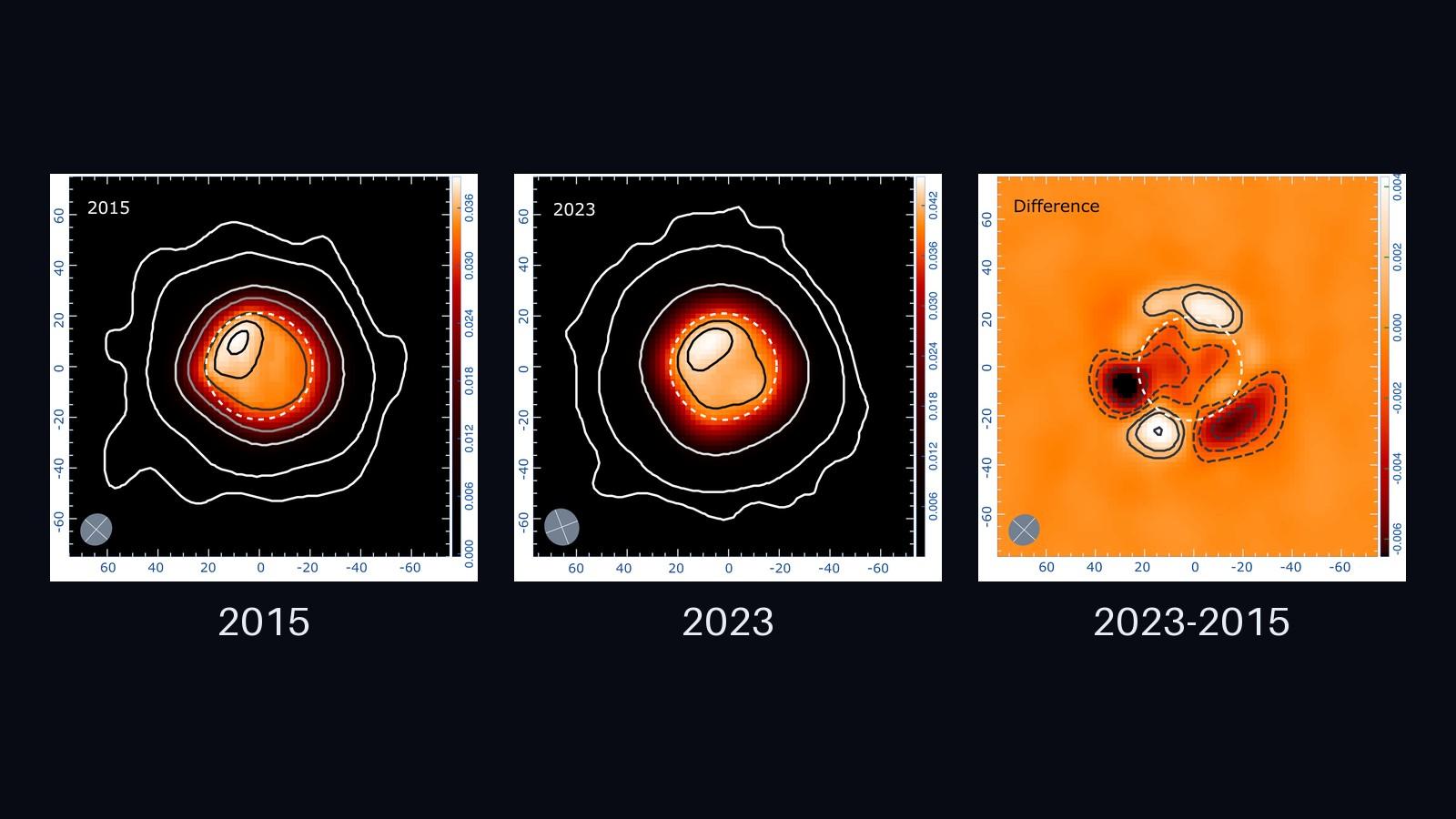
Convection tells that story. Picture a pot of boiling water: hot water rises from the bottom, cools at the surface, sinks back. In the Sun, millions of small cells churn the surface. In a supergiant like Betelgeuse, the huge size and weak gravity flip the recipe: 3 to 5 giant cells cover the whole disk. Gas reaching the surface drives shock waves into the atmosphere, and those waves light up the patches ALMA photographs. The brightest one alone carries about 1% of the star's light at these wavelengths.
A lopsided star, churned by giant bubbles
The disk's outline is not round. ALMA measures radius deviations up to 6%, like little ripples frozen into the silhouette. These warps cluster in one sector to the star's southeast, and they changed between 2015 and 2023. Unlike the bright patch, they live fast.
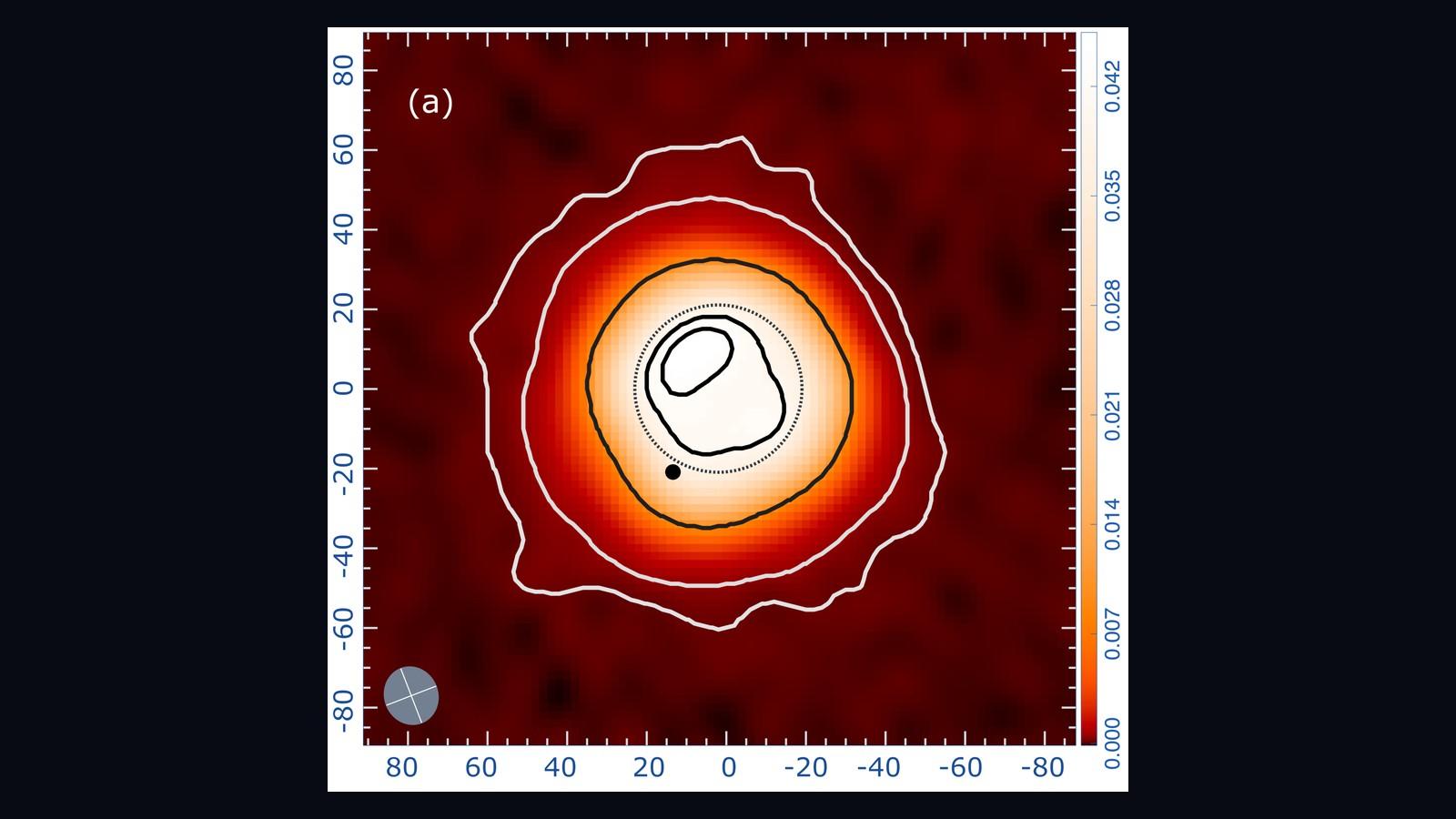
Around the star, fainter emission stretches beyond two stellar radii. The molecular gas looks even more uneven: clumps with contrasts up to 10 to 1 between the northeast side and the southwest side. Some of that gas has reshuffled since 2015, a sign the atmosphere keeps turning over.
The poles, the companion and an intriguing coincidence
The two hot spots line up along an axis pointing 51° across the sky. Betelgeuse's companion, confirmed in 2026 with observations at the Very Large Telescope, would orbit along an axis near 60°. The two axes nearly overlap, and the patches project near the star's proposed poles. The team's working idea: polar convection that is more active and steadier than the rest of the surface.
Nothing yet proves that the companion, orbiting at 2.3 stellar radii, shapes these patches. But the alignment is enough to keep the antennas pointed. Also in play: the memory of the Great Dimming of 2020, when Betelgeuse faded for weeks. The weakened southwest sector in the 2023 data could still carry its mark.
What it changes for those of us following along
Betelgeuse will end as a supernova, an event bright enough to see in broad daylight from Earth. Understanding its convection means understanding how these giants shed mass before the explosion, and what shapes their final act. "Its eventual fate as a supernova makes it fascinating to know what it actually looks like now," sums up Bill Dent, astronomer at ESO and lead author of the study.
The images also carry a lesson in method: two campaigns seven years apart were enough to shake up a theoretical expectation. ALMA's next passes will tell whether the northeastern patch still holds its post.
Going further
- The definitions to follow the story: supernova, interferometer and the Sun in our glossary.
- Hubble captured the first image of a star's surface: the Hubble mission page.
- To find Betelgeuse in Orion, head to the interactive sky map and the observing guide.
- The main sources for this article: the ALMA press release and the research paper accepted in Astronomy & Astrophysics.