Some 26,000 light-years away, at the center of the Milky Way, the black hole Sgr A* is fasting. Its mass is about 4 million times that of the Sun. A team at McGill University in Montreal has now measured the chemistry of the gas around it with the James Webb Space Telescope. That gas contains roughly 1.8 times more heavy elements than the Sun. The likely legacy of ancient supernovae, and a clue to why this black hole eats so little. The study appeared on October 19, 2026, in The Astronomical Journal.
A black hole that feeds on a trickle
Sgr A* is the closest supermassive black hole to Earth. That proximity makes it a unique laboratory, since no other black hole of this size can be studied in such detail. Yet it shines very little. Active supermassive black holes, the ones devouring matter from their host galaxy, drive disks of gas that rank among the brightest objects in the Universe. Sgr A* stays quiet.
The popular image of a black hole is misleading. It is not a vacuum cleaner that swallows everything passing by. For gas to fall in, it must first cool, compress and shed its rotation. Hot, swirling gas can stay in orbit for millions of years. The feeding rate therefore depends on the fuel itself: its temperature, its density and its chemical composition.
That is where the new study comes in. The researchers pointed JWST's MIRI spectrograph at the central parsec of the Galaxy, where the gas lies closest to the black hole. There they dissected the light of the Minispiral, a body of hot gas orbiting Sgr A*.
The Minispiral, a three-armed swirl around the monster
The Minispiral owes its name to its shape. Seen from Earth, it draws three arms that seem to spring from a common center: the Northern Arm, the Eastern Arm and the Western Arc. Astronomers call it a triskelion, the three-branched motif found on ancient Greek coins. A ring of cold gas, the circumnuclear disk, wraps around it and holds the raw material of the region.
The three arms act as bridges. They connect the cold molecular gas of the disk to the scorching plasma around the stars at the center. Work going back to the 1980s shows this gas streaming at 100 to 400 kilometers per second along our line of sight. The arms meet in a region called the Bar, nearly stationary in our direction. Closer still to the black hole sit small compact structures, including an object named X7.
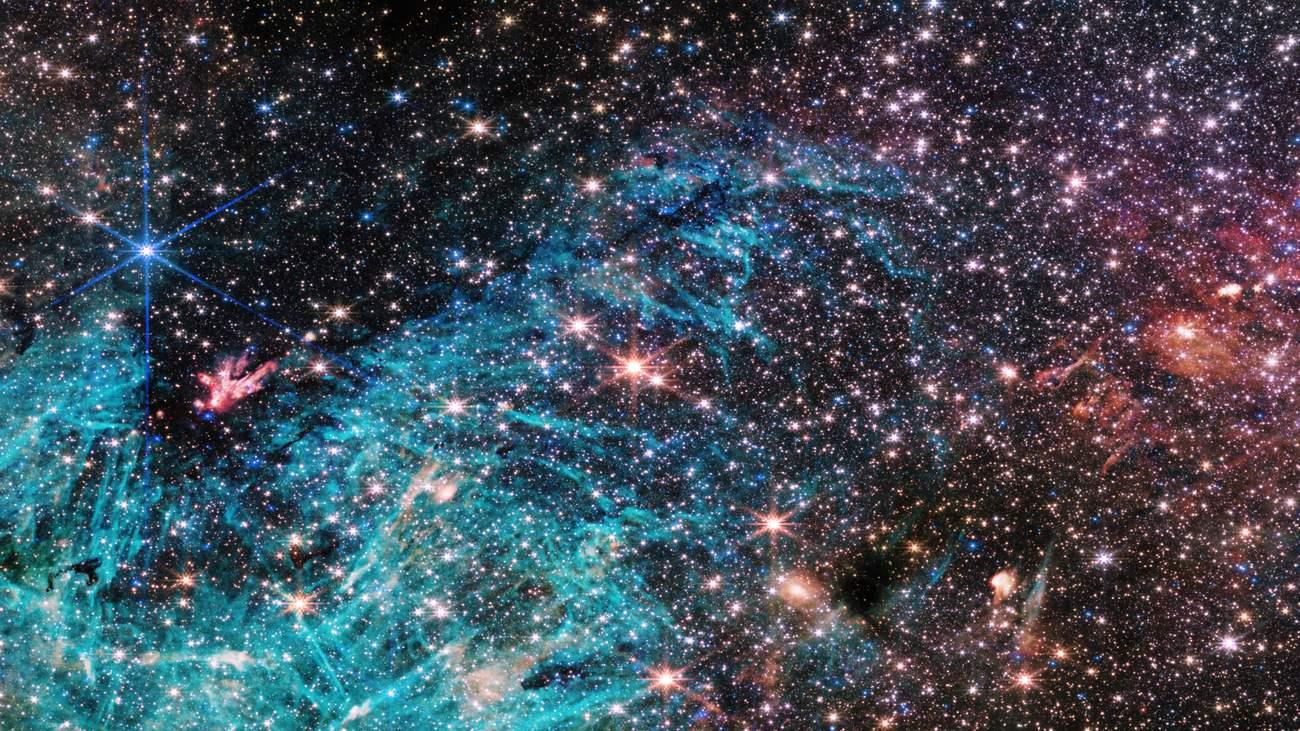
MIRI revealed this architecture in unprecedented detail. The spectrograph works in the mid-infrared, between 4.9 and 27.9 micrometers, and splits light into thousands of wavelengths. At the distance of Sgr A*, one parsec spans about 25 arcseconds on the sky. MIRI reaches below a tenth of a parsec, about a third of a light-year, and separates each arm by its velocity and shape. In November 2023, Webb's NIRCam camera had already delivered a striking portrait of the galactic center in the Sagittarius C region, some 300 light-years from Sgr A*. MIRI now looks at the very heart.
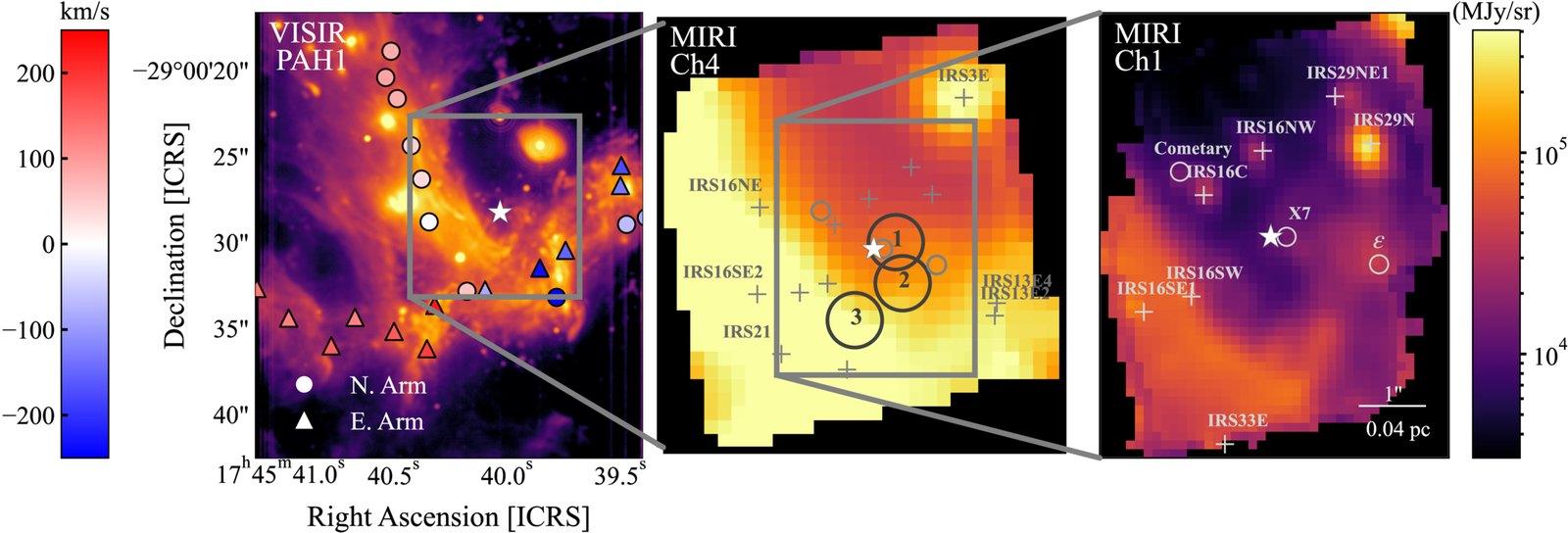
One detail intrigues the researchers. Several compact clouds race at more than 600 kilometers per second, about 2 million kilometers per hour. At that speed, you would cross France in under two seconds. These objects lie within 0.05 parsec of Sgr A* on the sky. X7 is one of them, and the new data confirm the orbital model proposed for it in 2023.
Reading a gas by its light
How do you measure the recipe of a gas 26,000 light-years away? You cannot scoop up a sample. You read its light. A heated, ionized gas emits lines at very precise wavelengths, characteristic of each atom and each ionization state. That is the principle of spectroscopy, the splitting of light into its colors, much as a prism spreads out a rainbow.
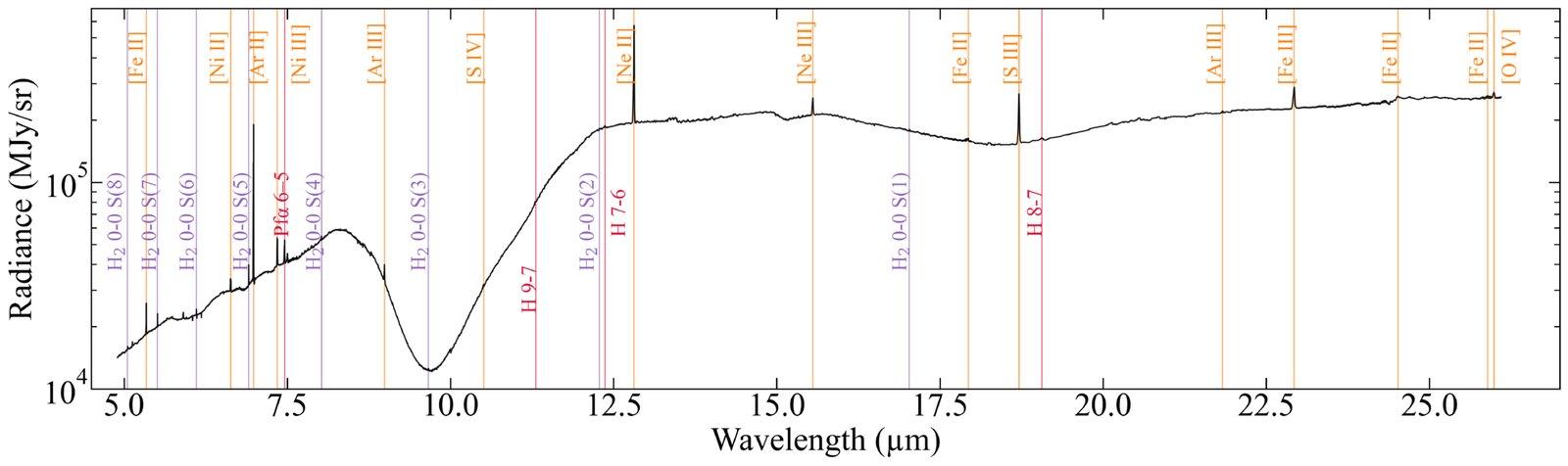
The team identified thirteen fine-structure lines in the mid-infrared. They come from neon, argon, sulfur, nickel, iron and oxygen. Four hydrogen recombination lines complete the spectrum. These atoms have lost one or more electrons, which takes energies between 8 and 55 electronvolts. An electronvolt is an energy unit suited to photons: it is the energy an electron gains by crossing a one-volt battery. These values place the radiation in the ultraviolet, far beyond visible light.
Each line tells two stories at once. The ratio between lines from the same atom, for instance singly and doubly ionized neon, reveals how hard the incoming radiation is. The ratio of a line to hydrogen reveals how many atoms are present. By combining these measurements across each structure, the researchers built a chemical map of the Minispiral.
The result fits in one number. On average, the gas holds 1.8 times more heavy elements than the Sun, with a range of 1.4 to 2.2 times depending on the element and the region. Neon and argon, which are easy to measure, carry that average. Sulfur and nickel vary more, and gas-phase iron shows a comparable excess.
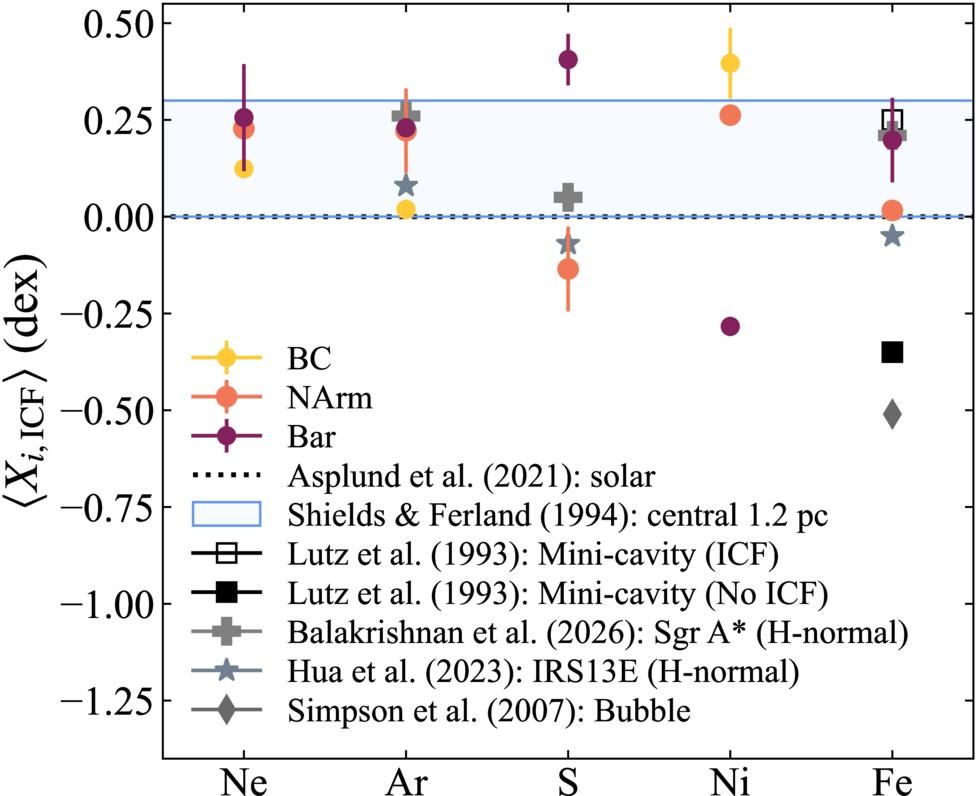
A second result hides behind those figures. In ordinary interstellar space, most iron and nickel atoms are locked inside dust grains, which keeps them out of the measurement. In the Minispiral, the researchers find 58 to 87 percent of iron in gaseous form, against only 5 to 10 percent in the rest of the galactic center. The dust has been destroyed, and its atoms released into the gas.
Where did these metals come from? The supernova trail
The elements themselves tell their origin story. Neon, argon, sulfur and oxygen belong to the alpha-element family. Massive stars forge them and release them when their cores collapse at the end of their lives. Nickel and iron are heavier, and they come mainly from Type Ia supernovae, the explosions of white dwarfs that have piled up too much matter.
The observed mix fits that picture. The same team also compared the gas with the stars orbiting Sgr A*. Stars in the galactic center have a composition 1 to 2 times solar, and the winds of Wolf-Rayet stars, massive stars that have burned through their hydrogen, show similar values. The Minispiral gas resembles those stars. It may therefore come from the same material, or have been enriched by the same stellar generations.
Then there is the most obvious suspect. Sgr A East is the closest known supernova remnant to Sgr A*. It covers part of the sky that overlaps the black hole, and its age is estimated at about 10,000 years. A companion study led by Mayura Balakrishnan at McGill produced the sharpest X-ray maps of this object. It shows that Sgr A East expanded into the surrounding gas, compressed and heated it, and injects energy across the whole region.
The metals could well come from there. Supernovae enrich gas with heavy elements, and the shocks they drive free atoms trapped in dust. That is exactly what the compact clouds suggest: their stronger ionization and destroyed dust point to fast shocks. The researchers remain cautious. The measurement does not pinpoint a single explosion, and the enrichment may be cumulative, inherited from millions of years of star formation in the galactic nucleus.
Why Sgr A* eats so little
Here is the heart of the matter. Metal-rich gas radiates better, so it cools faster. Gas that cools becomes denser and falls more easily toward the black hole. You might expect 1.8 times solar to speed up the meal considerably. It does not. The enrichment stays modest and cannot trigger rapid cooling on its own.
Other effects push in the same direction. Radiation from Wolf-Rayet stars ionizes the gas and keeps it warm. Sgr A East, for its part, has maintained turbulence and heat in its wake for about 10,000 years. As a result, much of the gas remains too hot and too stirred up to collapse toward the black hole. Only a small fraction, cooled and compressed, reaches the region where gravity wins.
Nicole Ford, the study's lead author and a PhD student in Daryl Haggard's group, sums up the paradox: "We know there's a black hole at the centre of our galaxy pulling material into itself, but we see that it's eating a lot less material than other supermassive black holes, and more slowly. Part of understanding why this is happening means looking at the properties of the materials available for it to consume, including gas, dust and the stars orbiting around it."
What this changes for us
The study reaches beyond the center of the Milky Way. The chemistry of the gas feeding a supermassive black hole shapes the models that describe its growth. Simulations that send gas falling toward Sgr A* rely on assumptions about metals, and those assumptions have just been tightened. The chemical composition of the fuel is now measured in the very zone where gas tips toward the black hole.
It also connects two scales. Supermassive black holes in distant galaxies cannot be observed this closely. Sgr A* serves as a reference, and the way metals are distributed around it informs models of how entire galaxies get enriched. The authors hope their work will help explain the distribution of metals around more distant black holes.
There is a more personal echo as well. The iron in our blood, the calcium in our bones and the carbon in our cells were forged in stars and scattered by their explosions. The supernovae that enriched the Minispiral belong to the same chemical machine. By studying the gas around Sgr A*, we are watching a workshop where the material of future planets is being prepared, on the scale of a galaxy.
Two steps come next. Simulations that follow the gas over millions of years, to see how it cools and falls. And more sensitive measurements of highly ionized lines, such as those of oxygen and neon, to separate the role of starlight from that of shocks. Both paths are now identified.
Going further
- The mission page for James Webb (JWST), whose MIRI spectrograph produced these measurements.
- The key concepts behind the story: the supermassive black hole, the Milky Way, infrared and spectroscopy.
- To observe the galactic center yourself: the interactive sky map and the observing guide show where to point, and the astrophotography gallery shows what an equipped amateur can capture.
- The official sources: the study in The Astronomical Journal (open access), the arXiv manuscript, the McGill University news release and Chandra's X-ray maps of Sgr A East.