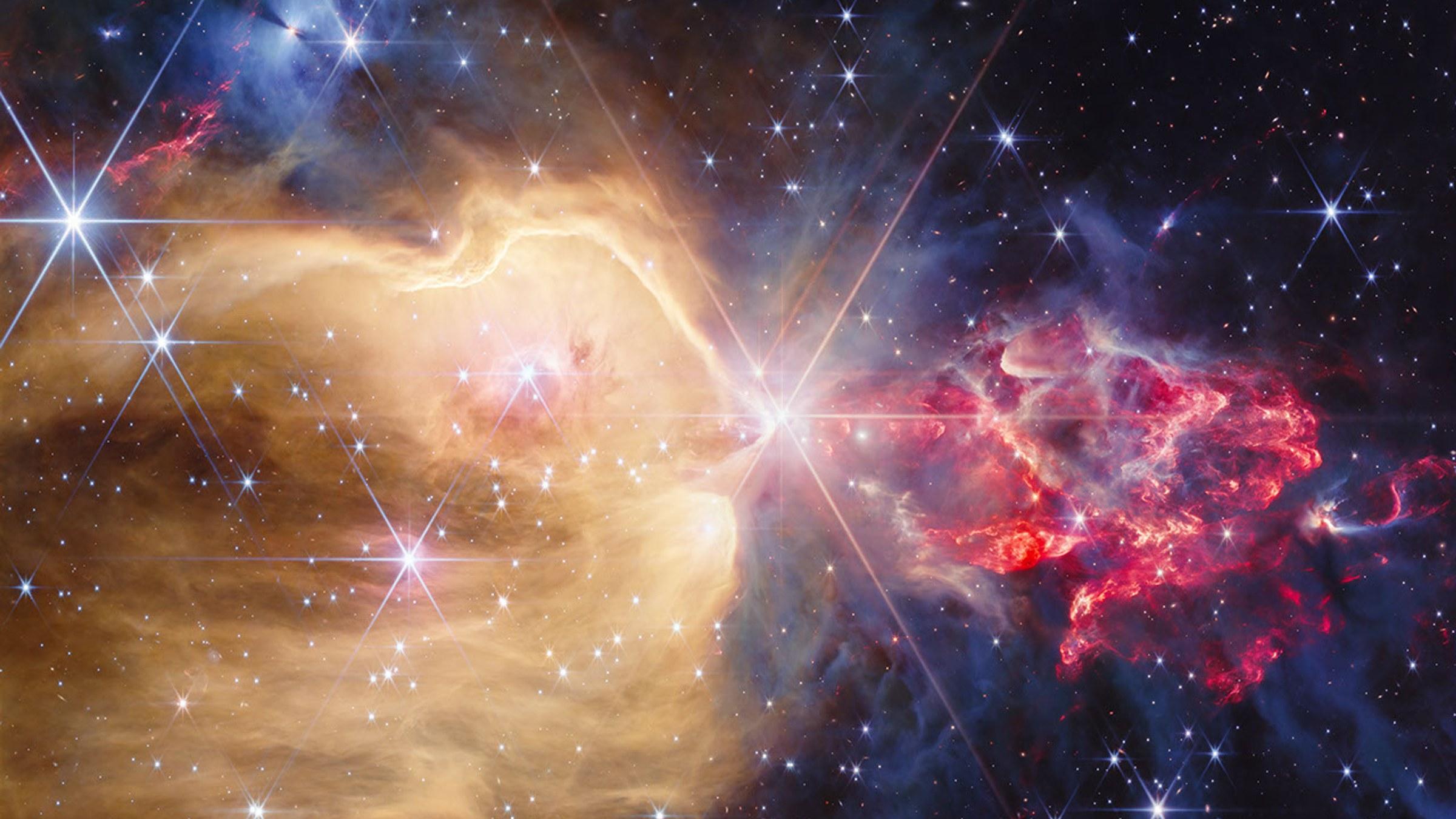
About 3,300 light-years from Earth, inside a cloud of gas and dust, a stellar nursery is stirring. Webb's infrared NIRCam camera has just delivered its portrait: protostars still putting on mass, stars nearing adulthood, and the jets of material that carve into the cloud. The image was released on Oct. 6, 2026.
Under the dust, a nursery in full swing
The cloud is called NGC 7129. To the eye, or through an ordinary telescope, it would look like a dark patch, because the dust filling it absorbs and scatters visible light. Telescopes that cannot capture infrared see almost nothing there.
Webb, by contrast, is highly sensitive to infrared. That is the radiation given off by warm objects, and it travels through dust instead of stopping in it. The result is closer to an X-ray: where the eye finds only an opaque fog, NIRCam reveals a teeming population of stars.
What Webb has uncovered is a region where objects of very different ages sit side by side. Some have just switched on, others have already sculpted their surroundings. The most massive stars evolve fastest, so they tend to be the oldest.
Stars at every stage of youth
At the center shines LkHα 234, pronounced Lick-H-alpha, named after the Lick Observatory where the star was identified. It is the most massive and most mature object in the region, weighing 5 to 8 times the mass of the Sun. It also sports the image's most prominent diffraction pattern, the cross-shaped spikes a mirror telescope adds around very bright sources.
LkHα 234 belongs to the pre-main-sequence class of stars. One comparison helps place the stage: think of a car engine. A mature star has started its engine, the fusion of hydrogen in its core, which holds it steady for billions of years. LkHα 234 has gathered almost all of its material, but has not turned the key yet. It is contracting under gravity, and that contraction heats it up. One day, its core will be hot enough to ignite fusion, and it will become a star like the Sun.
Several of its neighbors, inside the same cavity, are at the same stage and blow out particle winds. Meeting the surrounding gas, those winds trace curved compressed arcs, like waves frozen inside the cloud.
A 3.5-light-year cavity carved by a single star
To the left of LkHα 234 opens the most spectacular structure in the image, a golden cavity about 3.5 light-years across. One light-year is nearly 9.5 trillion kilometers, or roughly 63,000 times the distance between Earth and the Sun. The cavity therefore spans about 220,000 times that distance.
The central star carved this bubble itself. At an earlier stage of its life, it ejected floods of material, and those floods plowed through the dense hydrogen cloud. Even now, its glare and its past jets keep energizing the surrounding gas, which starts to glow.
The process does more than destroy. Much of the hydrogen is blown away, but a large amount is also compressed, packed down by the outflow. Compressed gas eventually collapses on itself and gives birth to new stars. Today's cavity is therefore setting the stage for the next generation.
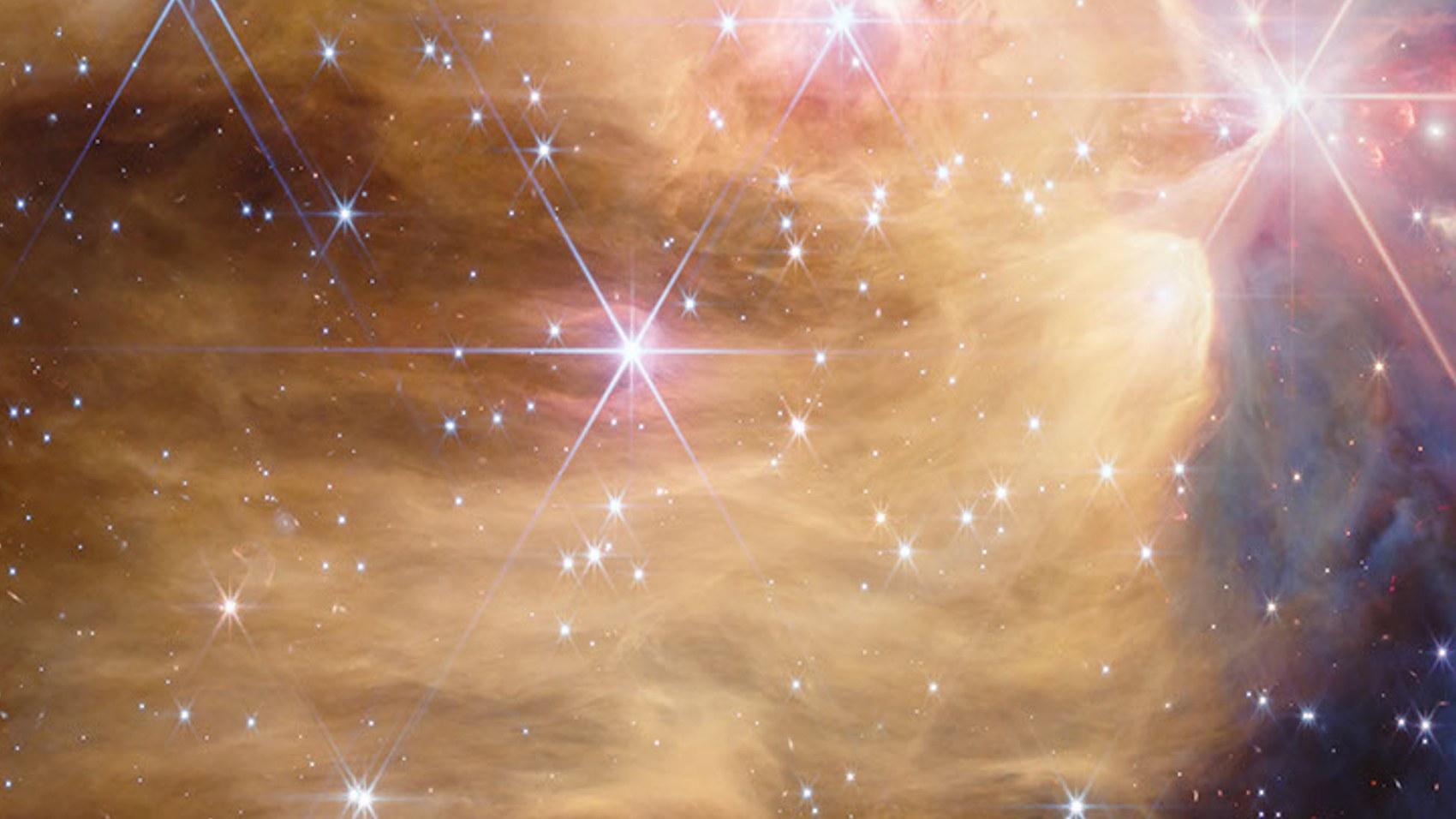
At the top of that cavity, starlight meets the cold gas still outside. There, it breaks hydrogen molecules into separate atoms and traces a sharp boundary that astronomers call a photodissociation region. It is the front line between the lit zone and the dark one.
Red, jets, and chaos
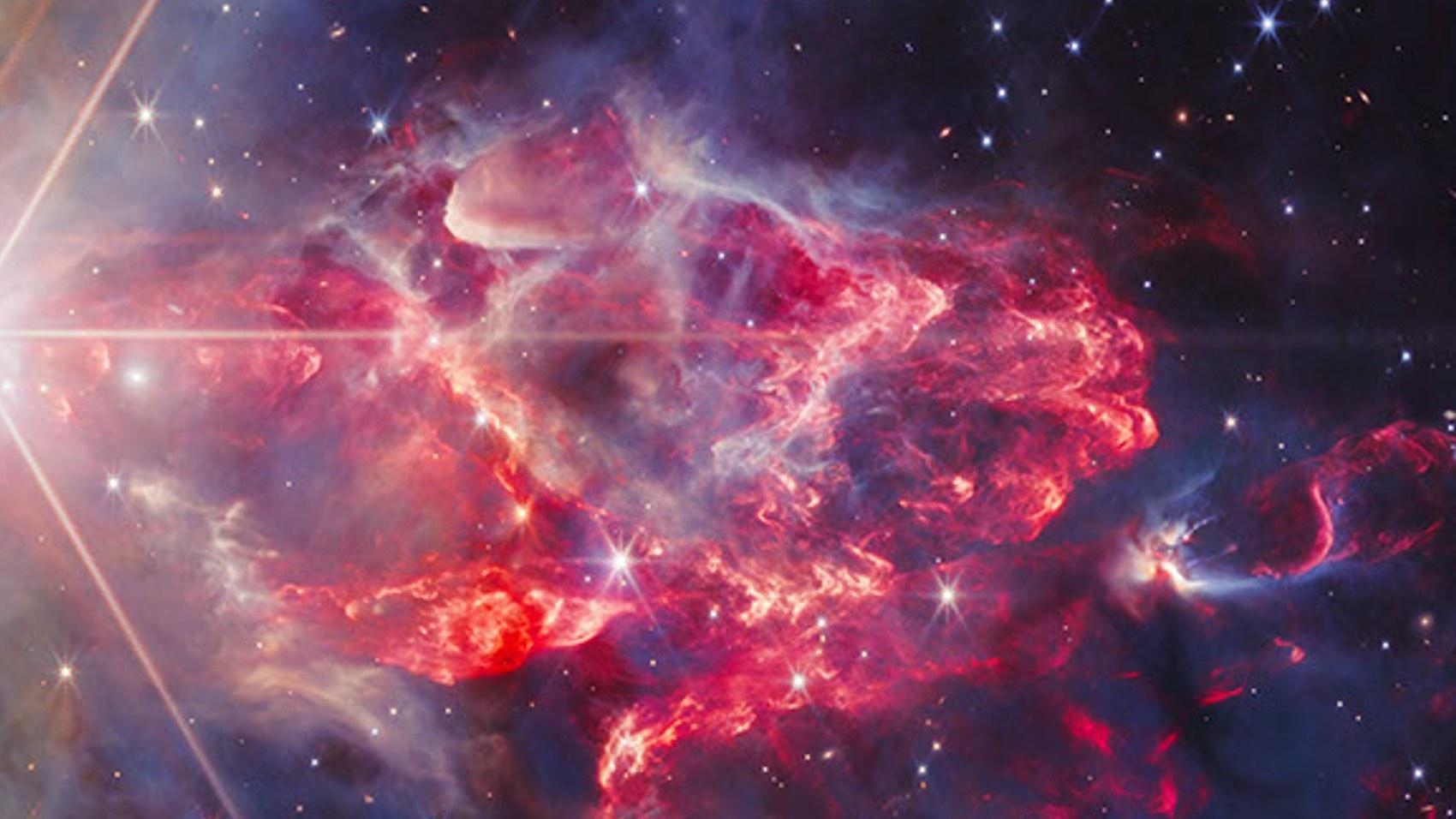
The right-hand side of the image tells a different, even busier story. This clumpy red mass hides objects far younger than those on the left: protostars. The protostar stage comes before the pre-main-sequence stage. It begins when a chunk of cloud collapses and fragments.
As a protostar grows, it ejects superheated material in opposite directions. Those jets race through the thick envelope around it. The impact draws swirls and textures, and their light produces the red glow. Because several stars are ejecting at once, and their jets overlap along our line of sight, the scene looks thoroughly chaotic.
Near a blue nebula in the upper left, another detail stands out. A protostar there is wrapped in a doughnut-shaped disk of material. That disk casts its shadow onto the cloud behind it. Astronomers have seen a matching structure before with Hubble, in a region nicknamed the "Bat Shadow."
What this changes
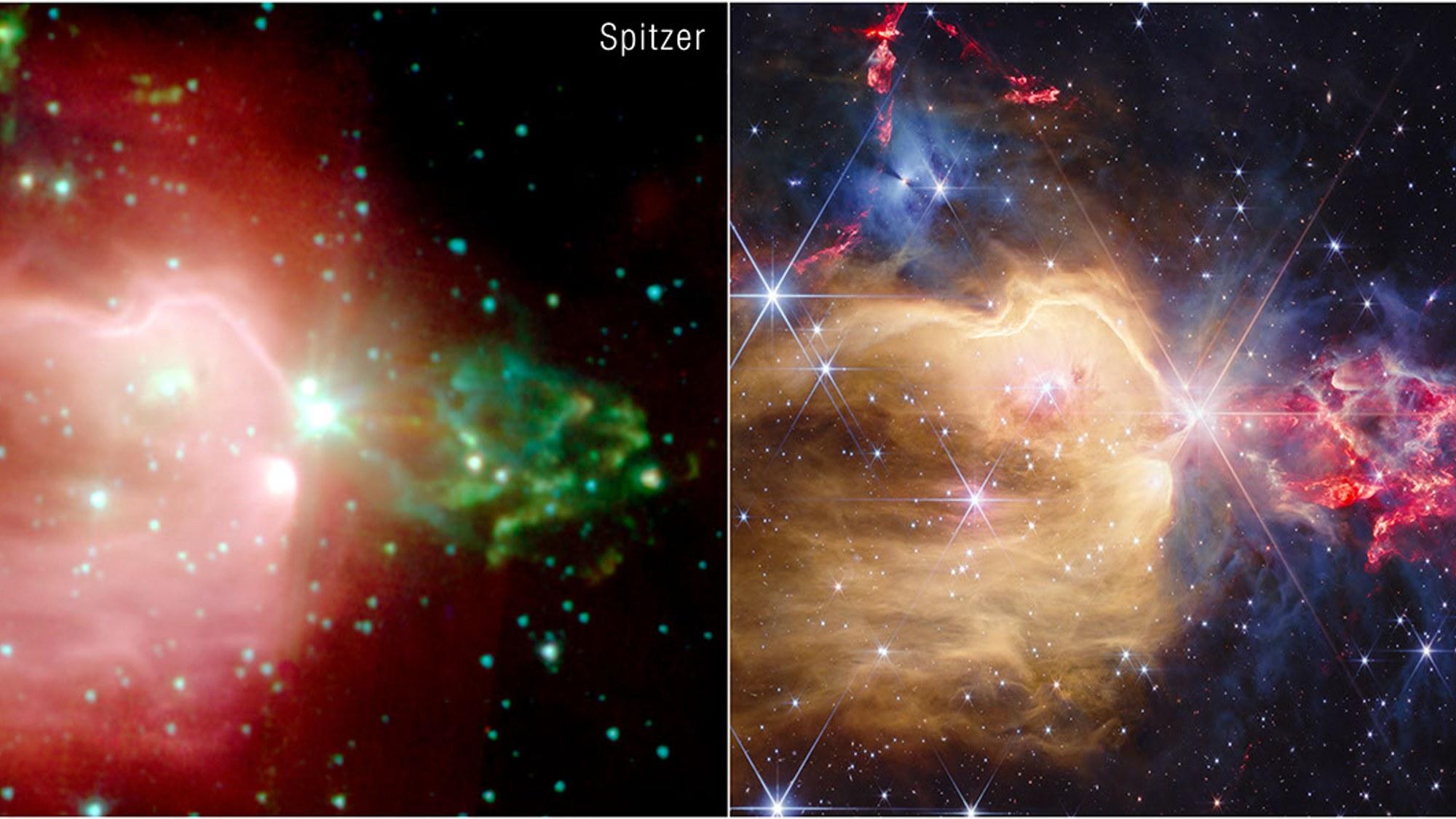
Spitzer, now retired, had already observed the gas and dust of NGC 7129. Comparing the two images is telling: Webb distinguishes far finer filaments and brings out galaxies shining well behind the cloud.
Astronomers will keep mining this data. The goal is to understand how a group of young stars shapes its environment, and how that environment in turn shapes the stars that follow. Every jet that carves a cavity, every pocket of gas that collapses into a birth: NGC 7129 offers a stage where those mechanisms can be read almost like an open book. Over millions of years, this cloud will disperse, leaving behind the stars it helped create.
Going further
- The telescope behind the image: the James Webb Space Telescope, whose NIRCam camera captured this scene, with its full mission page and latest news.
- The ideas that make sense of it: star formation, nebulae and infrared light in our glossary.
- To explore the sky from home: the interactive sky map, the stargazing guide and the astrophotography gallery.
- The official sources for this article: NASA's release and ESA's publication on NGC 7129.