The James Webb Space Telescope has spotted star clusters of extreme density inside two very distant galaxies. One sits in the Cosmic Gems arc, the other in a galaxy called Firefly Sparkle. A study published in Astronomy & Astrophysics, led by Viola Bocchi at Sapienza University of Rome, with Matías Liempi and Dominik R. G. Schleicher, models what happens at their centers. Chain collisions between stars there would build intermediate-mass black holes, up to nearly 2,700 times the mass of the Sun. That is one possible origin for the seeds of supermassive black holes. The work remains theoretical: Webb has not observed these black holes.
Two galaxies seen through a cosmic lens
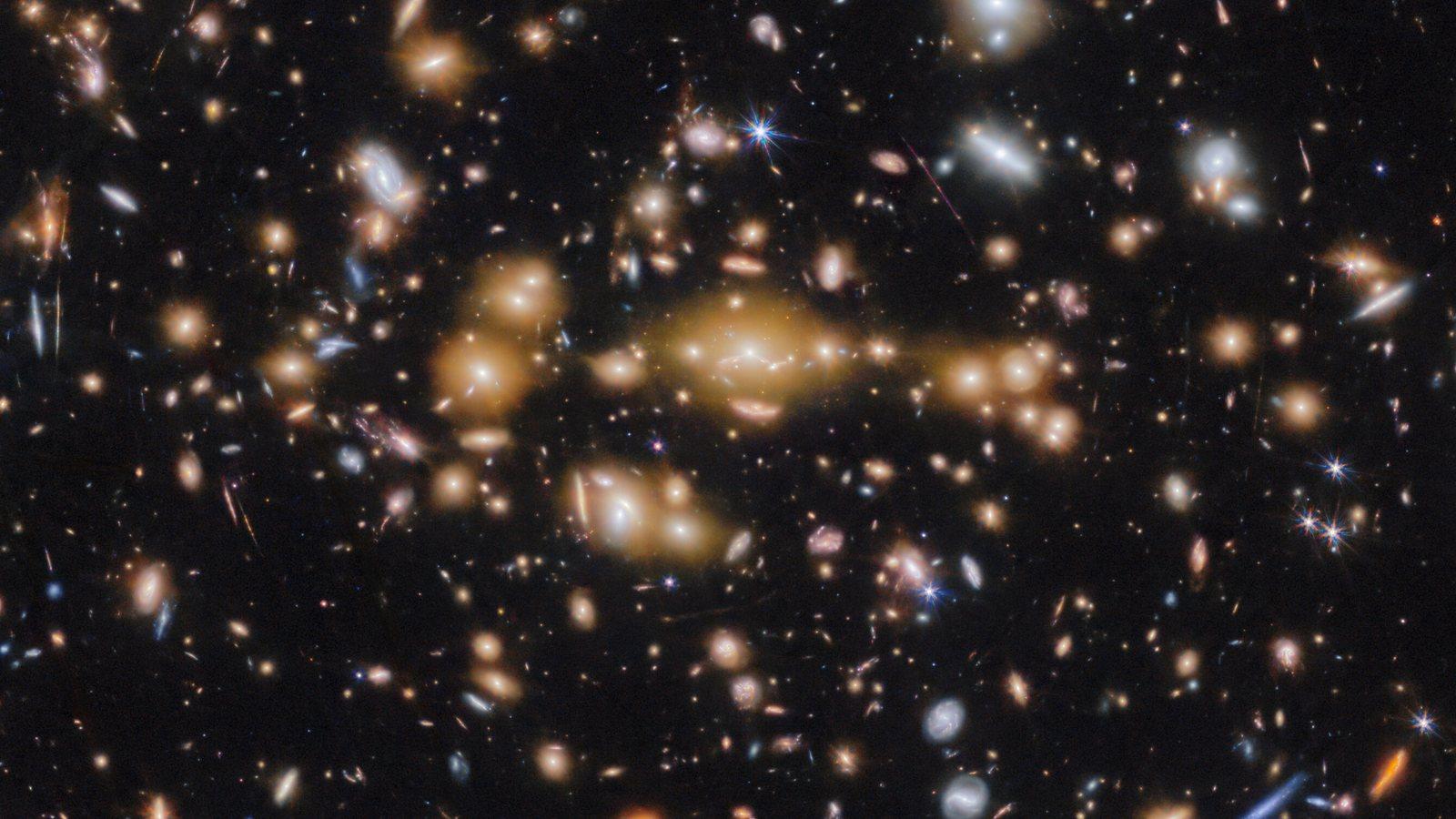
The two galaxies share one feature. Both sit behind other galaxies, and the gravity of those foreground objects bends their light. Astronomers call the effect gravitational lensing. Mass curves the space around it, and light traveling through that curvature follows a bent path. A galaxy cluster, a group of hundreds of galaxies bound together by gravity, therefore plays the part of a magnifying glass. The image of the distant galaxy comes out stretched, sometimes split into several copies, and far brighter than it would otherwise look. Think of the bottom of a drinking glass laid on a page: the letters underneath look bigger and warped. Without that natural lens, the star clusters of Cosmic Gems and Firefly Sparkle would be too small and too faint to tell apart.
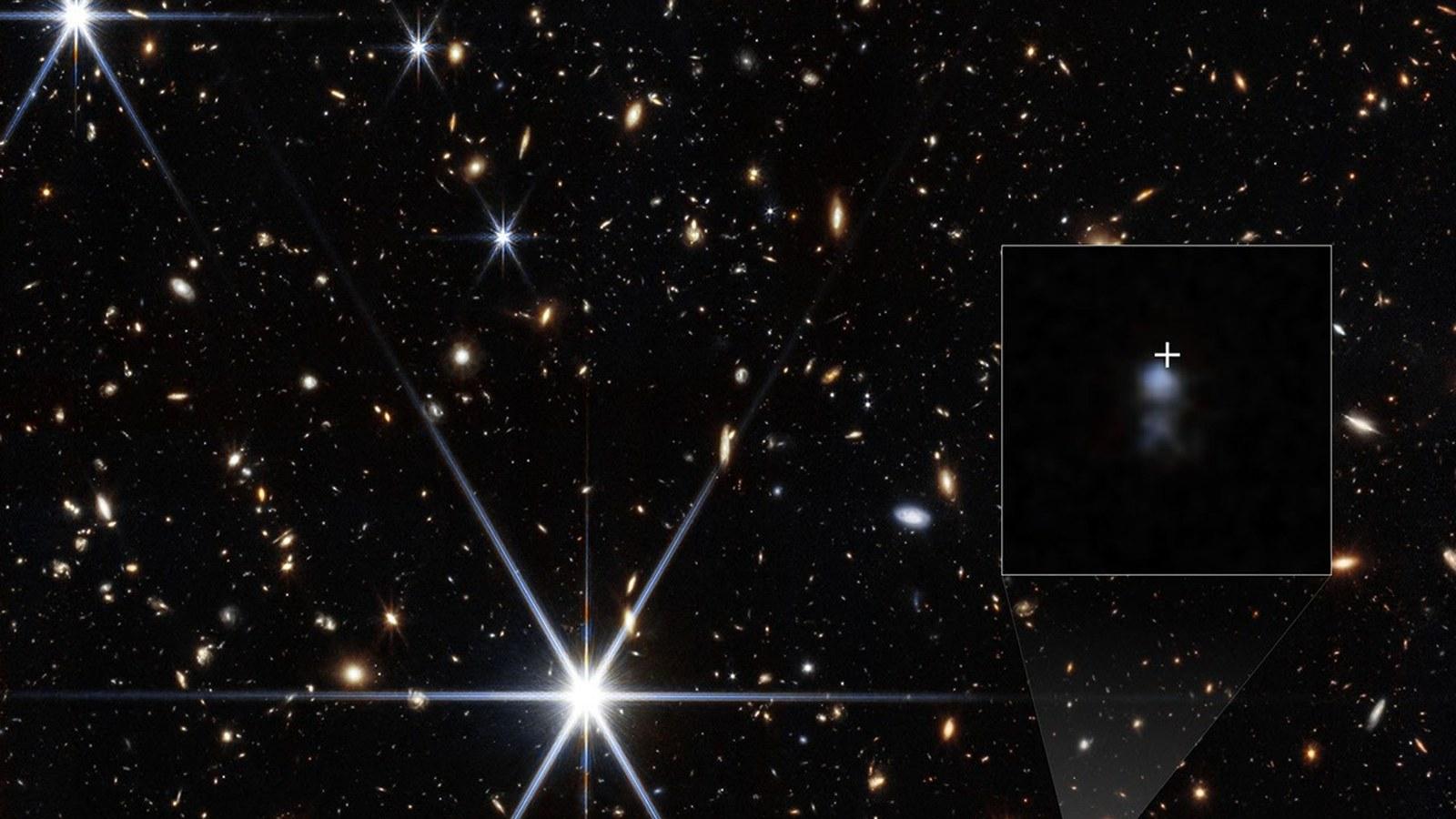
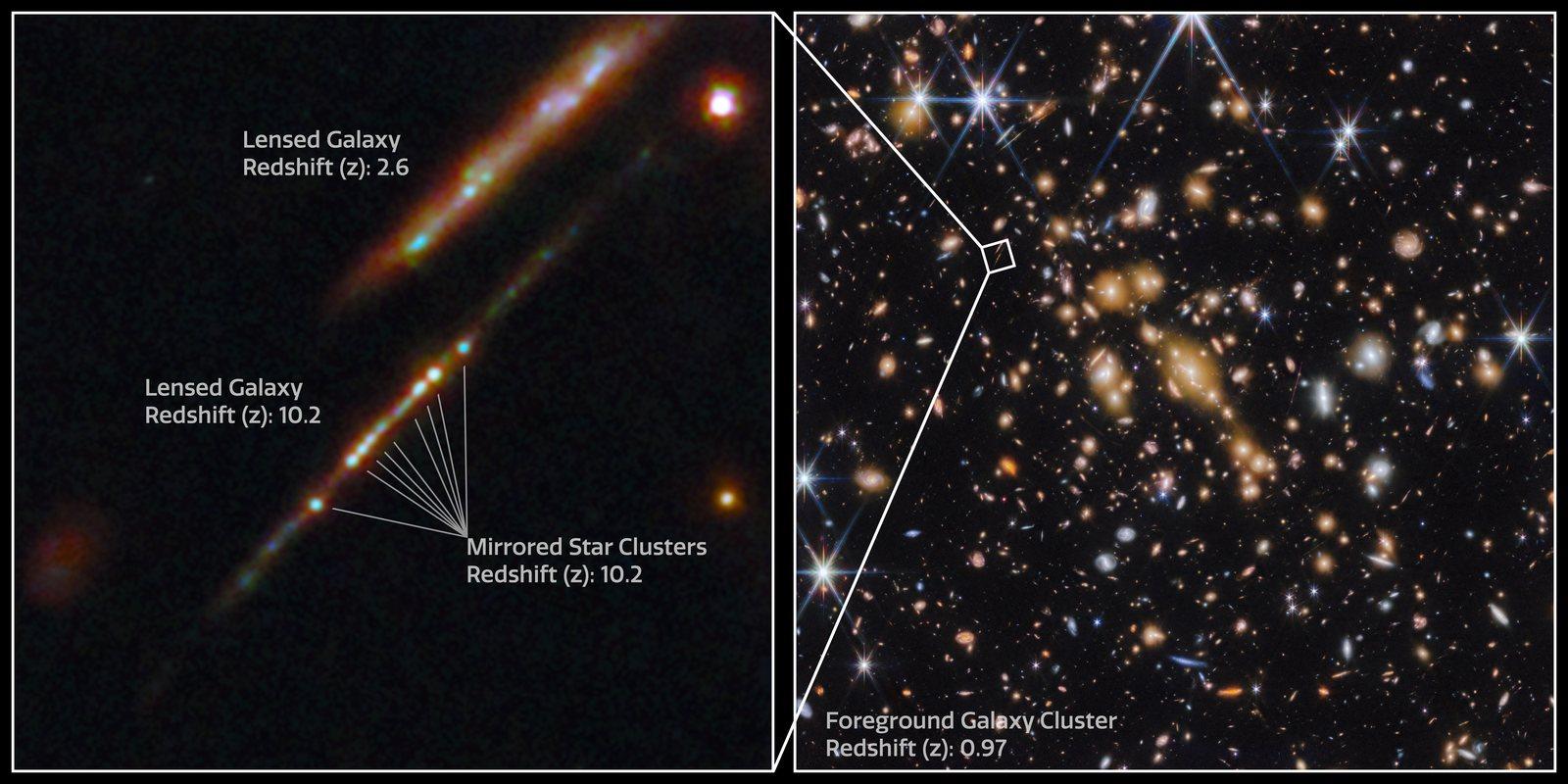
Cosmic Gems is an arc of light found by Hubble during the RELICS survey, a program devoted to the galaxy clusters that lens the distant sky. In 2024, Webb took its own look and resolved five young, massive star clusters. The light of that galaxy left when the Universe was about 460 million years old, at a redshift of 10.2. Firefly Sparkle sits at a redshift of 8.3. Its light left about 600 million years after the Big Bang, and Webb found ten clusters there.
Redshift, written z, measures how much the expansion of the Universe has stretched light. The higher z climbs, the farther away the galaxy lies, and the younger it looks. At a redshift of 10.2, we are looking at a Universe that was only 3% of its present age.
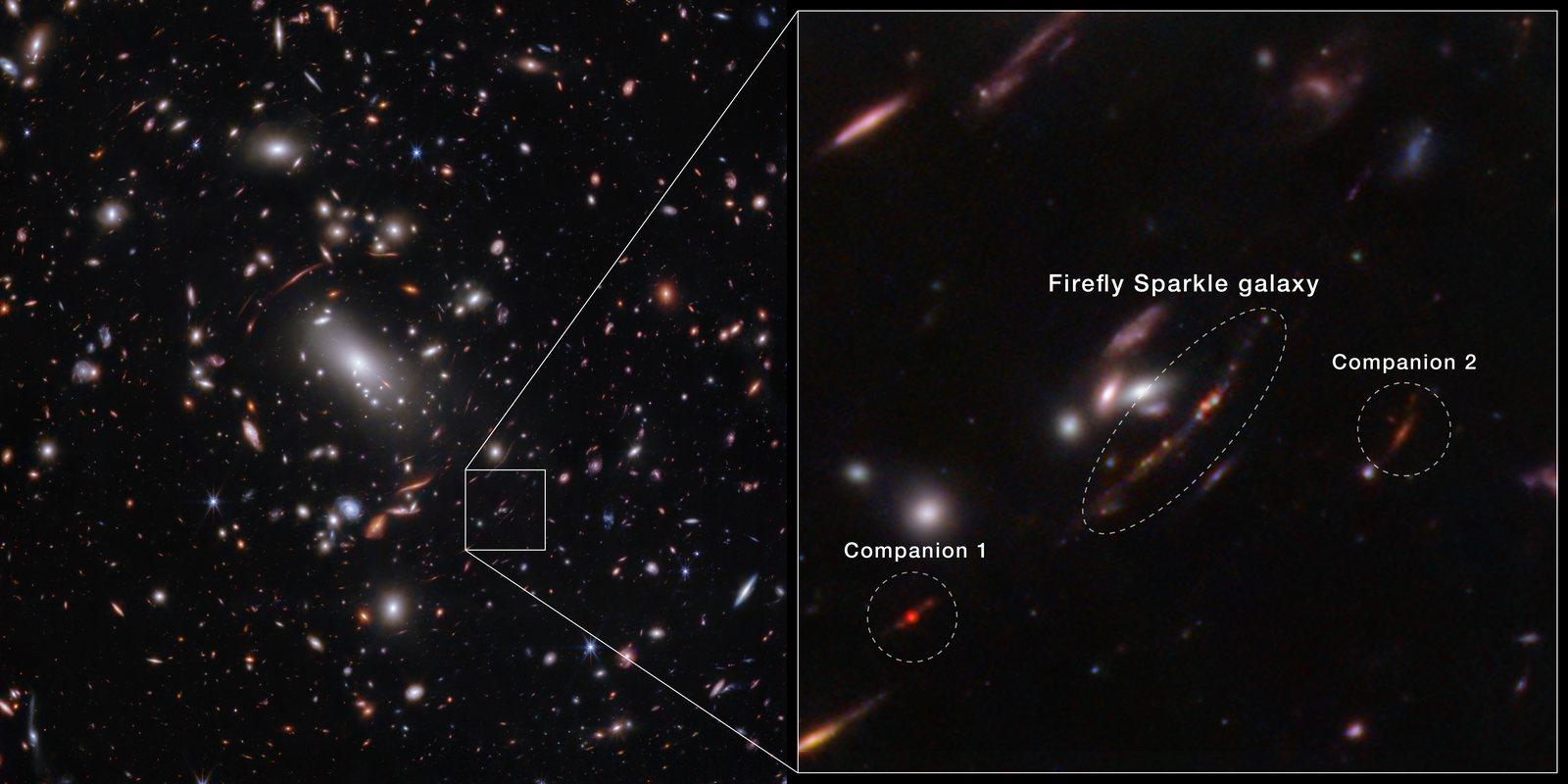
Those two galaxies are not the only ones. Webb's observations keep turning up more of them, always thanks to gravitational lenses. That abundance suggests very dense star clusters were not rare in the young Universe, even though astronomers can only see them when chance lines up a lens.
A million Suns inside 3.26 light-years
The clusters Webb found do not look like the ones around us. Their masses run from 100,000 to 10 million solar masses. A solar mass is the mass of the Sun, the unit astronomers use to weigh stars. Their half-mass radius, meaning the radius of the sphere that holds half of their mass, goes from 0.4 to 15 parsecs. One parsec is 3.26 light-years, the distance light covers in 3.26 years.
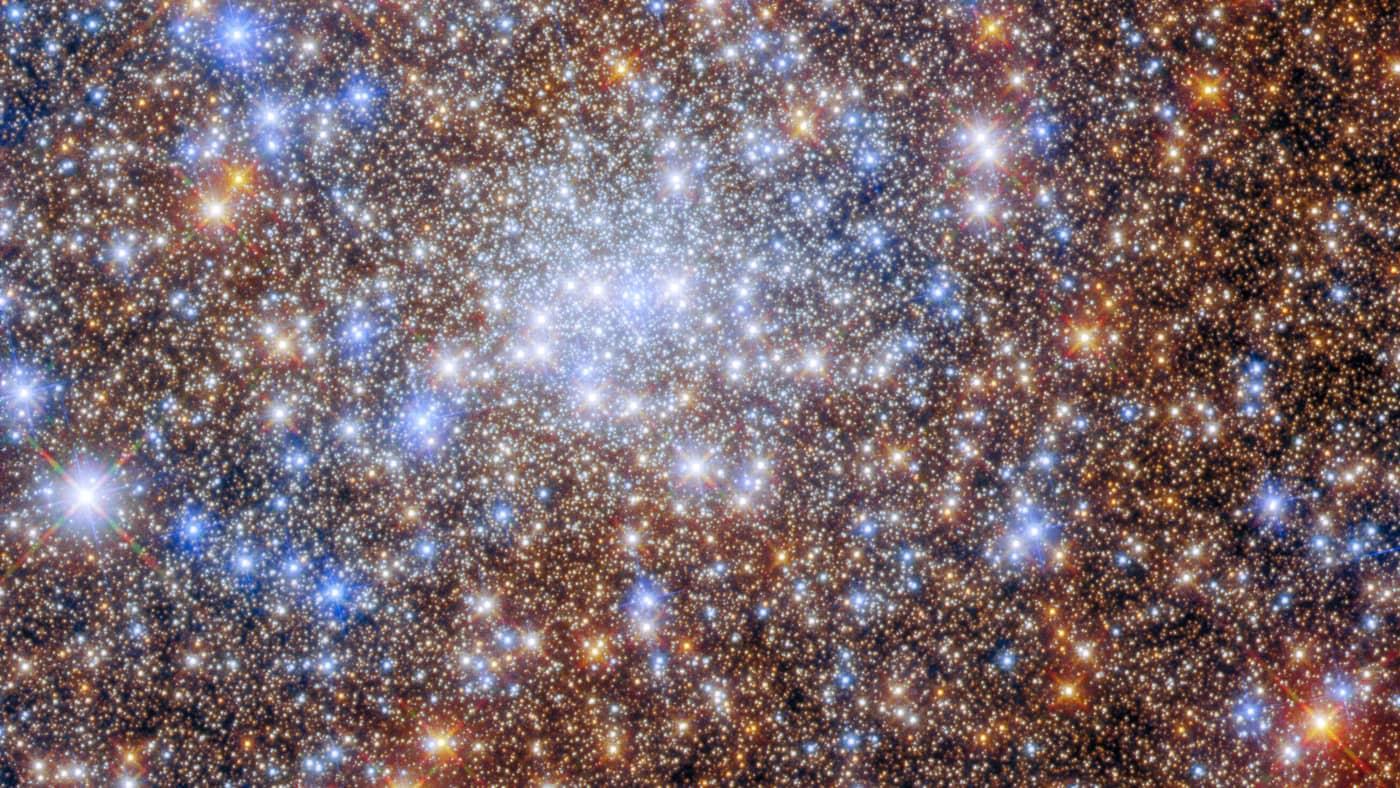
The five clusters of Cosmic Gems push compactness to an extreme. Each packs about a million solar masses, some up to 2.65 million, into a half-mass radius of about 1 parsec. Put another way, half the mass of a million stars fits inside a sphere 3.26 light-years in radius. That is less than the gap between the Sun and Proxima Centauri, the nearest star, which sits 4.24 light-years away. In the Sun's neighborhood, the same sphere holds no star at all.
The same crowding can be measured in two dimensions. The Cosmic Gems clusters reach about 100,000 solar masses per square parsec, a figure that says how tightly everything is crammed. In that environment, stars do not live out calm lives at a distance from each other. They keep crossing paths, pulling on one another, brushing past, and now and then hitting head-on.
The Firefly Sparkle clusters tell a different story. Their half-mass radius runs from 4 to 6 parsecs for masses that are often lower, between 100,000 and a few million solar masses. They are more spread out, and their core is less dense. That difference will change everything.
Chain collisions all the way to collapse
To picture what happens at the center of such a cluster, imagine a crowd. The most massive stars are also the heaviest. They slow down less than the others when they meet and sink toward the middle, a phenomenon called mass segregation. The core turns extremely dense. Stars jostle, form unstable pairs, and those two- and three-body systems act as a springboard. One close encounter throws a star toward another, and a collision becomes likely.
A first merger produces a slightly heavier star. Heavier, it stays at the center and pulls harder. The process runs away, and astronomers call it a runaway collision. The star grows into an object of several thousand solar masses, a very massive star with no equivalent in today's Universe.
That growth has a brake. A star that large blows a powerful wind that carries matter away, and the wind strengthens as the star gets bigger. The final mass therefore comes out of a balance between what collisions add and what the wind removes.
Chemistry decides the rest. Astronomers give the name metals to every element heavier than helium. Stars make them, so galaxies in the young Universe hold very few. Metals give photons handles to push matter off the star. Fewer metals mean fewer handles, and a weaker wind. The study assumes about 0.005 times the Sun's metal content for Cosmic Gems, and 0.02 for Firefly Sparkle. The difference looks tiny. It is enough to change the final mass.
When the wind finally balances the collisions, the star stops growing. It ends its life within a few million years and collapses. The authors assume that collapse runs straight to a black hole, with no significant loss of mass. The seed is born.
1,600 to 2,700 solar masses for the Cosmic Gems seeds
To work out that evolution, the team combined two tools. First, a Fokker-Planck model, which describes statistically how stars redistribute themselves inside the cluster over time, without following each one. Then, an analytic framework for runaway collisions, laid down twenty years ago and recently extended to include stellar winds. The whole thing is checked against N-body simulations. Where the calculation is possible, the two methods agree to within a factor of 2 to 5. That is the expected uncertainty of a simplified model.
Then come the numbers. In Cosmic Gems, the five clusters would produce black holes of roughly 1,600 to 2,700 solar masses. The heaviest reaches 2,680 solar masses. In Firefly Sparkle, the black holes come out lighter, from 180 to 810 solar masses. The study applies the same model to other clusters observed by Webb, in the Sunburst arc and in the deep fields of the Frontier Fields program, with black hole masses up to about 3,700 solar masses.
Those figures need a scale. A run-of-the-mill stellar black hole weighs a few solar masses to a few tens. A supermassive black hole weighs millions to billions of solar masses and occupies the center of a galaxy. In between sits the intermediate-mass category, from about 100 to 100,000 solar masses. The Cosmic Gems seeds belong to that class, on the heavy side. Conversion stays inefficient: a few percent of the cluster's mass ends up in the black hole.
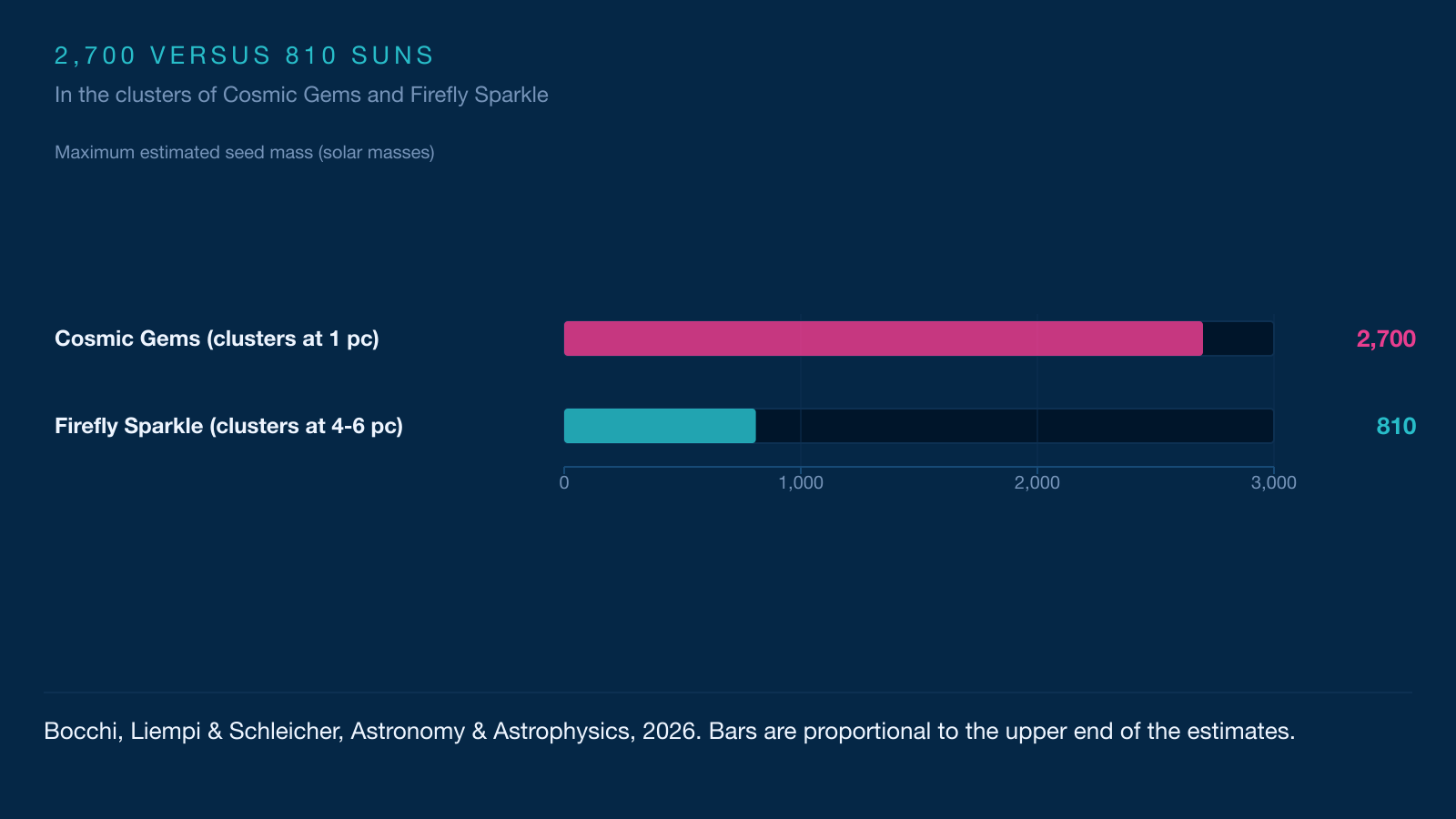
The gap between the two galaxies comes down to two differences. The Cosmic Gems clusters are more compact, so their core is denser, collisions more frequent and the reservoir of matter larger. Their lower metallicity also limits losses through winds. The Firefly Sparkle clusters, by contrast, are more spread out, with a less massive core, and their winds work better. The model therefore predicts lighter seeds, near the bottom edge of the intermediate category.
A heavy seed is a shortcut to the giants
Why does that difference matter? Because supermassive black holes in the young Universe create a problem of time. Webb has found them at epochs when the Universe was only a few hundred million years old. A black hole that swallows gas cannot grow without limit. The pressure of the light it gives off eventually pushes back the matter falling in, a ceiling called the Eddington limit. At that pace, going from a seed of a few tens of solar masses to a giant of a billion solar masses takes longer than the young Universe can offer.
A heavier seed shortens the road. Starting from 2,700 solar masses instead of 100 does not change how long one mass doubling takes, but it removes several doublings from the race. The authors calculate that seeds formed at a redshift of 10 reach 10 to 100 million solar masses at a redshift of 6 more easily. They also suggest that these clusters could supply the seeds of the "Little Red Dots", the compact and very red objects Webb has found, whose light is often attributed to a growing supermassive black hole.
The study opens one more door. If intermediate-mass black holes exist and merge, future gravitational-wave detectors, such as LISA in space or the Einstein Telescope on the ground, could pick up their signal. A merger of that size would leave ripples in space-time with a signature the instruments could measure. A prediction that can be tested.
Going further
- The telescope behind these observations: James Webb (JWST), with its full mission page.
- The key ideas for the whole story: black holes, supermassive black holes and star formation.
- You can also observe the sky from home: our interactive sky map, our observing guide and the astrophotography gallery.
- The study: Bocchi, Liempi & Schleicher, Astronomy & Astrophysics, 2026, also open access on arXiv.