The James Webb Space Telescope has found supermassive black holes in a young Universe that had no time to build them. A team at the University of California, Los Angeles, proposes a two-step answer. In the dense star clusters of the early cosmos, collisions chain together and build giant stars, which collapse into seeds of black holes. Around those seeds, the same collisions supply the gas that may explain the puzzling "Little Red Dots". The study appeared in The Astrophysical Journal on October 26, 2026.
A thousand stars within a 3.26 light-year radius
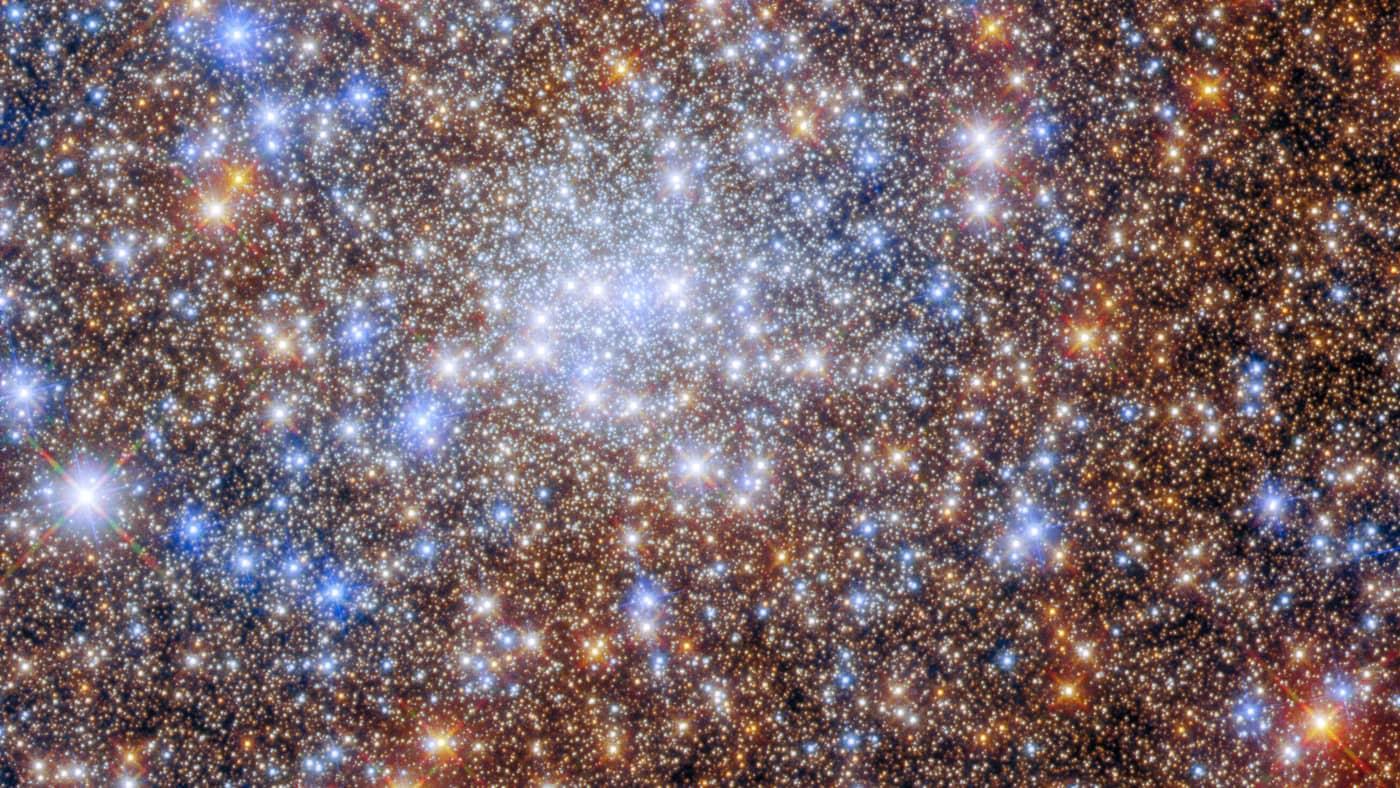
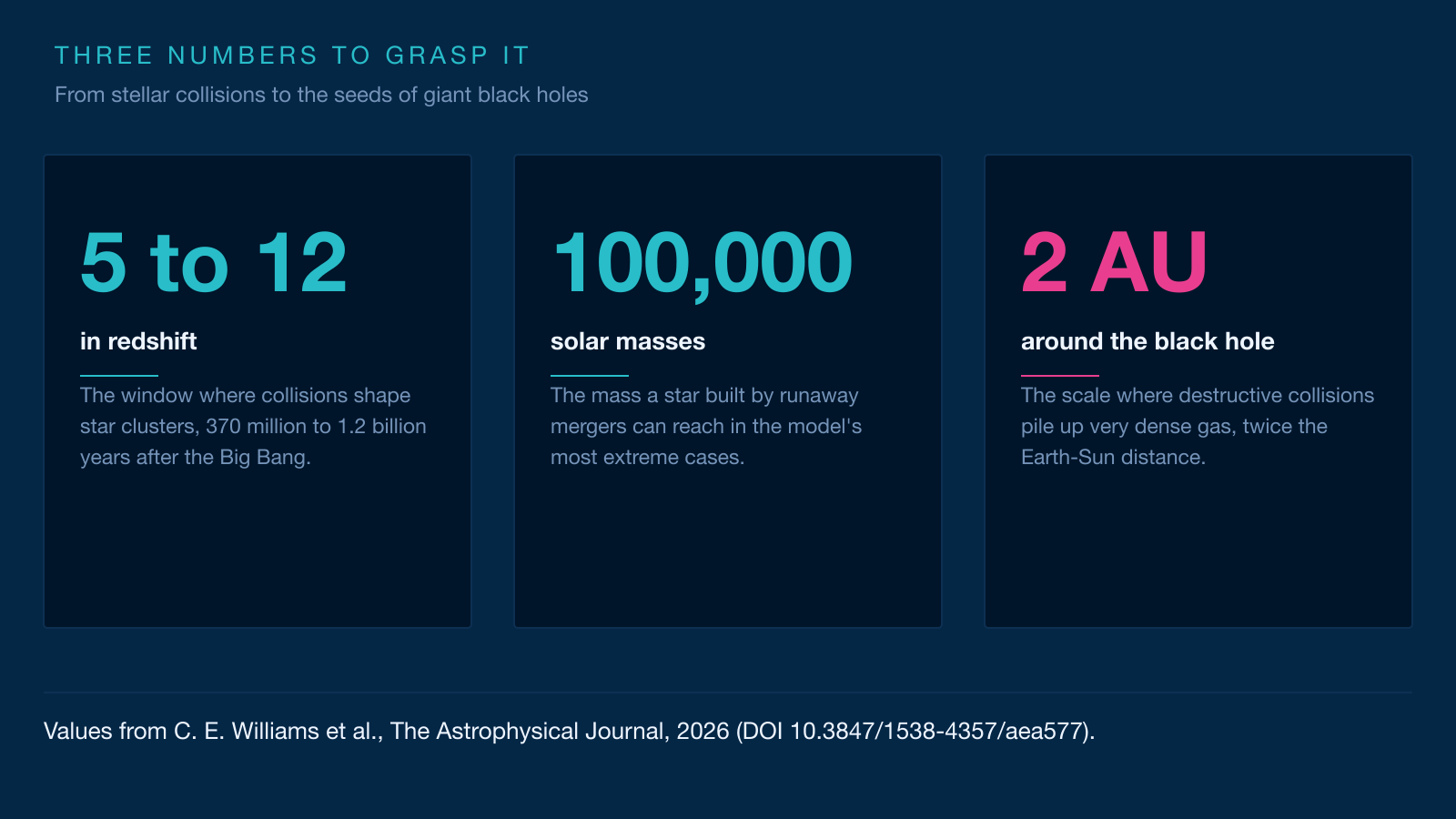
The young Universe was not empty space dotted with neatly arranged galaxies. Webb's observations and cosmological simulations show star formation happening in tight groups, inside compact and dense clusters, some of them glimpsed through the magnifying effect of a closer galaxy. A few reach surface densities of 100,000 solar masses per square parsec. To picture that, put a thousand stars inside a sphere one parsec in radius, which is 3.26 light-years. The same volume around the Sun holds no star at all. Proxima Centauri, our nearest neighbour, sits 4.24 light-years away.
In that kind of crowd, encounters are anything but rare. Stars pass close, pull on each other, brush past, and now and then hit head-on. Claire Williams, a doctoral student at UCLA, and ten co-authors wanted to know what those collisions produce, and how far they change the life of a cluster.
Their method works in two stages. An analytic model describes, layer by layer, what happens inside the cluster. The starting conditions come from high-resolution cosmological simulations that pin down which clusters really exist at those epochs, identified by their redshift, the stretching of their light by the expansion of the Universe. The authors explored hundreds of combinations: cluster masses from 10,000 to 1 billion solar masses, radii from 0.2 to 100 parsecs, internal velocities from 2 to 200 kilometres per second, with or without a central black hole.
Then comes the check. The researchers compare the analytic model with so-called Monte Carlo simulations, named after the casino because the whole method runs on chance draws. The idea is easy to tell: replay the scene a large number of times, picking orbits and possible encounters at random each time, then look at what happens most often. Each test case holds 1,000 stars, all within one parsec of the centre. The model and the simulations agree on the essentials, and that gives the framework some credibility.
No black hole? Then collisions build bigger and bigger stars
First case: the cluster has no black hole yet. A collision between two stars there looks like a merger. The two bodies crush into each other, matter mixes, and out comes a more massive star. That product is heavier than its neighbours. In the crowd of the cluster it slows down and sinks towards the centre, an effect astronomers call dynamical friction. The same thing that slows a heavy marble dropped into a bowl of light ones.
At the centre, density climbs, and collisions speed up. Each merger makes a bigger star, which swallows its neighbours in turn. A chain reaction. The model shows it can end in a very massive star, an object of several hundred, even several thousand solar masses. In the most extreme cases the final mass passes 100,000 solar masses, the equivalent of 100,000 Suns gathered into a single body.
The authors treat that number with care. The outcome depends heavily on cluster density and on how the masses of the stars are spread. With a population of stars heavier than the one in our neighbourhood, only 22 systems out of the whole tested set build a very massive star, and the heaviest reaches 512 solar masses. The general trend holds: the denser the cluster, the more massive the final star.
Then comes the end of life. A body that size cannot hold against its own gravity. When its core gives way, it leaves no neutron star behind, but a black hole. The model assumes that the whole mass of the giant star goes into the black hole, which yields seeds of 200 solar masses and beyond, up to 100,000 solar masses in the extreme cases. That is how the compact clusters of the young Universe could produce the first supermassive black holes, without waiting billions of years of meals.
Speed is the whole point. A black hole that feeds on gas grows at best at a capped rate, set by the pressure of the light it gives off, which pushes back on the matter falling in. Astronomers call it the Eddington limit. Held at that ceiling, a seed takes billions of years to become a giant. The young Universe did not have billions of years.
Once a black hole is there, collisions shred stars into gas
Second case: a black hole is already in place, with a mass between 10,000 and 10 million solar masses. It dominates the gravity at the cluster's centre. Stars whip around it far faster, and a collision stops looking like a merger. At high speed, the two stars shatter instead of joining. The model speaks of destructive collisions: matter is ground into gas and released in the immediate neighbourhood of the black hole.
That gas does not disappear. The calculations show it piling up within 0.00001 parsec of the black hole, about two astronomical units, twice the Earth-Sun distance. Density there is extreme. Part of the gas can fall in and feed the black hole, another part can be blown out by winds and by the radiation of the cluster. The model does not follow those exchanges yet, but it predicts that the gas is there, very dense, very close to the centre.
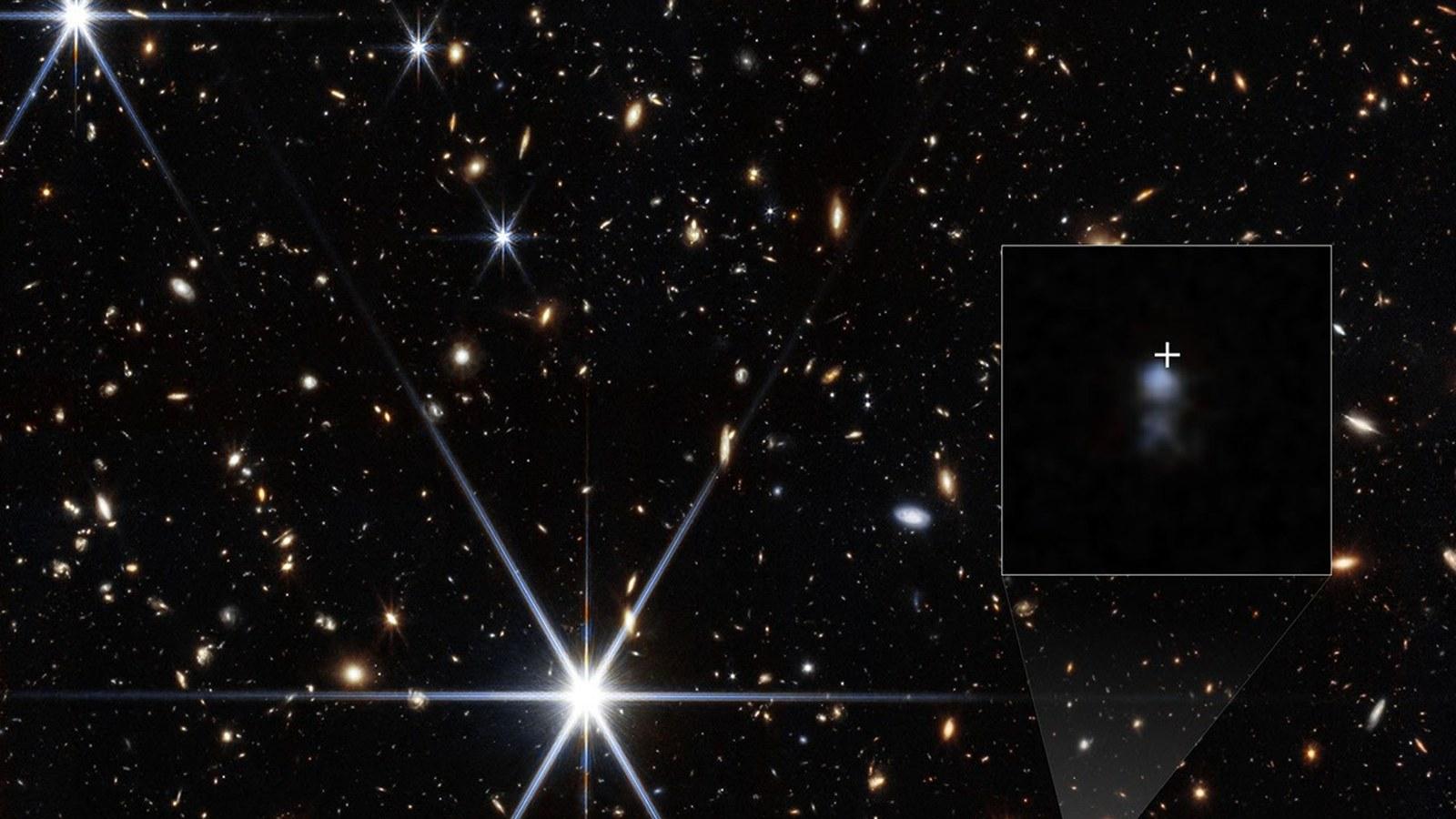
The setting is exactly what astronomers have been looking for to explain the "Little Red Dots". These compact red objects, found in large numbers by Webb, appear about 600 million years after the Big Bang and grow rarer towards 1.5 billion years. Webb's infrared light sees them well, but their nature splits the field: a very dense star cluster, or a black hole swallowing thick gas?
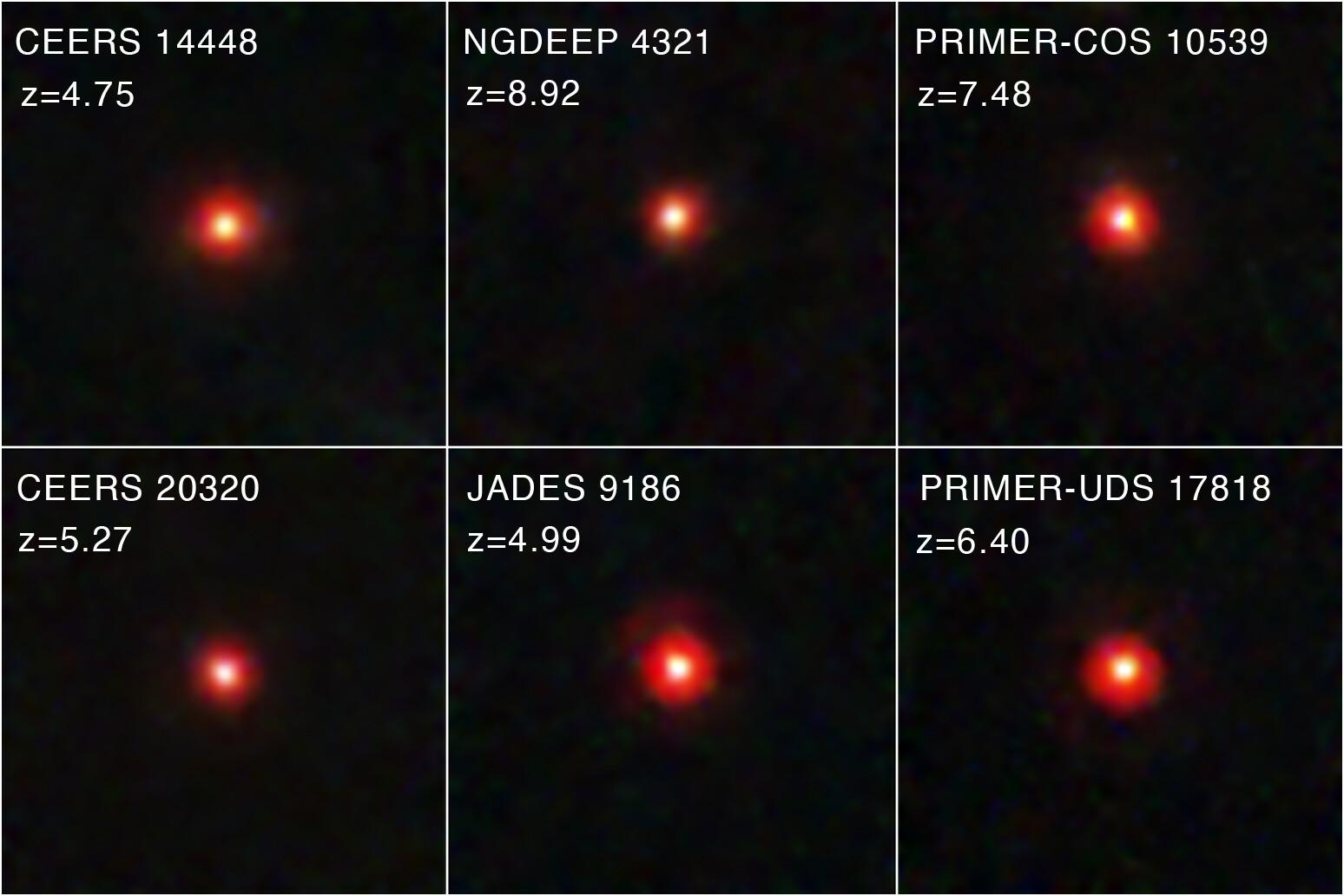
The model adds a piece to the debate. Destructive collisions supply the dense gas around the black hole, which can both feed its growth and absorb part of its radiation. Infrared light crosses that cocoon more easily than X-rays, which would produce objects that look red and stay faint in X-rays. A compact red source with no detectable X-rays, that is the portrait of a Little Red Dot as this hypothesis draws it.
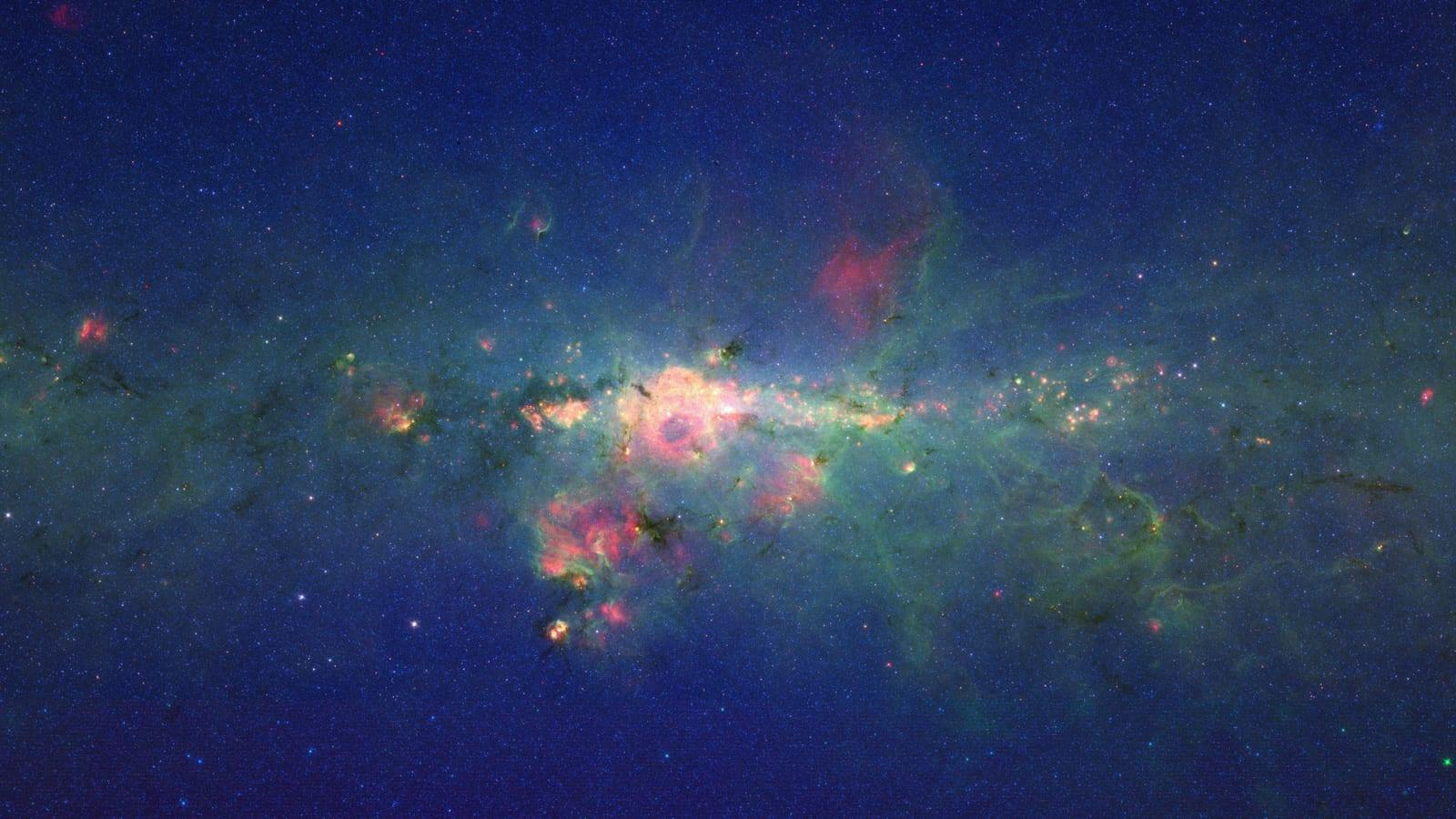
The authors connect it with an object we know well: the centre of the Milky Way. Around Sgr A*, the black hole of 4 million solar masses, a very dense nuclear star cluster is packed tight, the compact knot of stars bound to the heart of a galaxy. If the giant stars of the first case collapse into intermediate-mass black holes, objects of a few hundred to a few tens of thousands of solar masses, the system then looks like what we see at home, a black hole ringed by its swarm of stars. The same mechanism, at different scales and in different eras.
What this explains, and what the model still owes us
The value of this work is not just a recipe for giant black holes. It ties together observations that used to be handled separately: the compact clusters Webb sees at high redshift, the nuclear clusters of nearby galaxies, intermediate-mass black holes and the Little Red Dots. One framework, with or without a central black hole, tries to hold them all at once.
We should be clear about how far the result goes. The model is analytic, checked against Monte Carlo simulations with 1,000 stars per case, not against full simulations that follow the gas, star formation and stellar winds. Collisions are handled in a simplified way, either a merger or a loss of mass. The assumption that all the mass of the giant star ends in the black hole favours the scenario. The authors say so themselves: adding gas could change the accretion rates.
Still, the framework fits several observations. The densities inferred for the Little Red Dots match very massive stars of 10,000 to 100,000 solar masses, which argues for a black hole inside those objects. Destructive collisions also leave a possible signature: gas enriched by the insides of stars, with unusual chemical abundances, which Webb's spectroscopy could go looking for.
So the next round plays out in the data. Full hydrodynamic simulations, which follow the gas together with the stars, would say whether the collisions keep their promises. Finer observations of the Little Red Dots could settle the question between a star cluster and an accreting black hole. In the meantime, an old idea is back with a new argument: the first giants of the Universe may have been born in collisions, not in meals.
Going further
- The study in The Astrophysical Journal: A Cosmological Framework for Stellar Collisions at High Redshift in Proto-globular Clusters, Nuclear Star Clusters, and Little Red Dots, also available as a preprint on arXiv.
- The Webb images of the "Little Red Dots" and their description: ESA/Webb.
- On the site: our article on black holes that may swell with the universe, our sky map and our observing guide.