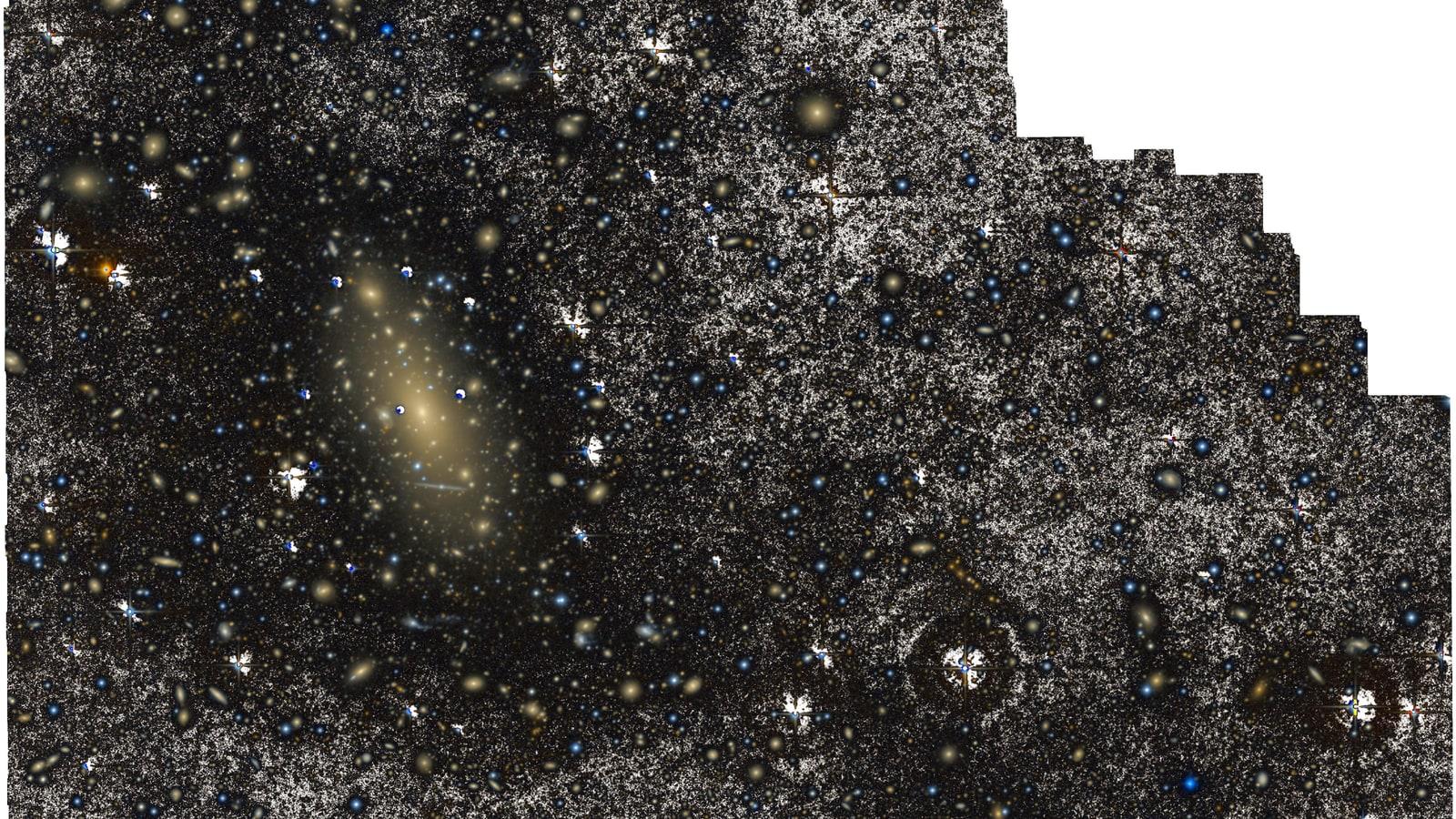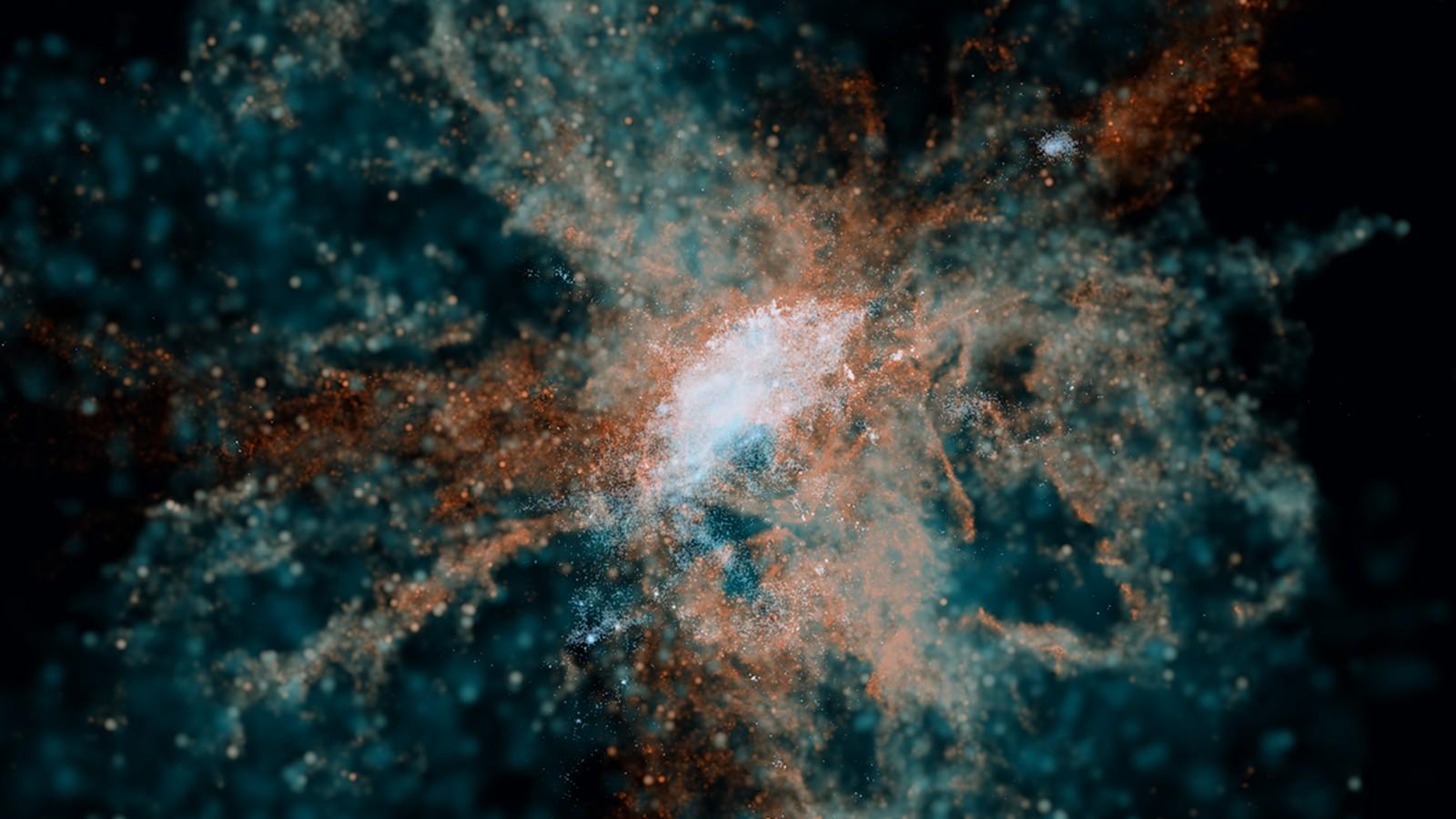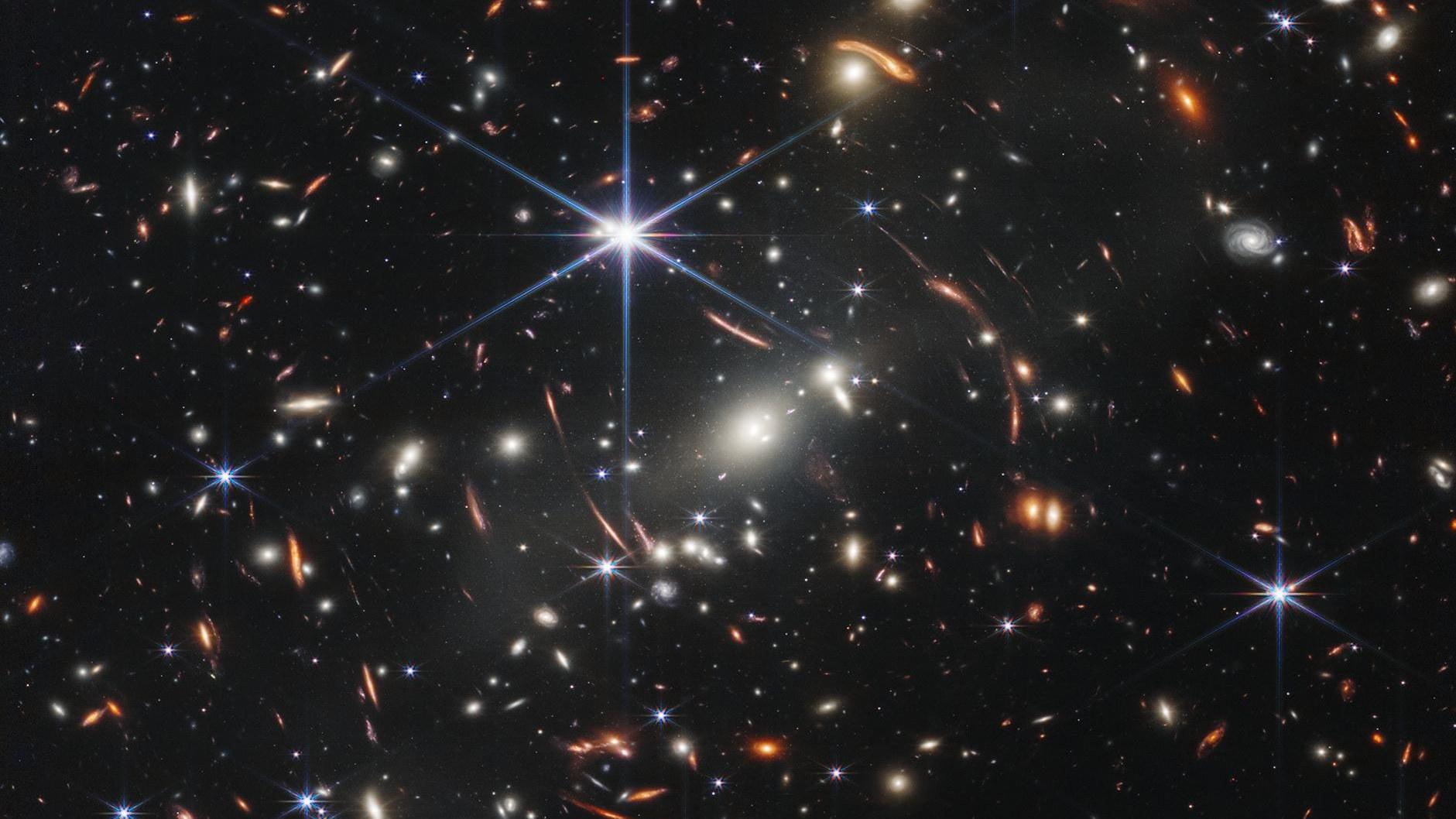
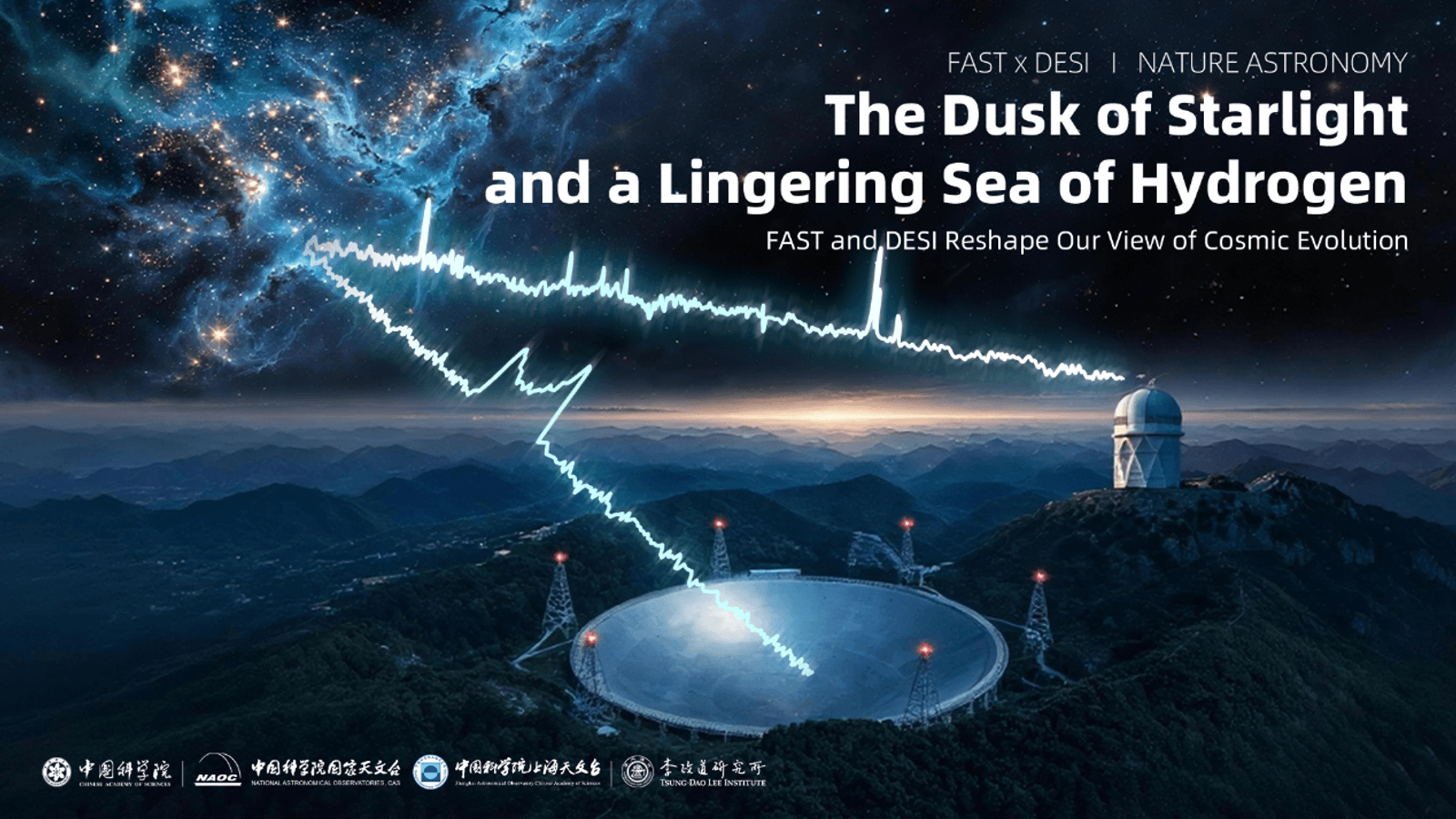
The universe is making fewer and fewer stars, and the obvious culprit would be a fuel shortage: less cold gas, fewer stars. An international team led by the Chinese Academy of Sciences has now tested that idea on an enormous scale, using the FAST radio telescope and the DESI survey. The verdict overturns the simple story. The universe's atomic hydrogen reservoir has stayed almost untouched for 4.5 billion years, while star birth has fallen by more than half. The gas is still there. It simply turns into stars less and less often.
One telescope for the gas, one survey for the galaxies
Everything hinges on two instruments, so they come first. Their pairing is what makes the measurement possible at all.
The first is FAST, the Five-hundred-meter Aperture Spherical radio Telescope, sitting in a natural basin in Guizhou province, China. Its dish is 500 meters across, which makes it the largest single-dish radio telescope on Earth. Its specialty is the 21-centimeter line, a very faint radio emission that every neutral hydrogen atom releases. That line is the only direct way to spot atomic hydrogen, or HI, the cold gas that comes just before stars are born.
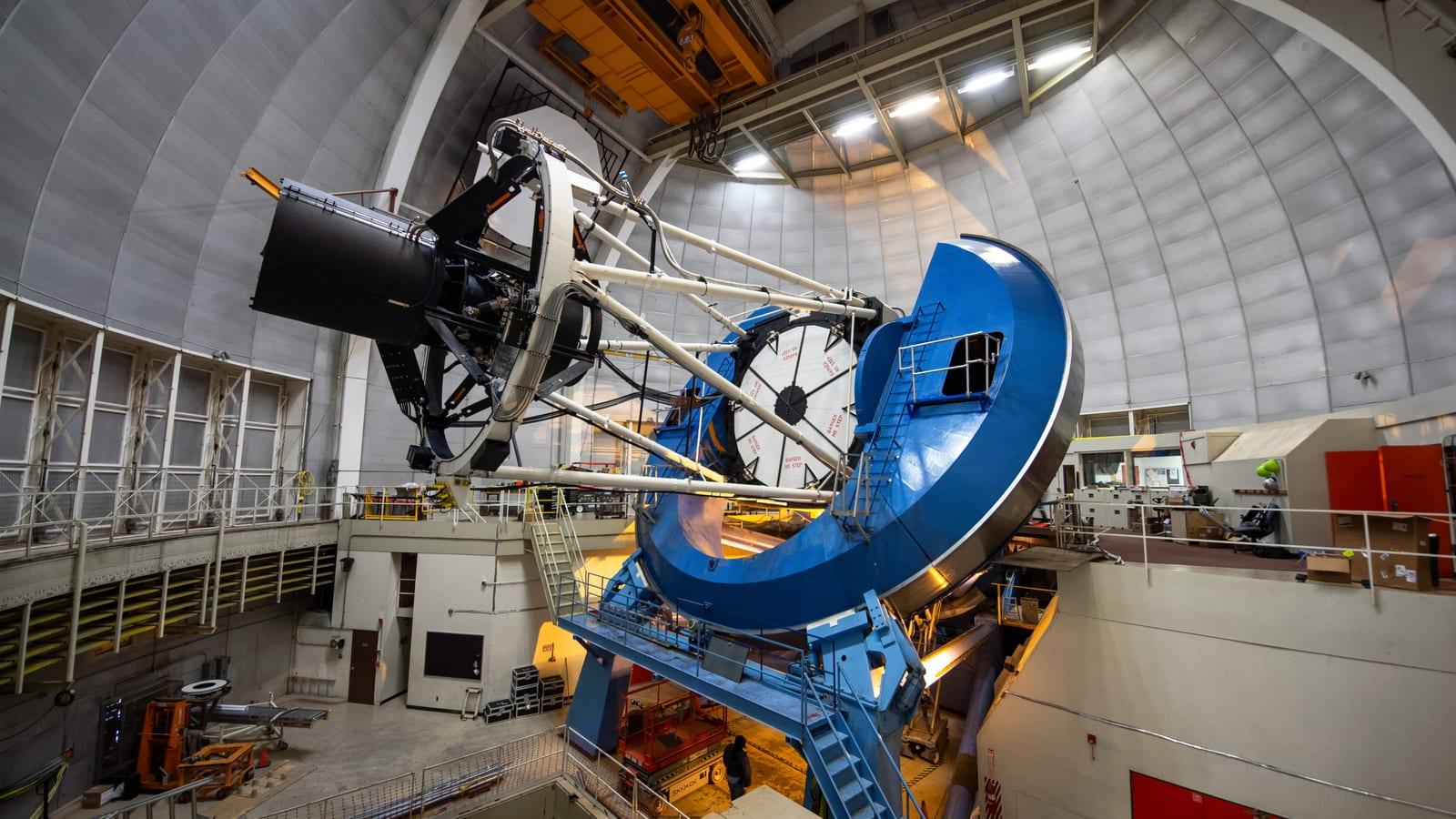
The second is DESI, the Dark Energy Spectroscopic Instrument, mounted on the 4-meter Mayall telescope at Kitt Peak National Observatory in Arizona. It is a distance-measuring machine: its 5,000 optical fibers point at 5,000 galaxies at once, and its spectrograph reads their redshift, the stretching of their light that reveals how far away they are. Each measurement pins a galaxy in space and in time.
2.5 million galaxies listened to at once
A single hydrogen atom in a distant galaxy gives off a signal a hundred billion times too faint to detect. The team's workaround is to stop looking at galaxies one by one and stack them instead. In practice, they align the radio spectrum of hundreds of thousands of galaxies on their redshift, then add them together. The background noise points in every direction and partly cancels out. The hydrogen signal adds up and eventually rises above it. The method has a name: spectral stacking.
The exercise covers exactly 2,473,945 galaxies spread over roughly 12,000 square degrees, close to a third of the sky. The galaxies come from DESI's Bright Galaxy Survey, the part of the survey devoted to nearby, bright galaxies. FAST delivers the hydrogen, DESI delivers the positions. Two data sets that nothing had tied together on this scale before this work.
The gas held on, the stars gave way
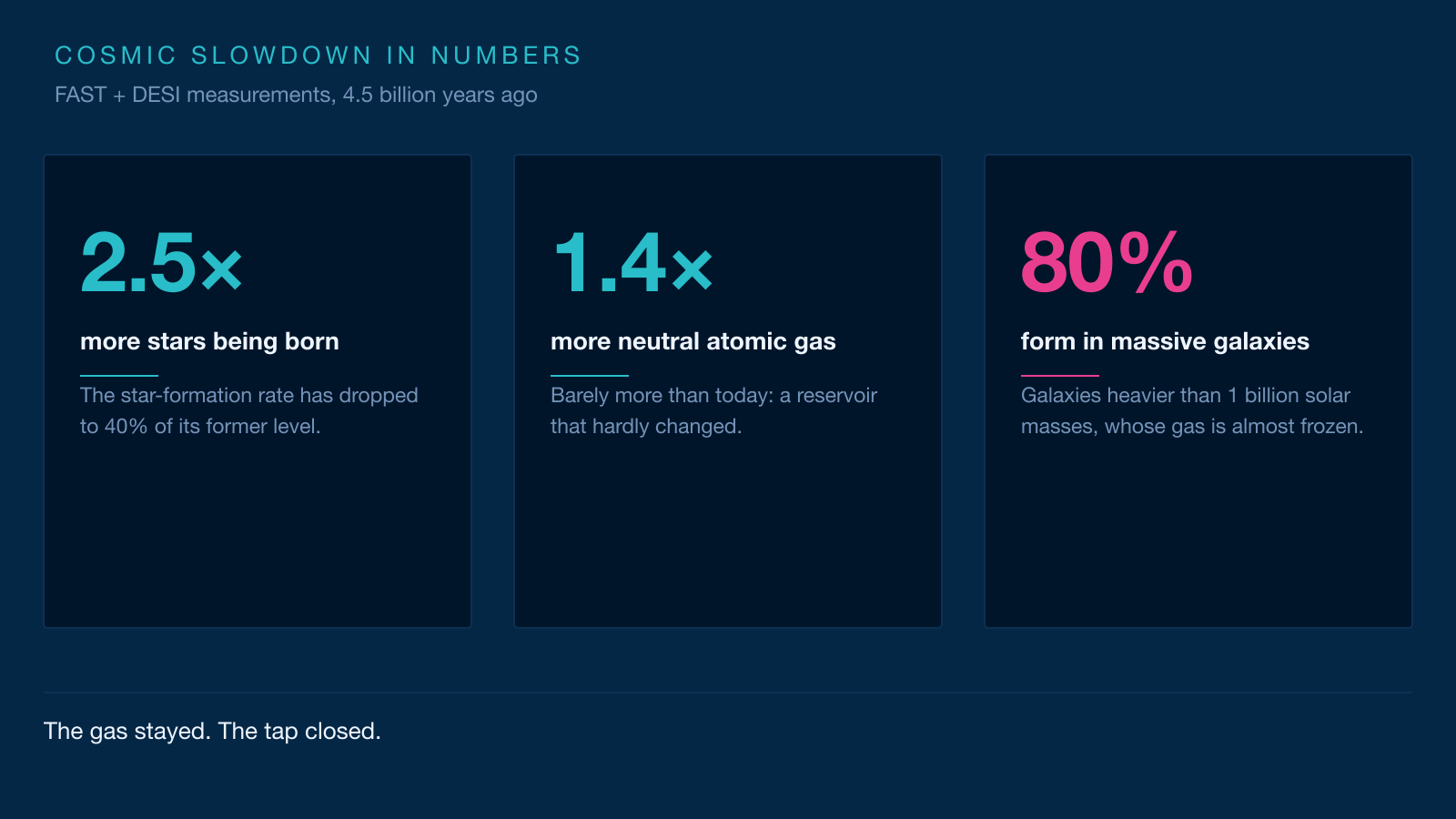
Here is the result, in two numbers. Some 4.5 billion years ago, the universe formed about 2.5 times more stars than it does today. At the same time, its atomic hydrogen density was only 1.4 times higher. In other words: star birth fell by more than half, while the fuel on hand barely moved.
That is no accounting detail. If stars were running out of gas, the two curves should fall together. They do not. The team even goes further and corrects the measurement biases that work against its own conclusion, among them confusion inside the FAST beam, when two galaxies land in the same patch of sky. The raw decline in gas comes out at a factor of 1.35. After corrections, it drops to 1.12, with an uncertainty of 0.10. In plain terms: the total amount of HI in the universe may not have changed at all.
The finding is not just a global average, which could have hidden opposite trends inside it. The team measured the gas fraction separately for each range of galaxy mass. That fraction changes by less than 0.2 dex across the whole range studied, meaning a factor of about 1.6 at most, and the shape of the relation stays put. In plain terms: this is not some galaxies losing their gas while others make up for it. The entire population behaves the same way.
Where does the gas go?
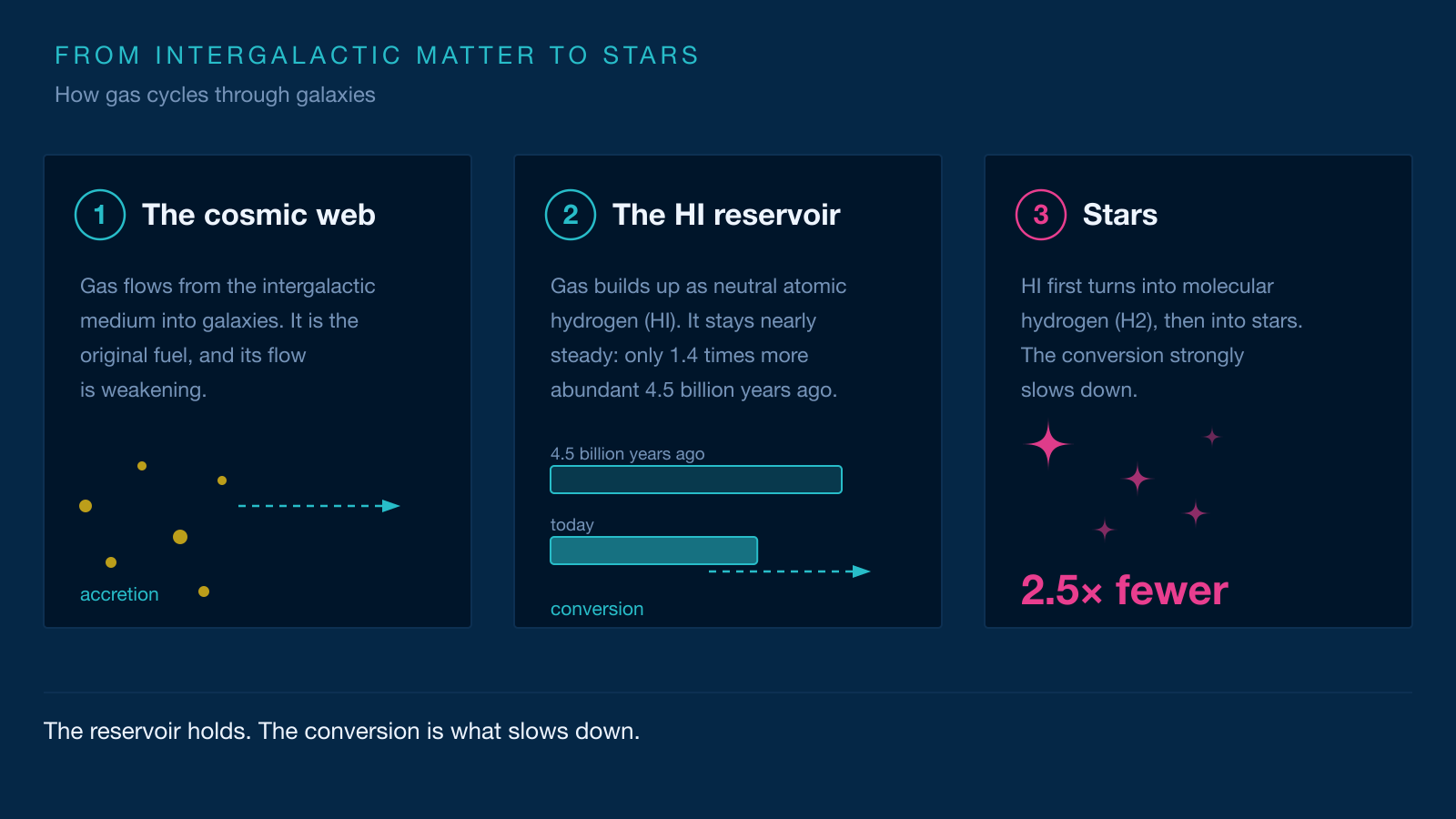
If the fuel remains, why are stars becoming rarer? Because atomic hydrogen is not yet usable as it stands. To be born, a star needs molecular hydrogen, or H2, two hydrogen atoms bound together in cold, dense clouds. HI is the step before, an intermediate reserve between the gas flowing in from outside and the matter that collapses into stars.
The authors' idea is that the reservoir is not draining. The conversion is gumming up. As the universe expands, the gas thins out, the clouds grow less dense, and the shift from HI to H2 loses efficiency. The neutral hydrogen reservoir holds its ground, but the share that manages to become molecular clouds shrinks. Less H2 means fewer stars, with no need for the starting fuel to disappear.
Picture a river whose flow at the source never changes, while the factory downstream runs at half speed. The water keeps coming, the output falls. It is not a drought that stops the line, it is the yield.
What it changes
The study moves the question. For years astronomers asked whether the universe was running out of gas. Now they have to ask why it struggles to make stars despite an abundant gas supply. That shift points research toward the gas cycle inside galaxies, the constant back-and-forth between galaxy interiors and the intergalactic medium, where gas is pulled in, transformed, pushed out and recaptured.
The result also pins down the models. It sets a tight constraint: any solid theory of galaxy formation must reproduce a universe whose neutral hydrogen reservoir stays almost frozen while its star production collapses. Two reference simulations handle the shock differently. IllustrisTNG predicts a nearly constant reservoir, which fits the observations, but overstates the gas in the most massive galaxies. SIMBA underestimates the gas in lightweight galaxies and overstates it in heavy ones.
Going further
- The key concepts, plainly explained: star formation, galaxies and spectroscopy.
- Find galaxies in your own sky with our interactive sky map and its observing guide.
- Official sources: the Chinese Academy of Sciences release, the scientific paper on arXiv and its Nature Astronomy publication. The EurekAlert release and the ScienceDaily summary round out the file.