Can a black hole "ignore" the expansion of the universe? On August 21, 2026, theorists Valerio Faraoni, at Bishop's University in Canada, and Massimiliano Rinaldi, at the University of Trento in Italy, posted a proof on arXiv that answers with a firm no. Dropped into an expanding cosmos, a black hole inevitably turns comovable: its horizon grows at the exact rate of expansion. A serious lead toward the premature giants Webb keeps finding.
Three trajectories, only one survives physics
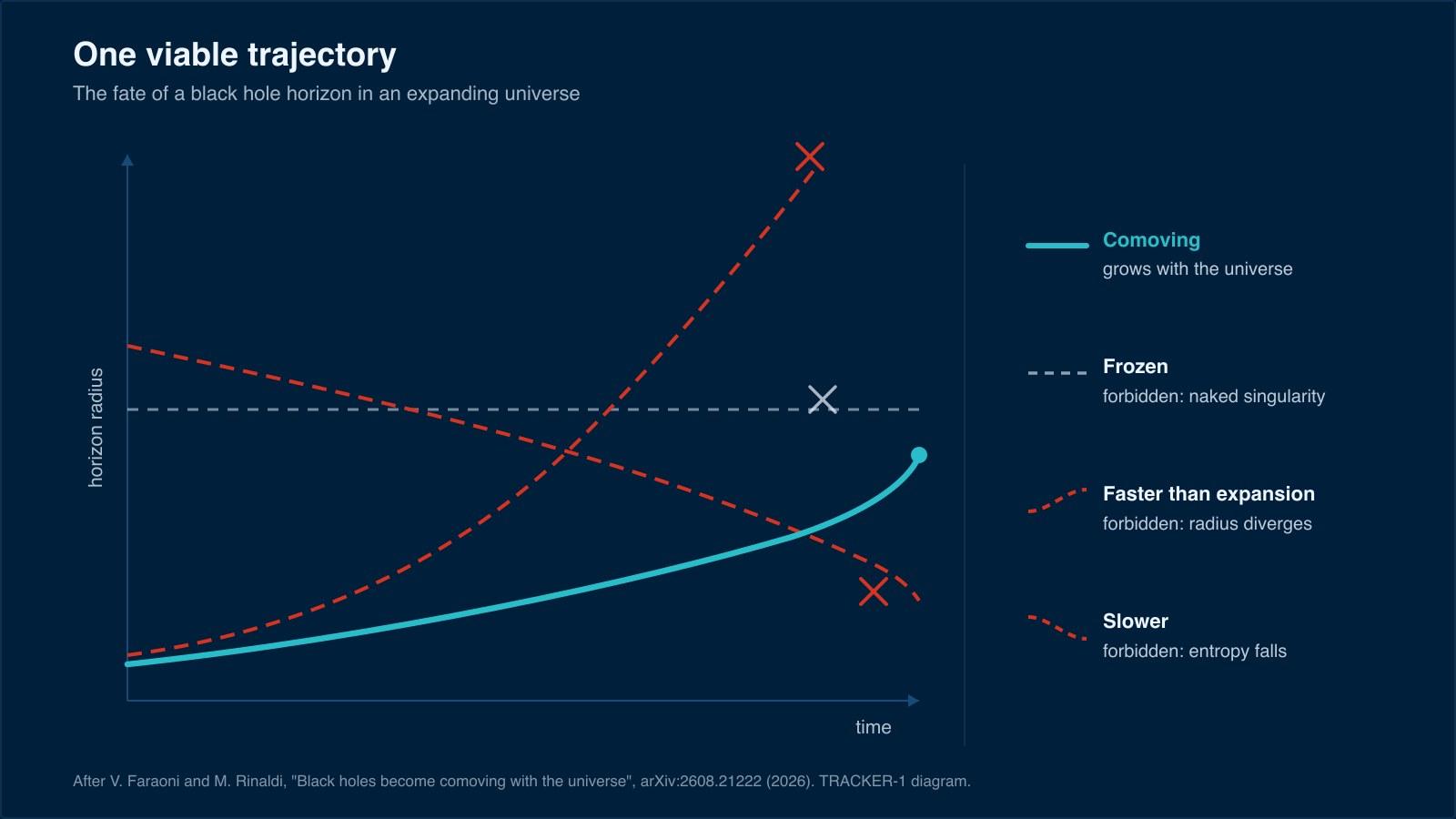
The result fits in one sentence: in an expanding universe, a black hole cannot stay frozen, and it cannot follow any rhythm other than the cosmos itself. The authors list the possible fates of its horizon, the boundary past which not even light escapes, and strike them off one by one.
The detail that makes the proof sturdy: it uses no particular solution of Einstein's equations. Just the geometry of spacetime and reasonable physical assumptions. It therefore depends on neither the exact model of the black hole, nor its environment, nor its history. A result that rests on nothing contingent is hard to dodge.
The illusion of the frozen black hole
Why did this need a proof at all? Because for more than a century theorists have described black holes with the same shortcut: the Schwarzschild solution, an isolated, motionless black hole set in an infinite, eternal void. The math is crisp. The premise is wrong: the universe is neither empty nor static.
In 2024 the same two authors had already tightened the screw. An event horizon, the theoretical boundary defined for all eternity, cannot stay motionless in a changing universe: general relativity turns it into a naked singularity, a point of infinite density exposed for all to see, something the theory forbids on principle. To describe a black hole that evolves, physicists turn to the apparent horizon instead: the same boundary, but measured here and now, the tool behind the black hole mergers LIGO has been catching since 2015.
Faraoni and Rinaldi then asked the question that was missing: does that radius track expansion faster, slower, or at the same pace? Their math leaves no room: any path other than exact coupling leads to a paradox. A comovable horizon behaves like a raft set loose mid-river: after a few lurches it rides the current, neither faster nor slower.
The puzzle of premature giants
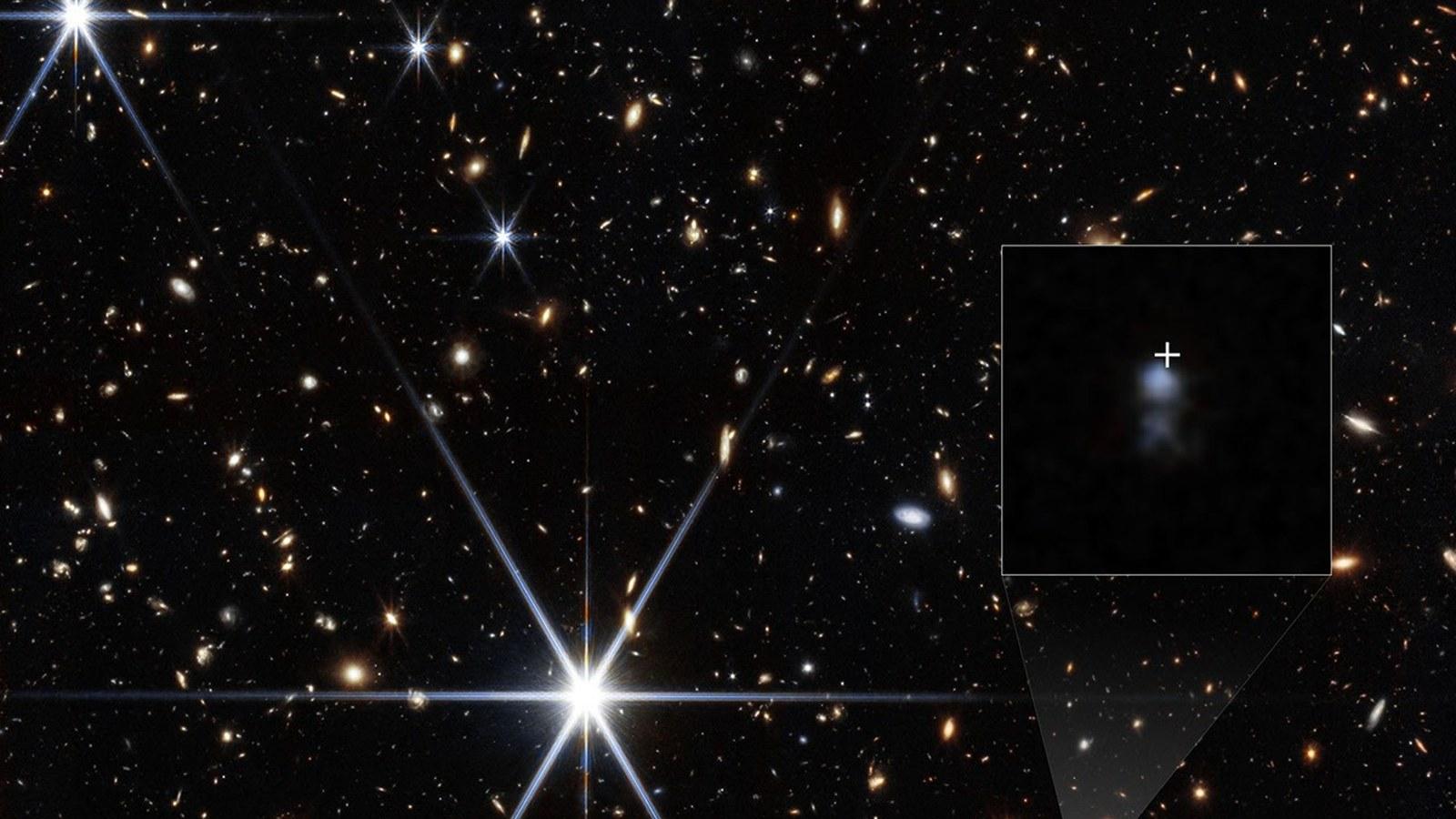
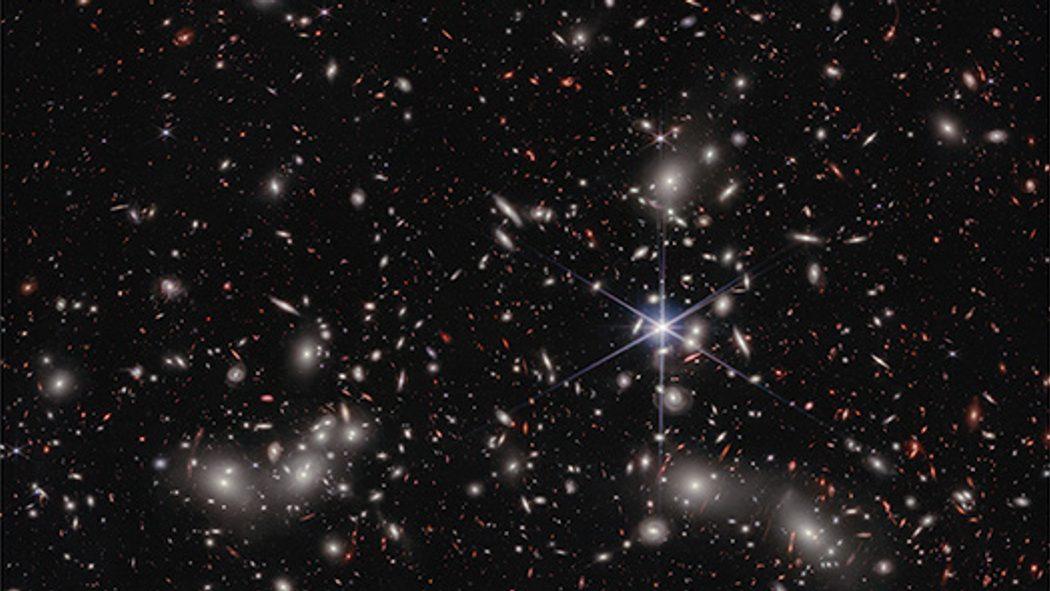
Why does this result land at just the right moment? Because since 2022 the James Webb Space Telescope has been daring theorists: it spots supermassive black holes, millions to billions of solar masses, within the universe's first few hundred million years. The sharpest case is named UHZ1: 13.2 billion light-years away, Chandra and Webb saw a black hole of 10 to 100 million solar masses there, a mere 470 million years after the Big Bang. Its mass rivals that of every star in its galaxy combined.
The problem comes down to food. A black hole swallowing gas heats that gas and makes it shine, and its own glow pushes the next supply away. Past a certain intake rate, light wins and shuts the tap: that is the Eddington limit, the maximum feeding rate of a gas-powered black hole. At that ceiling, building a giant takes billions of years. The young universe had none to spare.
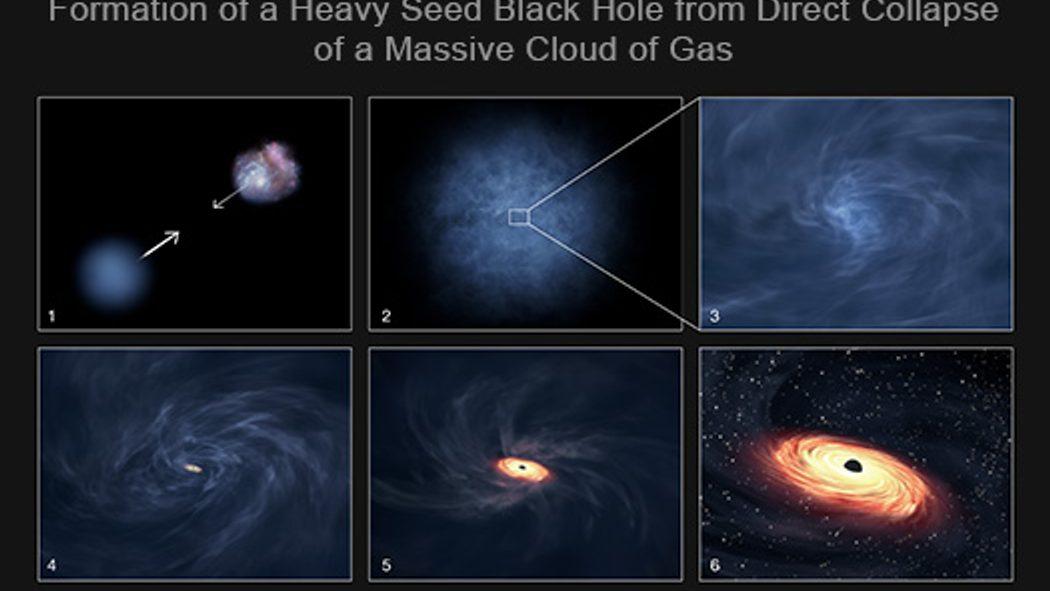
The standard routes keep astrophysics busy: heavy seeds born from the direct collapse of colossal gas clouds, or phases of feeding beyond the Eddington limit. Faraoni and Rinaldi add a different option, an engine that owes nothing to the environment: if a black hole's mass tracks the scale factor, then dropping it into a blazing expansion phase sends it soaring. That is exactly the case of inflation, the near-exponential growth of the universe's first instants. The authors see a possible mechanism there for building primordial black holes, formed before the first stars, far larger than expected.
The idea of a coupling between black holes and expansion is not new. In 2023 a team compared the masses of supermassive black holes in red elliptical galaxies, which have formed no stars for billions of years, across cosmic time: the masses seemed to track the scale factor. That signal remains debated, with several teams failing to recover it. It might also explain the 150-solar-mass black holes LIGO saw merge, inside a mass range where stellar evolution makes none. And it echoes DESI's measurements, the instrument mapping the relics of the early universe, which point to evolving dark energy.
What the hypothesis does not say yet
The authors set their own limits. Their proof treats a spherical, non-rotating black hole, while real black holes spin, sometimes fast: the extension to rotating objects is expected, but still to come. The apparent horizon, their yardstick, depends on the observer's viewpoint: that is the price of evolving boundaries, and sensible slices of spacetime agree here.
Above all, they do not claim to have solved the puzzle. The proof establishes a matter of principle, the coupling. It says nothing about the precise timescales, which will depend on each scenario, nor about the exact share this mechanism would take in the growth of the early giants. Observations will deliver the verdict: black hole populations across cosmic epochs, measured by Webb and its successors, will settle the question.
Going further
- The key notions: black holes, supermassive black holes and galaxies in our glossary.
- The universe's expansion also shows up in exploding stars: our story on the Unite catalog and evolving dark energy, and the telescope hunting those primitive giants: James Webb.
- Feel like looking up tonight? Track galaxies with our interactive sky map, then plan your nights with our observing guide.
- The sources for this article: the preprint on arXiv by Faraoni and Rinaldi (August 21, 2026) and the Chandra photo page for UHZ1 for the observations that feed the puzzle.