A single interaction, and 250 physicists are on alert. On September 1, 2026, the LUX-ZEPLIN (LZ) collaboration presented an event recorded in its 10 tonnes of liquid xenon that known physics cannot explain. The detector operates 1.5 km beneath a former gold mine in South Dakota, where it hunts dark matter.
A collision with no explanation
Start with the strongest fact. Over 220 live days of data collected between March 2023 and April 2024, LZ spotted one interaction. A single one. And it lands exactly where scientists expect dark matter to show up, where background noise sits lowest.
Months of additional analysis came up empty: no residual radioactivity, no stray neutron, no detector flaw. None of the known processes fit. Hence the measured excitement of Rick Gaitskell, spokesperson for the collaboration and professor at Brown University: "We are not claiming to have seen dark matter. But we have seen something interesting that we want to share with the scientific community for their input."
Aaron Manalaysay, a physicist at Berkeley Lab and chair of LZ's Institutional Board, put the surprise in perspective. Over an entire career of experiments, he had never seen an outlier event hold up from every angle.
So where do we really stand? Particle physics requires 5 sigma to announce a discovery. Sigma is the yardstick for statistical evidence, and 5 sigma means about a 1-in-3.5-million chance that the signal is a fluke. LZ stands at 2.6 sigma. In plain words: there is still about a 1-in-200 chance that the event comes from ordinary noise. Intriguing, not proven.
Dark matter, the invisible mass shaping the universe
Let's back up. Everything we can see, stars, planets, gas, you and me, accounts for about 15% of the matter in the universe. The remaining 85% does not shine, does not absorb light, does not reflect it: that is dark matter. No one has ever seen it, but its effects have been measured for decades. Galaxies spin too fast for their visible mass, and the light of distant galaxies bends as it passes near unseen mass. Something massive is out there, and it never shows itself.
If all the matter in the universe weighed 100 kg, 85 kg would be dark matter. The question "what is the universe made of?" remains wide open.
The candidate LZ is hunting is called a WIMP, short for weakly interacting massive particle. The name sums up the problem: a WIMP would stream through the Earth, our walls and our bodies like a bullet through fog, leaving no trace in almost every case. Only a head-on collision with an atom, an extraordinarily rare event, would let a detector feel it passing.
That is exactly the territory of this new analysis. LZ's dataset had already been scanned for the simplest kinds of collisions, the ones that carry the least energy. This time the team explored a region never examined in this dataset: more energetic interactions that LZ is particularly good at catching while rejecting false positives. "We expect dark matter events to be extremely rare, so only a handful could mark the first detection of WIMP dark matter," says Sam Eriksen of the University of Bristol, lead author of the study.
And if the mystery event does come from a WIMP, it would be no ordinary candidate: the particle would weigh at least 200 times the mass of a proton, the building block of every atomic nucleus. It would also interact with matter in a richer way than the simplest model predicts. Enough to get theorists off their chairs.
How to catch a particle that goes through everything
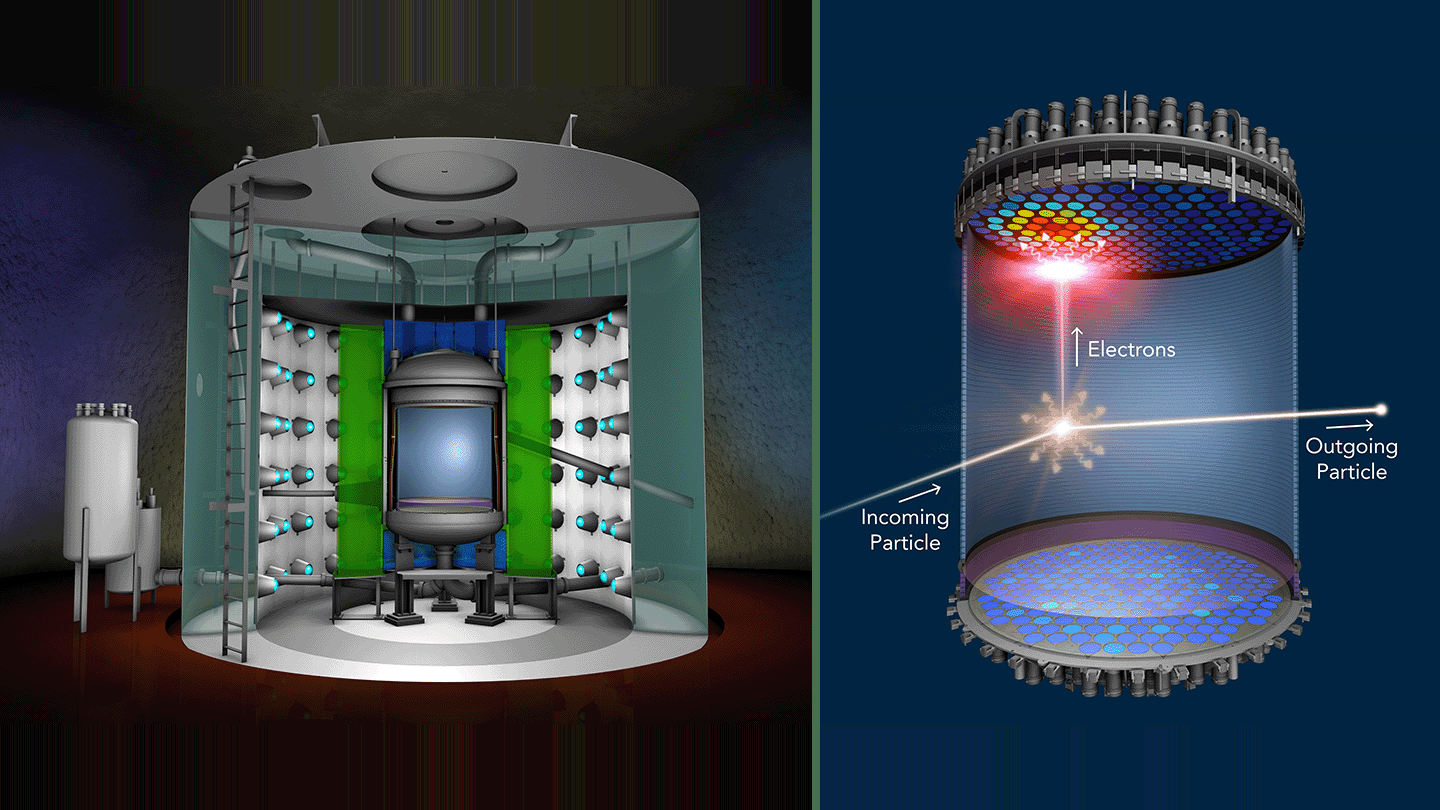
Picture LZ as one giant trap for flashes of light, buried under 1.5 km of rock. Its heart is 10 tonnes of liquid xenon, an inert gas best known for lighting premium headlights, here compressed and chilled to around -100 °C, just shy of freezing solid.
The principle is almost childishly simple. When a particle hits a xenon atom, the atom recoils the way a pool ball absorbs a strike, and emits a flash of light. An electric field, an invisible pull on charged particles, then drives the knocked-off electrons toward the top of the tank, where they produce a second flash. Two flashes, two signals, and the experiment can characterize the intruder.
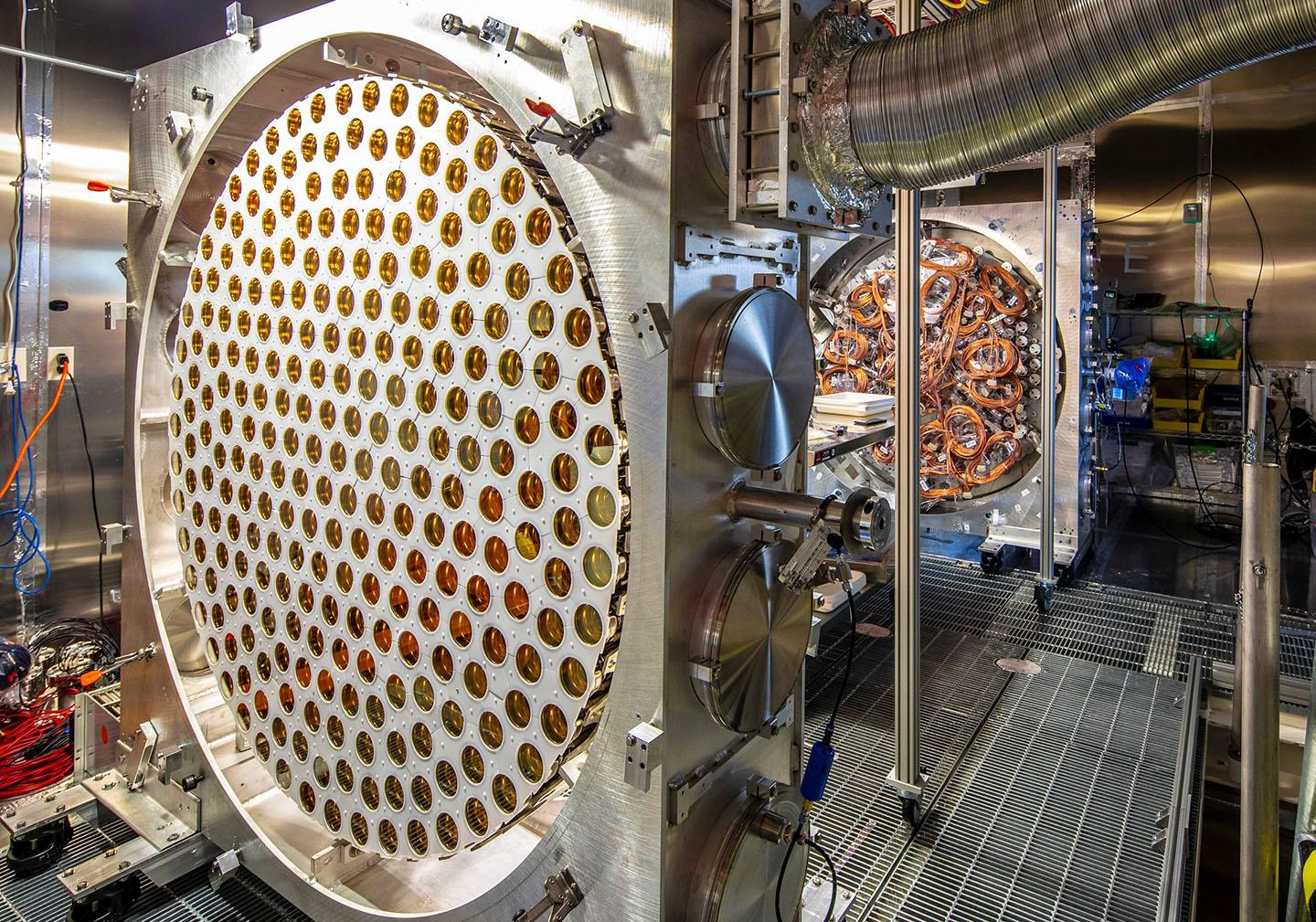
To catch those flashes, LZ relies on photomultiplier tubes, sensors so sensitive they turn a handful of photons, the tiny grains of light, into a usable electrical signal.
The real challenge is not seeing a flash, it is seeing only the right ones. A single cosmic ray can imitate a WIMP. The answer comes in three layers:
- 1.5 km of rock: LZ operates at the bottom of the former Homestake gold mine in Lead, South Dakota, now the Sanford Underground Research Facility (SURF). The mountain filters out cosmic bombardment, the constant rain of particles from space.
- A water tank and outer detectors that flag stray neutrons before they reach the xenon.
- Computing tools that disentangle every interaction and reject dark-matter lookalikes.
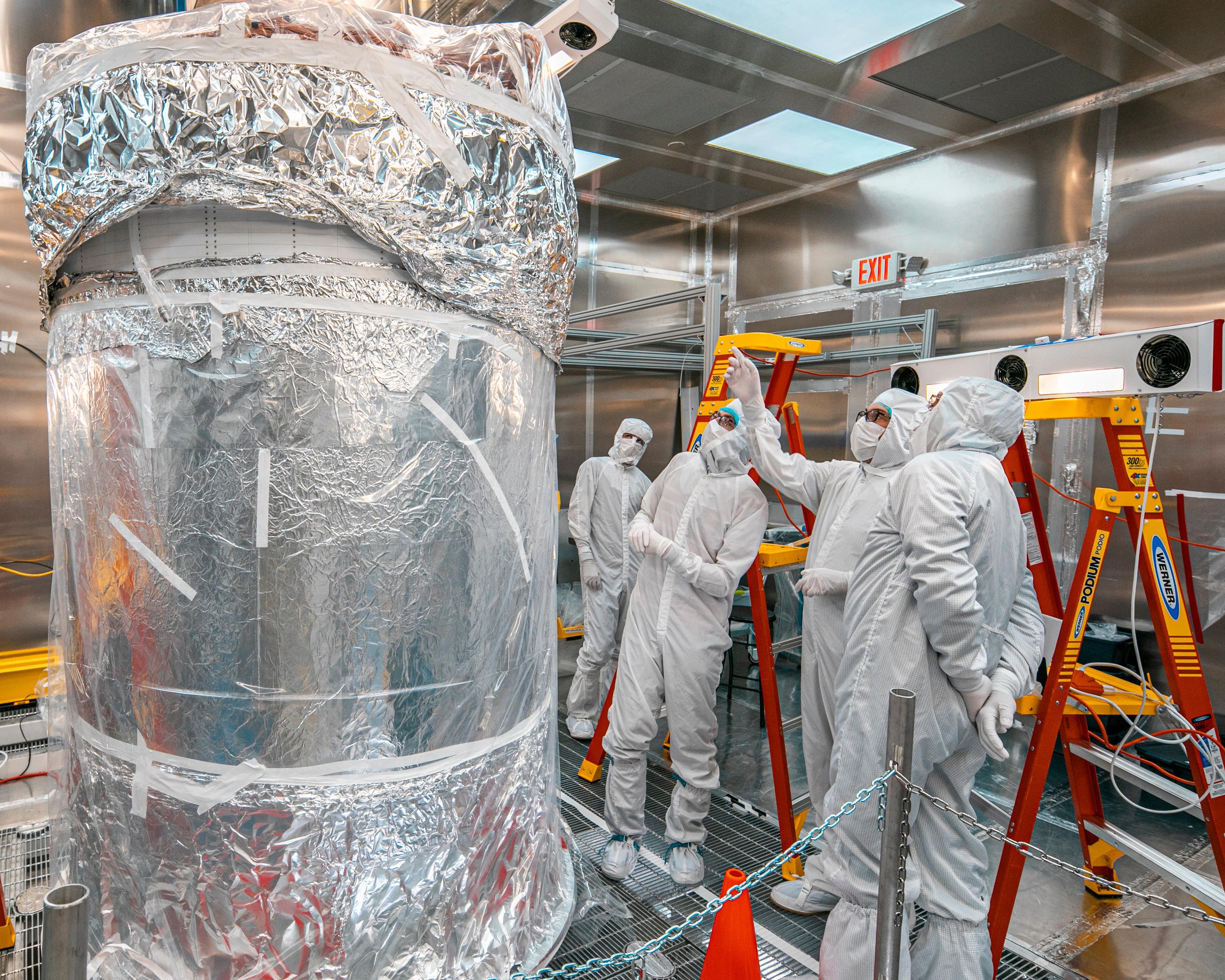
That careful screening is what gives the discovered event its full weight: it passed every net, in the cleanest corner of the experiment.
2.6 sigma: why scientists are not celebrating yet
Let's say it again, because the number will probably be oversold elsewhere: nobody has detected dark matter. 2.6 sigma is the level of "intriguing result, worth watching", not a discovery. The field's history is full of excesses that dissolved as data grew. The collaboration itself says so with exemplary caution, and prefers to share its result so the whole community can hunt for a rare noise mechanism that months of analysis may have missed.
The follow-up is already underway. LZ keeps accumulating data in its South Dakota mine, already holding the world's largest dark matter dataset. Every new batch will settle it: either the excess grows and significance climbs toward 5 sigma, the discovery threshold, or it fades into the noise and joins the long list of false trails. The scientific paper is being released on arXiv, the researchers' open preprint server, and submitted to Physical Review Letters, after a presentation at the 2026 TeV Particle Astrophysics conference in Japan.
This hunt also happens in space. ESA's Euclid mission is mapping billions of galaxies to reveal dark matter through its gravitational effects, and Roman will take over with its panoramic surveys. The two approaches complement each other: LZ waits for a direct collision, Euclid and Roman map the imprint left in the deep sky.
Going further
- Key concepts to understand it all: dark matter and WIMPs in our glossary.
- Dark matter observed from orbit: the Euclid mission page, gravitational mapping in action.
- Dark matter never shows up in an eyepiece, but tonight's sky can be observed: our interactive sky map and its observing guide.
- The official sources of this article: the Berkeley Lab press release and its SLAC version, plus the LZ collaboration press page.
- The video: Dark Matter Hunt with LUX-ZEPLIN (LZ), SLAC's official animation.