On November 4, 2026, a team at Northwestern University published a method in Nature that finds planets the James Webb Space Telescope had already photographed and nobody could see. The tool is a physical twin of the telescope's optics, adjusted image by image until it reproduces the glare of a star almost exactly. Subtract that glare and 51 Eridani b, a giant planet 97 light-years away, reappears in archive data where the standard analysis found nothing. Here is how better modelling got more out of the same photons.
A planet 100,000 times fainter than its star
A young giant planet is a dim ember beside a furnace. In the near-infrared, even the brightest of them are about 100,000 times fainter than their star. Put both in the same image and the planet vanishes in the glare, the way a candle disappears next to a lighthouse.
Webb carries coronagraphs for this job. A coronagraph is a small mask in the light path that blocks the star's core before it reaches the detector. The mask works, but not completely. What remains is a halo of scattered starlight, plus tiny optical defects that drift as the telescope warms and cools in space.
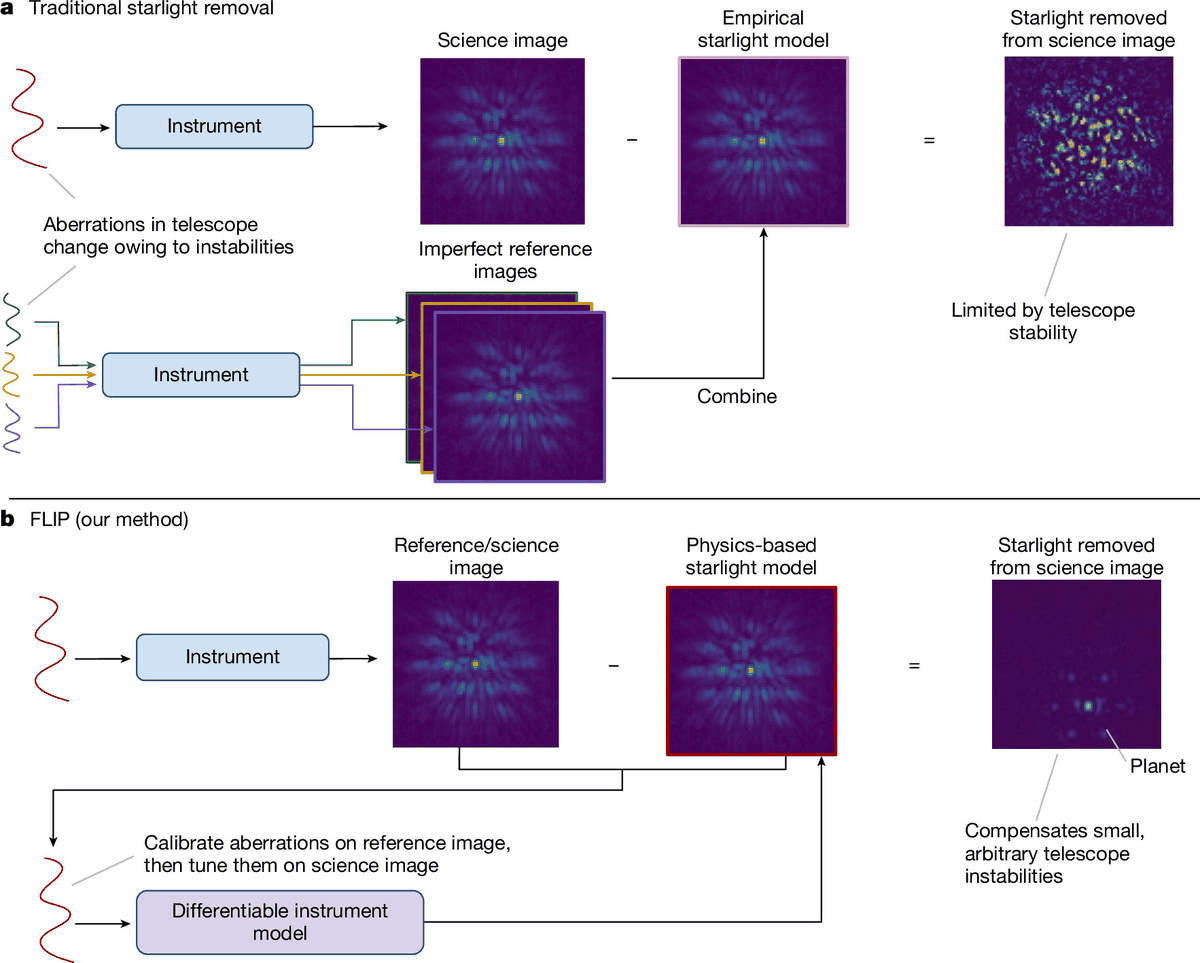
For more than 35 years, astronomers have attacked that halo with a subtraction step. The standard recipe is called KLIP. Take images of the same star from other moments, or images of a similar star, stack them into a model of the glare, then subtract that model from the image you care about. Whatever survives should be the planet.
The model is built from imperfect copies. "For the past 20 years, astronomers have tackled this problem by observing a different star and using its image as a reference," said Jason Wang, an astronomer on the team. "Then, they subtract that reference image from the original observation to remove the unwanted glare to reveal faint planets that otherwise might be hidden."
A reference star is never a perfect twin. Its optics differ, its position on the detector differs, and the telescope has moved on since. Those mismatches leak into the subtraction and set the floor on how faint a planet can be.
A digital twin that learns the telescope's flaws
FLIP takes another road. Instead of describing the glare with pixels borrowed from elsewhere, it simulates the instrument. The model follows the physics of light through the telescope: the masks, the mirrors and the way the wavefront deforms as it travels. Every surface that can carry a defect gets a number the computer may change.
The decisive step is to make that simulation differentiable. Put simply, the software can work out whether raising or lowering each of those numbers brings the simulated image closer to the real one. That is the machinery used to train AI models. The team calls the result a digital twin, a replica faithful enough to stand in for the instrument.
The calibration runs in two stages. Reference images of a bright star fix the baseline, so the model learns the instrument as it behaved then. Then the model is pointed at the science target, and the fit tunes about 1 million free parameters until the simulated starlight matches the real glare. Subtract that result and the planet is what remains.
One safeguard keeps the fit honest. The team injects fake planets into the data and checks that the method recovers them. Without that test, the model could swallow a real planet while chasing a better fit and return a clean image with nothing in it.
The whole fit takes around 35 minutes on an Nvidia A30 graphics card, using an optimiser called Adam that nudges each parameter a small step in the direction that reduces the error.
One planet back from the glare
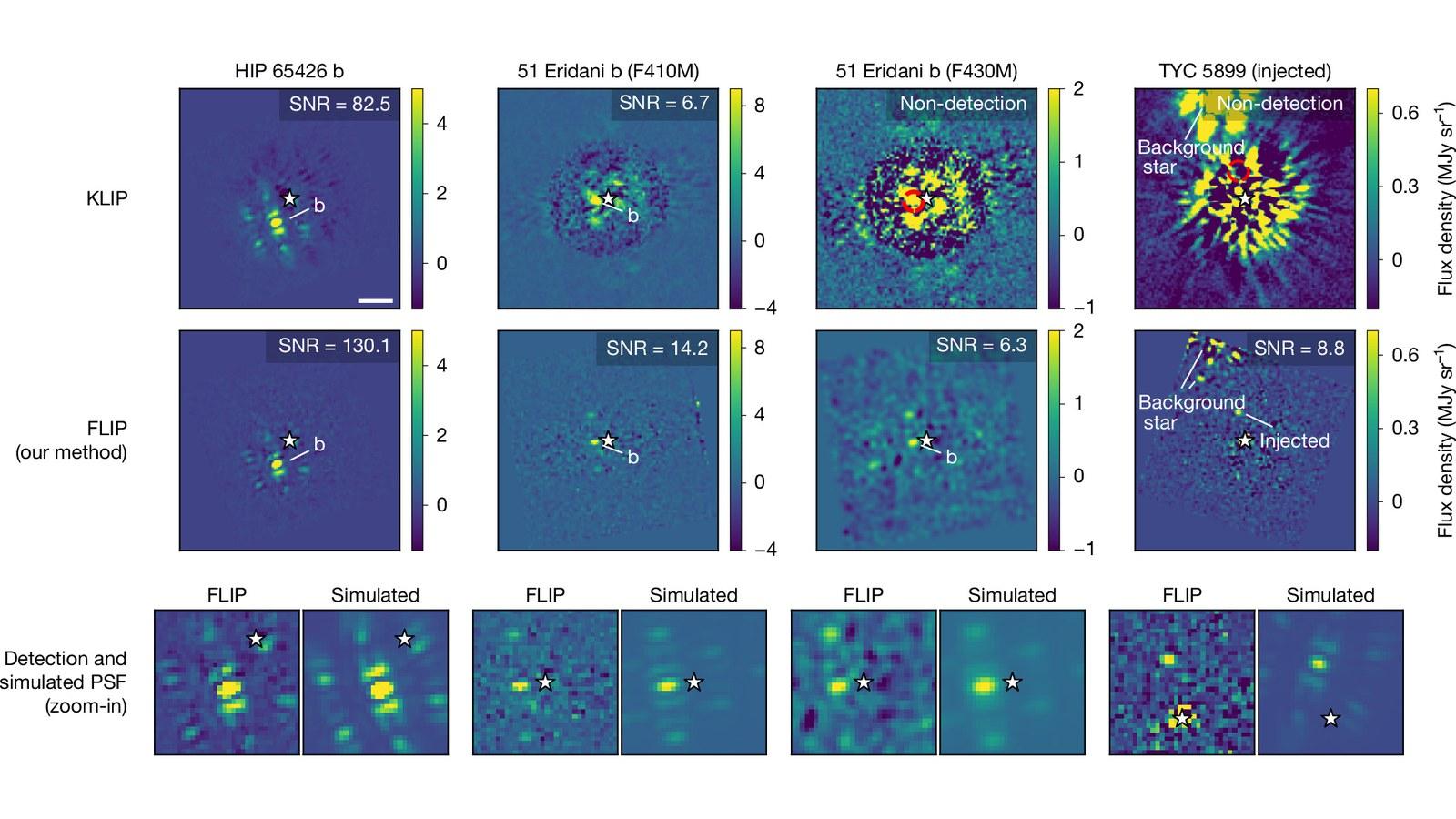
The team tested FLIP on four datasets from Webb's Near-Infrared Camera, covering three stars, and compared it with the standard method on the same pixels.
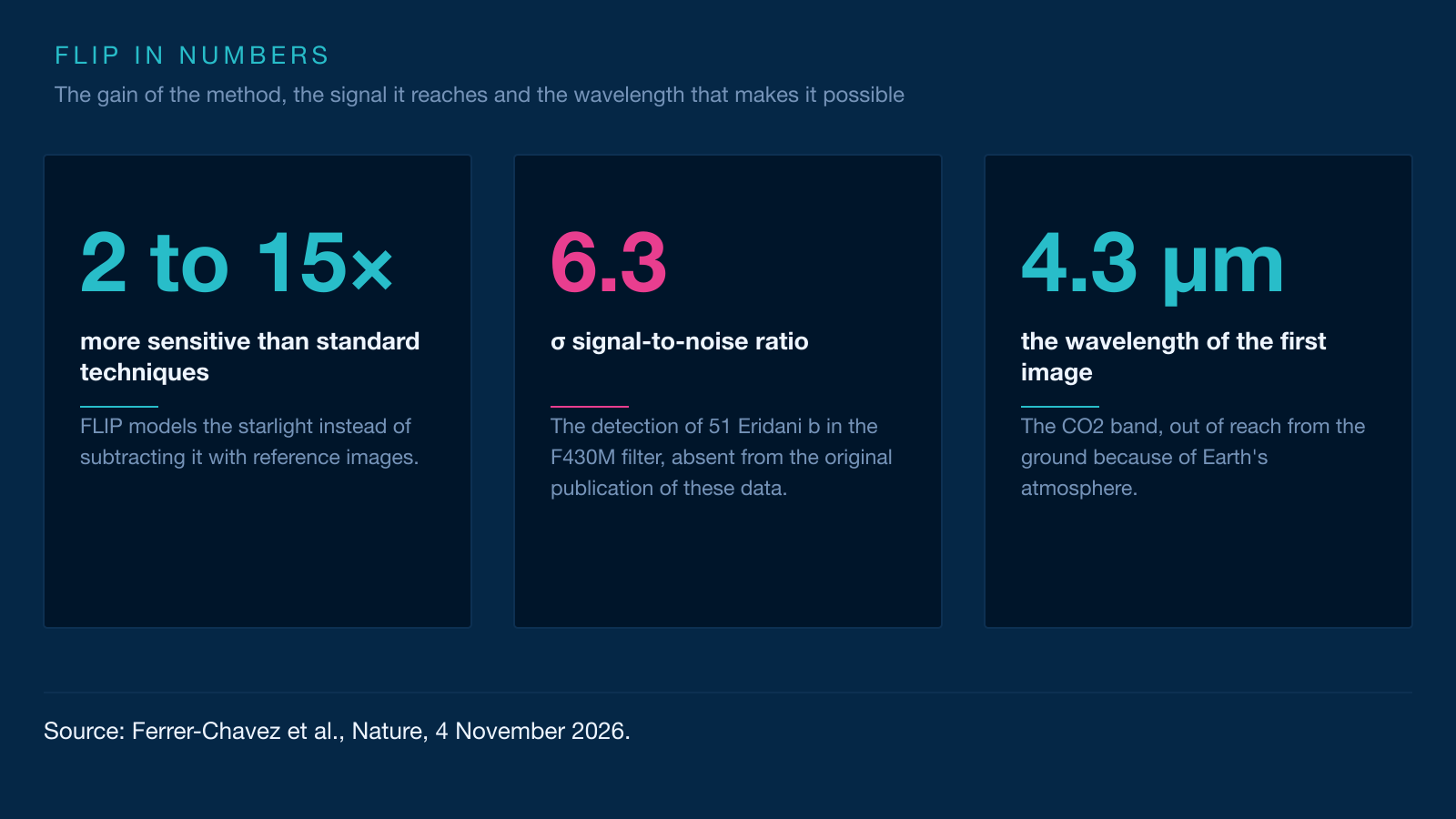
Around HIP 65426, a star with a known planet, FLIP improves the signal-to-noise ratio by about 1.6 times. That ratio measures how confidently a faint spot rises above the noise. On 51 Eridani b in the F410M filter, the gain is about 2.1 times.
Then comes the result that matters. In the F430M filter, FLIP detects 51 Eridani b at a signal-to-noise ratio of 6.3, where the original publication reported no detection at all. At the planet's position, the sensitivity is about four times better.
That F430M image is the first view of 51 Eridani b at 4.3 micrometres. It matters because that wavelength falls inside an absorption band of carbon dioxide, one of the molecules that traces a planet's atmosphere. Earth's atmosphere blocks that band for telescopes on the ground, so this measurement is only possible from space.
The planet itself is a young giant, between 2 and 4 Jupiter masses and about 750 kelvins, or 891 °F. It was discovered in 2015 by the Gemini Planet Imager. The new data should also help settle an older hint that its atmosphere holds about five times the stellar abundance of heavy elements.
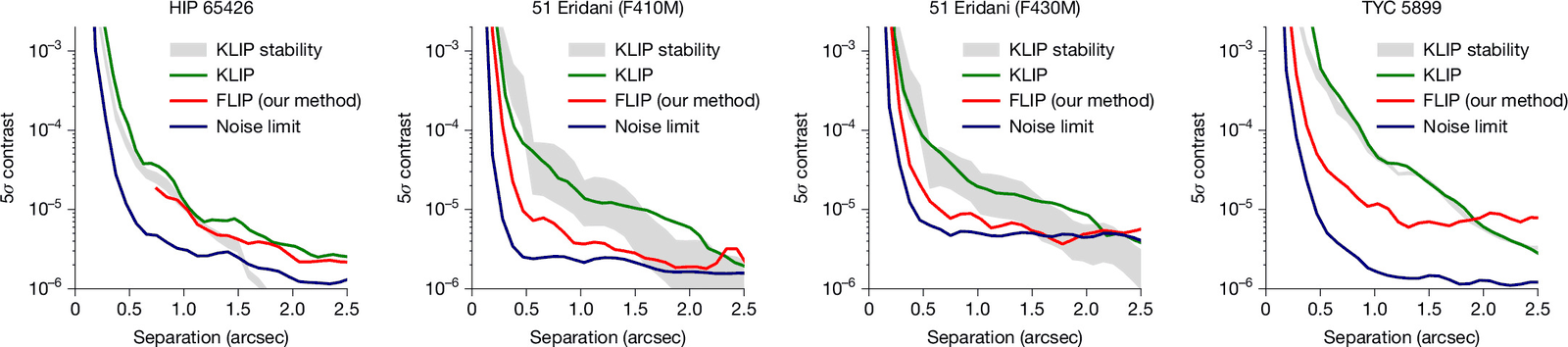
The third star is the hardest case. TYC 5899 has no known planets, and its observation came four months after the reference data, a gap that defeats standard subtraction. With an artificial planet injected, FLIP gains about 15 times in sensitivity at 0.5 arcsecond from the star, and about 5 times at 1 arcsecond, a tiny angle on the sky.
What FLIP changes, and what it does not
After more than 35 years of coronagraphic imaging of exoplanets, this is the first time a subtraction built on a physical model has beaten the standard techniques on real images from a telescope. "We showed that we can actually recover a planet that people previously couldn't see," Wang said. "This is real data in a real scenario. It was science left on the table because we didn't have the right tools to analyze the data in the most optimal way."
That matters beyond one planet. The same archive can keep giving, because sensitivity now depends on the model as much as on the instrument. "We know of no planets around other stars that are like those in our own solar system," said Rodrigo Ferrer-Chavez, who led the study. "It's not that they don't exist. It's that we cannot see them. Every time we improve our techniques, we discover new types of planets."
It also comes with limits. The method cannot invent photons Webb never collected, and it does not yet reach the floor set by the random arrival of light. Earth-sized planets around sun-like stars remain out of reach.
Where it could travel matters too. The same framework applies to other instruments on Webb, and to future observatories such as the Nancy Grace Roman Space Telescope and the Habitable Worlds Observatory. There, correcting for small drifts in the optics could relax one of the most expensive requirements to meet in space.
Going further
- The mission behind the data: James Webb.
- The key ideas: exoplanets and the coronagraph that hides a star's light.
- Under your own sky: the interactive sky map and our observing guide.
- The official sources: the paper by Ferrer-Chavez and colleagues in Nature and the ESA/Webb release on 51 Eridani.