NASA's James Webb Space Telescope has analysed 21 extreme debris disks, the hot dust clouds that collisions between young bodies leave around their star. The makeup of that dust betrays how violent the impacts were. About a third of the disks come from collisions between Mars-sized bodies, the rest from softer run-ins between Moon-sized objects. The study, led by Kate Su of the Space Science Institute in Boulder, Colorado, appeared on October 1, 2026 in The Astrophysical Journal.
Here is how a simple reading of light turns those dust clouds into archives of planetary crashes.
A thermometer hidden in the dust
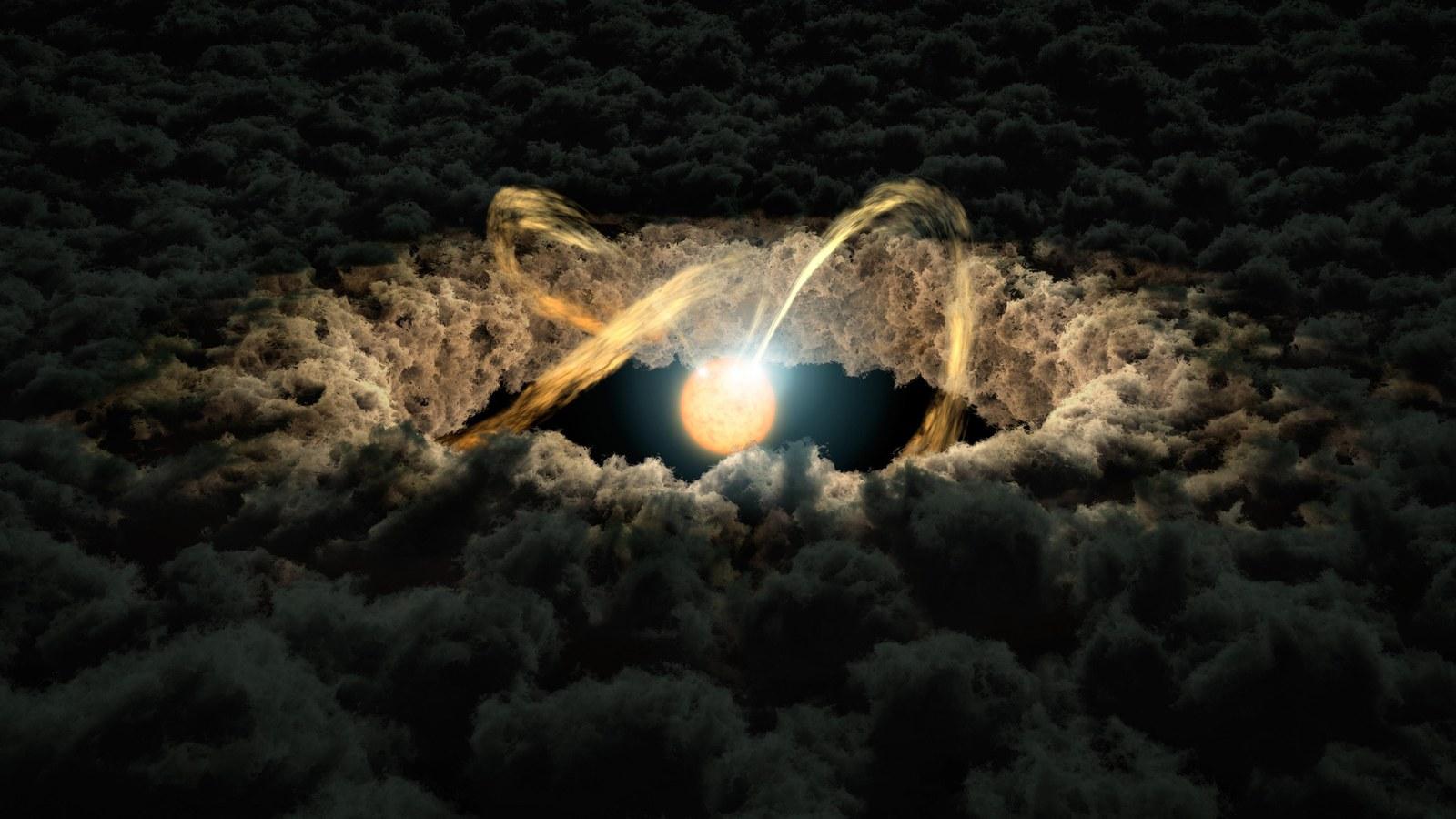
Around a newborn star, everything starts with a disk of gas and dust, the protoplanetary disk, where planets take shape. The gas eventually fades. What remains is a debris disk, a ring of grit and dust kept supplied by collisions among the bodies still orbiting there. Our solar system has two such rings, the asteroid belt and the Kuiper belt.
In the 2000s, the now-retired Spitzer Space Telescope caught a handful of disks that behaved oddly. They shine far more infrared light than usual, a sign of abundant warm dust close to the star, exactly where rocky planets orbit in our own system. Their brightness shifts from one observation to the next with no predictable rhythm. Astronomers named them extreme debris disks.
Such objects are rare. Based on the data gathered so far, roughly 1% of young stars carry the signature. Theory had predicted many more, and that gap is what drove Kate Su's team to examine them one by one.
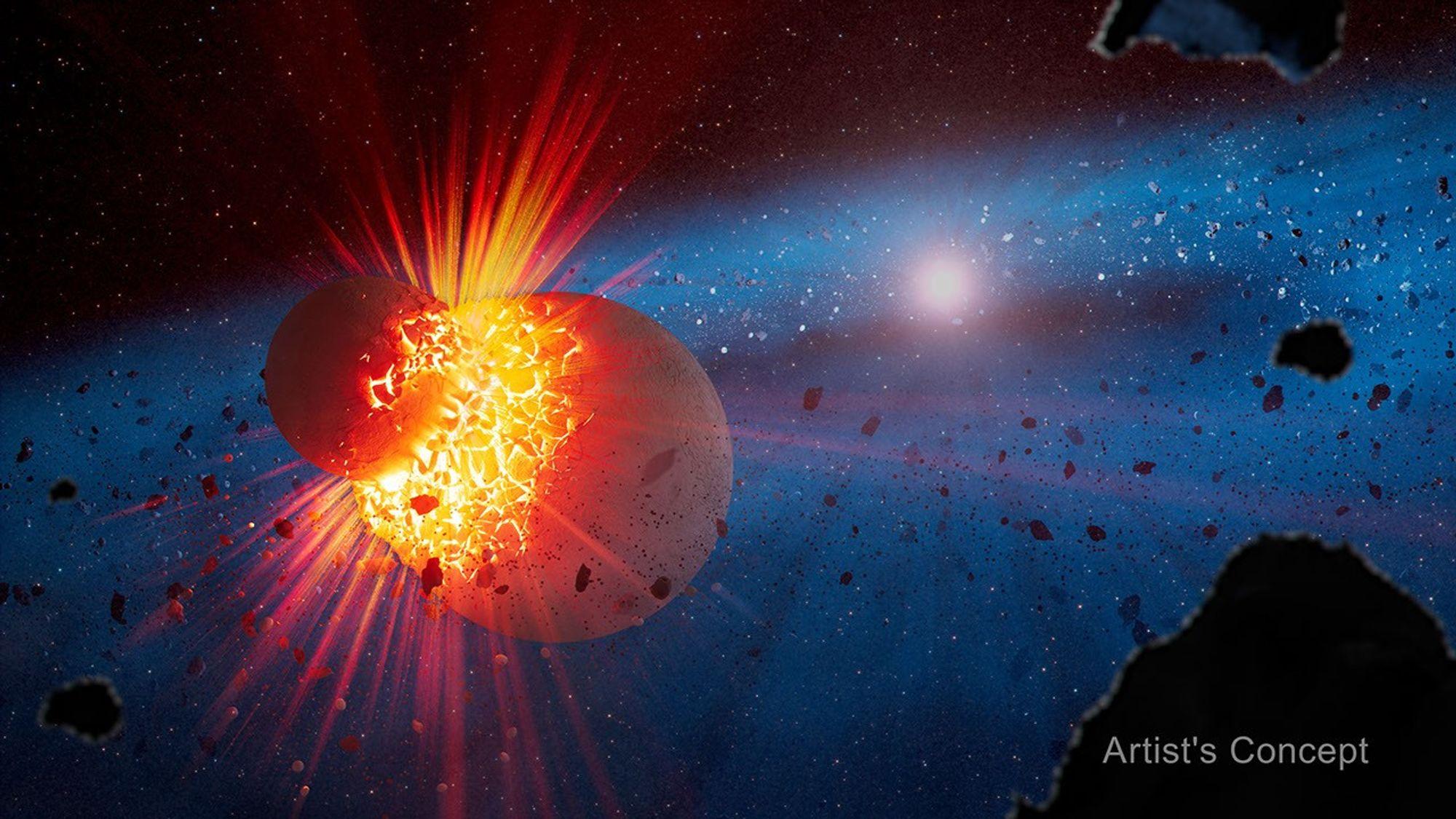
The dust is where the reasoning starts. When two rocky bodies collide at very high speed, part of the rock vaporises and melts. Out of it come tiny grains whose composition preserves the temperature that was reached. Reading the makeup of the dust is therefore reading how violent the impact that produced it was.
Volcanic glass versus green sand
To tell the disks apart, the team studied the mineral makeup of their dust. The result is clean: the sample splits into two families by how much silica it holds.
Silica is the stuff of window glass and beach sand. Rock rich in it was heated to a very high temperature, then cooled fast. Obsidian, the black volcanic glass, is one earthly example. At the other end, forsterite, a mineral poor in silica, forms the green sands of some Hawaiian beaches. Two kinds of dust, two stories.
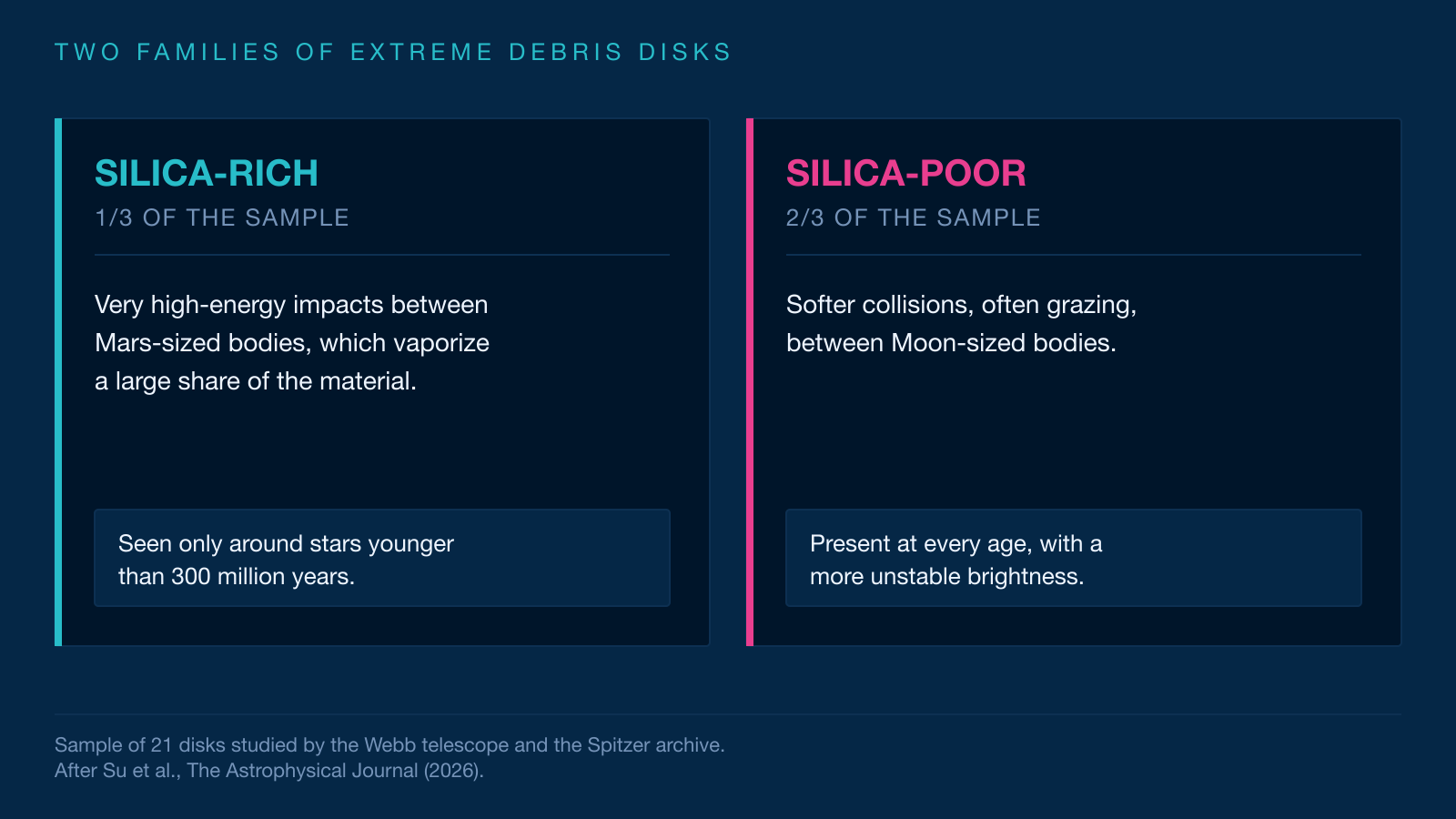
Roughly a third of the 21 disks are silica-rich. According to the authors, they come from very high-energy impacts between Mars-sized bodies that vaporise much of the material. The remaining two-thirds are silica-poor and point to smaller-scale, often grazing collisions between Moon-sized bodies.
"To see their mid-infrared emission and these beautiful spectral features with Webb, which let us pin down their compositions, was the most exciting thing for me," said Ágnes Kóspál of Konkoly Observatory in Budapest, a coauthor of the study. "We have no other way to study these planetary embryos directly, they are too small."
Violent crashes stop at 300 million years
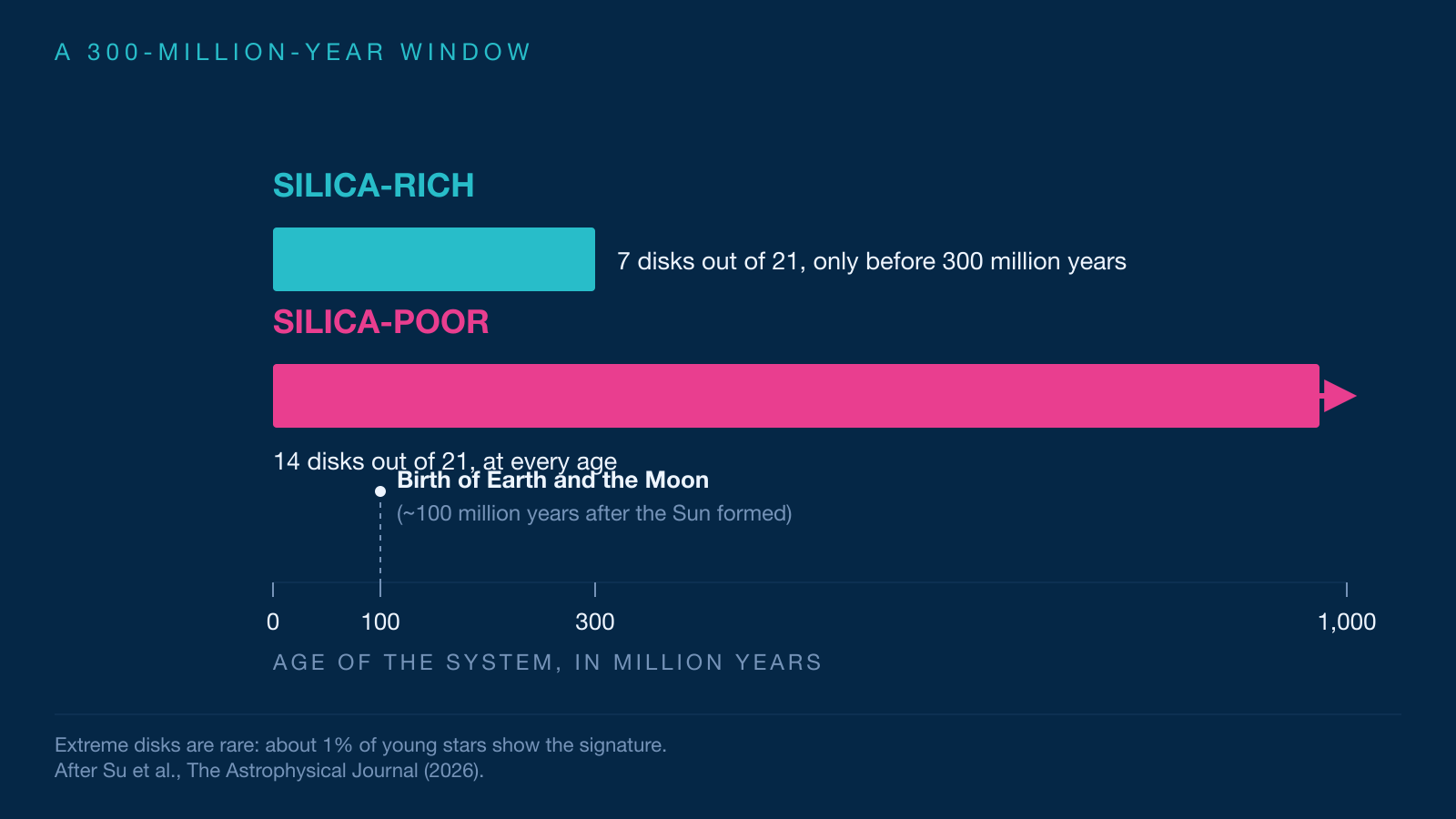
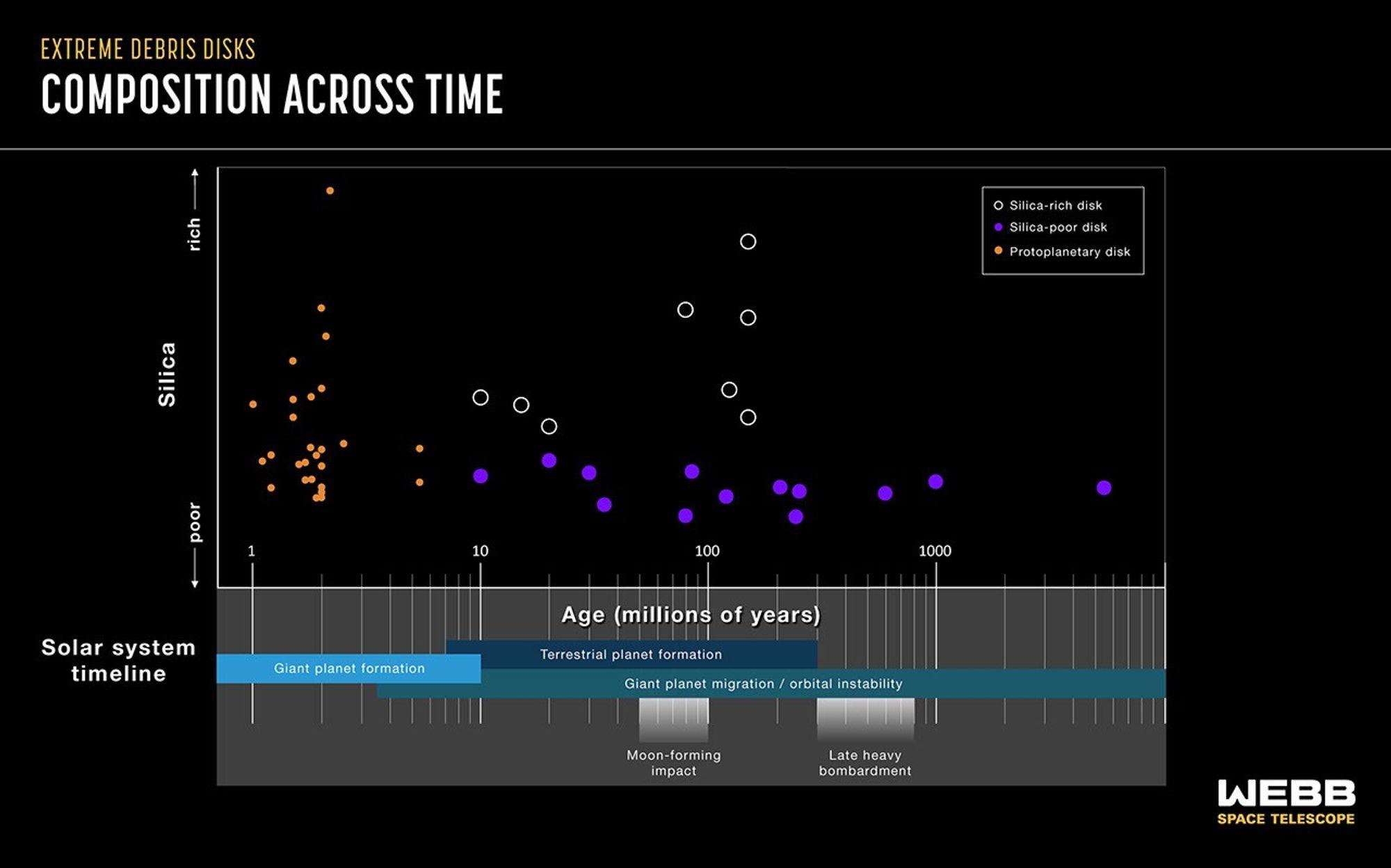
A second split shows up, this time in time. Silica-rich disks exist only around stars younger than 300 million years. Silica-poor disks turn up at every age, and their brightness is often the more erratic.
That boundary has an explanation. Simulations of planet formation show that rocky planets are built within the first few hundred million years of a system's life. In our own case, Earth and the Moon are thought to have formed about 100 million years after the Sun, following an impact between Earth and a Mars-sized body, Theia. Once that window closes, too few large bodies remain to drive collisions capable of vaporising rock on a grand scale. Impacts keep happening, but they get smaller.
What if our solar system lived through several of these phases
One question the study leaves open, and it concerns us directly. Our solar system may have gone through more than one extreme debris disk phase.
The idea hinges on the restlessness of the silica-poor disks. If their brightness swings track orbital instability, then they could line up with the Late Heavy Bombardment, the stretch when the giant planets are thought to have migrated, scrambled the orbits of smaller bodies and set off a barrage of collisions. A brief, dusty episode, written into the same archives Webb is now reading.
"How rocky planets formed and how giant planets evolved are part of the same larger story, the story of how the solar system formed," Su said. "Our work on extreme debris disks helps bring together the big picture of what we understand today."
What this changes
The finding amounts to more than a pretty gallery of disks. It hands astronomers a tool. The composition of a debris disk becomes a marker of how violent the collisions behind it were, and therefore a clue to how far along the system is in building its planets.
That reading cuts two ways. On one side, it helps untangle the impacts that assembled the rocky planets, our Earth among them. On the other, it offers a signal for spotting systems caught in orbital instability, the configurations where bodies keep crashing, far from equilibrium. For exoplanets, whose surfaces we will never see up close, that is valuable information.
The team stays cautious. Only three disks in the sample match the age of the silica-rich systems, a narrow base.
"We expect no silica-rich systems among older extreme debris disks," noted Attila Moór of Konkoly Observatory, a coauthor. "We only have three disks in our sample that fit that age criterion, so it would be good to observe more of them to confirm our hypothesis."
Going further
- The mission page for the instrument behind the study: James Webb and its infrared instruments.
- The key ideas behind the story: infrared, the Moon, the solar system and exoplanets.
- Under your own sky: find the young stars ringed by these disks with the interactive sky map, plan a session with our observing guide, and see what the deep sky delivers to enthusiasts in the astrophotography gallery.
- The official sources: the NASA release and the paper by Su and colleagues on arXiv, published in The Astrophysical Journal.