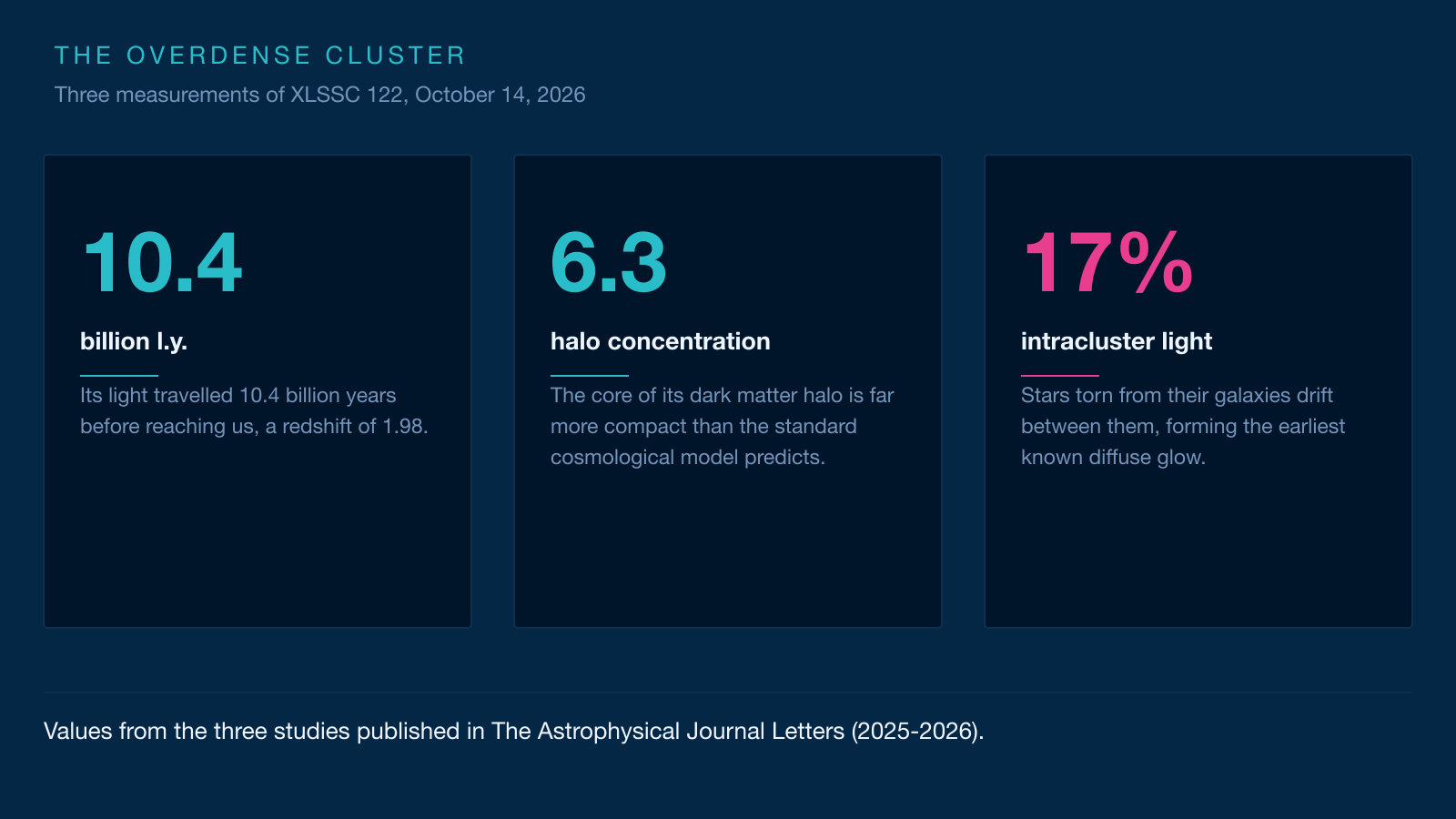
About 10.4 billion light-years from us, the galaxy cluster XLSSC 122 has just delivered a measurement that sits badly with theory. It is the most distant known cluster that strongly warps the light of galaxies behind it. That warping works as a natural magnifying glass, and also as a scale for weighing invisible matter. The verdict: its core is far more tightly packed than the reigning cosmological model allows. Three studies led by IPAC, Caltech's astrophysics research centre, also tell the story of the earliest light from stars wandering between galaxies.
A grown-up cluster, a lens nobody expected
Start with the strongest fact. XLSSC 122 is the first cluster this distant seen to produce strong gravitational lensing, meaning its gravity bends background light hard enough to visibly distort it. Its redshift is 1.98, against 1.75 for the previous record. Redshift, written z, measures how much the expansion of the universe has stretched an object's light: the higher z is, the farther away it lies and the younger we see it. At 1.98, we see it as it was when the universe was 3.3 billion years old, against 13.8 billion today.
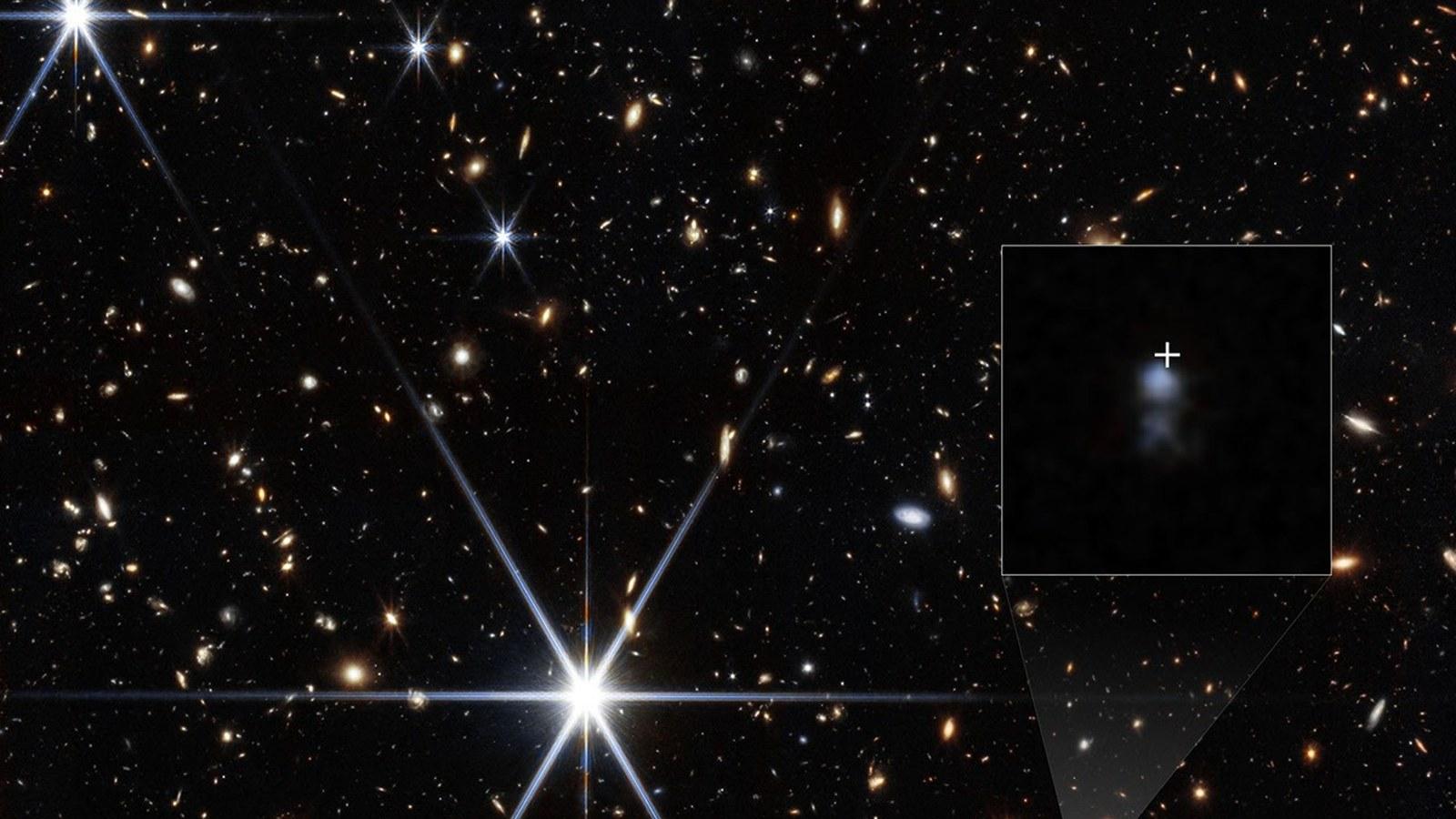
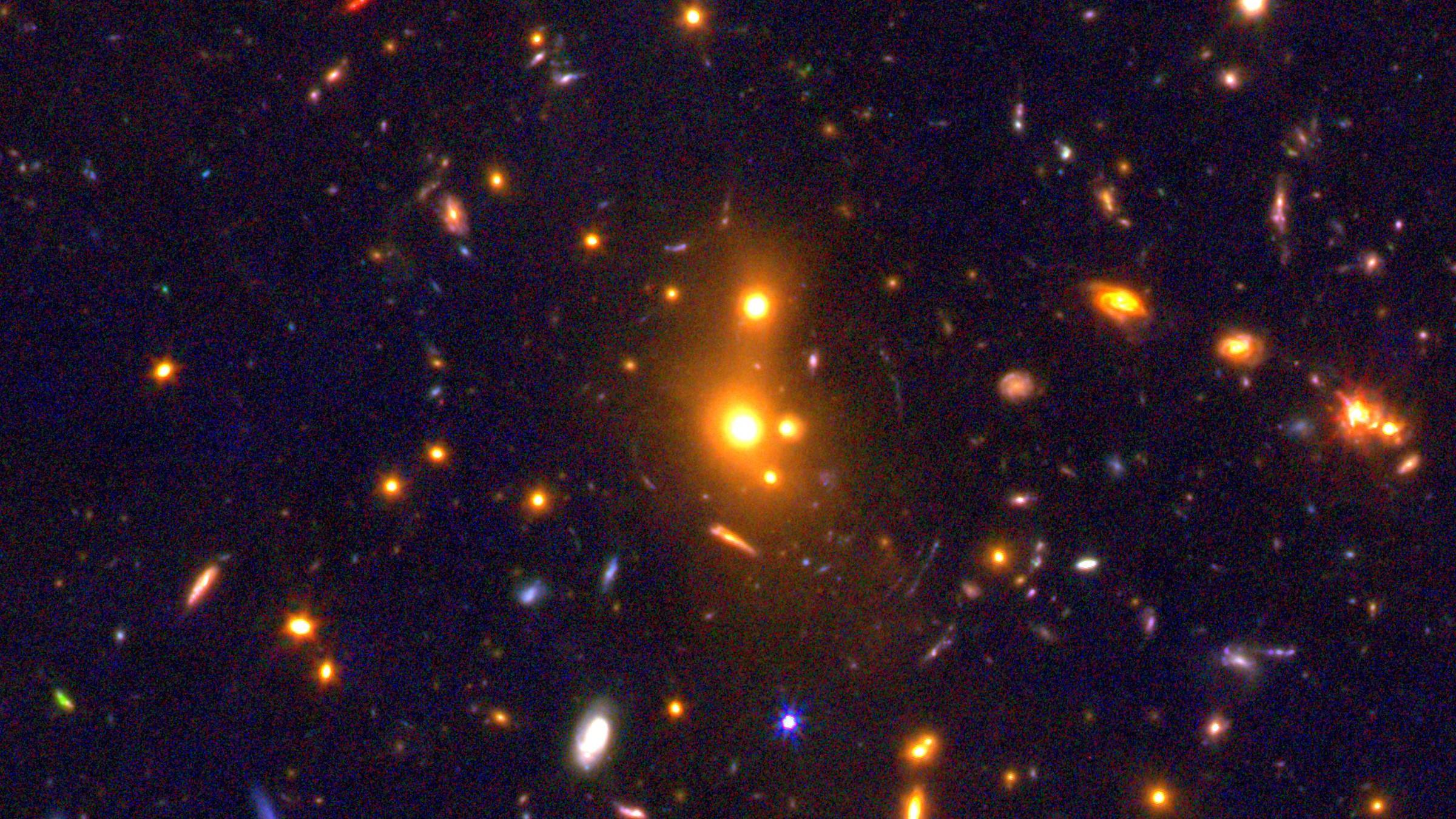
The cluster turned up in 2014 in an X-ray sky survey called XXL, run with the European Space Agency's XMM-Newton telescope. Hubble later pinned down its distance and its surprisingly organised look. But Hubble showed no clear sign of strong lensing. The James Webb Space Telescope changed that, revealing long arcs of light curving around the cluster's centre.
"When we got those first images back from JWST, we said, 'wow, look at this, there's strong lensing coming from this cluster!'" said Kyle Finner, a staff scientist at IPAC and lead author of the main study. "XLSSC 122 has now set the record for the most distant galaxy cluster displaying strong lensing."
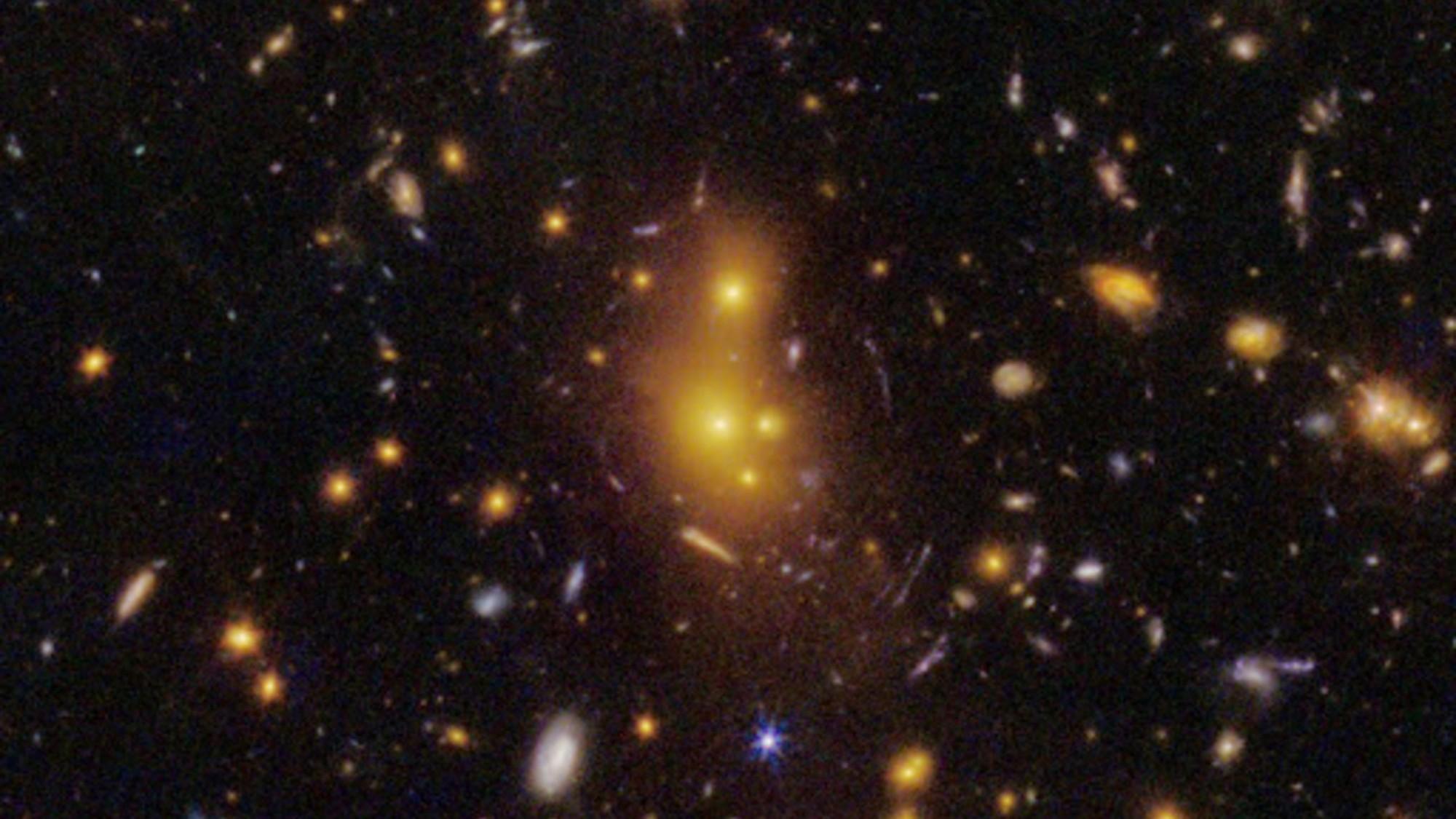
Why does the find matter? Because at that time, galaxy clusters were only beginning to come together. Catching one that is already massive and organised, and that doubles as a magnifying glass, clashes with the picture of a slow, gradual build-up. Its galaxies back up that precocious maturity: among the spectroscopically confirmed members, a very large majority have stopped forming stars, well above the share in ordinary galaxies of the same era. Some of those stars were already old when the universe was just 370 million years old.
The natural lens that weighs the invisible
The mechanism fits in one sentence. Light has no mass, yet it follows the dips that matter carves into space. A huge mass bends that space, and therefore bends the path of any light crossing it. Albert Einstein predicted this in 1915, and a star seen to shift during the solar eclipse of 1919 confirmed it.
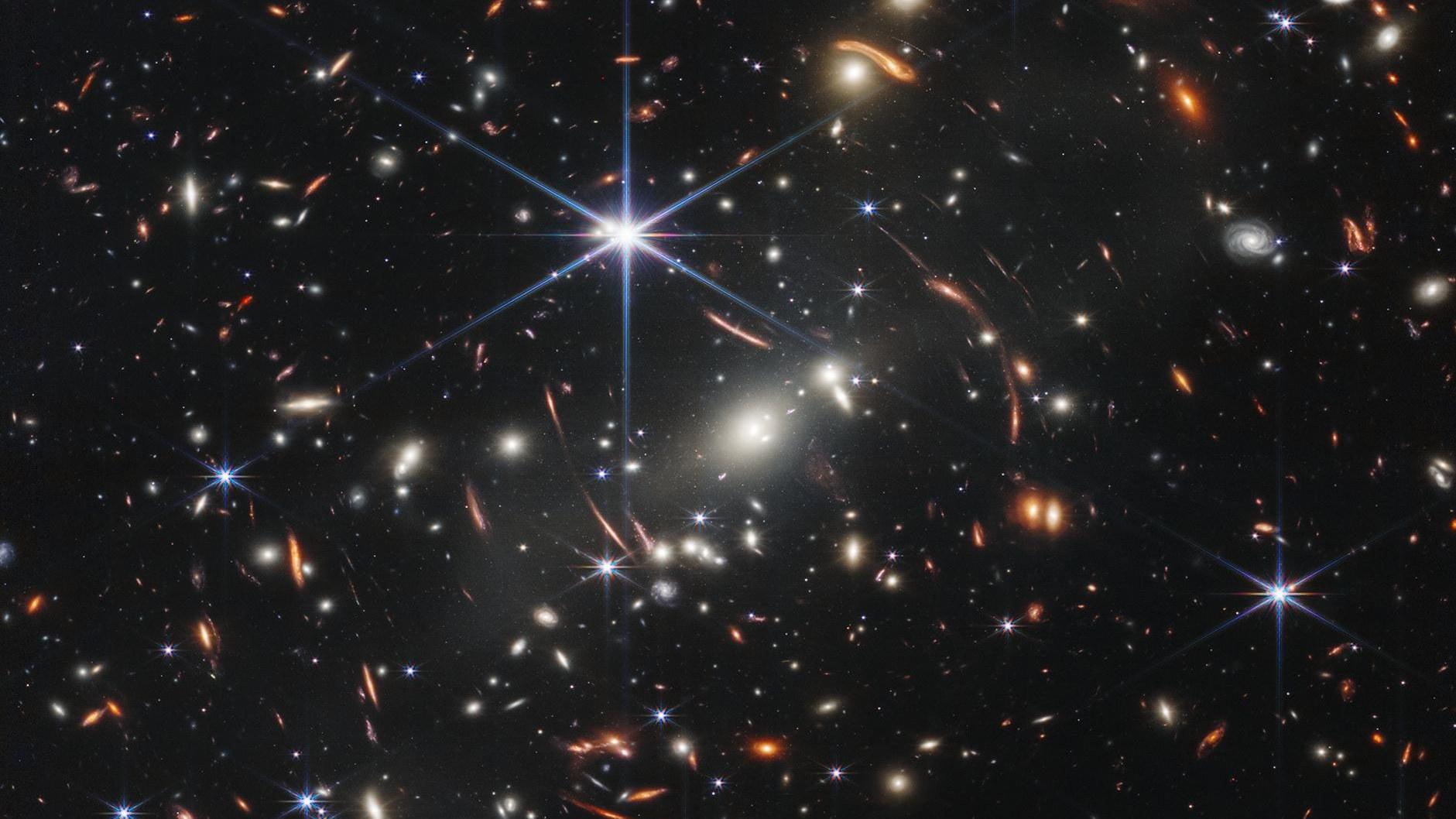
One image makes it clear. Take a thick-bottomed glass and look at a candle through the base: the flame sometimes appears doubled, because the glass bends the light. A galaxy cluster does the same, except the lens is made of mass and spans millions of light-years. When the bending is strong enough, a galaxy far behind shows up several times, each image stretched into an arc. That is strong lensing. When the bending is gentler, background galaxies are only slightly distorted, and thousands of them must be measured to pull out the signal: that is weak lensing.
The team used both to weigh XLSSC 122. From the position of the arcs, they rebuilt a map of the mass, which is in truth a map of dark matter, since dark matter supplies about 85% of a cluster's mass.
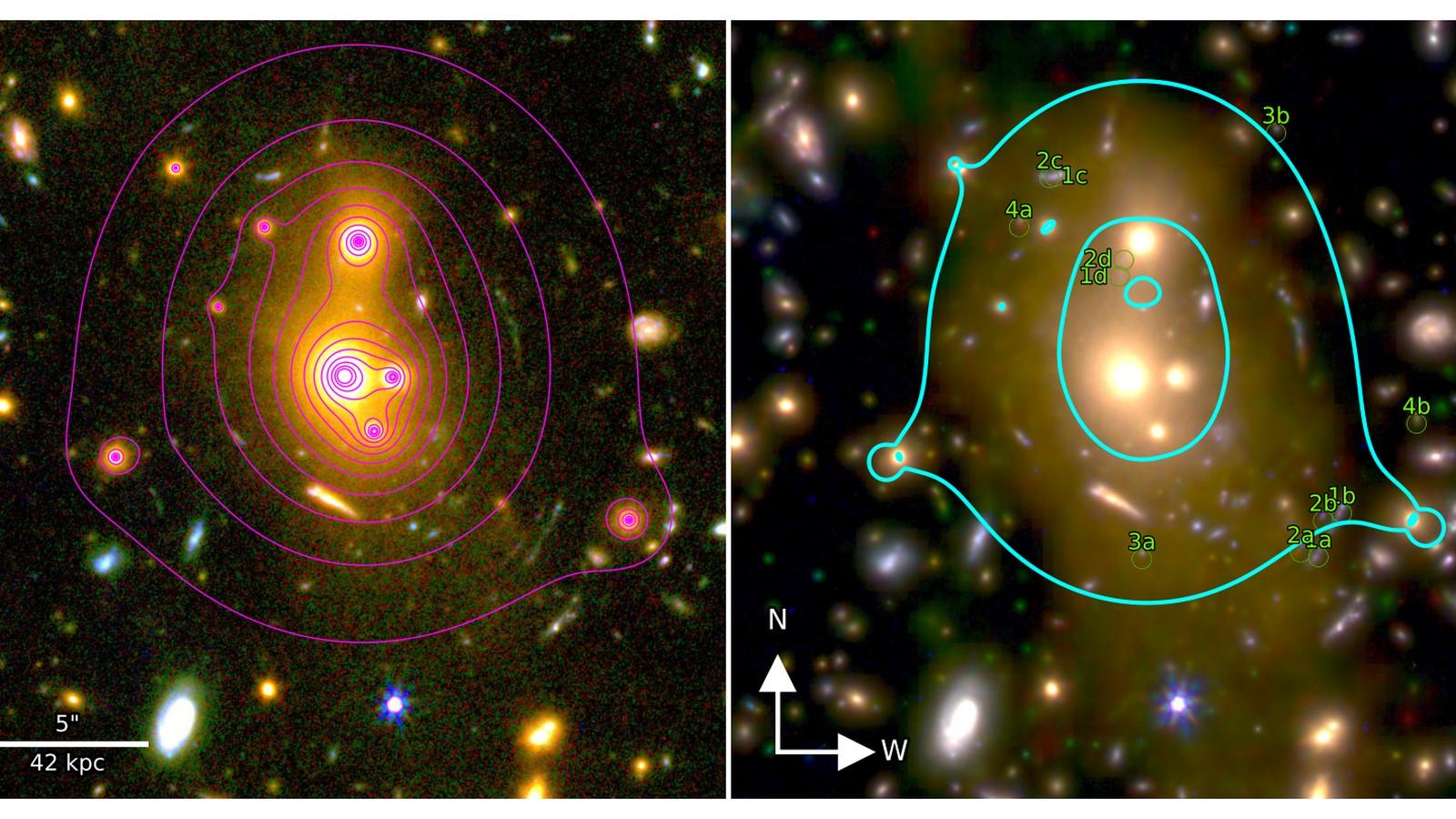
The team then boiled the shape of that map down to a single number, the concentration. It compares the size of the dense core with the full extent of the cluster. The larger it is, the more matter is packed towards the centre, like a pizza dough barely rolled out: thick in the middle, thin at the edges. For XLSSC 122, the concentration comes out at 6.3, give or take 0.5.
That number is high. Set against the reference relation built by Aaron Duffy and colleagues from simulations, it lands 8.2 standard deviations above the prediction. A standard deviation measures the spread expected around an average value: 8.2 of them is far more than ordinary scatter. Most of the concentration relations astrophysicists rely on cannot reproduce such a steep mass profile.
Mass follows the same pattern. Within the 100,000 light-years around the centre, the cluster weighs about 65 billion times the mass of the Sun. Its total mass, inside a sphere that encloses the whole cluster, reaches about 260 billion solar masses. A second study, based this time on weak lensing and a wider view of the cluster, found the same concentration, 6.3 with an uncertainty of 0.4, and a matching mass. Two separate methods, one answer.
A core that had no business forming so early
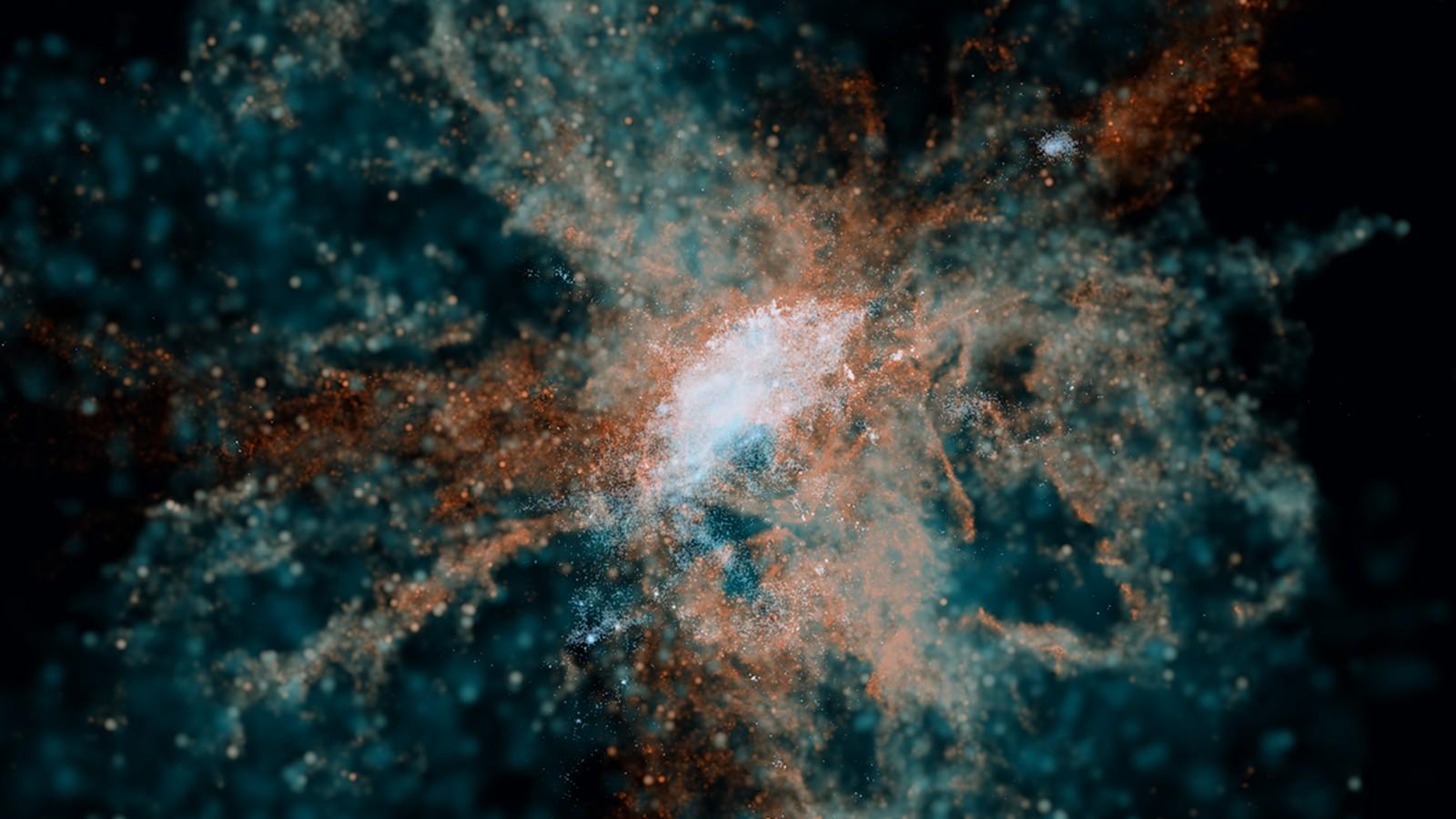
So why does this over-tight core unsettle anyone? The standard cosmological model goes by Lambda-CDM: a universe filled with cold dark matter and shaped by a cosmological constant that speeds up its expansion. It describes a build-up in stages, small structures first, large ones after, through mergers. In that story, a galaxy cluster gathers its matter over billions of years, and its core only really packs in at the end.
Picture a city growing. Villages appear first, merge into districts, and downtown only fills up once the city is already large. XLSSC 122 looks like a city whose downtown is packed while the first villages are still forming.
How could such a concentrated pile assemble so early? The researchers are chasing several leads. The first: the cluster's grown-up galaxies formed unusually fast, and the dark matter halo followed suit. The second calls on still-hypothetical physics, early dark energy, a push that may have sped up the expansion just after the Big Bang and let structures grow earlier than expected. The third is more down to earth: a projection effect. If the cluster is stretched along our line of sight, it only looks more concentrated than it really is.
The team tested that last idea, and ruled it out. The cluster's hot gas, observed at millimetre wavelengths, shows a pressure peak offset by about 100,000 light-years from its centre of mass. That offset points to a merger of galaxy groups, a system still on the move. A cluster seen end-on along the line of sight would not leave that signature. XLSSC 122 is a restless object still being assembled, not a trick of perspective.
It is also rare. Comparing the measured mass with the number of clusters expected at that time inside the XXL survey area, the researchers find just 0.12. Put another way, catching one is close to a lottery win. That does not prove the model is wrong, but it does question how well it forecasts the extremes.
The earliest light from orphaned stars
The third study homes in on a much fainter signal. Between the galaxies of a cluster drifts a very dim haze, the light of stars that no longer belong to any galaxy. Astronomers call it intracluster light. These stars were pulled away during encounters between galaxies, then left behind in intergalactic space.
A landscape holds the analogy. Picture a strong wind that tears leaves off every time branches brush past each other, leaving them floating between the trees. That is intracluster light: lost stars, too spread out to trace a galaxy, yet together forming a pale halo.
James Webb has now picked it up in XLSSC 122. It is the earliest intracluster light ever seen. It stretches several hundred thousand light-years around the central galaxy and accounts for about 17% of all the light in the cluster.
That percentage carries a meaning. In a settled cluster, the share of intracluster light stays roughly flat from one colour to the next. In a cluster in the middle of a merger, it rises around a wavelength in the blue-green. XLSSC 122 shows exactly that bump, confirming the merger activity already hinted at by the shifting gas.
The most puzzling result lies elsewhere. Within the 100,000 light-years of the centre, the shape of this diffuse light hugs the dark matter map from lensing almost perfectly. The overlap between the two patterns reaches 0.82 on a scale running from 0 to 1. In short, the glow of wandering stars traces the shadow of dark matter.
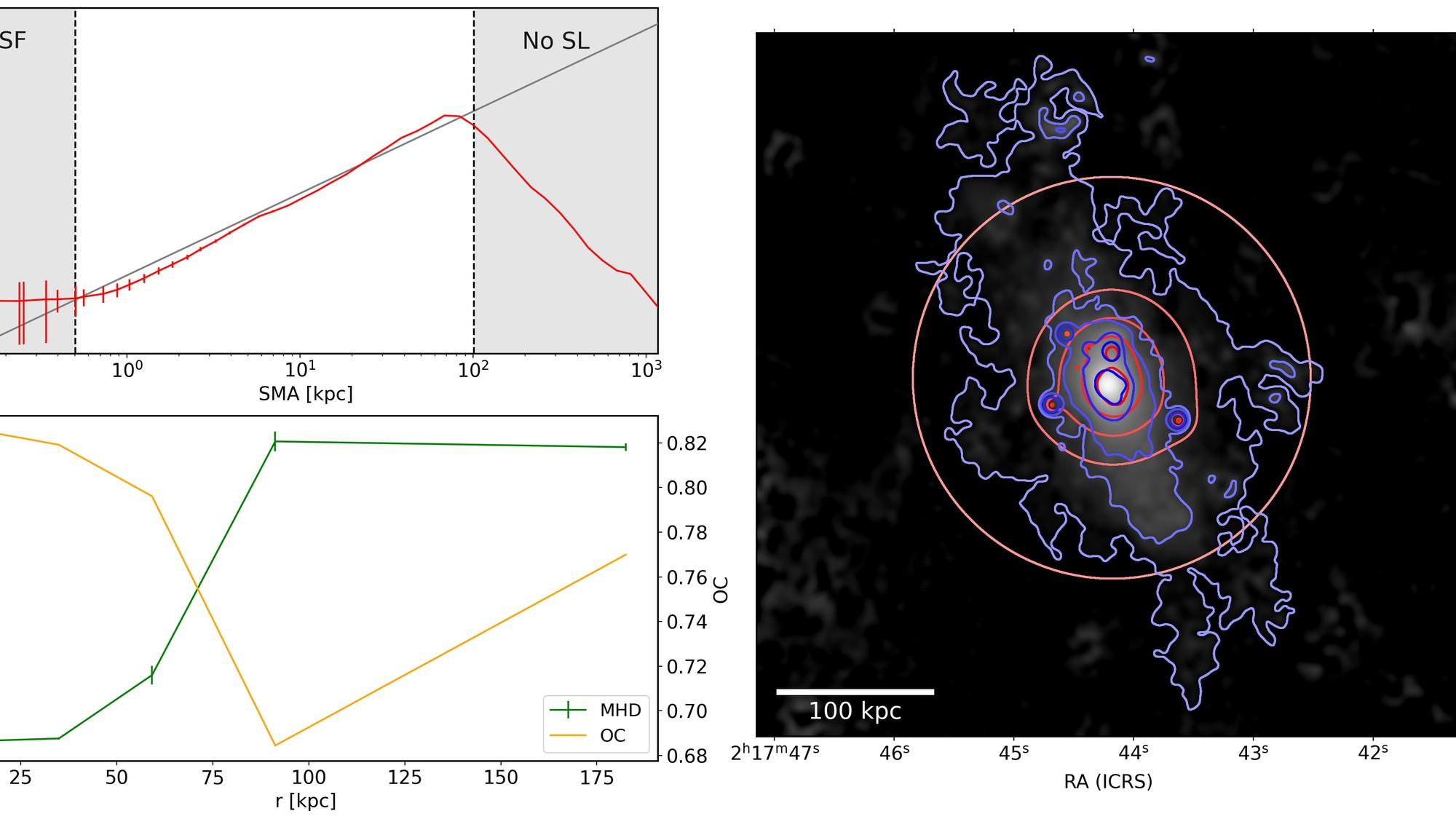
If that match holds in other clusters, and above all in other distant ones, it will hand astronomers a new way to map dark matter without leaning on lensing arcs. The researchers already see it as a route to probing how clusters assembled back when they were still forming.
Going further
- Follow the telescope behind the arcs: James Webb (JWST), with its full mission page.
- The key ideas to make sense of it all: dark matter, galaxies and space telescopes.
- Dark matter stays out of sight in an eyepiece, but the sky is out tonight: try our interactive sky map, our observing guide and the astrophotography gallery.
- The official sources for this article: the IPAC press release at Caltech, and the three studies published in The Astrophysical Journal Letters: the strong lensing paper by Finner et al. (2025), the weak lensing paper by Scofield et al. (2026) and the intracluster light detection by Joo et al. (2026).