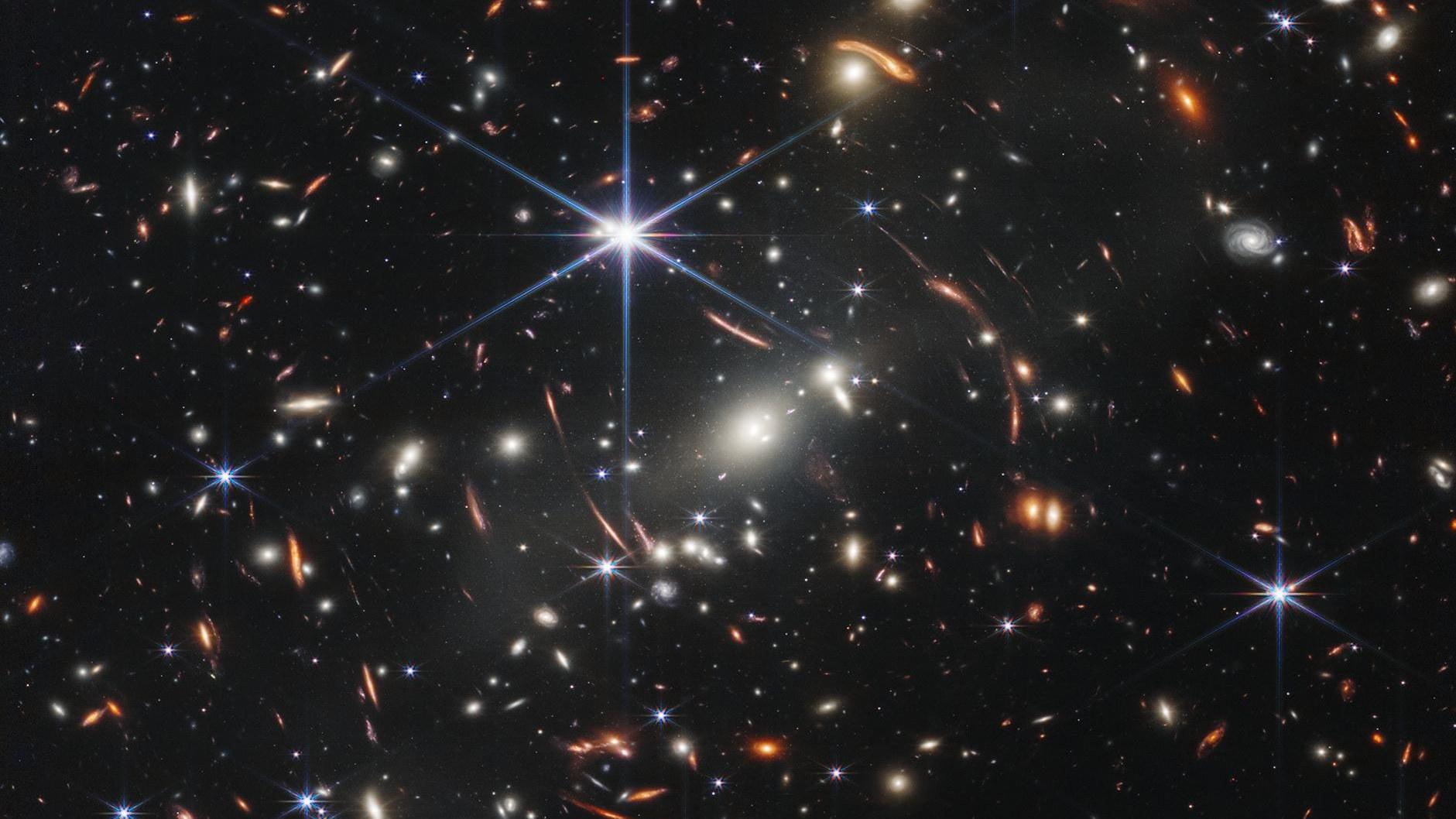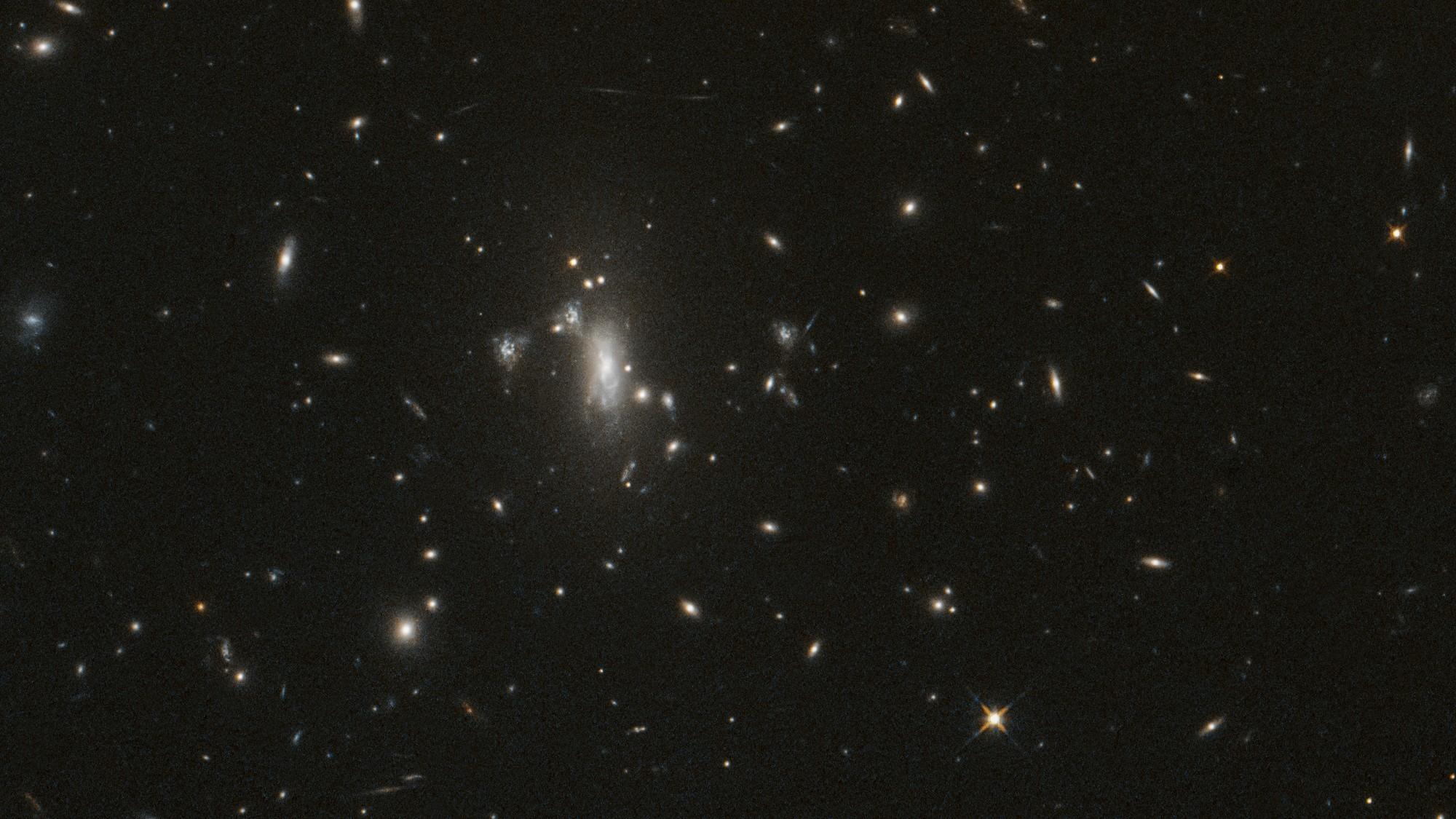
Five hundred million years after the Big Bang, the universe was barely out of its dark ages. Yet the gas surrounding some of its earliest galaxies already contained oxygen, carbon and silicon. A team at the University of Arizona, in Tucson, reports on September 24, 2026 in Nature Astronomy the direct detection of those heavy elements in three galaxies observed with the James Webb Space Telescope. The most striking part: the gas was not staying put. It was streaming into intergalactic space.
Three galaxies let their metals escape
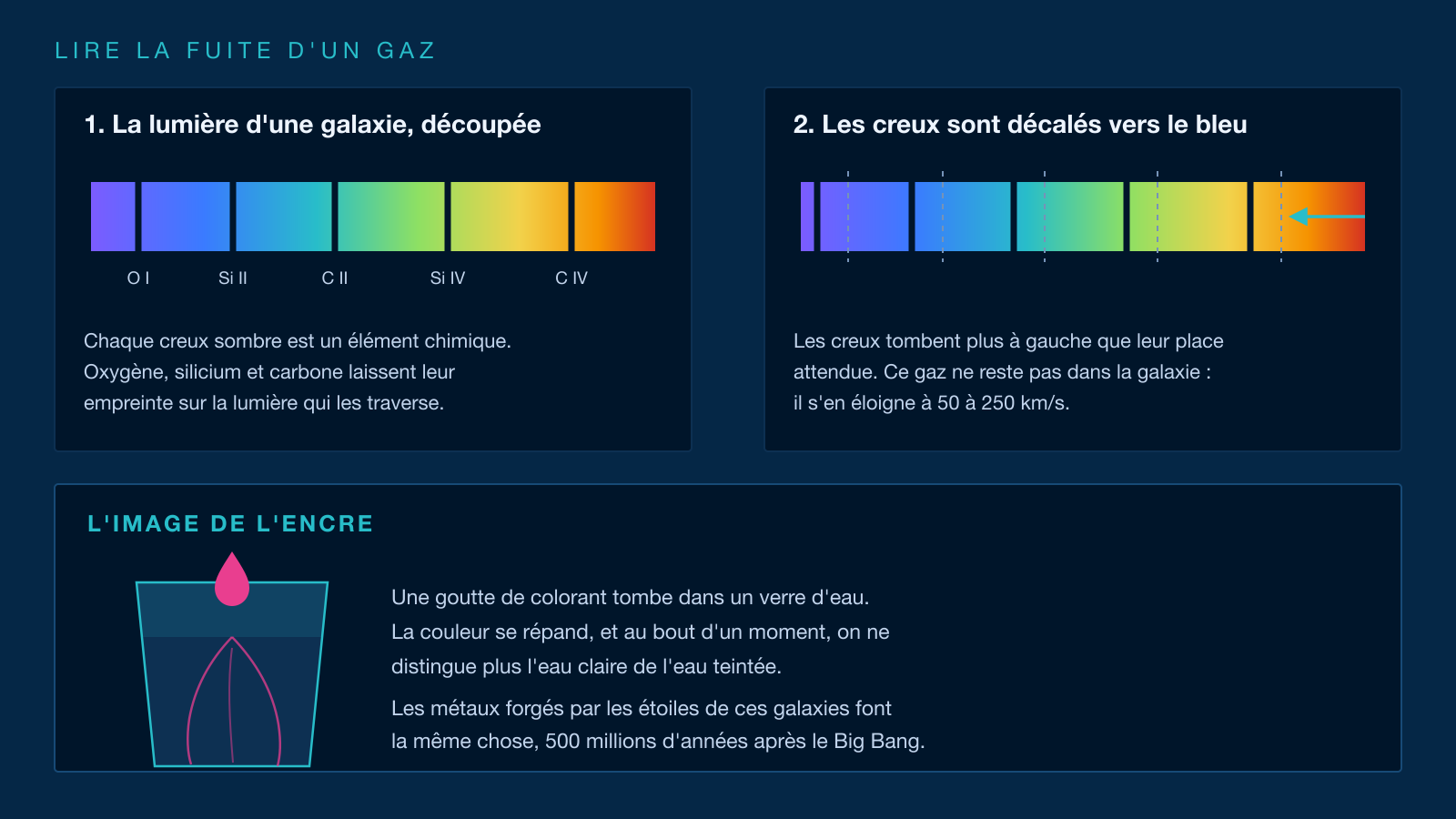
The result starts with a reading trick. Astronomers never see the gas around a distant galaxy directly, because it is too thin and too cold to glow. Instead they use the galaxy as a lamp. Its light passes through its own halo of gas before traveling 13 billion years to reach us, and every chemical element along the way leaves a dark notch at one precise color.
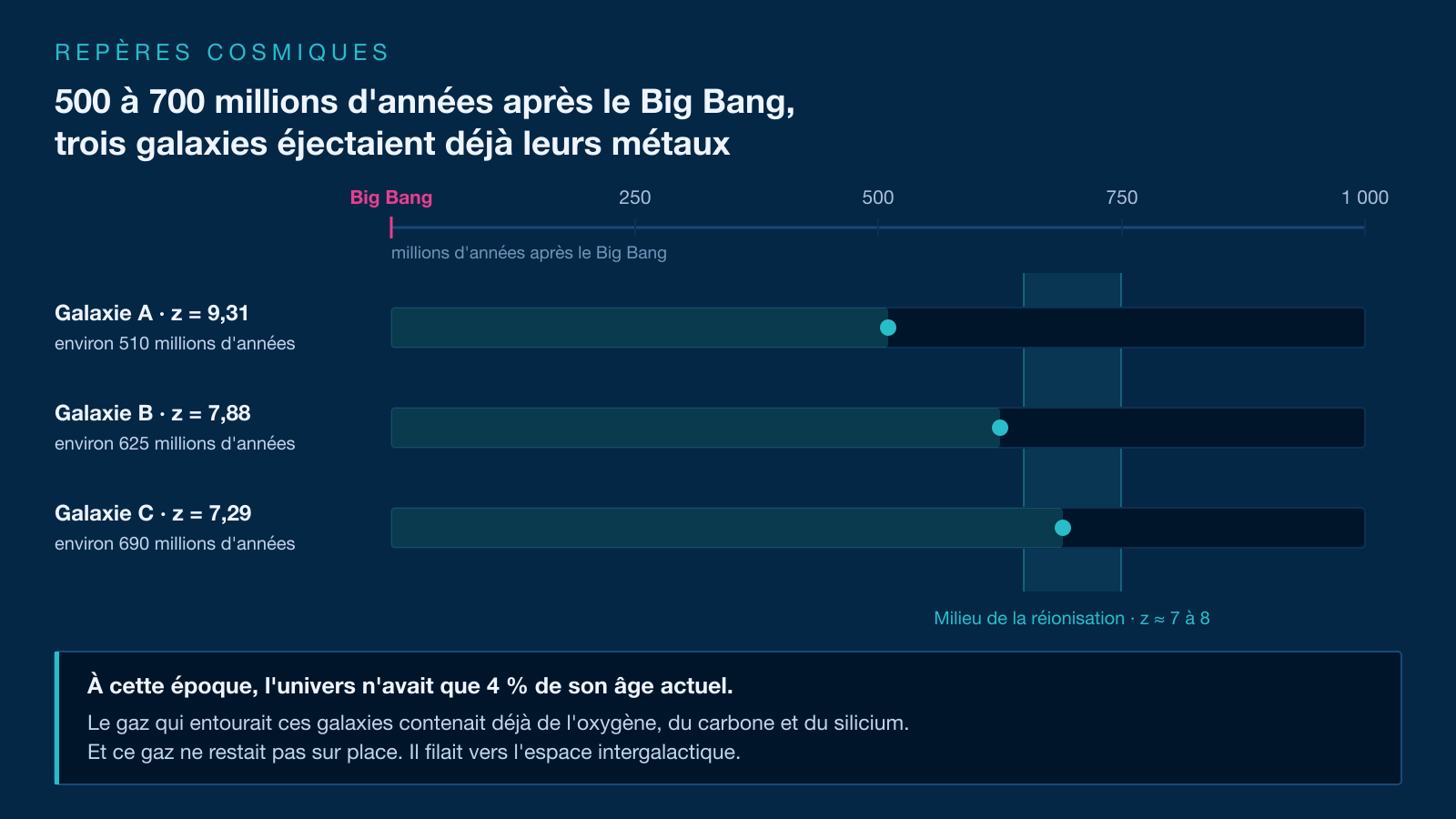
Yongda Zhu, the study's first author and a postdoctoral researcher at Steward Observatory, spent a long night combing through public James Webb spectra by hand, the plots that spread a galaxy's light across all its colors. Out of hundreds of galaxies, three showed sharp notches in the infrared. Their light has traveled more than 13 billion years, so we see them as they were 500 to 700 million years after the Big Bang, when the universe was only 4% of its present age.
The notches point to three families of elements: oxygen (O I), silicon (Si II and Si IV) and carbon (C II and C IV). All are heavier than helium, so they were forged in stars and were absent from the primordial gas. Finding them at this early time forces a question about speed. Stars had to be born, die and release their metals remarkably fast.
Notches pushed toward the blue
A second observation turns the discovery into a puzzle. The notches do not sit exactly where they should. They are shifted toward the blue, meaning toward shorter wavelengths, compared with the rest of the galaxy's light.
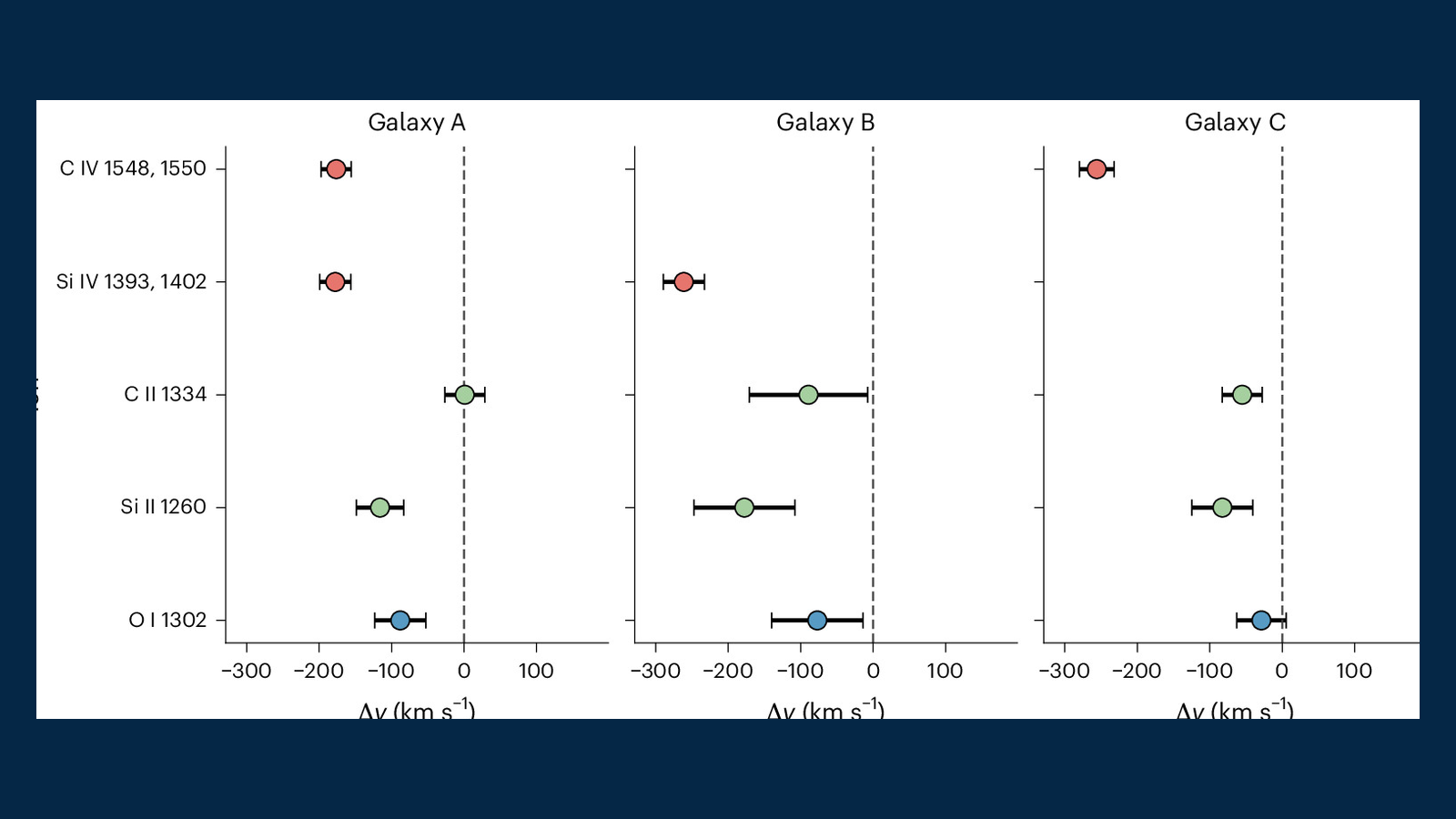
For astronomers, such a shift works like an arrow. If the gas notches lean blue, the gas is moving toward us relative to the galaxy. In other words, it is leaving the galaxy, or crossing it at high speed in our direction. The team measures shifts of 50 to 250 kilometers per second. This gas is not sitting quietly around the galaxy. It is in motion, and it is clearing out.
The rest is a matter of degree. The measurements suggest that the most energetic notches, the ones that reveal highly ionized gas, are shifted further than the others. It is as if the hottest layers were racing ahead of the cooler ones. The authors stay cautious: higher-resolution spectra would be needed to settle the point. But the pattern they see matches simulations of galactic winds, in which the hottest gas leads the flow.
The image of dye in a glass of water
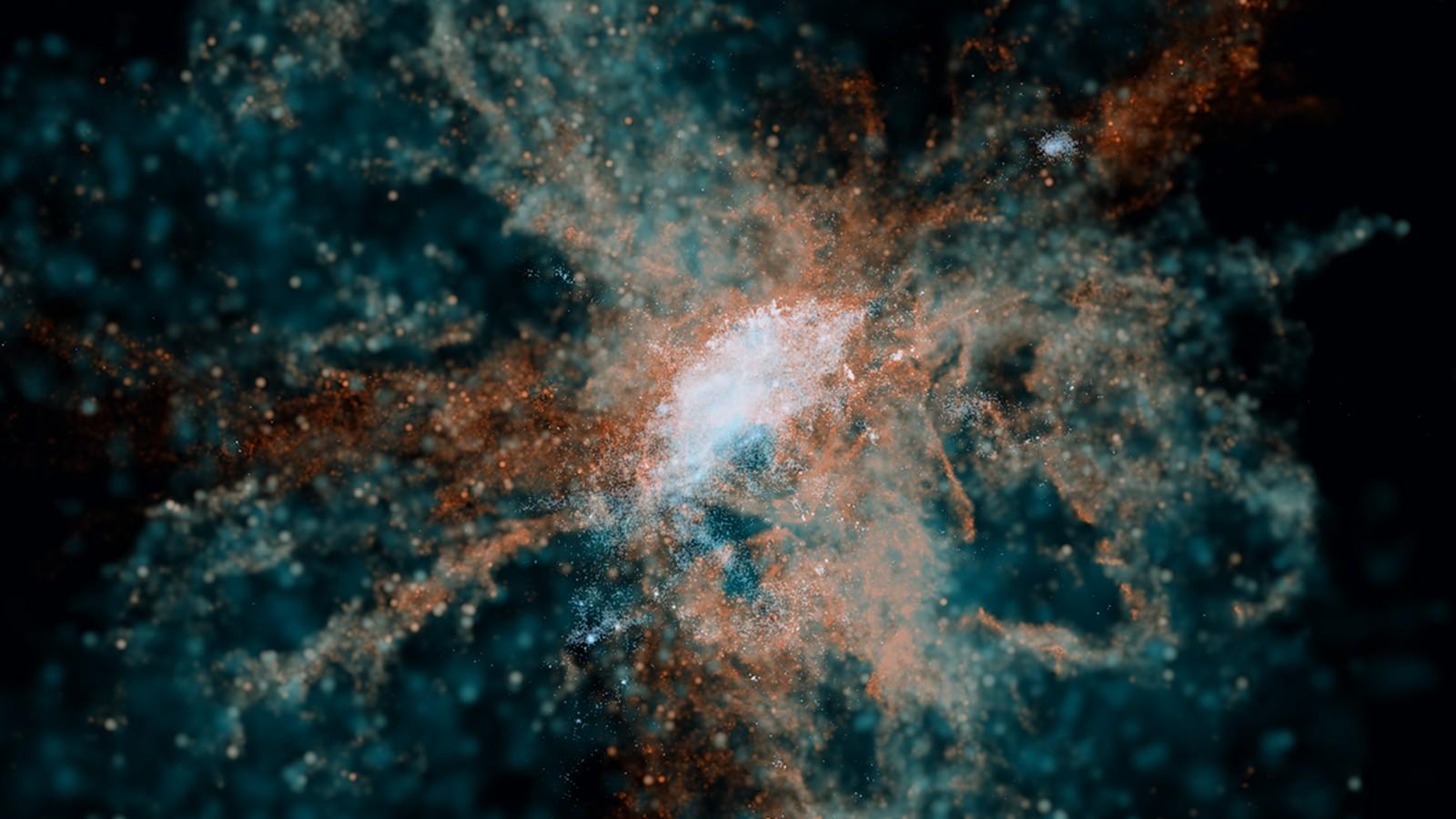
Why are those metals moving at all? The answer involves one of the most important processes in galaxy evolution, baryon cycling. A galaxy is not a closed system. It constantly exchanges gas, heavy elements and energy with the space around it.
The path is always the same. Primordial gas collapses to form stars. Inside their cores, fusion forges heavier elements. When those stars explode as supernovae or fade more gently, they return those elements to the interstellar medium. Winds and explosions then drive them outward, where they can enrich a new generation of stars, and sometimes a neighboring galaxy.
Yongda Zhu offers a simple image: "Think of these elements, which originated from the galaxies' stars, as food dye dropped into a cup of water. The color begins to spread through the water, and, in a similar fashion, these heavy elements from early galaxies began to escape into space and enrich their surroundings."
Why the first stars stay out of sight
Here the result meets an old mystery. Population III stars, the very first ones, would have formed from pristine gas made almost entirely of hydrogen and helium. Models describe them as giants hundreds of times more massive than the Sun, extremely hot, extremely bright and extremely short-lived. They should have left traces. Yet astronomers have never identified one with confidence.
If galaxies were already enriching their surroundings 500 million years after the Big Bang, then pristine gas did not stay pristine for long. Population III stars may have had only a narrow window in which to form before metals mixed through everything.
Zhu extends the comparison: "If you start out with pure vanilla ice cream but start mixing in sprinkles soon after, it won't be long until you can no longer find any pristine, plain, vanilla ice cream."
Recent theory fits that picture. Work published in 2025 shows that the rapid enrichment Webb observes does not require a large population of Population III stars. Population II stars, the next generation, already slightly enriched, can yield just as many metals, provided they are massive. In short, the very first stars may have been rare, and their absence from our telescopes may say less about our observations than about how quickly they vanished.
What it changes
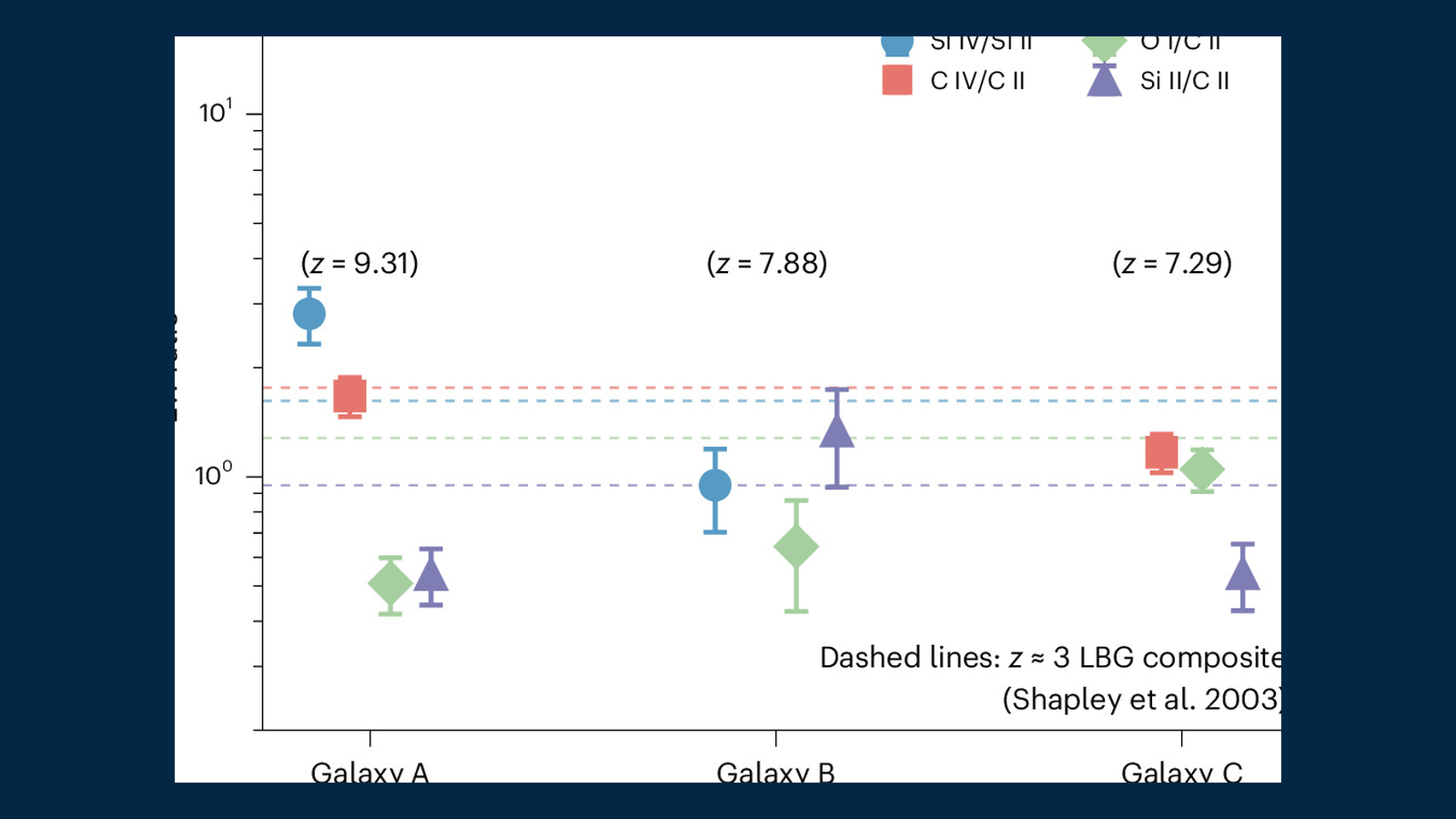
Three galaxies is a small sample. The study says so plainly. Reading notches that faint requires very bright galaxies with enough signal in the ultraviolet. Within the SPURS program, which observed these targets with the NIRSpec spectrograph on the James Webb Space Telescope across roughly 30 hours of exposure, only three met the criteria. The authors also note that the ratios between notches differ from one galaxy to the next, pointing to uneven enrichment across systems.
Still, the finding carries a point of principle. It shows that the ingredients of baryon cycling, metal enrichment and the coexistence of several gas phases, were already in place before the midpoint of the epoch of reionization, the moment when the first light made the universe transparent. Models predicted it. Observations now confirm it object by object, rather than as an average over large samples.
It also opens a lead. These galaxies belong to the "blue monsters" family, unusually luminous and dust-poor objects whose color puzzled astronomers. The gas escaping them could partly explain that look, by carrying away the dust that would otherwise redden their light. That would tie two puzzles of the early universe into a single story.
The data behind these observations are already public, and ongoing programs are pushing the technique toward even more distant galaxies, all the way to the doorstep of the first stellar generations.
Going further
- The telescope behind the discovery: the James Webb Space Telescope, whose NIRSpec spectrograph produced these measurements, with its full mission page and latest news.
- The ideas that make sense of it: galaxies, spectroscopy, infrared light and star formation. A supernova is where much of this chemistry begins.
- To find galaxies in your own sky: the interactive sky map and its observing guide. The astrophotography gallery shows what amateur observers capture of these same objects.
- The official sources: the scientific paper Zhu et al., Nature Astronomy (2026) and the University of Arizona release.