On September 19, 2026, the Hubble Space Telescope completed its 200,000th orbit around Earth. One of its observations that day addressed a signature Hubble quest: measuring how fast the universe is expanding. The target was supernova Athena, a star that blew up billions of years ago and whose light should reach us a second time between now and early March 2027. Here is why that return matters.
200,000 orbits, 36 years, and a telescope still on duty
The number is symbolic, and telling. Since its 1990 launch, Hubble has looped around Earth roughly every 95 minutes, close to 15 times a day, at 17,000 mph and about 300 miles up. Add that up over 36 years and you pass 200,000 laps, more than 5 billion miles of travel, and more than 1.7 million observations.
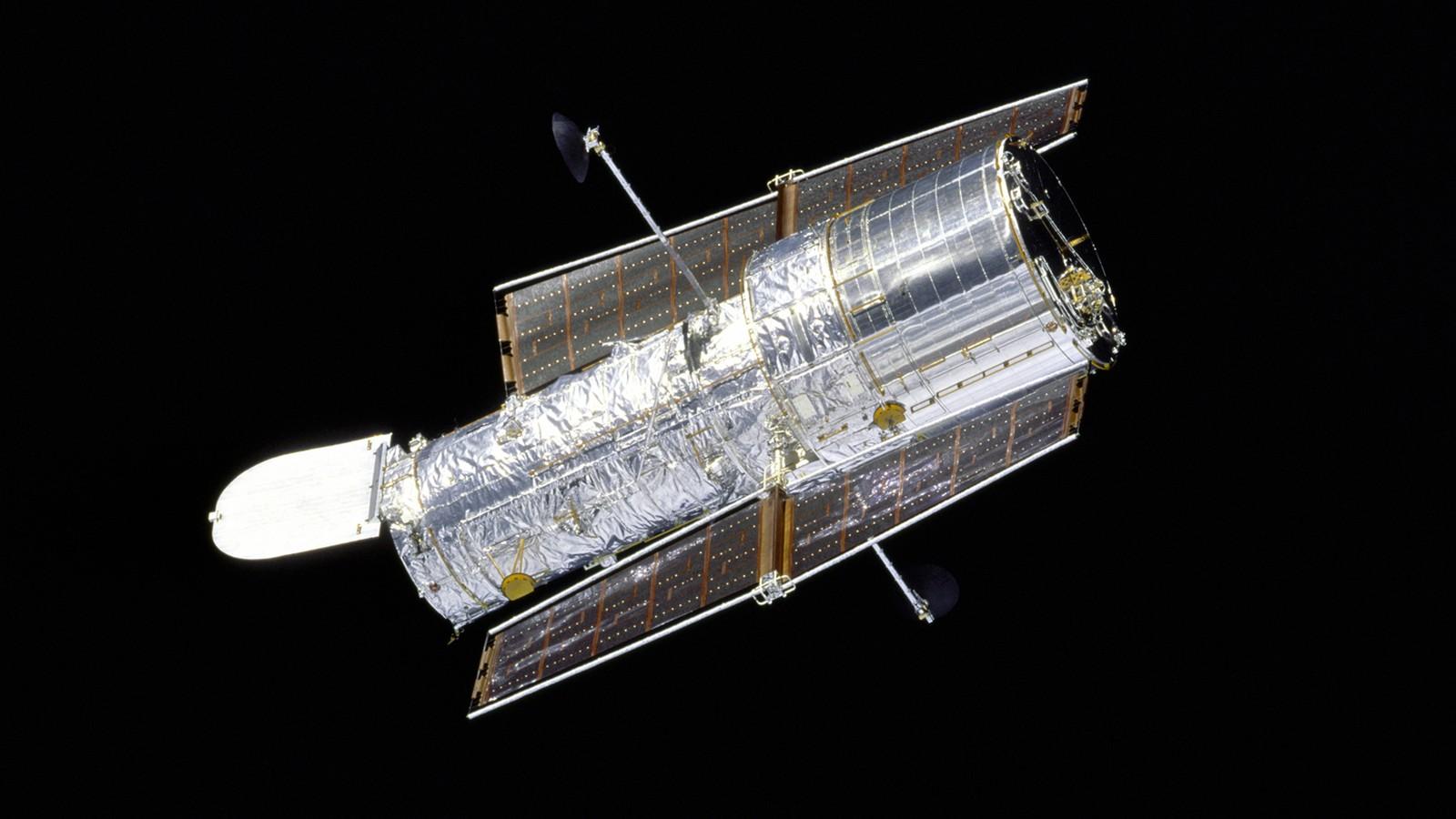
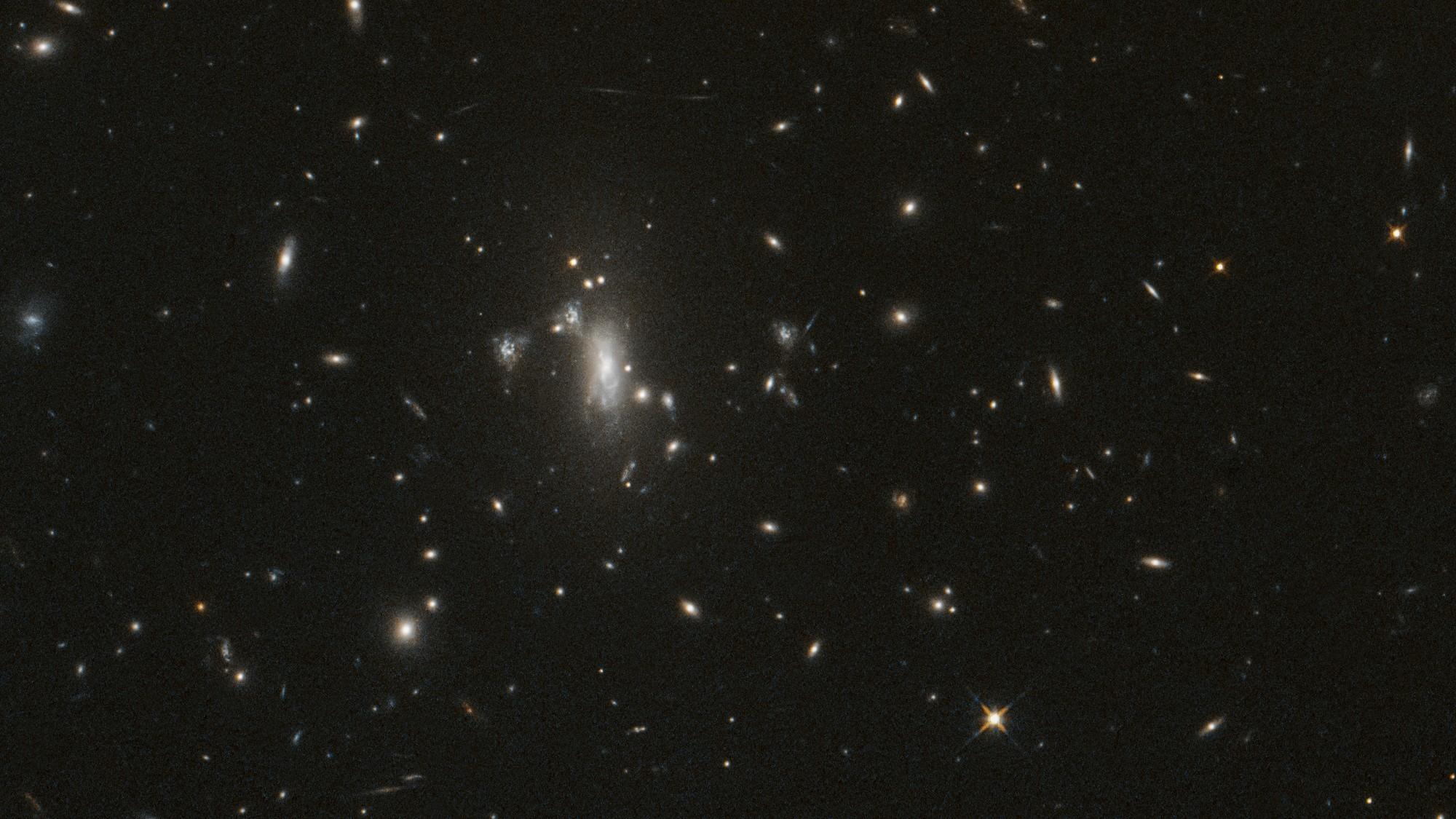
What makes the milestone worth a story is what was happening that very day. The observation completed on September 19 belongs to the science that built Hubble's reputation: pinning down the expansion rate of the universe, known as the Hubble constant. The telescope had its eye on galaxy cluster MACS J0417, a target picked for a very specific reason.
Hubble is no longer the only great eye in orbit, and that is precisely what extends its mission. Its instruments read ultraviolet and visible light, wavelengths where the infrared-sensing James Webb Space Telescope sees less. The two complement each other, and demand keeps far ahead of supply: astronomers ask for roughly seven times more hours than Hubble can deliver each year.
Athena, the supernova we will see twice
Back to cluster MACS J0417 and what it conceals. Behind it sits supernova Athena, the explosion of a massive star, found by the James Webb Space Telescope in 2025 and announced by the VENUS observing program, which uses the infrared observatory to survey 60 galaxy clusters. Athena blazed when the universe was about half its current age.
Here is the detail that changes everything: we will not see it once, but several times. The reason lies in the path its light takes. Cluster MACS J0417 is a colossal concentration of matter, and according to Einstein's general theory of relativity, mass curves the space around it. Light grazing the cluster therefore does not travel straight: it is deflected, stretched and magnified. The cluster behaves like an irregular, bumpy magnifying glass placed between the explosion and us.
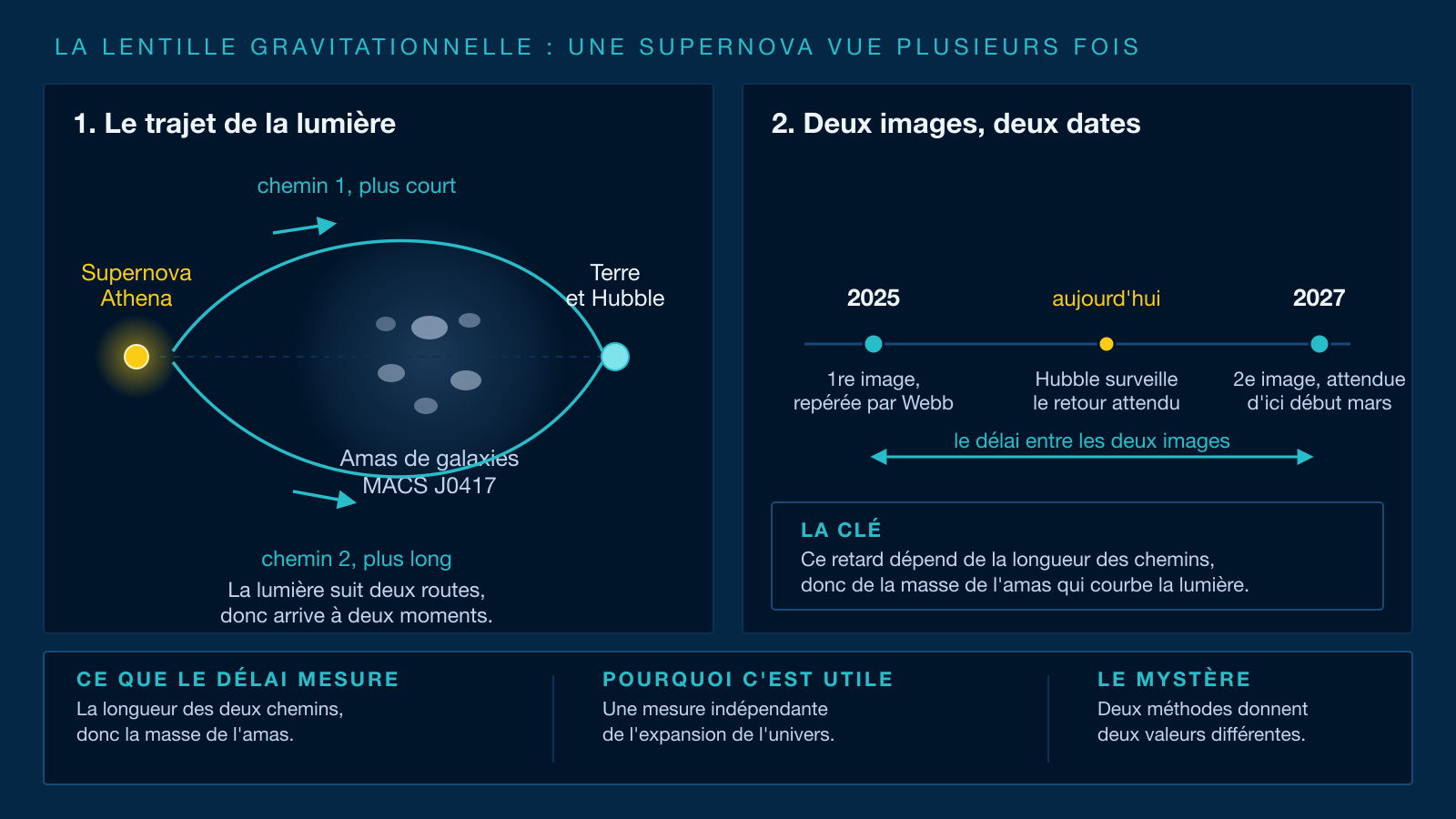
An ordinary lens forms a single image. A bumpy lens does not. Depending on exactly where the light crosses it, the light emerges along a longer or shorter route, and each route delivers its own image of the supernova, at a different spot in the sky. Two routes of different lengths also mean two travel times. Picture two hikers leaving the same lodge for the same village: one takes the direct road, the other a winding mountain trail. They arrive at different hours despite setting off together.
This is where Hubble steps in. The telescope images the cluster in repeated series, watching for Athena's second image. The forecast is tight: it should surface between now and early March 2027. The VENUS program also found a second supernova of the same kind, Ares, whose final image will not arrive for about 60 years, which shows the scale of the phenomenon.
Why this return is worth its weight in cosmology
A delay between two images is no mere curiosity. Its length depends on how long the two paths are, and that in turn depends on how the cluster's mass curves space. By timing Athena's return, astronomers map the mass of MACS J0417, which lets them pin down the supernova's distance properly. And a well-measured distance across the cosmos delivers one more handle on the Hubble constant.
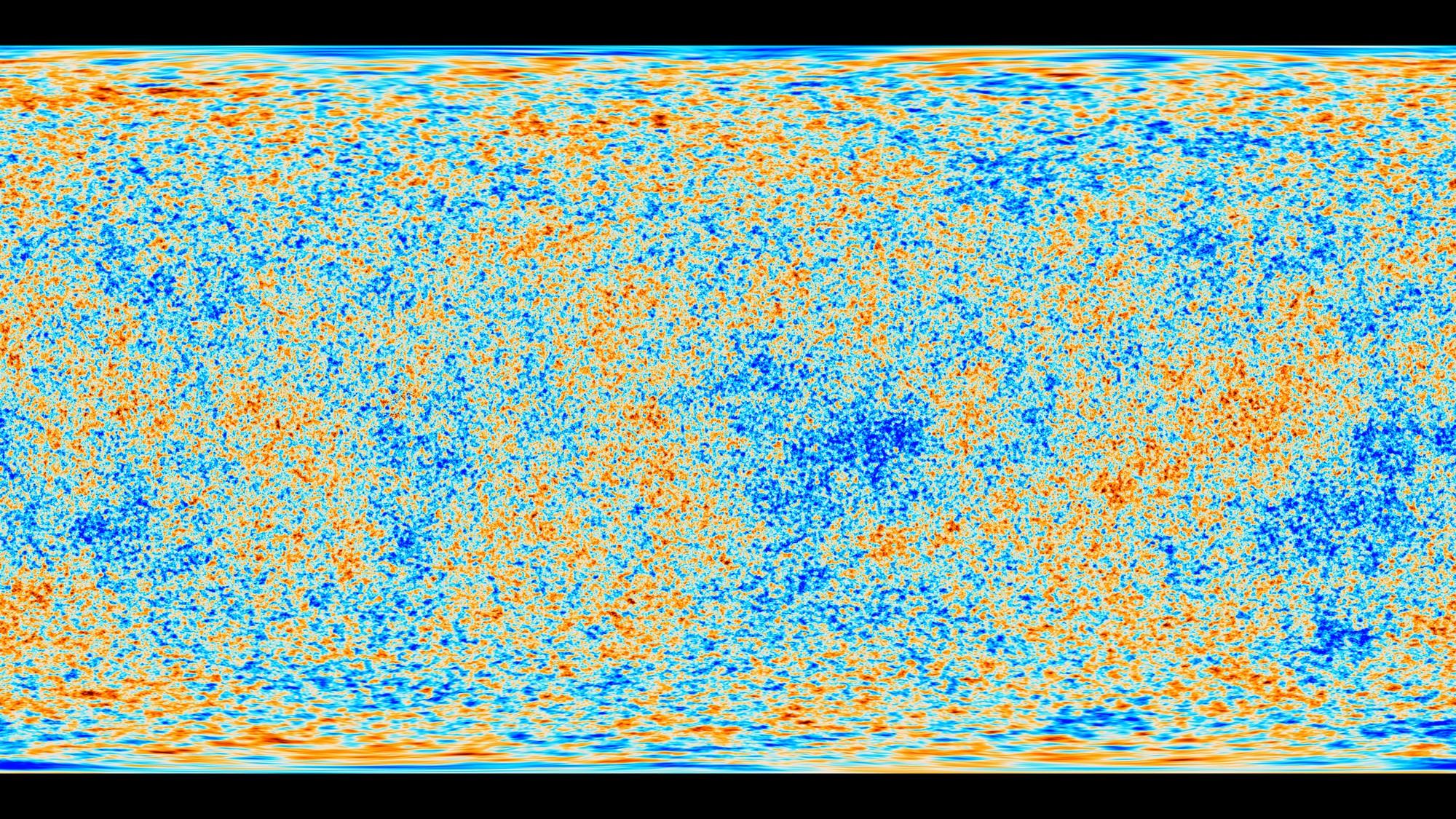
Why press on this measurement? Because the value of the Hubble constant is not settled, and the disagreement has a name: the Hubble tension. Two families of methods give two answers. Early-universe estimates start from the cosmic microwave background, the oldest light in the universe, released when the cosmos was only 380,000 years old. That baby picture, built by ESA's Planck satellite, points to a constant of 67.4 km/s per megaparsec. Late-universe estimates rely on a distance ladder built from standard candle stars and return 73.04. The gap exceeds 5 sigma, the threshold physicists treat as solid evidence of a real discrepancy.
To picture these numbers, think of a cosmic rule of three. A constant of 70 km/s per megaparsec means a galaxy 3.26 million light-years away recedes by 70 km every second. Twice as far out, it flees twice as fast. The constant therefore sets the tempo of space's expansion, and a shift of a few units rewrites how we read the universe's history.
That is exactly where Athena earns its keep. The delay between its two appearances is written into the cluster's geometry, independent of standard candle stars and of the cosmic microwave background. A third opinion, measured another way. "The predicted time delay to the next image of SN Athena of a few years will allow us to weigh in on the value of the Hubble Constant at a time when such an independent measurement is sorely needed," says Justin Pierel, a researcher at the Space Telescope Science Institute, which runs science operations for Hubble and Webb.
One caveat remains, and the team owns it: Athena's return could shore up the standard model, or it could expose a flaw in our best cosmological analyses. Either way, the date is set for spring 2027.
Going further
- The mission page of Hubble, the telescope marking its 200,000th orbit, and of the James Webb Space Telescope, which spotted Athena.
- Key ideas to follow the story: the supernova, the explosion of a dying star, and the galaxies that fill the lensing cluster.
- To understand what a space telescope adds over a ground-based instrument, see the space telescope entry in our glossary.
- To track down galaxy clusters and the brightest galaxies in the sky, the interactive sky map and the observing guide are the place to start. The astrophotography gallery shows what amateurs capture of those same objects.
- Official sources: the NASA release on the 200,000-orbit milestone, the VENUS program release on supernova Athena and NASA's update on the Hubble tension.