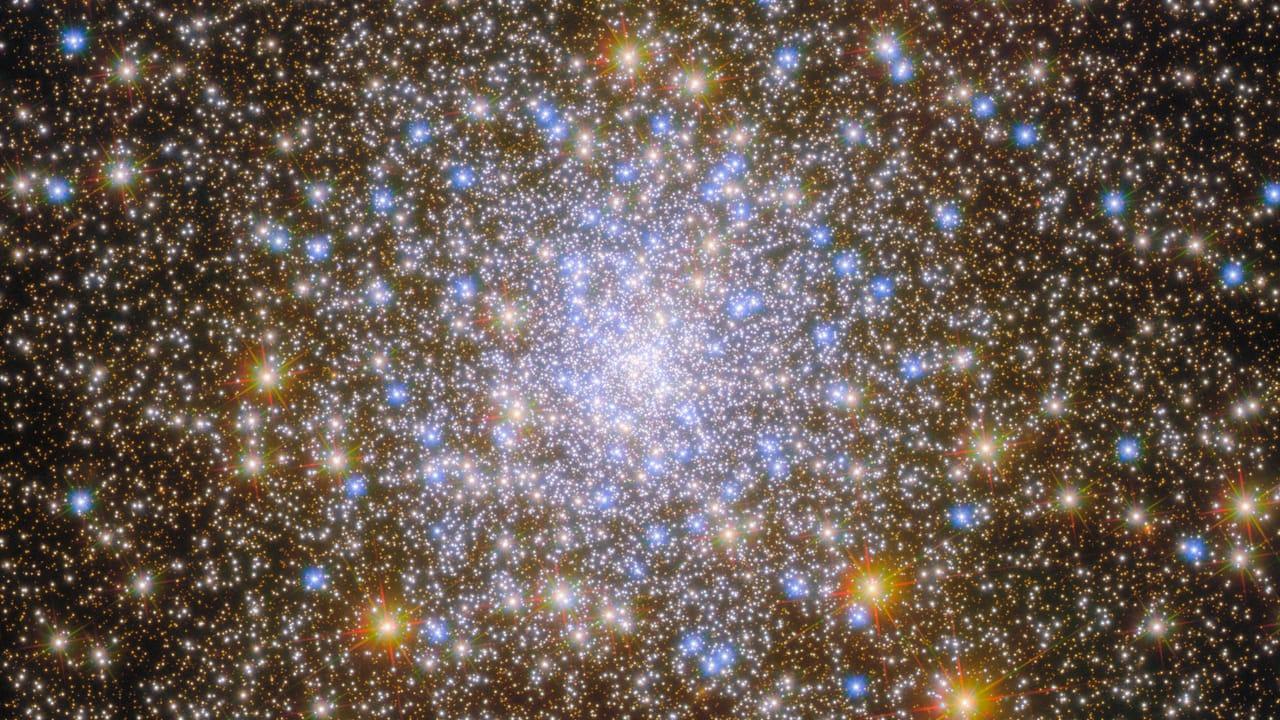
On November 5, 2026, NASA and ESA released a new image of M30, a globular cluster about 27,500 light-years away in the constellation Capricornus. The picture combines three Hubble observing programs and three bands of light: ultraviolet, visible and near-infrared. Yet the most striking part is not the image. M30 and many other clusters orbit in the direction opposite to the Milky Way's spin. That path suggests the cluster did not form here, and that our galaxy captured it long ago. To test the idea, Hubble tracked how its stars moved over fifteen years.
A cluster 13 billion years old
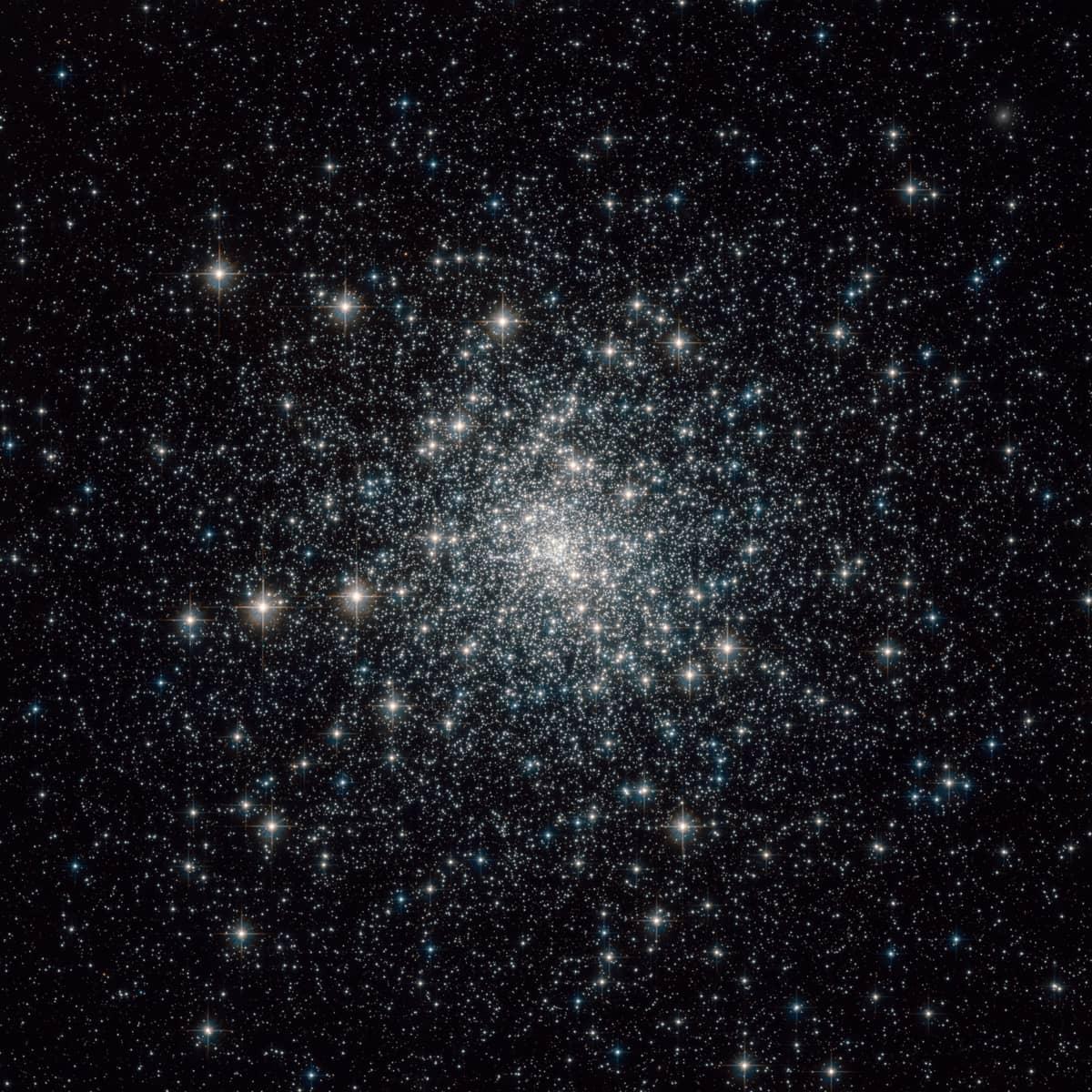
A globular cluster is a roughly spherical group of stars held together by gravity. It can contain tens of thousands to millions of stars, all born from the same cloud. M30, also known as NGC 7099, holds several hundred thousand of them. It spans about 90 light-years and formed 13 billion years ago. Charles Messier discovered it in 1764 and gave it its catalogue name. It shines at apparent magnitude 7.7, on a scale where a smaller number means a brighter object. As a result, M30 remains visible through binoculars, especially in October.
These clusters are not scattered at random. They orbit at the outskirts of galaxies, in a vast, diffuse region called the halo, like a swarm of moths around a lightbulb. The Milky Way has at least 150 of them, and the nearest lies about 6,000 light-years away. Their ages run from 11.5 to 13.5 billion years, which makes some of them among the oldest objects in the universe.
That matters. These clusters watched the Milky Way take shape. Those born here preserve the chemistry of the young galaxy, like time capsules. The others tell a different story.
Why M30 orbits backwards
The Milky Way spins. Its disk, with its spiral arms, carries stars and gas along in one overall motion. M30 and many other globular clusters, however, orbit the other way. Researchers have measured it, and the anomaly has a possible explanation. These clusters may not have formed in our galaxy at all. They may have come from elsewhere, and the Milky Way may have captured them in the distant past.
The idea is not new. In the early twentieth century, Harlow Shapley used a type of variable star, whose brightness changes on a regular rhythm, to locate dozens of globular clusters. His work showed that the Sun is not at the centre of the galaxy, and that the galactic centre lies toward the constellation Sagittarius. Shapley got the distances wrong, though. He concluded that the Milky Way was about twice as large as it really is.
Today, clusters still serve as landmarks. Their orbits are a memory. A cluster born in the galaxy follows the general motion. A captured cluster can keep an orbit inherited from its original galaxy, sometimes running backwards. That is what M30 suggests.
Fifteen years of watching stars
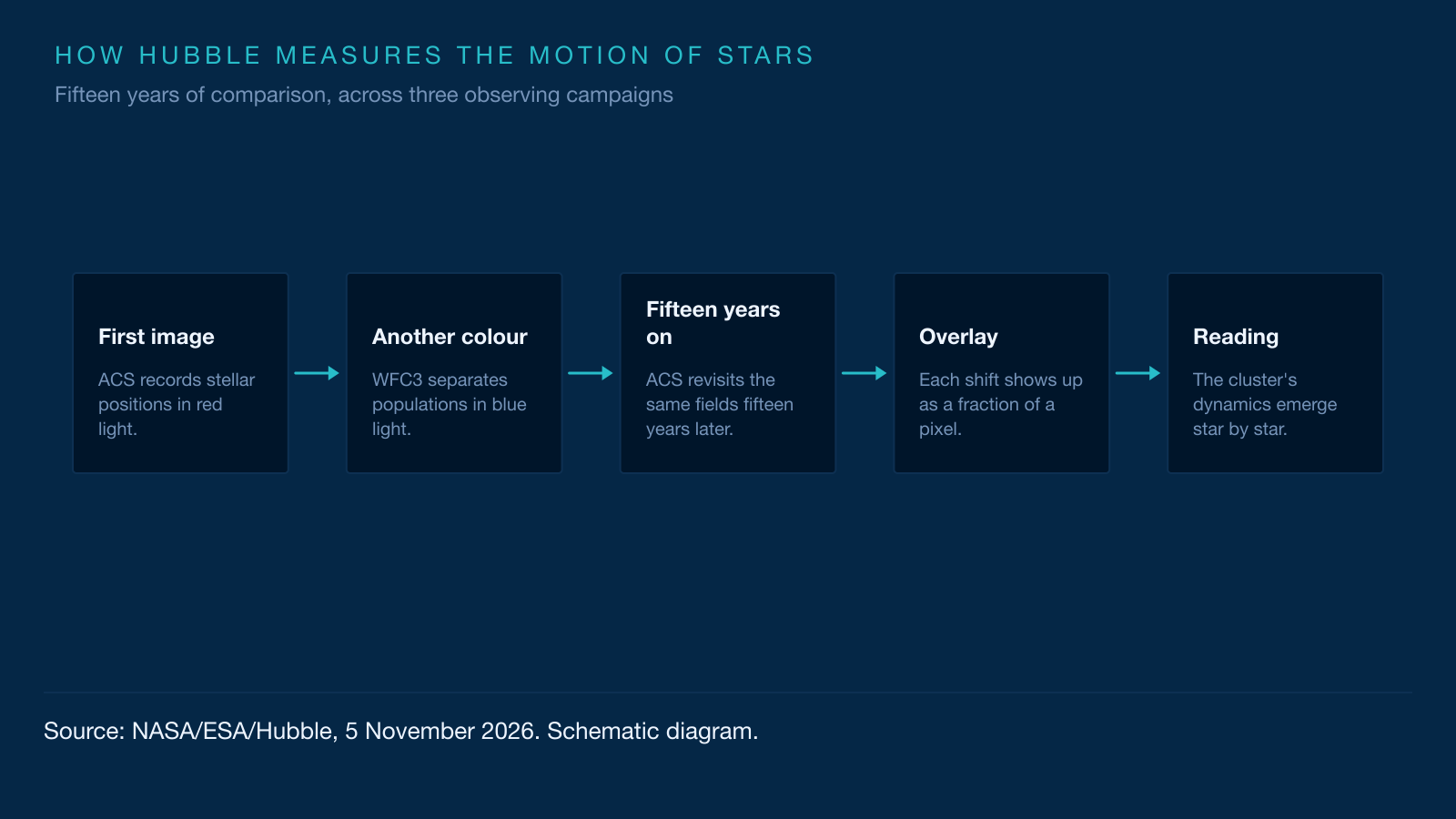
To look back in time, Hubble photographed M30 several times with different instruments. Three programs work together. The first, program 10775, led by Sarajedini, surveyed dozens of clusters in red and near-infrared light. It revealed stars down to just 20% of the Sun's mass. The second, program 13297, led by Piotto, returned with Wide Field Camera 3 and three filters that captured bluer light. The goal was to study blue stragglers and the multiple stellar populations that share a single cluster. The third, program 16298, led by Libralato, revisited the same clusters with ACS. This time, it measured how the different populations moved over the fifteen years since Hubble first observed them.
The principle is simple. Hubble takes a picture. Fifteen years later, it takes the same one again. In between, the stars have moved. Not by much, just fractions of a pixel. But Hubble can see it. By comparing positions, astronomers measure the proper motion of each star, meaning its apparent shift across the sky.
Stars that will not grow old
In a cluster this ancient, stars should be cool and red. Some shine with a clear blue light instead. They are called blue stragglers. They seem to lag behind the ageing of the rest of their population, as if they had regained a hot, bright youth.
Two mechanisms can make them, and M30 is one of the rare clusters where both have been identified. First, two stars collide almost head-on and merge. The collision mixes their hydrogen fuel, and the new star burns faster, therefore hotter and bluer. Second, a binary pair, where one star siphons hydrogen from its companion. This is the stellar vampirism model.
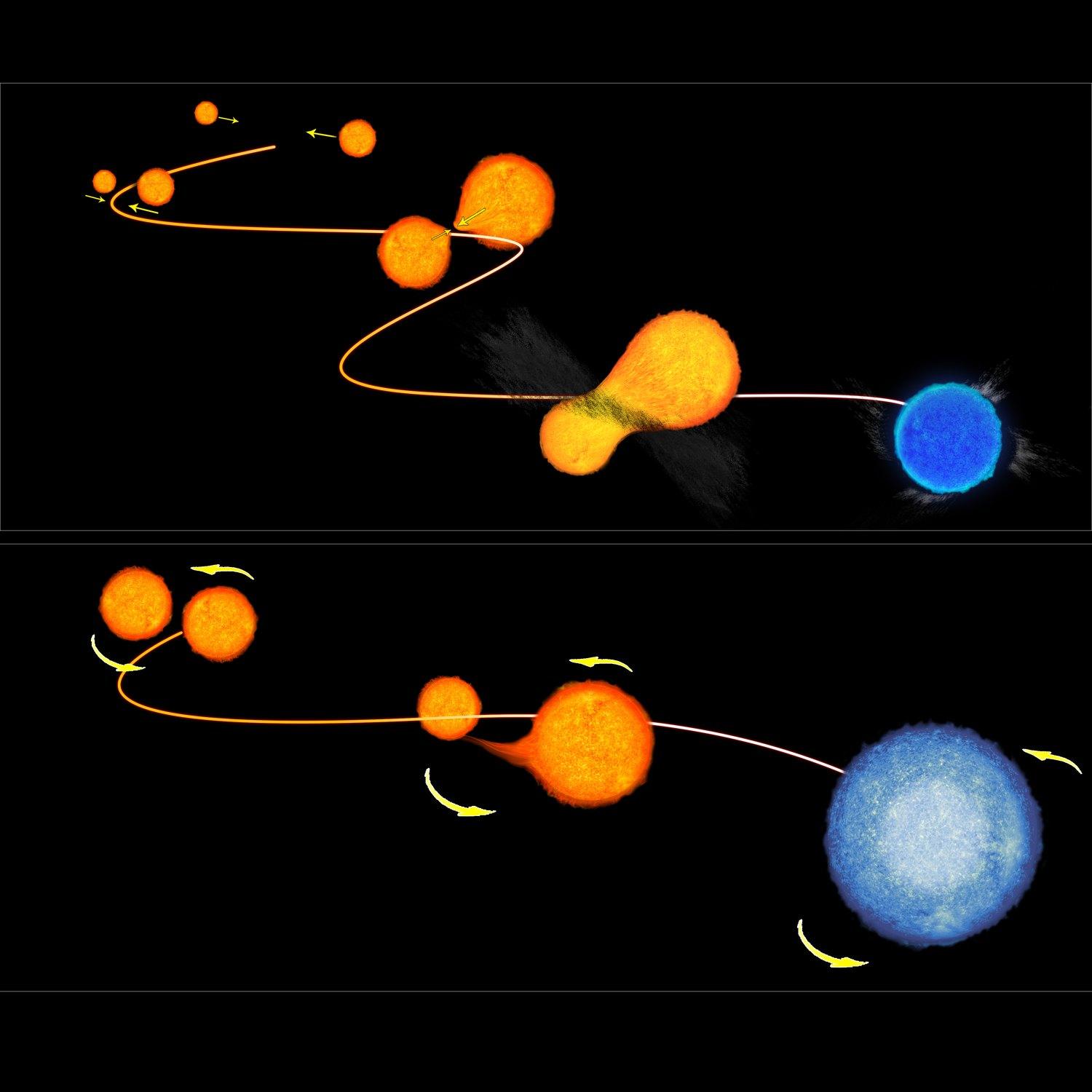
A study published in Nature on December 24, 2009 brought these stars into focus. The team led by Francesco Ferraro, of the University of Bologna, used Hubble's retired WFPC2 camera. It showed that both families exist in M30, with slightly different properties. Better still, the stars are more concentrated toward the centre than the cluster average, which indicates that they are more massive. Like a billiard ball sinking in a bucket of honey, massive stars drift down to the core.
The explanation comes down to one event. One or two billion years ago, M30 may have undergone a core collapse. The stellar density rose, encounters and collisions multiplied, and binary pairs were disturbed. Both formation channels then went into overdrive. About 10% of the Milky Way's globular clusters have experienced such a collapse, but this is the first time its effect has been seen in a stellar population. "The two distinct populations of blue stragglers discovered in Messier 30 are the relics of the collapse of the core that occurred two billion years ago," Ferraro summarises.
One image captures the oddity. "It's like seeing a few kids in the group picture of a rest-home for retired people. It is natural to wonder why they are there," the researcher says.
What M30 says about the Milky Way
M30 is more than a pretty cluster. It is a piece of galactic archaeology. Ancient globular clusters keep the memory of how the Milky Way was assembled. Those born here preserve the chemistry of the young galaxy. Those that arrived from elsewhere record the galaxies that were absorbed.
In this scenario, the Milky Way did not grow alone. It merged with smaller galaxies, whose stars and clusters were folded into the halo. A backwards orbit is one trace of that history. M30, with its retrograde path and its blue stragglers, is therefore a double witness. A witness to its own dynamics, and a witness to the assembly of the galaxy.
The new image sums up that work. Its colours are not decoration. Ultraviolet light reveals the hottest stars, visible light shows the bulk of the population, and near-infrared light pierces the dust to reveal cool stars. By combining all three, Hubble gives a fuller picture of what the cluster contains. Each wavelength helps us understand how these groups of stars formed and evolved.
One question remains open. Was M30 really captured? The answer will come from finer measurements, from its trajectory and from its chemistry. In the meantime, the cluster offers a dizzying shortcut. To look at M30 is to look at thirteen billion years of galactic history, packed into a ball of stars.
Going further
- The NASA/ESA release "Hubble Learns Galactic History From Stars", published on November 5, 2026.
- The ESA/Hubble Picture of the Month, "Lessons from a stellar instructor", with the image and its credits.
- The Messier 30 page of NASA's Hubble Messier catalogue, updated on November 5, 2026.
- The ESA/Hubble release on the two families of blue stragglers, published on December 23, 2009.
- The spacecraft: Hubble and its instruments, ACS and Wide Field Camera 3.
- The concepts: the Milky Way, galaxies, ultraviolet and infrared.
- For observers: find M30 in Capricornus with the sky map, and use the observing guide to plan the evening.