Hubble is coming down, slowly, and NASA has just asked the space industry for help. On October 29, 2026, the agency published a Request for Information on commercial servicing for the telescope. Three ideas are on the table: lift it higher, fix it where it flies, or bring it down under control. Answers are due November 30, and the calendar is tight.
Three possible endings for a telescope with no engine
A NASA Request for Information, or RFI, is not a call for bids. It is a question put to industry. NASA describes a need and asks companies what they can do about it, with which vehicles, on what schedule, and at roughly what price. Nothing guarantees a contract will follow.
The October 29 document splits the problem three ways. Option one, send a vehicle up to boost Hubble to a higher altitude and give it more years of science. Option two, service the telescope on orbit, replacing or modernizing its instruments. Option three, and the least cheerful, plan a safe, controlled re-entry into the atmosphere at the end of its life, or a clean orbital disposal.
"Hubble still has important science ahead of it, and we should be looking at every reasonable opportunity to keep it delivering for as long as possible," said NASA administrator Jared Isaacman. "If there are innovative and cost-effective ways to extend the life of an asset already on orbit, we owe it to the American taxpayer and the scientific community to explore them. Extending Hubble's life would mean more discoveries, more science, and more opportunities to expand our understanding of the universe."
The deadline is 3 p.m. EST on Monday, November 30. Hubble is a joint NASA and European Space Agency (ESA) project, and ESA has been a partner from the start.
Why the countdown started on launch day
Hubble has never had an engine. A space shuttle carried it to orbit on April 24, 1990, and let it go. Discovery's crew released the telescope about 500 kilometers above the ground, where it has circled ever since at 17,000 miles per hour, one lap every 95 minutes.
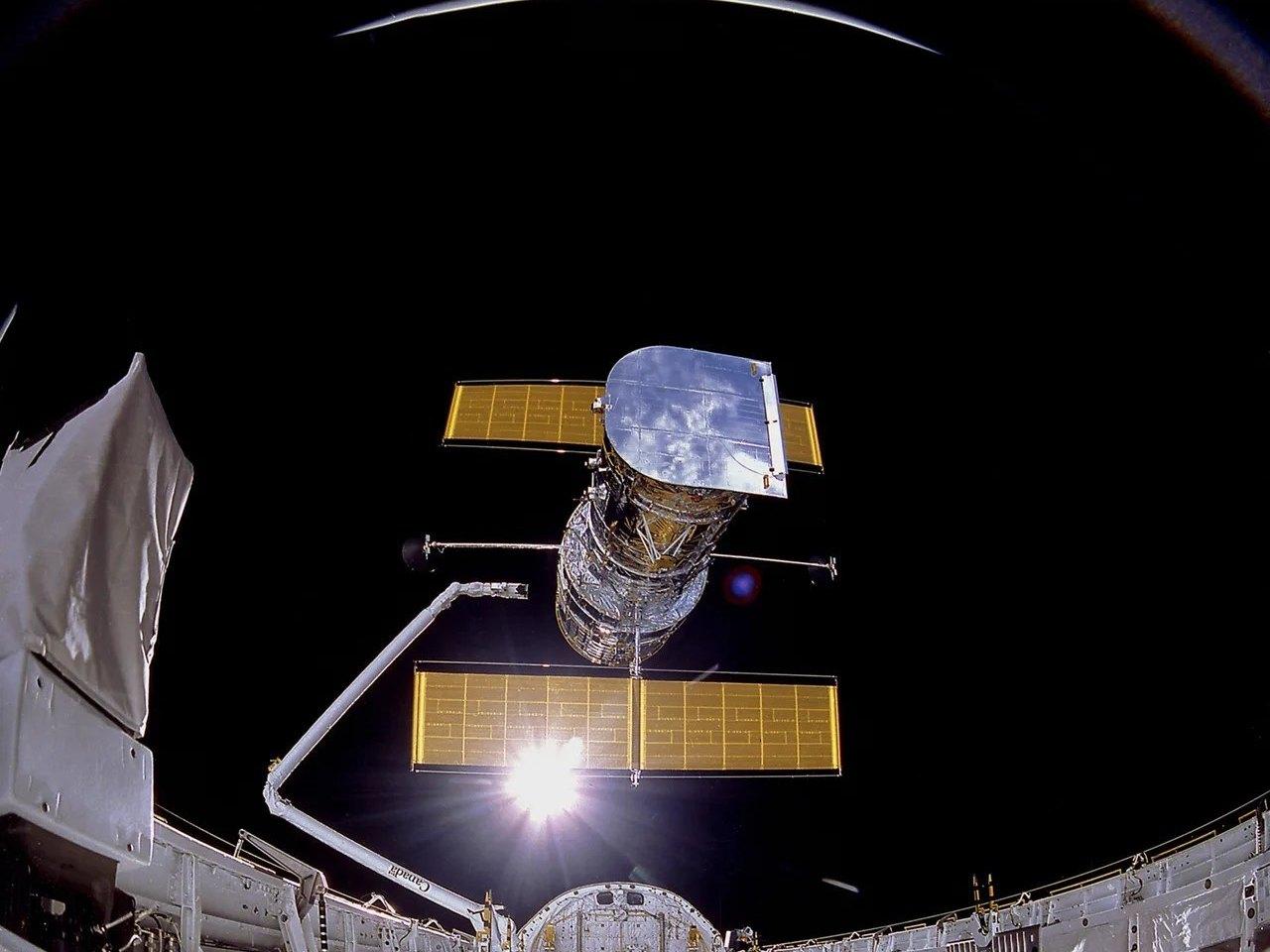
At that height the atmosphere has not disappeared. It has only become extraordinarily thin. The few air molecules still drifting around up there bump into the telescope and slow it, imperceptibly. Every orbit costs it a little energy, and therefore a little altitude. Picture a cyclist who stops pedaling on a perfectly flat road. Nothing is braking, and yet the bike slows, because the air takes its cut. For a satellite, losing speed means losing height.
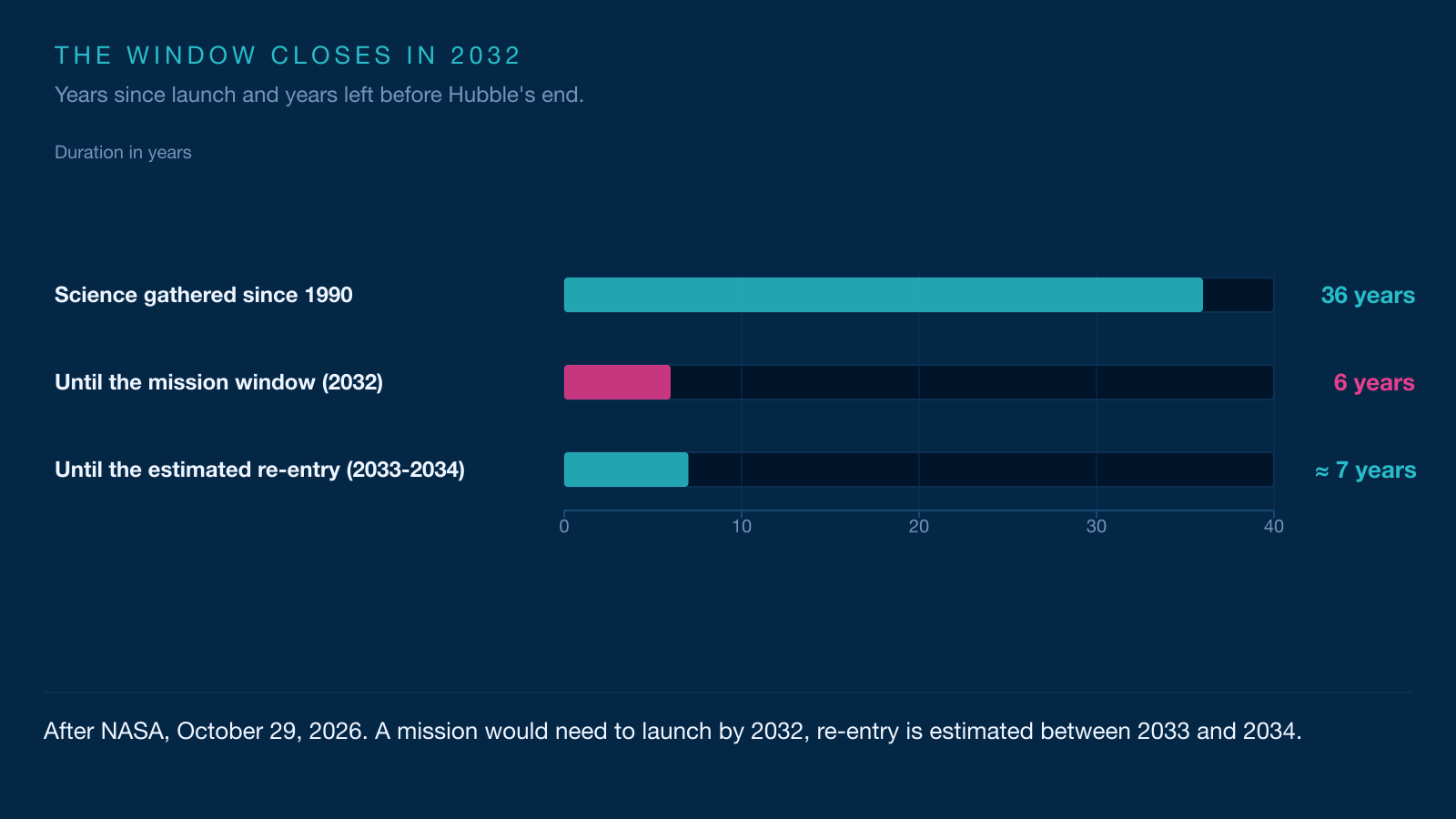
With no propulsion to make up the loss, Hubble cannot climb back. NASA now expects it to re-enter the atmosphere between 2033 and 2034. A servicing or boost mission would therefore have to launch by 2032 at the latest. That is where the urgency comes from, and that is what the chart below measures. Set against the 36 years already spent in orbit, the time left looks very short.
The telescope built to be fixed in space
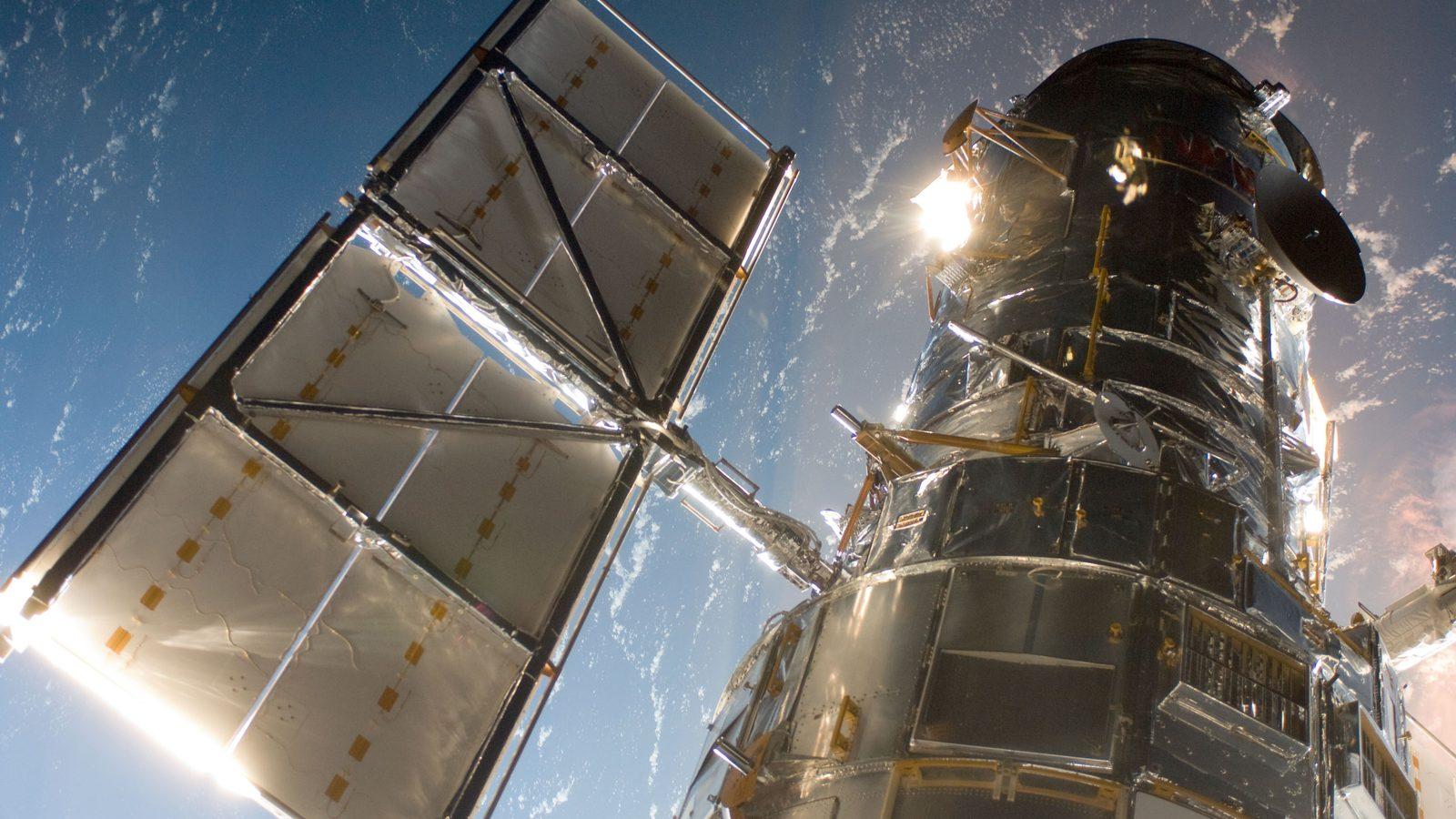
Hubble holds a rare advantage. It was designed to be serviced by astronauts. NASA calls it the first space observatory built specifically to be maintained by crews in orbit, and its handles, connectors and modular instruments made that maintenance possible.
Five shuttle missions followed between December 1993 and May 2009. The first fixed the main mirror, which had been polished to the wrong shape and was returning blurry images. The next ones swapped out solar arrays, gyroscopes, batteries and scientific instruments. The astronauts also used the shuttle's thrusters to nudge the telescope a little higher each time, a shove that added years to its life.
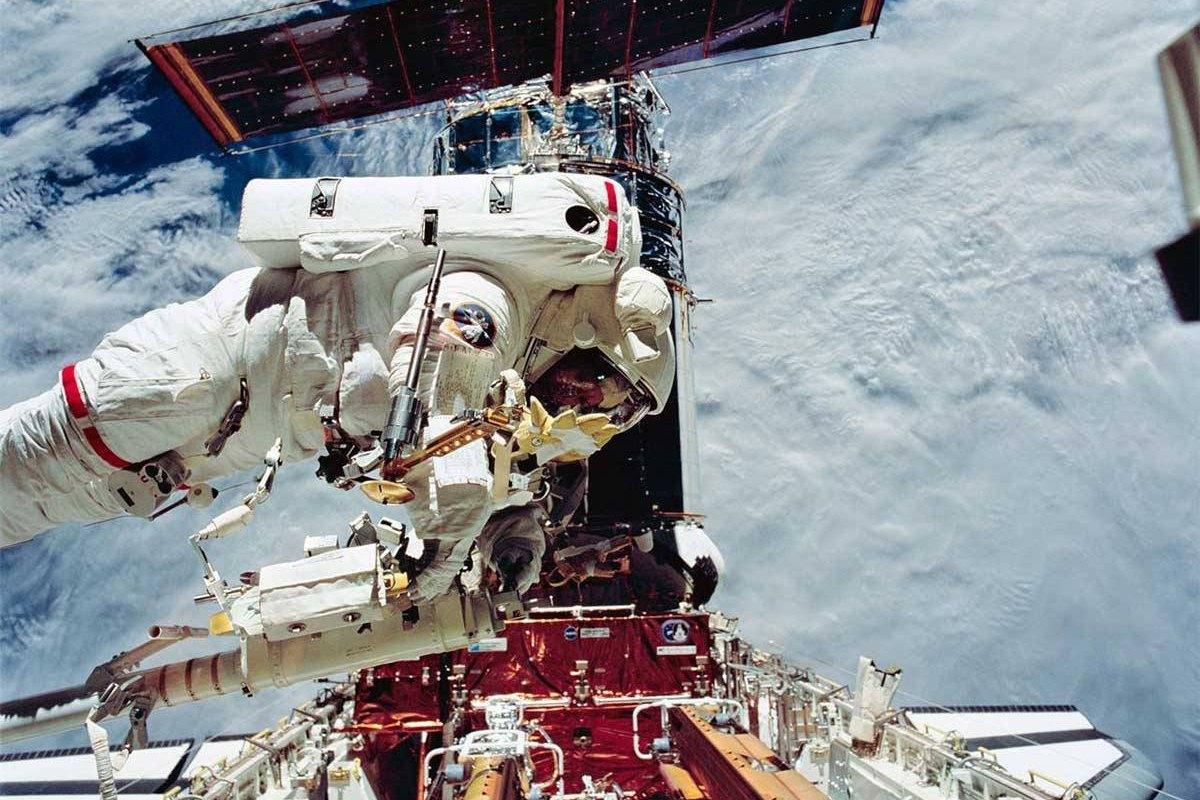
The last mission, in May 2009, was the heaviest of them all: five spacewalks over 12 days, and 36 hours and 56 minutes of work outside. The crew installed two new instruments, the WFC3 camera and the COS spectrograph. They repaired two more, the STIS spectrograph and the ACS camera, and put in fresh batteries. A spectrograph splits light into its wavelengths, so astronomers can read what distant objects are made of. They also bolted a fitting to the base of the telescope, designed to make a future deorbit easier. That detail suddenly matters a great deal.
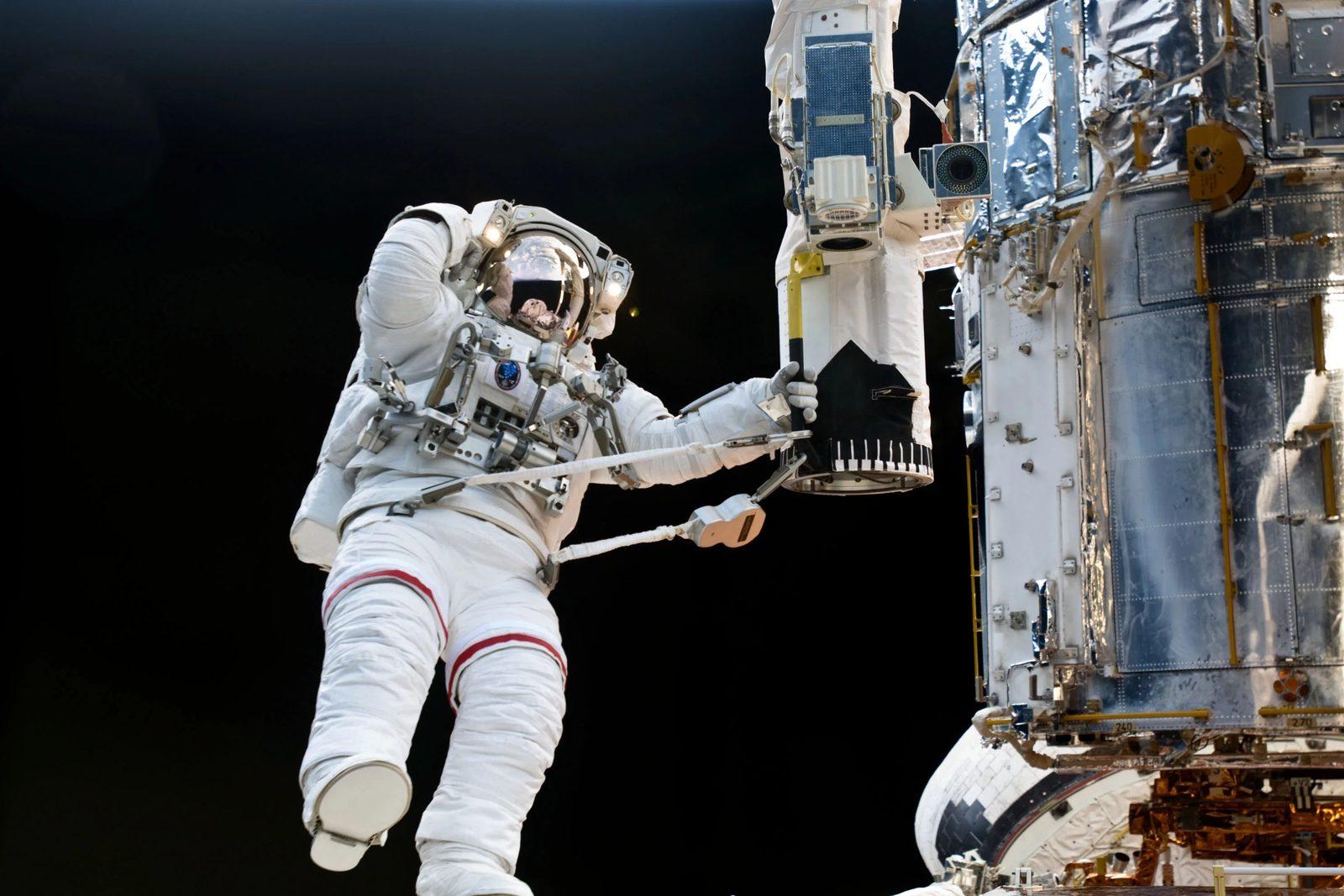
NASA also points out how quickly the commercial sector has learned to catch and tend satellites in orbit. "Hubble is a national icon that has fundamentally changed how humanity views our universe for more than 35 years," said Nicky Fox, associate administrator of NASA's Science Mission Directorate. "Commercial industry has rapidly evolved in recent years to offer new capabilities for in-space satellite capture and servicing. Given the time we have until Hubble's anticipated re-entry, we are eager to explore the breadth of possibilities to boost Hubble to a higher orbit while we develop the flagship mission to follow."
Catching Hubble remains hard. The telescope weighs about 12 metric tons. A vehicle would first have to match its orbit, then close in without touching it. The fitting installed in 2009 gives a future spacecraft something to grab. Boosting it means pushing those 12 metric tons without setting the telescope spinning, because the instruments have to stay pointed at the sky. Think of pushing a loaded van across a parking lot while keeping its headlights on one exact star.
What still has to be settled
NASA does not pick a winner in its document. It asks, compares, and leaves the decision for later. The timetable, though, does not move. The 2032 window leaves barely six years to design a vehicle, launch it and fly it around a telescope that was never meant to be docked with automatically.
The controlled re-entry option deserves a straight look too. With no vehicle to steer it, a 12-metric-ton object would come down wherever its orbit sends it, with a small but real risk to populated areas. A controlled re-entry means aiming at an empty stretch of ocean and spending propellant, the fuel a rocket engine throws out to move, to slow down in the right place. It is the fallback, the one that protects people on the ground and gives nothing back to science.
Then there is the real question. Hubble has been watching the sky for 36 years, and NASA still describes it as a productive instrument that the scientific community keeps citing. Every extra year is another year of observations, particularly in ultraviolet light. Hubble works mostly between 0.1 and 2.5 microns. A micron is one millionth of a meter, and that range covers visible light along with the ultraviolet and near-infrared on either side of it. The big infrared observatories such as Webb cannot see the ultraviolet at all. Industry's answers on November 30 will show whether another chapter has an acceptable price.
Going further
- NASA's official page on the request: NASA Explores Potential Commercial Servicing for Hubble Telescope, and the posting on SAM.gov.
- The story of Hubble's five servicing flights, told by NASA: Astronaut Missions to Hubble.
- NASA's own comparison of Hubble and Webb, and what each one can see: Hubble vs. Webb.
- The Hubble mission page, plus the ideas behind it: low Earth orbit and the space telescope.
- On this site: our article on Hubble's 200,000th orbit, the interactive sky map, the observing guide and the astrophotography gallery.