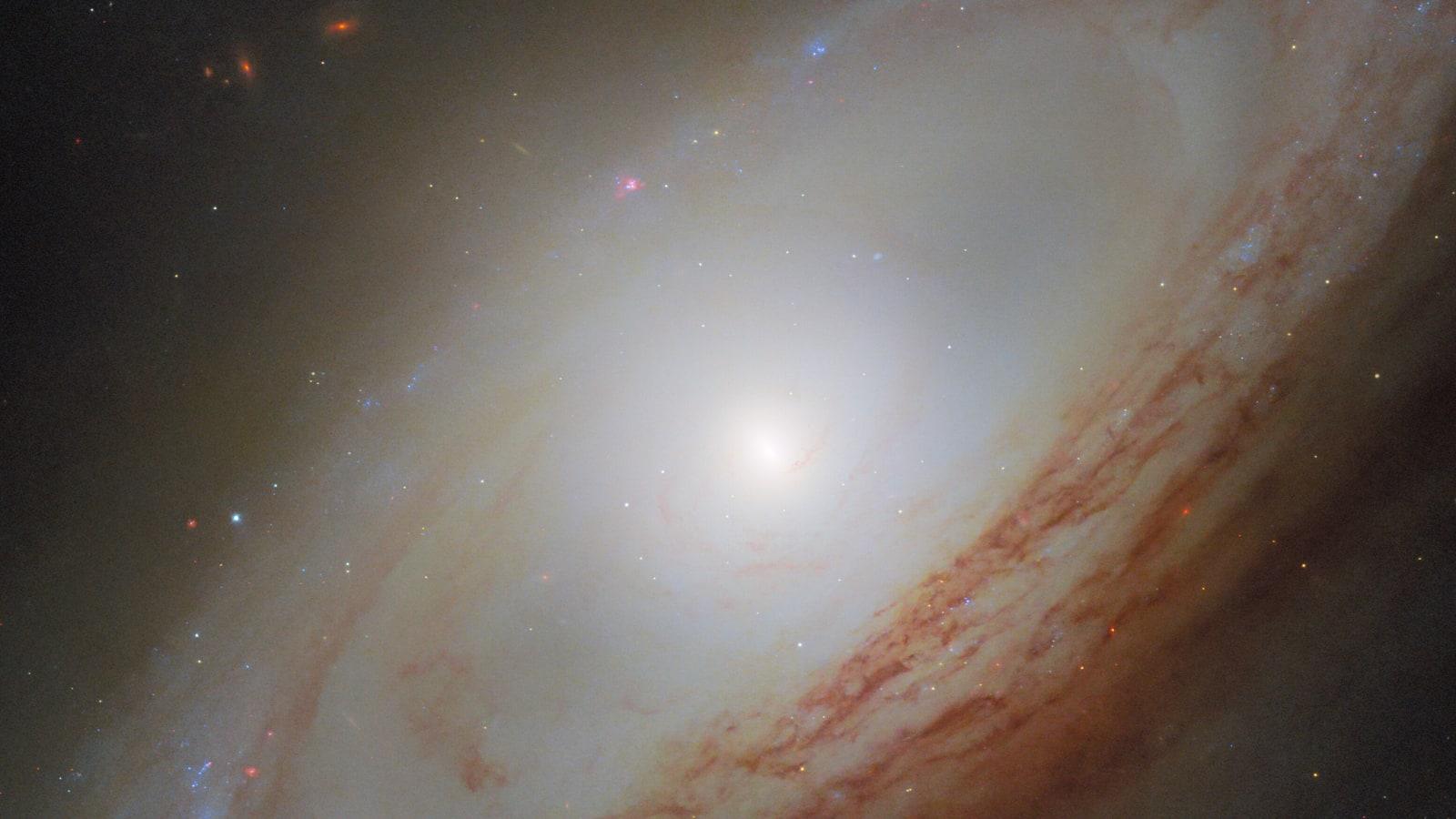
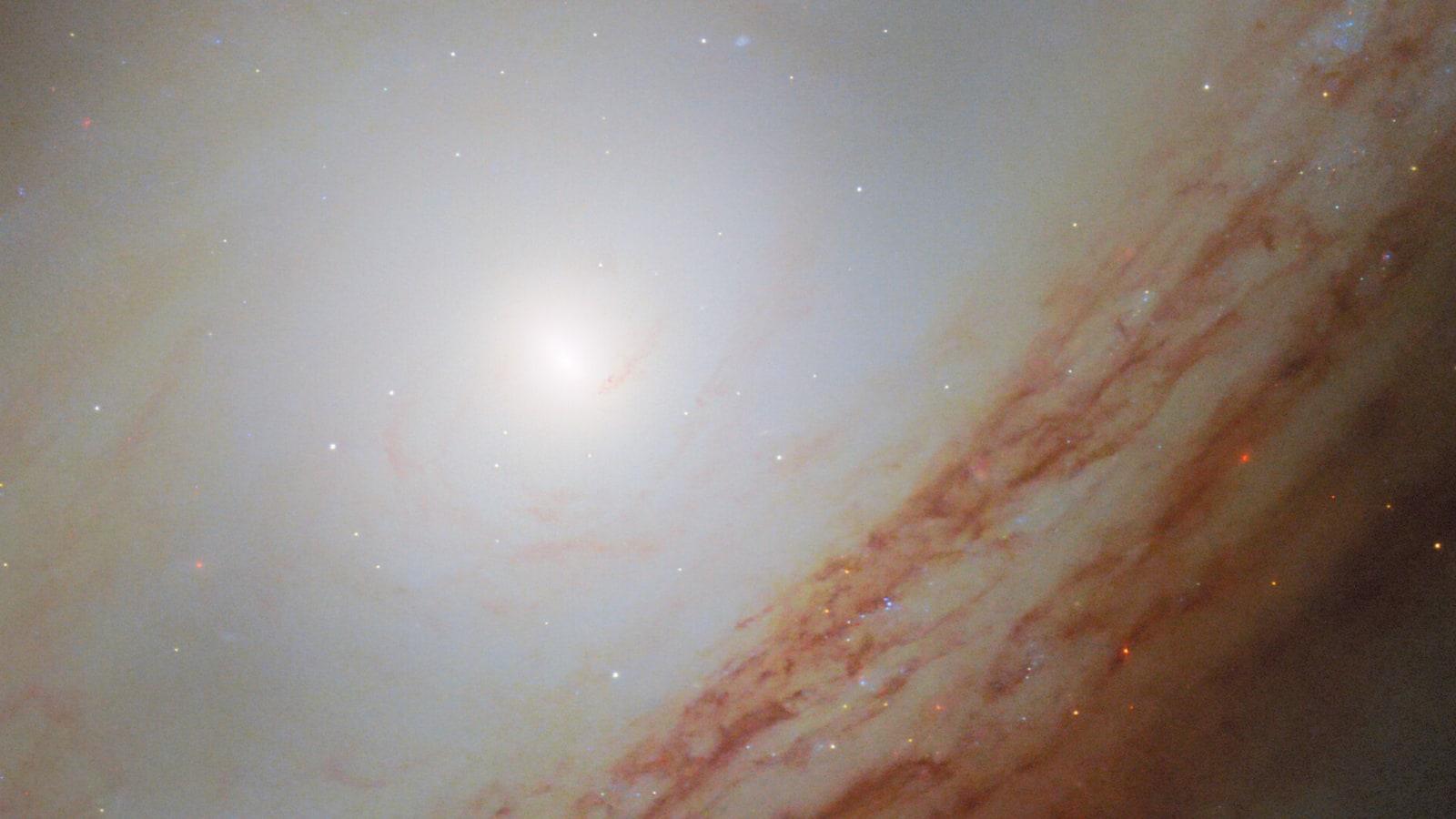
One galaxy, two directions of spin. NGC 4698, a spiral about 55 million light-years away in the constellation Virgo, holds a bulge of stars and a core of gas rotating at right angles to the rest of its disk. Hubble has just delivered its sharpest portrait yet, released by ESA/Hubble on September 18, 2026.
Behind the serene image lies the record of an old encounter, and one of the rarest arrangements in the whole classification of galaxies.
One galaxy, two crossing planes
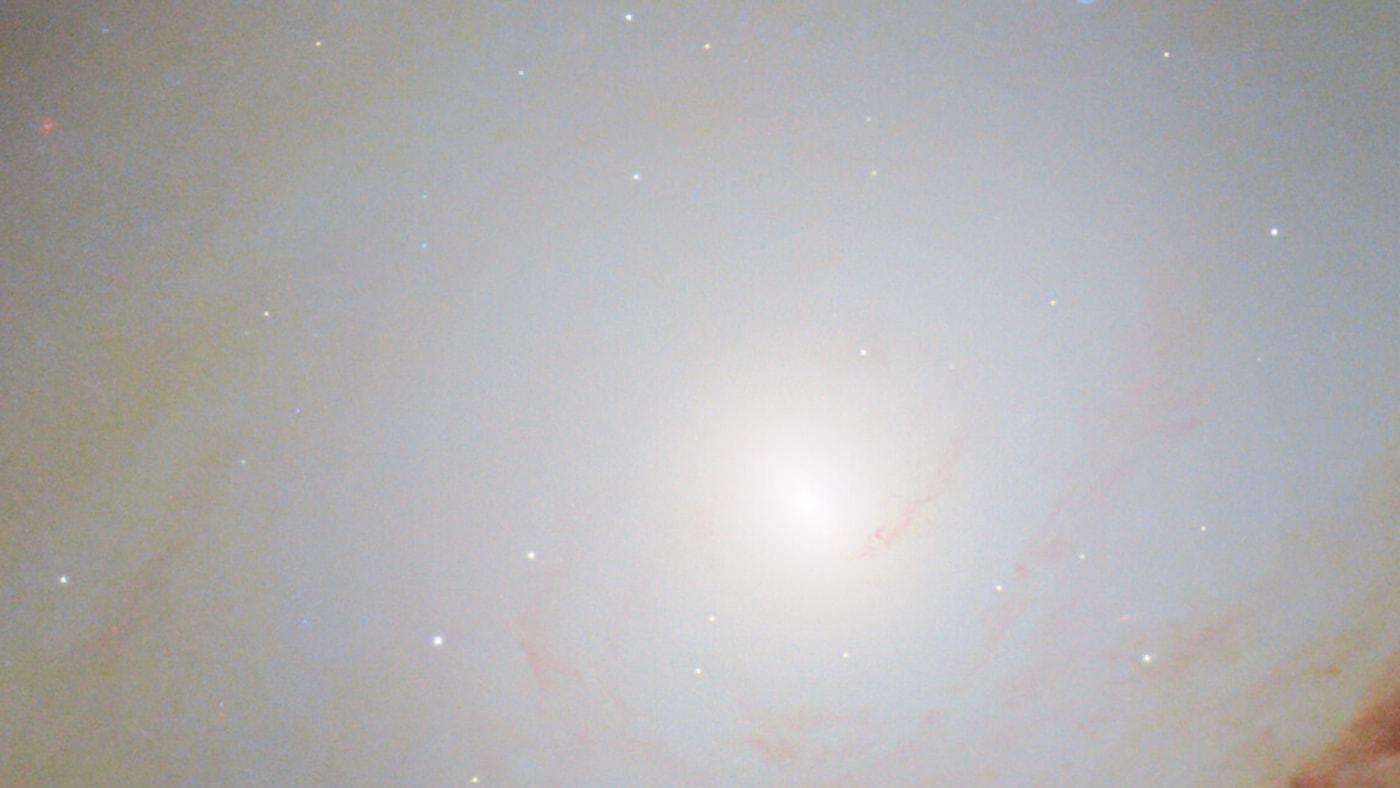
At first glance NGC 4698 looks like the Milky Way. A thin disk of stars, gas and dust, traced by spiral arms dotted with young blue stars and clumps of brown dust. One detail already sets it apart from most spirals: its arms do not wind all the way in. They stop short and form a ring around the heart, as though someone had removed the middle of the drawing.
That heart is the bulge. A zone of off-white glow, home to stars smaller, older and cooler than those in the arms. These stars sit tightly packed and orbit a supermassive black hole of several million solar masses. Hubble data show signs that this black hole is growing by drawing gas inward.
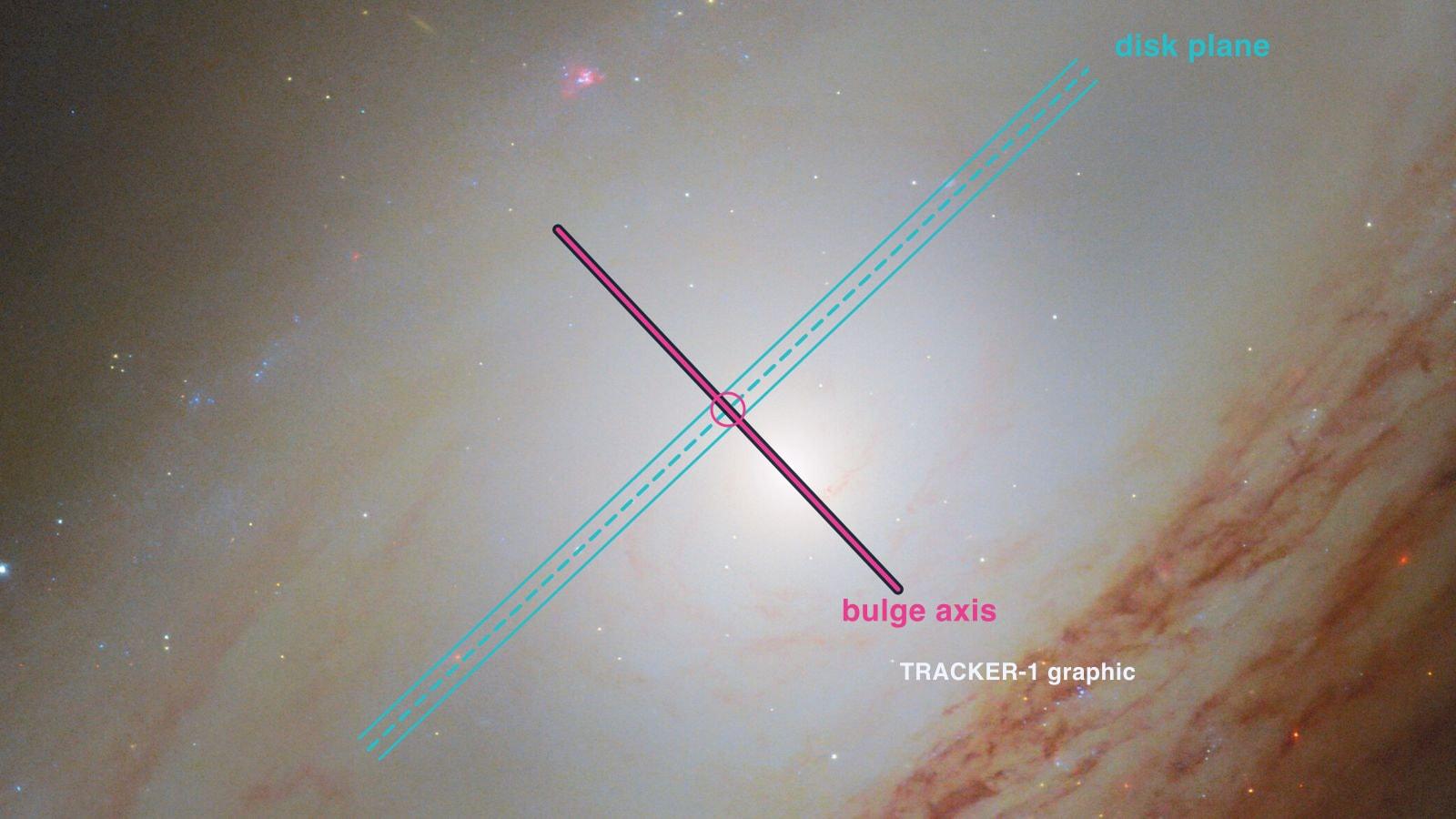
The real troublemaker lies elsewhere. The bulge stretches at right angles to the disk, like a rugby ball laid across a plate. In the image its ghostly glow peeks above and below the dust lanes. And it is more than a quirk of shape: the stars and gas nearest the center genuinely rotate in that perpendicular plane.
How to watch a galaxy spin 55 million light-years away
None of this is visible to the eye. To learn which way a galaxy rotates, astronomers use a spectrograph, an instrument that sorts light by color, meaning by the wavelengths it contains. Every chemical element leaves a signature in that light, and the signature shifts with the motion of the source.
The effect is the same as with an ambulance siren: the pitch rises as the vehicle approaches and drops as it pulls away. For light, that means a slight shift toward the blue if the object is coming toward us and toward the red if it is leaving. By placing the spectrograph slit along one axis of the galaxy, astronomers get the velocity of gas and stars at every distance from the center.
They ran that measurement in both directions. Along the disk's long axis came the surprise: in the central region velocities stay close to zero. As if nothing were turning. Then, with the slit placed perpendicular to it, along the disk's short axis, a clear signal appears, with a pronounced velocity gradient at the center.
A simple picture explains it. Imagine a square where two lines of pedestrians cross at right angles. Watch only the east-west traffic and the two lines cancel out, leaving the square apparently still. Only when you change your viewing axis does the crowd start moving again. In NGC 4698, the material in the core travels along the axis where the disk itself shows almost no motion. Two crossing movements that cancel out in the measurement, and a core with a rotation plane of its own.
What it takes to turn a core around
Where could such a disagreement come from? Not from a simple accident of shape. The trail astronomers favor leads outside the galaxy, to gas captured elsewhere that came to rest at the center in a perpendicular plane.
The mechanism rests on a well-known difference in behavior. Stars in a galaxy never collide and keep to their orbits, so they cannot rearrange themselves into a brand-new disk. Gas, by contrast, slams together, loses energy and settles into a plane. A merger between two purely stellar galaxies therefore cannot build a nuclear disk. Gas is required, and it has to come from outside, or be gathered up by the encounter. The incoming gas keeps its original momentum, then falls into the plane that matches that momentum, perpendicular to the main disk. There it starts rotating on its own and forms new stars, in small numbers.
One clue has long supported this reading. NGC 4698 trails a short tail of hydrogen, a wisp of gas escaping from one side only. That is the classic signature of a minor merger, the absorption of a galaxy much smaller than the main one. Enough material to supply both the gas and the momentum.
What this galaxy teaches us about the others
NGC 4698 matters because it makes visible a process that unfolds quietly in many galaxies, perhaps including our own. Astronomers have long known of elliptical galaxies wrapped in a ring of gas rotating perpendicular to the rest, the polar-ring galaxies. Those are always an inheritance: material captured after the fact. NGC 4698 shows the same mechanics inside a fully formed spiral, on a more modest scale. A laboratory for understanding how a galaxy absorbs gas without falling apart.
The observation was carried out as part of a survey program aimed at exactly that playground. MAUVE-HST, led by David Thilker of Johns Hopkins University, is scrutinizing 40 Virgo Cluster galaxies with Hubble's WFC3 camera across 145 orbits. Its goal: separate, within these galaxies, what belongs to their own history from what comes from life in a crowd, and track the gas that does or does not allow stars to form.
One last curiosity remains open. The central black hole is growing, gas keeps flowing in, and the core keeps turning against the disk's current. How long can such a balance hold? It is objects like this, halfway between two histories, that help astronomers answer for all the rest.
Going further
- The mission page of Hubble, the telescope that produced this image with its WFC3 camera.
- Key ideas to follow the story: galaxy and supermassive black hole.
- To hunt it down in the constellation Virgo, the interactive sky map and the observing guide tell you where and when to look. The astrophotography gallery shows what a well-equipped amateur captures on galaxies.
- Official sources: the NASA release and the ESA/Hubble release, rounded out by the image published by ESA.