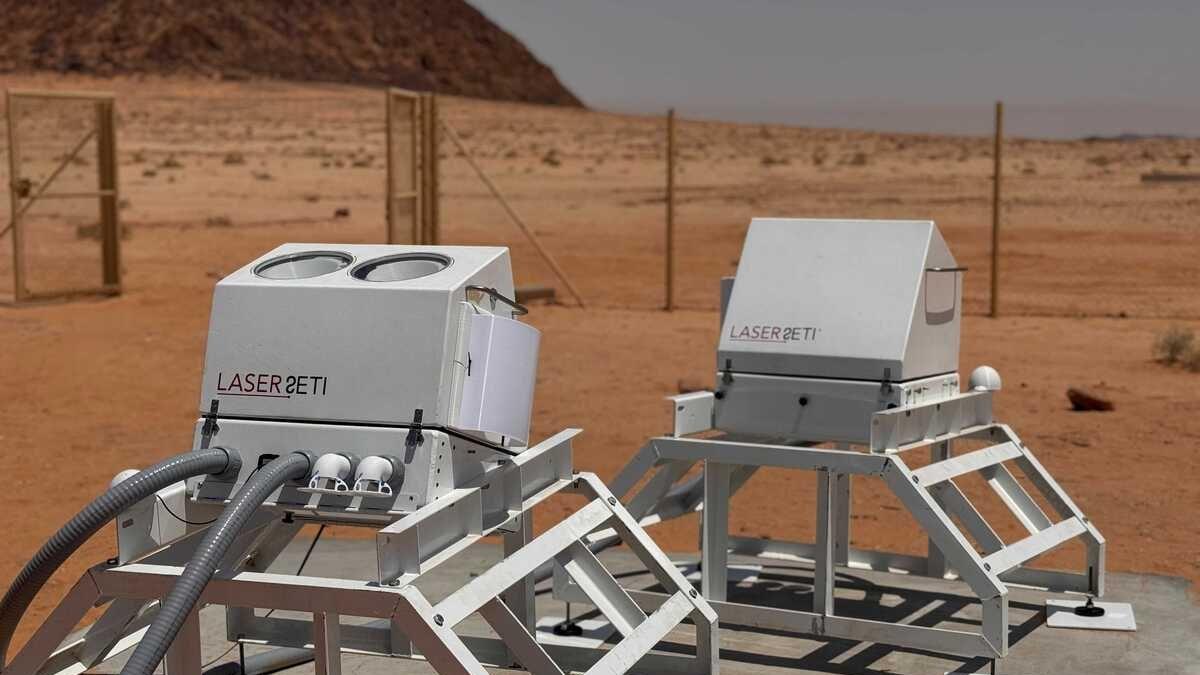
On August 19, 2026, two LaserSETI stations were installed at AlUla Manara in northwestern Saudi Arabia. The SETI Institute and the Royal Commission for AlUla announced on October 22 that the instruments are now operating. AlUla is the fifth site in this global camera network and the first in Asia. Its job is to watch the sky continuously for brief flashes of light, including some that could come from extraterrestrial technology.
Five sites, one observatory spread across the planet
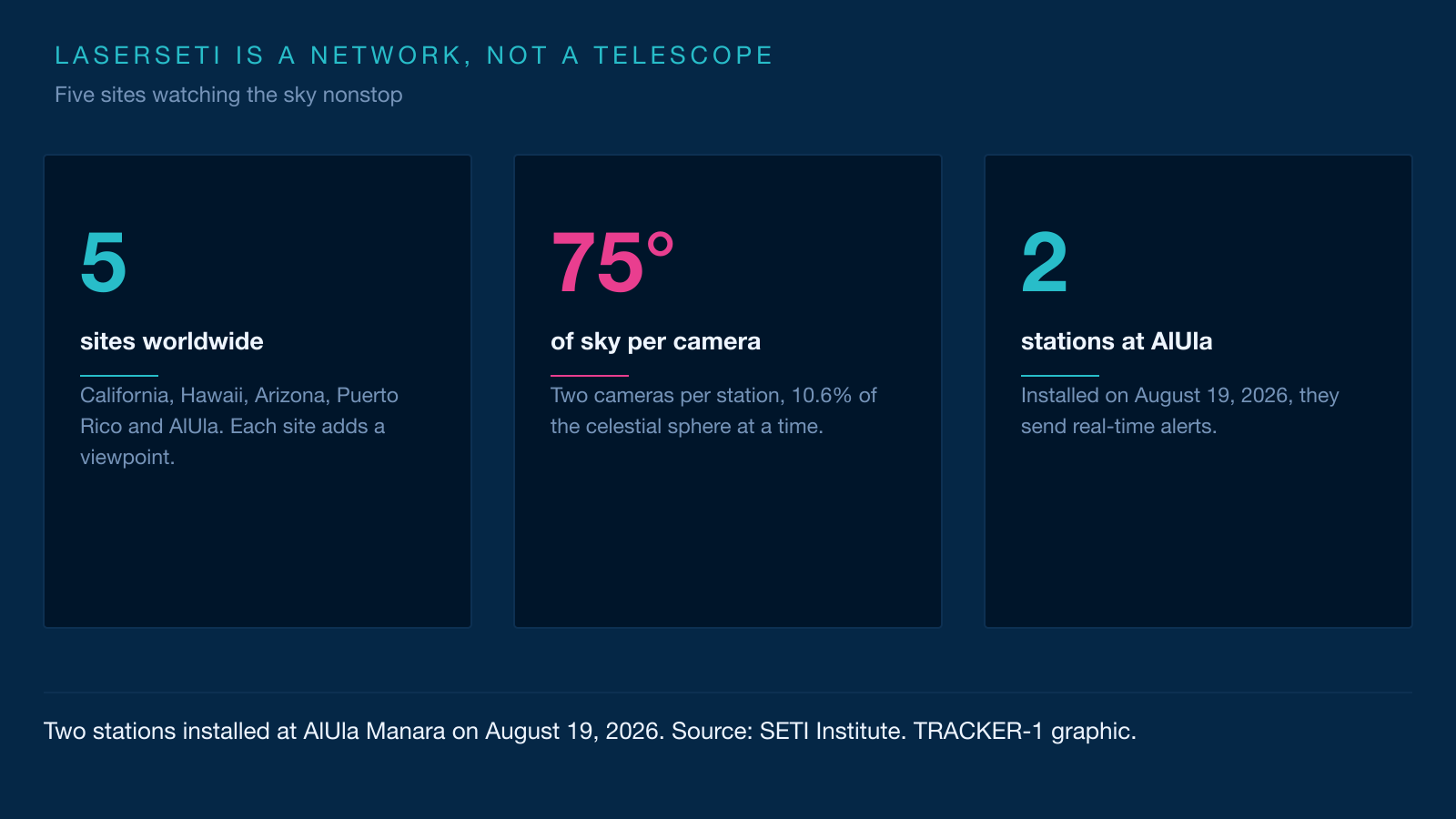
LaserSETI is not a telescope. It is a network. Each site hosts one or more stations, and every station carries two identical cameras pointed the same way. A single camera takes in 75 degrees of sky, or 4,395 square degrees, a little over 10% of the celestial sphere. A computer next to the cameras analyzes the images on the spot.
The guiding idea fits in one sentence: see the whole sky, all the time. A conventional telescope targets one object, a star, a galaxy, an asteroid. LaserSETI watches broad patches of sky without pause, so it does not miss the short event that falls between two observations. Think of it as watching a doorway versus watching the entire hallway.
Five sites, then. California came first, at the Robert Ferguson Observatory, with first light on August 6, 2019. Hawaii followed, at the summit of Haleakalā. Arizona joined at Sedona in 2024, Puerto Rico on Isla Magueyes in 2025, and AlUla Manara in 2026. Every new site adds a viewpoint and, more importantly, an overlap with its neighbors.
One site alone is not enough. To trust a flash, the network has to see it twice, from two different places. A cosmic ray hits a sensor, a satellite lidar (a radar that measures with light) sweeps a patch of sky, a reflection crosses the lens: all of these are false leads that a second site can rule out. The distance between California and Hawaii even lets LaserSETI pinpoint a source 9 million kilometers away, 25 times the distance to the Moon. The farther apart the sites, the better the network can tell where the light came from.
The full plan calls for six observatories, three per hemisphere. Below 30 degrees above the horizon, the atmosphere absorbs and blurs too much light. Sites therefore have to be spread out, with a little luck on clouds. AlUla brings both: a protected sky certified as an International Dark Sky Park by DarkSky in October 2024, and a West Asian position the network was missing.
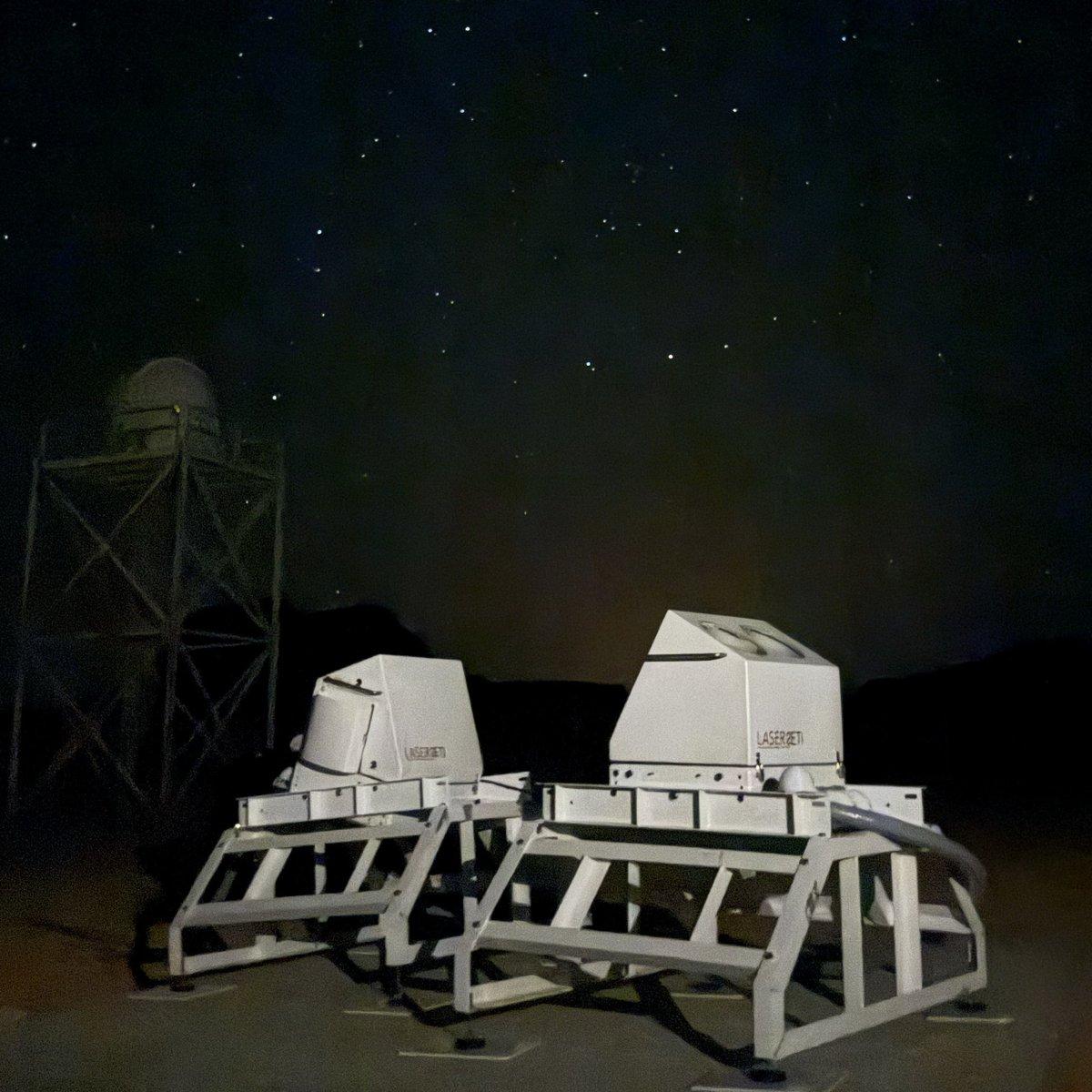
"The commissioning of LaserSETI at AlUla Manara marks an important milestone in our collaboration with SETI Institute," said Naif Al Malik, AlUla Manara Executive Program Head. He added that connecting AlUla's exceptional dark skies to a global observation network creates new opportunities for research, international collaboration and knowledge exchange.
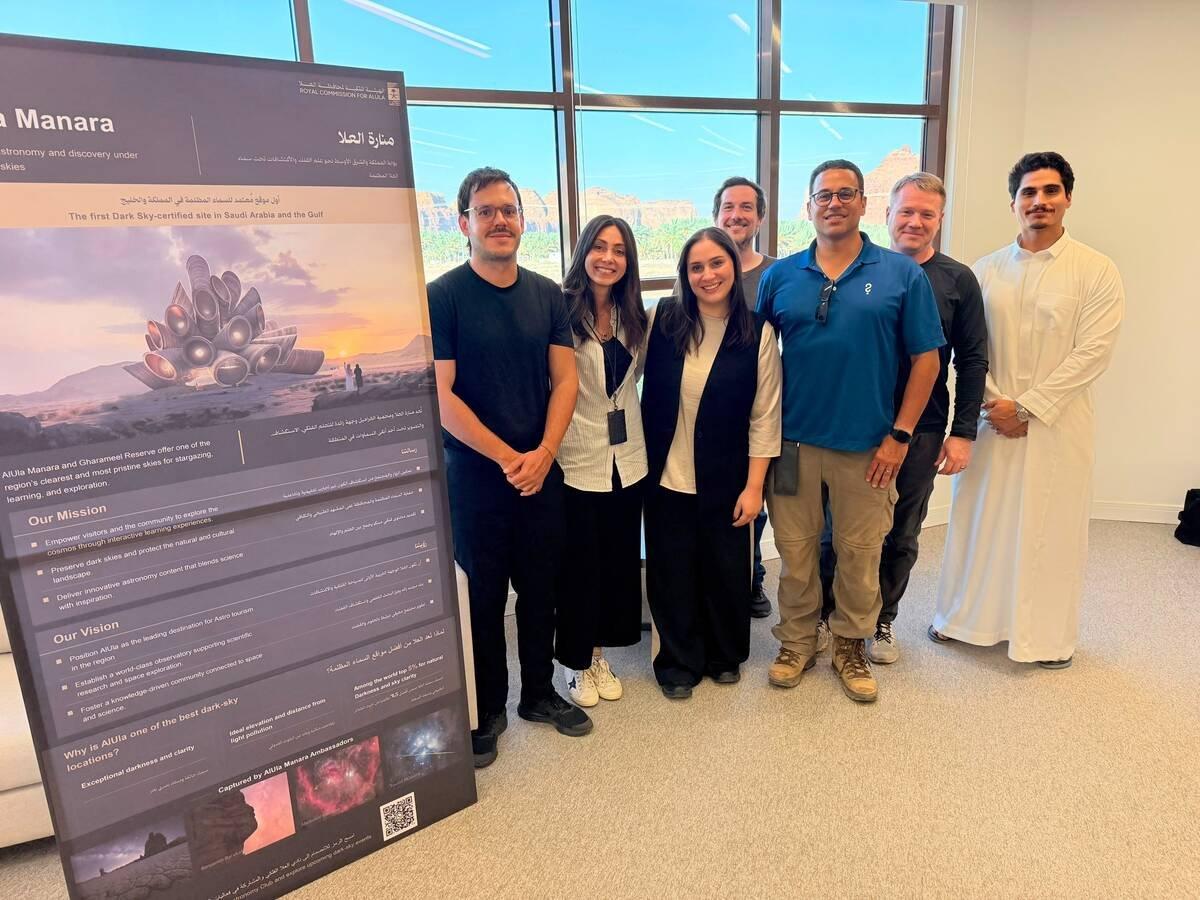
"AlUla gives LaserSETI an important new geographic vantage point and connects this remarkable astronomical site to a growing global network," said Franck Marchis, senior planetary astronomer at the SETI Institute. "This is exactly what LaserSETI needs: instruments distributed around the world, observing continuously and together."
How to spot a laser among the stars
Each camera uses a commercial lens, an off-the-shelf video sensor and, behind the lens, a diffraction grating. This finely ruled plate acts like a prism. It spreads the light of every source into a rainbow. A star, which emits across all colors, leaves a long colored streak. A laser emits at a single wavelength. It collapses into one sharp line, like the red dot of a laser pointer.
Nature is not known to produce a strictly monochromatic optical source. A bright, brief, isolated line would therefore point either to technology or to an astrophysical phenomenon nobody has seen yet. Both would be worth the detour.
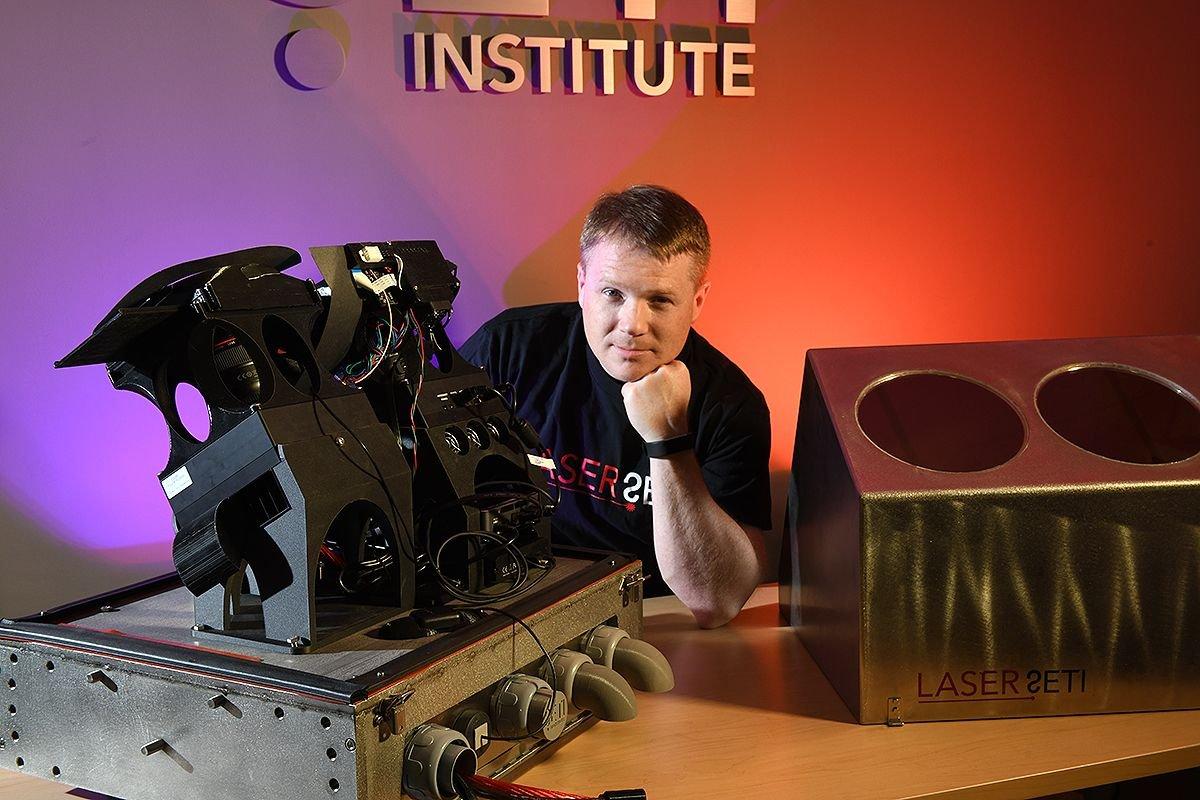
The two cameras at each station are rotated 90 degrees from each other. A flash has to show up in both at the same moment. That double check weeds out cosmic rays and sensor faults. The cameras read their sensors continuously, using a technique that smears the image along one axis but delivers millisecond time resolution. Each station produces 104 megabits per second. The onboard computer sorts events in real time, which avoids storing terabytes of images and makes fast alerts possible.
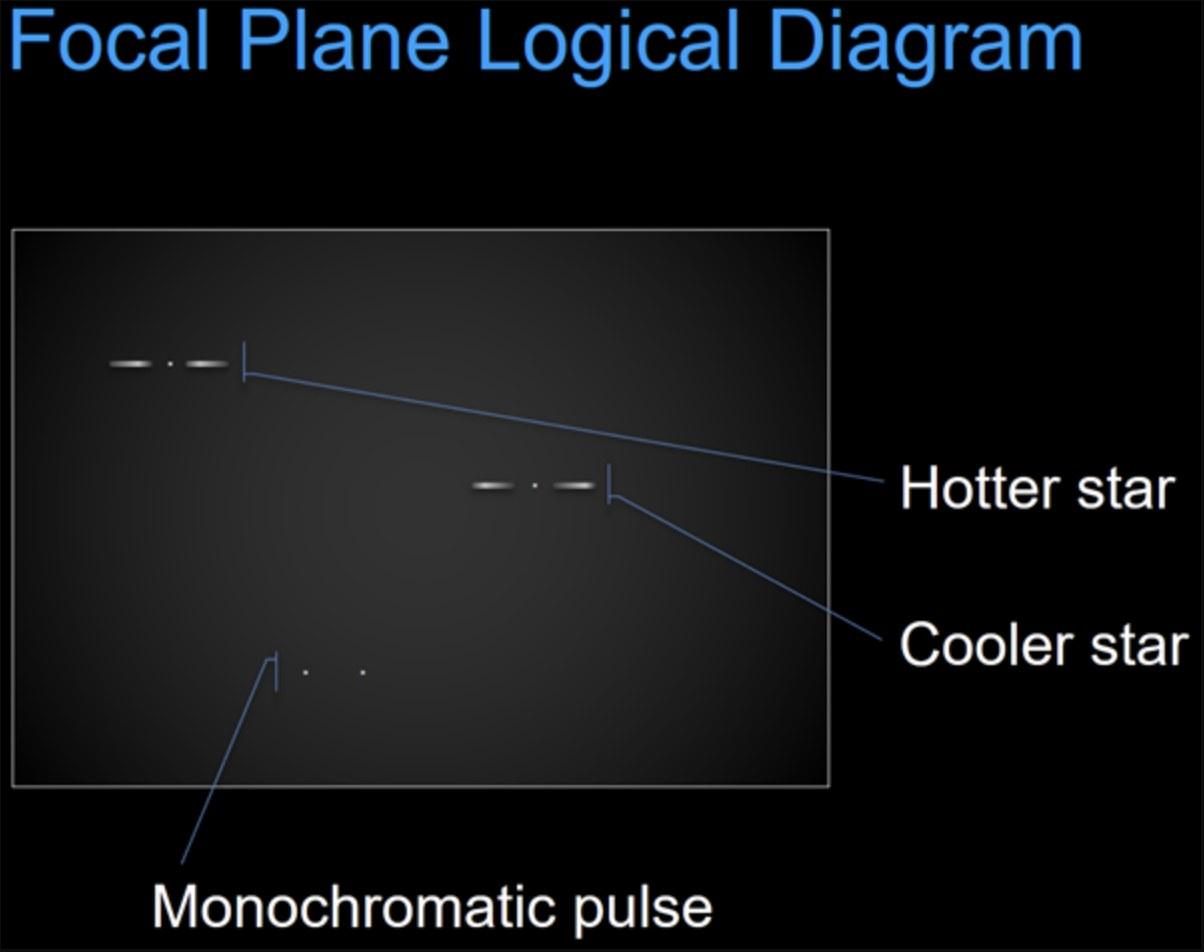
Sensitivity has a hard number. LaserSETI can detect a 100-gigawatt laser at 5 light-years, provided the wavelength is close to 500 nanometers. No such laser exists in our technology today. The figure mostly shows what the network could do once it is complete.
Six decades of listening without ever transmitting
SETI stands for the Search for Extraterrestrial Intelligence. The program does not look for life in general. It looks for evidence of an intelligence able to produce a signal. The distinction matters: a bacterium in a Martian lake belongs to astrobiology, not to SETI.
Since 1960 and Frank Drake's Project Ozma, the main method has been radio. Astronomers point large antennas at stars and listen. The Allen Telescope Array in California was the first radio telescope designed from the ground up for this job. It combines 42 dishes, each 6 meters across, and covers 1 to 14 gigahertz. SETI never transmits. It only listens. That rule keeps Earth from becoming a visible beacon for the whole galaxy, and it explains part of the silence: we are only lending an ear.
Optical SETI is decades old, but it relied on photomultiplier tubes, effectively one-pixel cameras. Only one star could be examined at a time. LaserSETI changes the scale by embracing the monochromatic assumption. An ordinary image sensor becomes usable, and a wide lens covers a large patch of sky.
Funding tells part of the story too. A NASA SETI program ran until 1993 and then stopped. Since then, US searches have depended on private donations. LaserSETI itself grew partly out of a crowdfunding campaign.
No convincing signal has been found so far. Silence does not prove that nobody is out there. It mostly says we have not looked enough, long enough, with enough sensitivity. That is precisely the bet behind the network: more eyes and more hours of sky.
What the network is for, and what it does not promise
The fifth site guarantees no discovery. It widens coverage, adds a time zone and a viewpoint, and brings the network closer to its critical size. That is the takeaway, without turning a commissioning into a contact announcement.
The partnership covers three years of operation and maintenance by the SETI Institute with the Royal Commission for AlUla. AlUla data will join observations from the other sites so researchers can compare events seen from different places. The next phase is analysis, with customized data products and scientific publications.
The network is not only about aliens. Its cameras also catch meteors, re-entering space debris and atmospheric flashes that remain poorly explained. Every brief burst of light becomes data, and a chance to understand the sky a little better.
AlUla is more than a dot on a map. The site is meant to become the kingdom's first major observatory, under some of the darkest skies in the region. Placing a SETI instrument there ties a global search to a long-term scientific project.
One point needs to be clear: LaserSETI has not found an extraterrestrial laser. The network is growing, covering more sky and cross-checking its observations better. That is how a search moves forward, in measurable steps. The day a flash returns in two cameras and on two continents, the work of interpretation will begin.
Going further
- Key concepts: astrobiology, exoplanets and the Milky Way in our glossary.
- Missions studying worlds where life might exist: TESS and James Webb in our catalogue.
- Our tools: the interactive sky map, the observing guide and the astrophotography gallery.
- Official sources: the SETI Institute release on the AlUla stations, the LaserSETI instrument page, the live observatory status and the AlUla Dark Sky Park announcement.