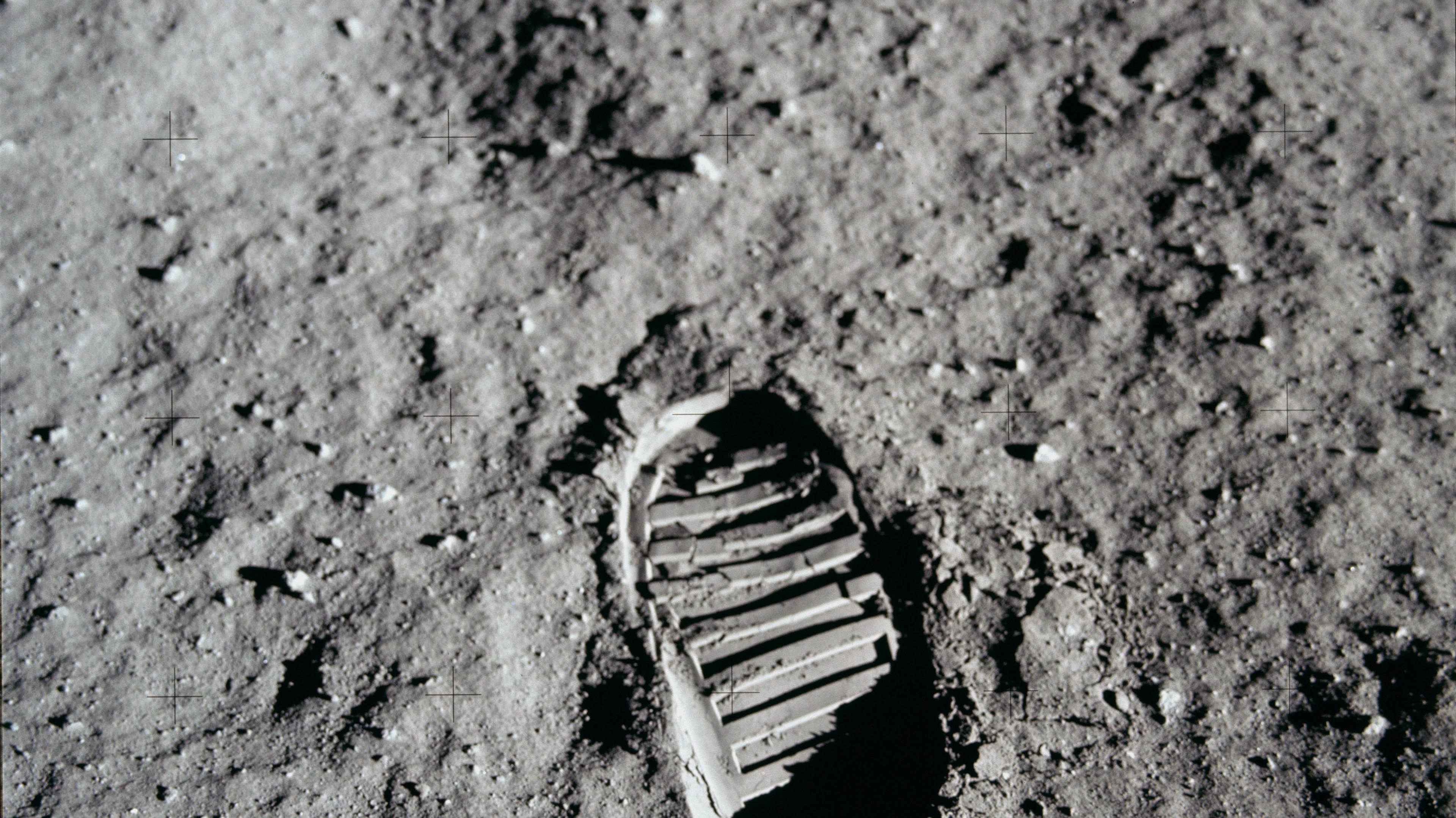
Could the oldest trace of an extraterrestrial civilization fit inside a grain of dust? On September 8, 2026, the SETI Institute unveiled the first quantitative framework for finding out: sift the regolith, the powdery soil that blankets the Moon, for manufactured particles that may have piled up over billions of years. The study, led by Lewis Pinault and submitted to the International Journal of Astrobiology, claims no discovery. It proves something else: this hunt, long pure speculation, has become a measurable experiment.
One cubic meter of dust to weigh vanished civilizations
Start with the strongest fact. The study turns an old idea into a calculation: what can a cubic meter of lunar soil, examined in depth, actually tell us?
The answer fits in one bound. If that volume contains no artificial particles, we could rule out scenarios in which Sun-like stars shed, on average, more than 0.1 Earth masses of durable technological debris. The threshold is a 5 followed by 23 zeros, in kilograms per star, over 10 billion years. For scale: humanity has sent five spacecraft toward the stars, including Voyager 1 and its twin Voyager 2, a few thousand kilograms in all. At that pace, about 100 kilograms per year leaving the solar system, it would take 6 followed by 21 zeros of years to approach that threshold, roughly 400 billion times the age of the Universe.
In other words, a cubic meter of dust works as a set of scales for vanished civilizations.
The reference volume is no accident. The Apollo missions brought back 382 kilograms of lunar rock, barely a quarter of an equivalent cubic meter of soil. A first test could target 0.1 cubic meters, with the cubic meter as the common benchmark for future searches. The authors also checked that the measurement holds over time: micrometeorite impacts turn the soil over the way a gardener turns the earth, and over 4 billion years this churning has mixed about 1.1 meters of regolith. A one-meter-deep sample therefore captures the dust flux of that entire span.
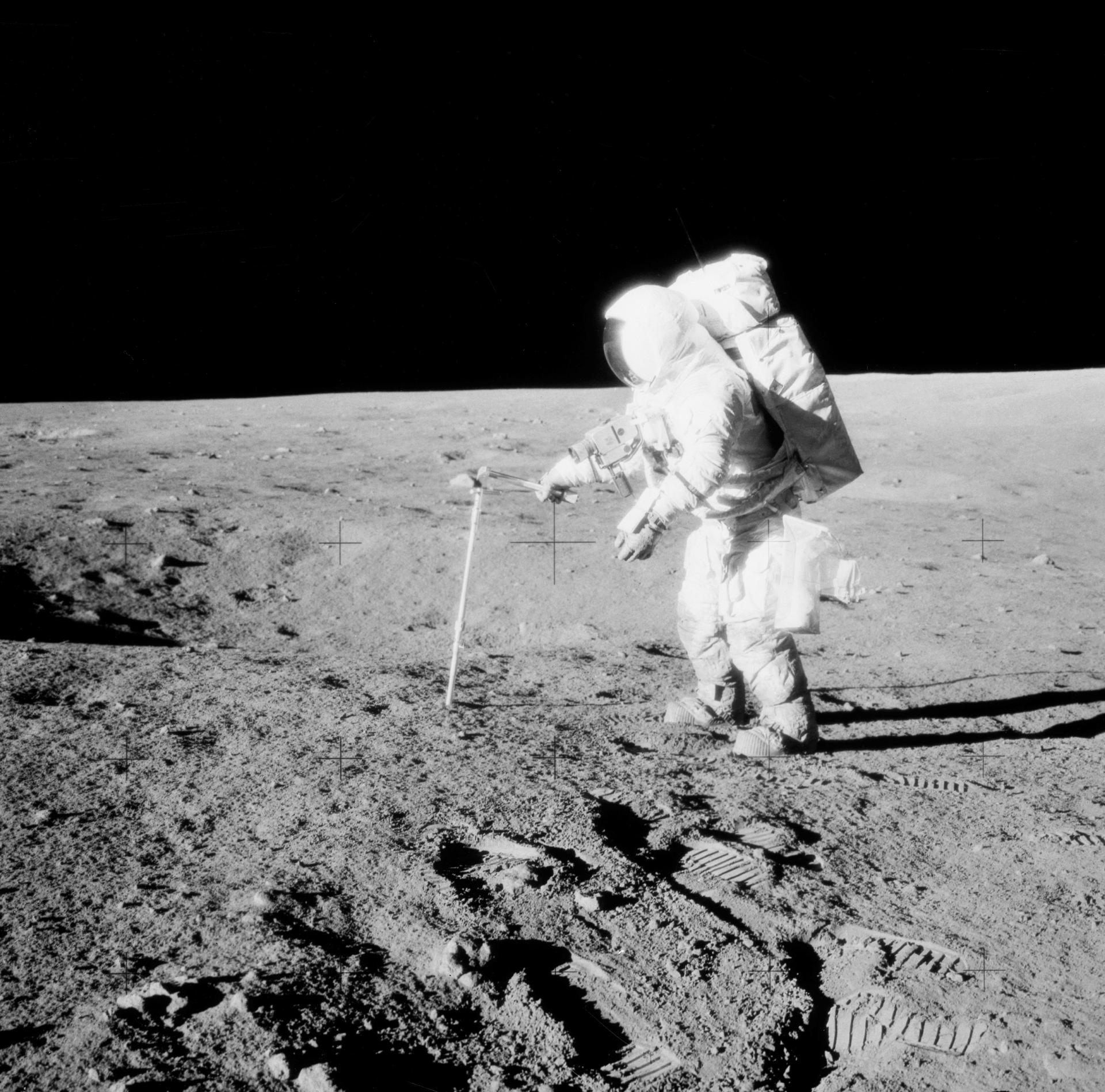
Why the Moon rather than Earth? Because Earth forgets. Our planet recycles its surface nonstop: air, water and plate tectonics, which drags the crust back down into the deep, erase everything. The Moon has no air or water, and its geology has gone nearly silent. For about 4 billion years it has trapped everything falling on it, from the solar system and from distant stars alike, without ever sweeping clean.
"The Moon has been quietly accumulating material from space for billions of years, much of it likely billions of years older than the Moon itself," explains Lewis Pinault, affiliate scientist at the SETI Institute and lead author of the study. "We're asking whether that ancient collection might contain microscopic traces of technologies that existed long before humans ever looked up at the sky."
0.3 microns: the long journey of an artificial grain
It all rests on an idea inherited from Alexey Arkhipov, a Ukrainian astrophysicist who flipped SETI's logic in the 1990s. Don't hunt big objects, he argued: hunt the residues. Any space industry produces waste, and that waste scatters through collisions, beyond its makers' ability to call it back.
The study sorts out two families of candidates. Arkhipov particles first: the unintended waste of industrial space activity, the microscopic equivalent of the debris cloud already crowding Earth's orbit. Bracewell particles next, more speculative: grains deliberately seeded among the stars, microprobes able to log, sense or copy themselves, a miniature take on the interstellar probes the radio astronomer Ronald Bracewell imagined in 1960.
A grain about 0.3 microns across, over a hundred times finer than a human hair, then has to survive the interstellar medium, that haze of gas and plasma filling the space between stars. Two dangers await: collisions with other grains, and sputtering, an atom-by-atom wearing down when the grain crosses hot plasma, the way wind wears down a stone. Models show the hardiest grains, refractory ones like silicates, last from 100 million to 1 billion years. Enough to cross thousands of light-years, provided they arrive intact.
Then it all comes down to speed. Grains riding the interstellar gas usually barrel in at 20 to 30 km/s as they enter the solar system, a pace that shatters them on impact. But the pressure of sunlight, which pushes relentlessly on tiny particles, can brake them: a non-negligible fraction arrives below 5 km/s. At that speed, arrival remains compatible with the grain's survival, partial or intact. The luckiest end up sealed inside agglutinates, glass beads born from micrometeorite melting, which preserve their contents the way amber keeps its insect. Even destroyed, a grain leaves an inclusion in the glass that tells its story.
Under the microscope: AI flags the suspect grains
An alien grain, if it exists, drowns in a sea of natural dust. Lunar soil is pocked with impact microcraters and melt splashes, features 0.1 to 1 micron across documented in the samples returned by Chang'e-5 and found on grains from the asteroid Ryugu. The challenge is not seeing: it's sorting.
First filter, artificial intelligence. The researchers propose training object detectors, the same family of algorithms that spots faces in your photos, on millions of microscope images. The system, dubbed YOLO-ET, makes no judgment: it escalates candidates, odd grains, strange microcraters, unexpected textures, for closer inspection.
Second filter, the laboratory. Scanning electron microscopy, which photographs a surface to within a micron, takes the grain's portrait. Spectroscopy, which reads the light the sample sends back to work out its makeup, flags an alloy outside natural recipes. Secondary-ion mass spectrometry weighs isotopes, the heavy or light variants of a single element, and compares the grain's recipe with the solar system's. Tomography, a 3D scanner for dust, finally reveals internal structure: stacked layers, ordered cavities, patterns that evoke a printed circuit. That much regularity doesn't come from chance, the authors insist.
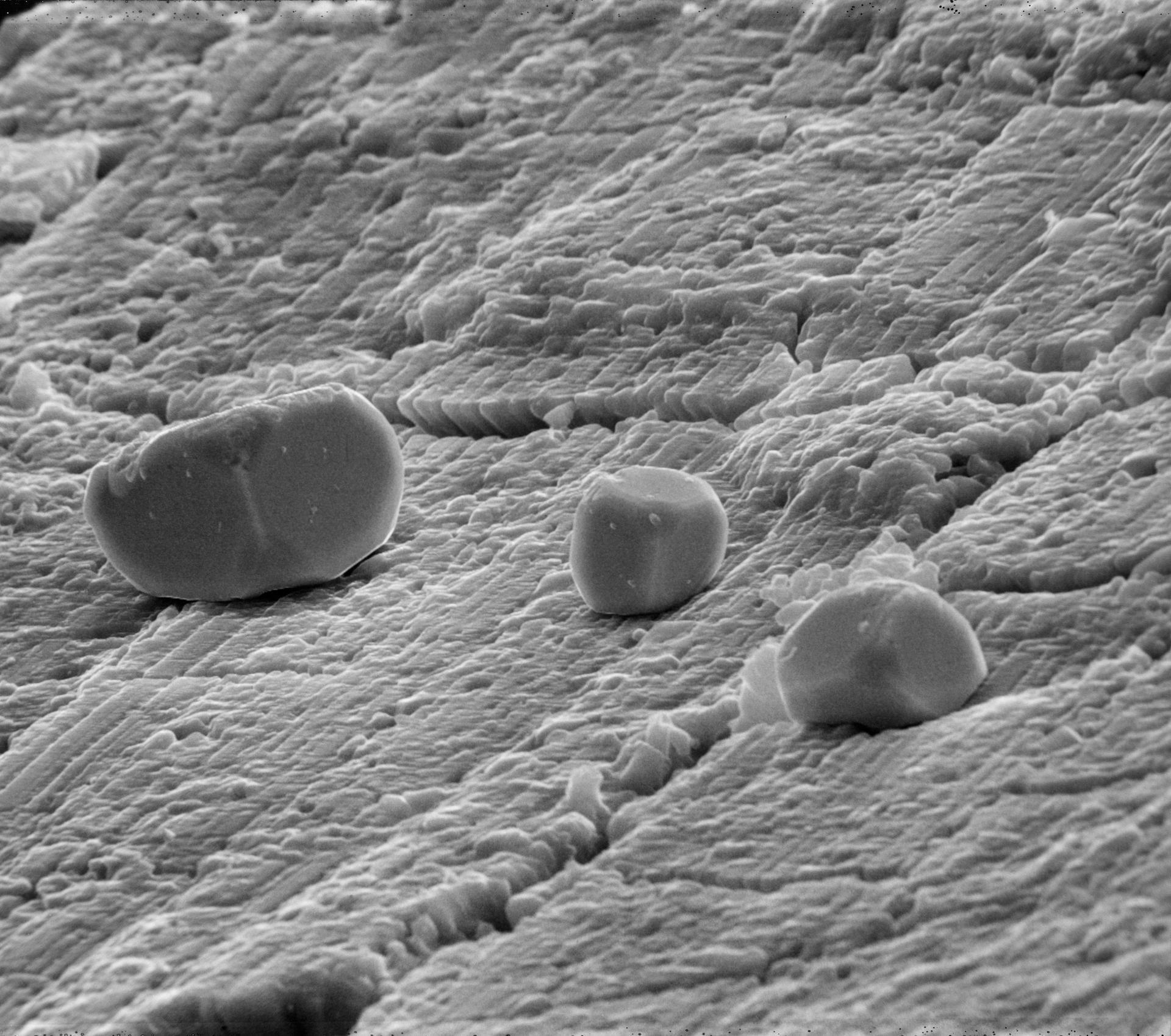
The volume wall remains. Labs today prepare soil samples by the milligram, with tweezers. Sifting a whole cubic meter, many billions of billions of grains, exceeds anything in existence. But the slope is favorable: automated microscopy, scanners and inspection lines born in the semiconductor industry are lowering the bar, on the rhythm of the coming lunar exploration programs.
What it changes: an archaeology of the stars
Classical SETI only hears live transmitters: a radio signal assumes someone, somewhere, is broadcasting today. Dust changes the rule. Piling up over billions of years, it can betray civilizations long extinct, makers no telescope will ever catch in the act. The authors speak of exo-archaeology: excavating the material traces of vanished technologies.
The most promising scenario is also the most targeted. Should a civilization have wanted to mark the inner solar system, deliberately depositing particles on a 100-square-kilometer patch of the Moon, a few milligrams of material would suffice for detection, against planet-scale masses for debris scattered randomly across the Galaxy. The catch: hitting the right plot, about 385,000 independent sampling sites for a fair chance of hitting it. The door is narrow, but it exists.
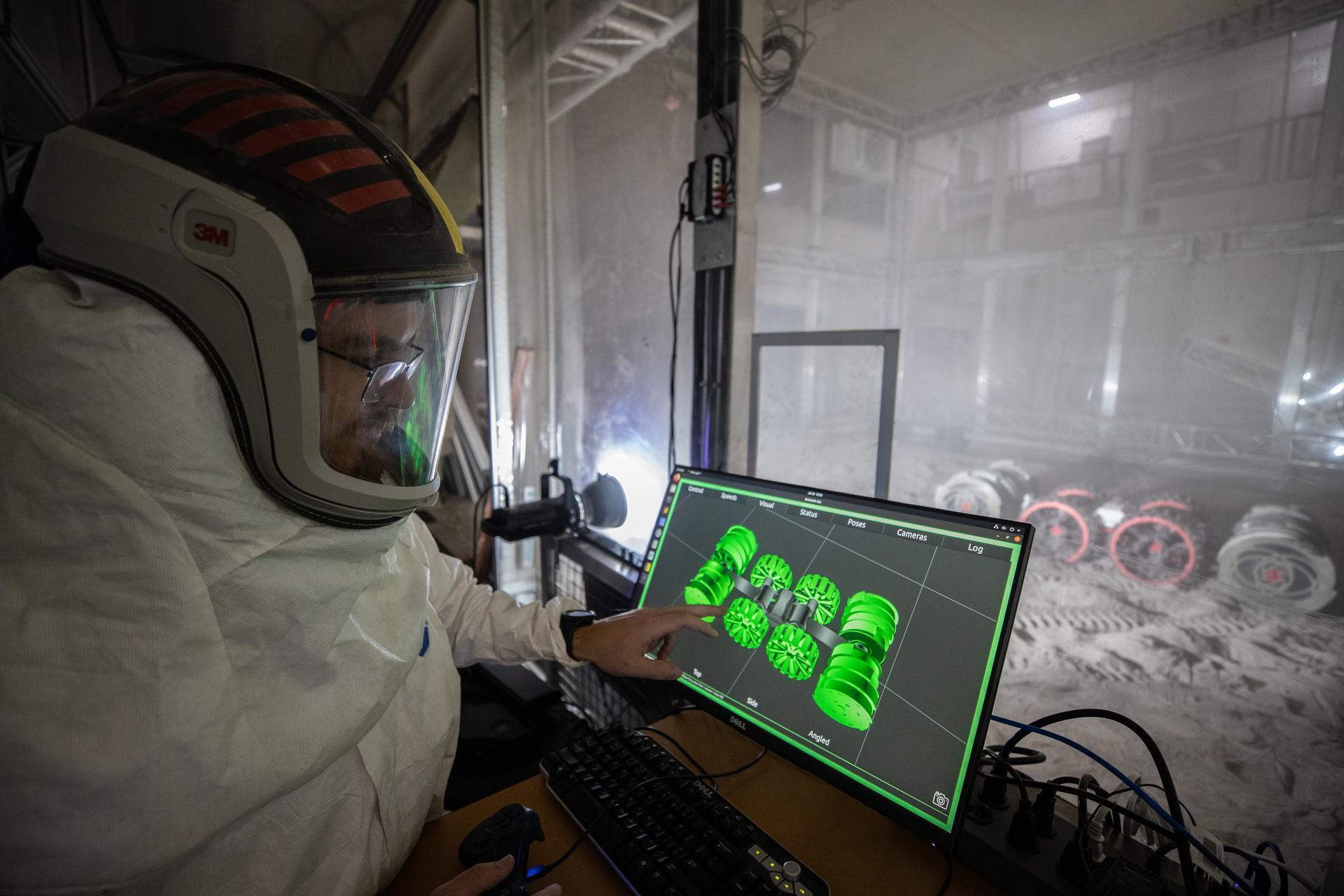
Chances to check are drawing closer. NASA's Artemis program and China's Chang'e probes will return fresh samples, and future digging operations will move volumes of regolith out of all proportion to Apollo's 382 kilograms. This robotic excavator tested at the Kennedy Space Center sets the tone: digging into the Moon is now, also, sorting through its history.
Every cubic meter sifted, even with no discovery, will strengthen the limit. As Bill Diamond, president of the SETI Institute, sums up: "The concept of searching the lunar regolith for microscopic technosignatures is at once extraordinarily original and eminently reasonable."
Going further
- The key notions to understand it all: the Moon entry and the sample entry in our glossary.
- The search for life and machines: our astrobiology entry.
- The five probes leaving the solar system, our own debris "budget" in the making: the Voyager 1 mission page.
- The Moon is on view tonight, no microscope needed: our interactive sky map and its observing guide.
- The official sources for this article: the SETI Institute press release and the scientific paper on arXiv, submitted to the International Journal of Astrobiology.