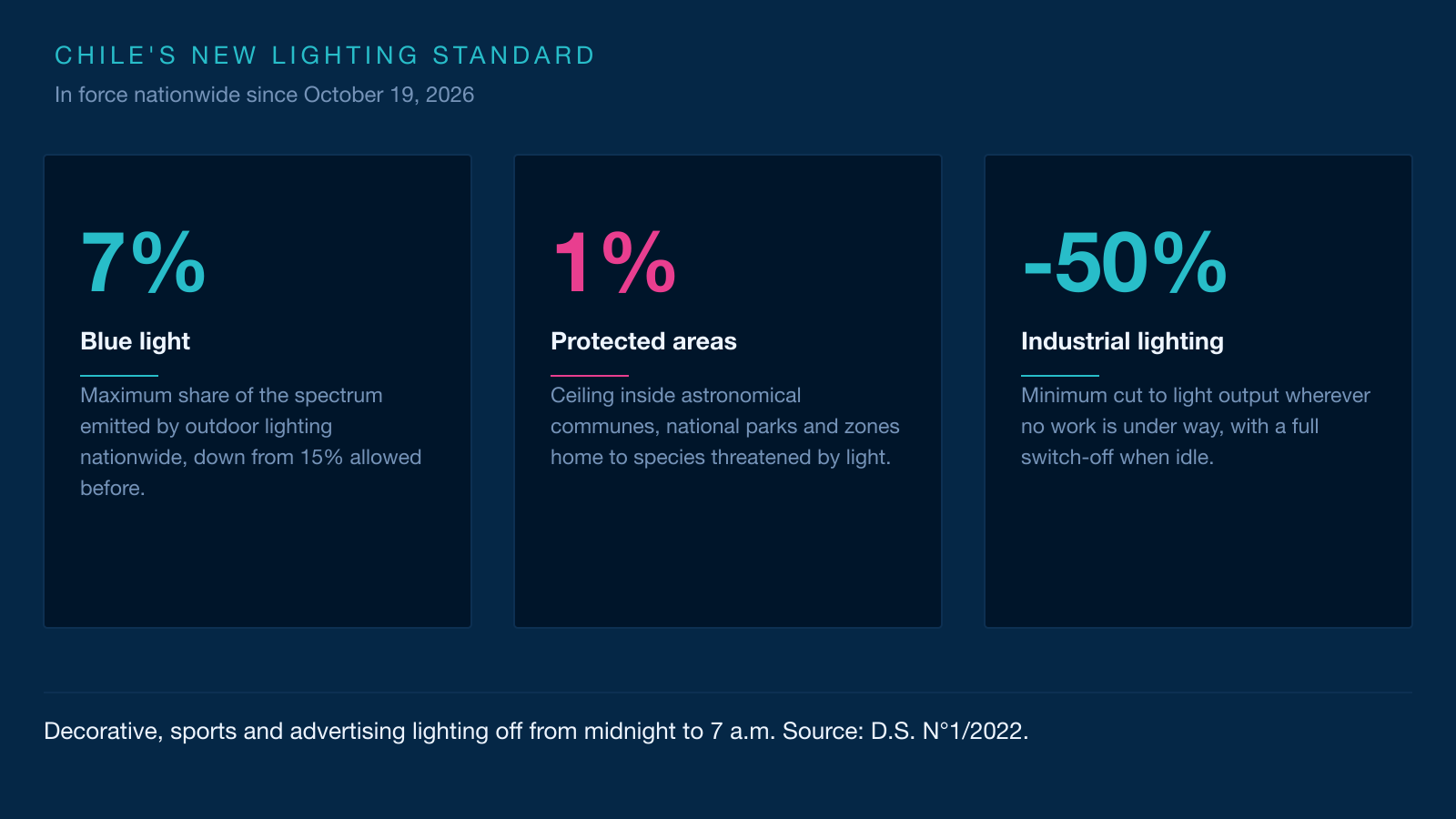
Chile holds some of the darkest skies on the planet, and it has chosen to defend them by law. Starting October 19, 2026, its lighting standard covers the whole country, from the Atacama Desert to Tierra del Fuego, more than 4,300 kilometres from north to south. The text caps blue light at 7% of the emitted spectrum, switches off decorative lighting between midnight and 7 a.m., and directly shields the largest telescopes in the world.
One rule for a country 4,300 kilometres long
Start with the scope of the text, because that is its real novelty. The previous standard, a 2012 decree, regulated lighting only in three northern regions, the ones that host the observatories. The new standard, known as the Norma Lumínica, was published in Chile's Official Journal on October 18, 2023. It extends the same rules to the entire country.
It took effect on October 19, 2024, leaving two years for the rest of the territory to comply. That window closes on October 19, 2026. From that date, every new installation must comply everywhere, and existing ones fall in line when they are replaced.
The rule works on three levers, each of which fits in a sentence. First direction, with a cap on how much light fittings send upward, above the horizontal. Then colour, with a limit on the blue share of the emitted spectrum. Finally timing, with a night-time switch-off for certain lighting.
The colour clause draws the most comment. The standard caps blue light at 7% of the emitted spectrum nationwide, against 15% allowed before. Inside so-called special protection areas, the ceiling drops to 1%. These areas cover several cases, not astronomy alone: the communes of astronomical interest defined by Chile's Science Ministry, national parks and reserves, and the breeding grounds of species threatened by artificial light.
The timing clause targets decorative, sports and advertising lighting, which must be off between midnight and 7 a.m. Lit signs and billboards follow the same rule, with a few exceptions such as fuel-station displays. For industrial lighting, the standard requires switch-off, or at least a halving of output, wherever no work is under way.
Why blue light comes first
The colour was not picked at random. Earth's atmosphere is made of nitrogen and oxygen molecules, tiny but countless. As light passes through them, short wavelengths, the blue ones, scatter far more strongly than red ones. The same mechanism paints the daytime sky blue.
At night, with artificial lighting, it works against astronomers. The effect is like car headlights in fog. The shorter the wavelength, the further it spreads from its source and the wider the halo it casts. A town lit in cool white therefore produces a much broader glow than a town lit in orange, for the same amount of light.
A technological shift made matters worse. Sodium lamps, dominant in the 2000s, gave off orange light, poor in blue. Light-emitting diodes, LEDs, replaced them because they use far less power. But white LEDs build their light from a blue chip, and keep a significant share of it. A lighting fleet that changes technology without changing colour can therefore brighten the sky more than before, even while drawing less power.
That halo is not an astronomers' issue alone. Artificial light at night weighs on human health, disrupting the biological clock that governs sleep, and on wildlife. The decree cites seabirds: drawn in by the lights of coastal towns, they circle until exhausted or collide with buildings. One badly designed light source thus touches telescopes, biodiversity and residents' sleep at once, which is what explains the breadth of the text.
The five giant telescopes the law shields
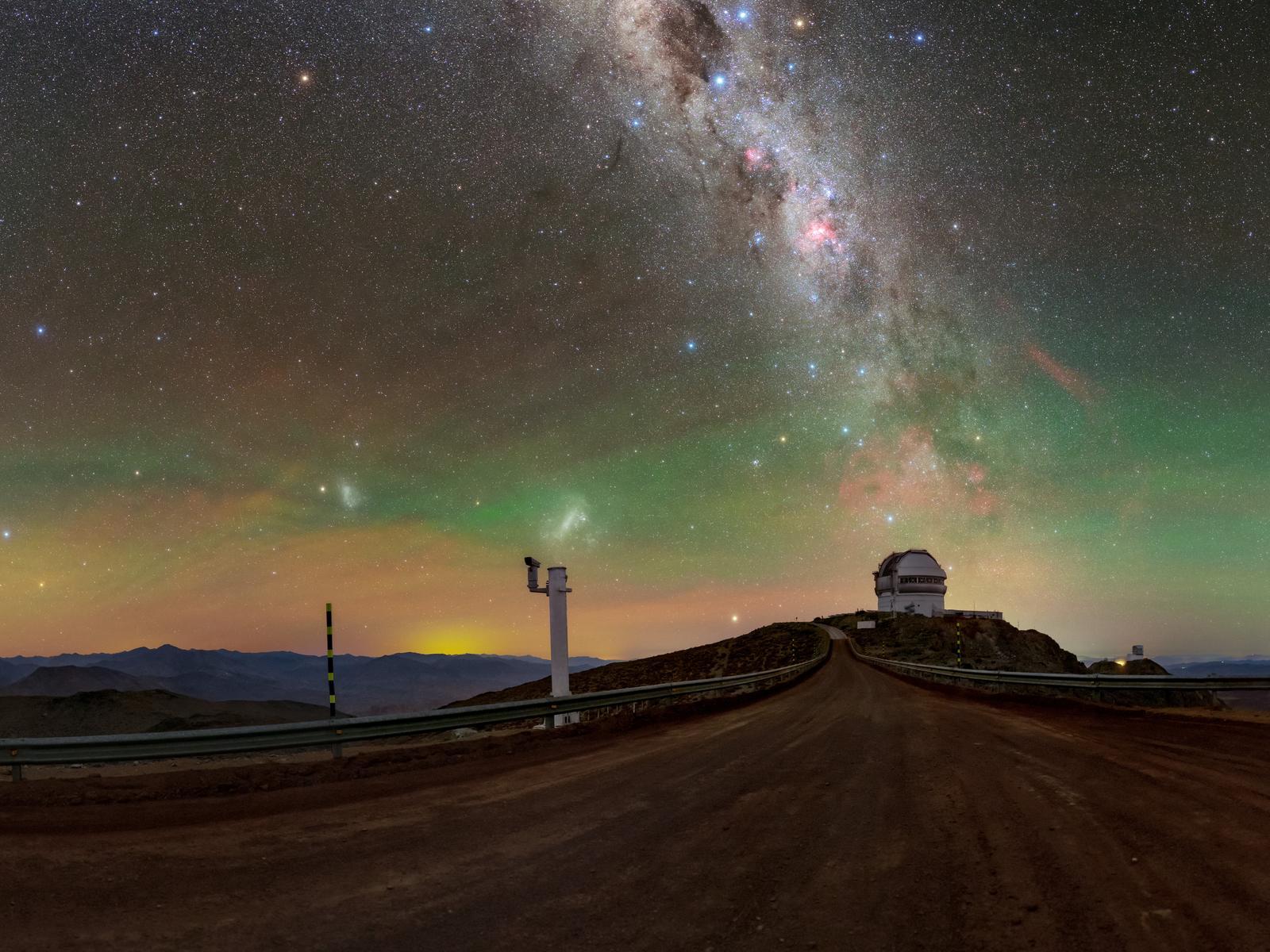
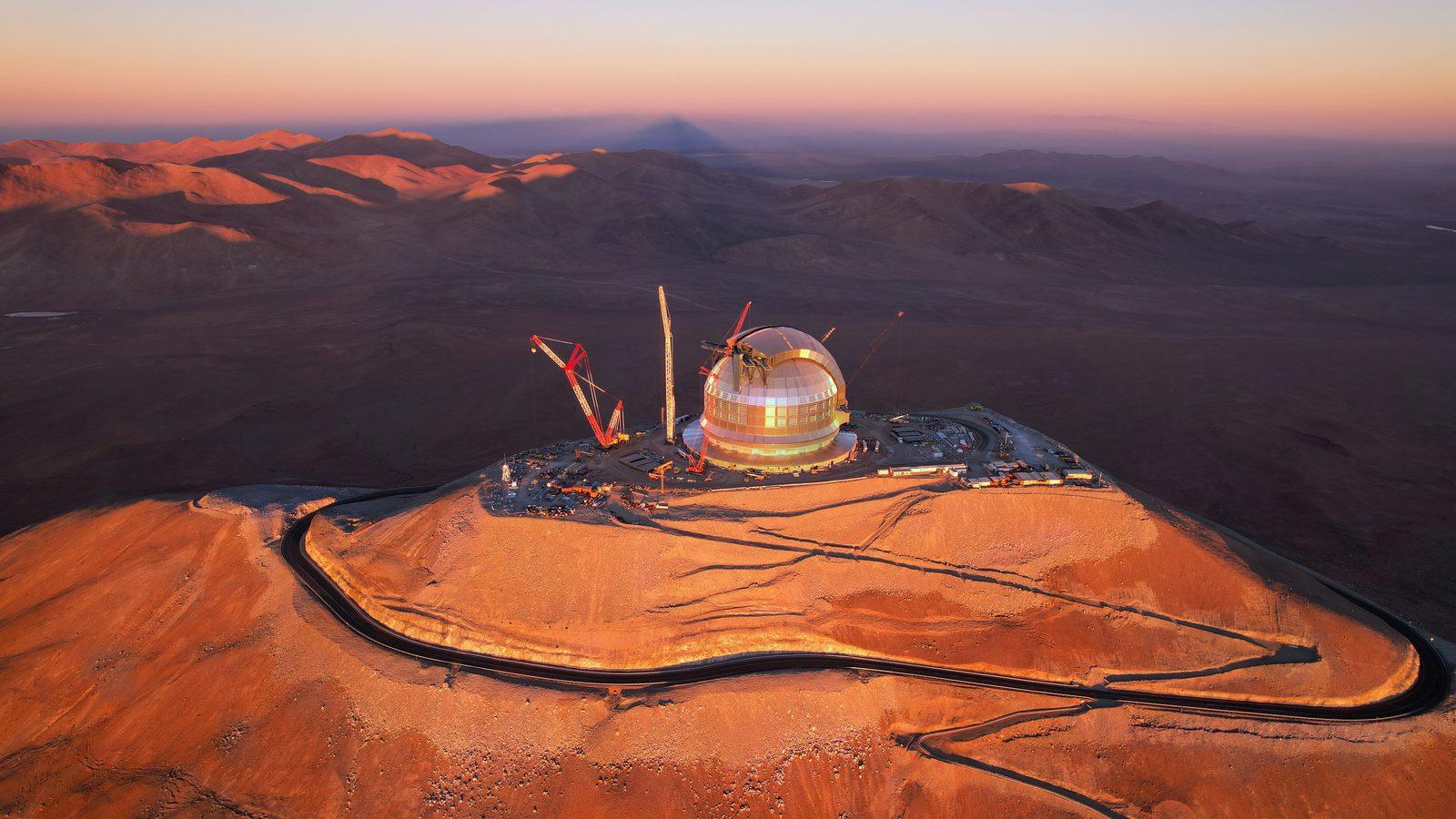
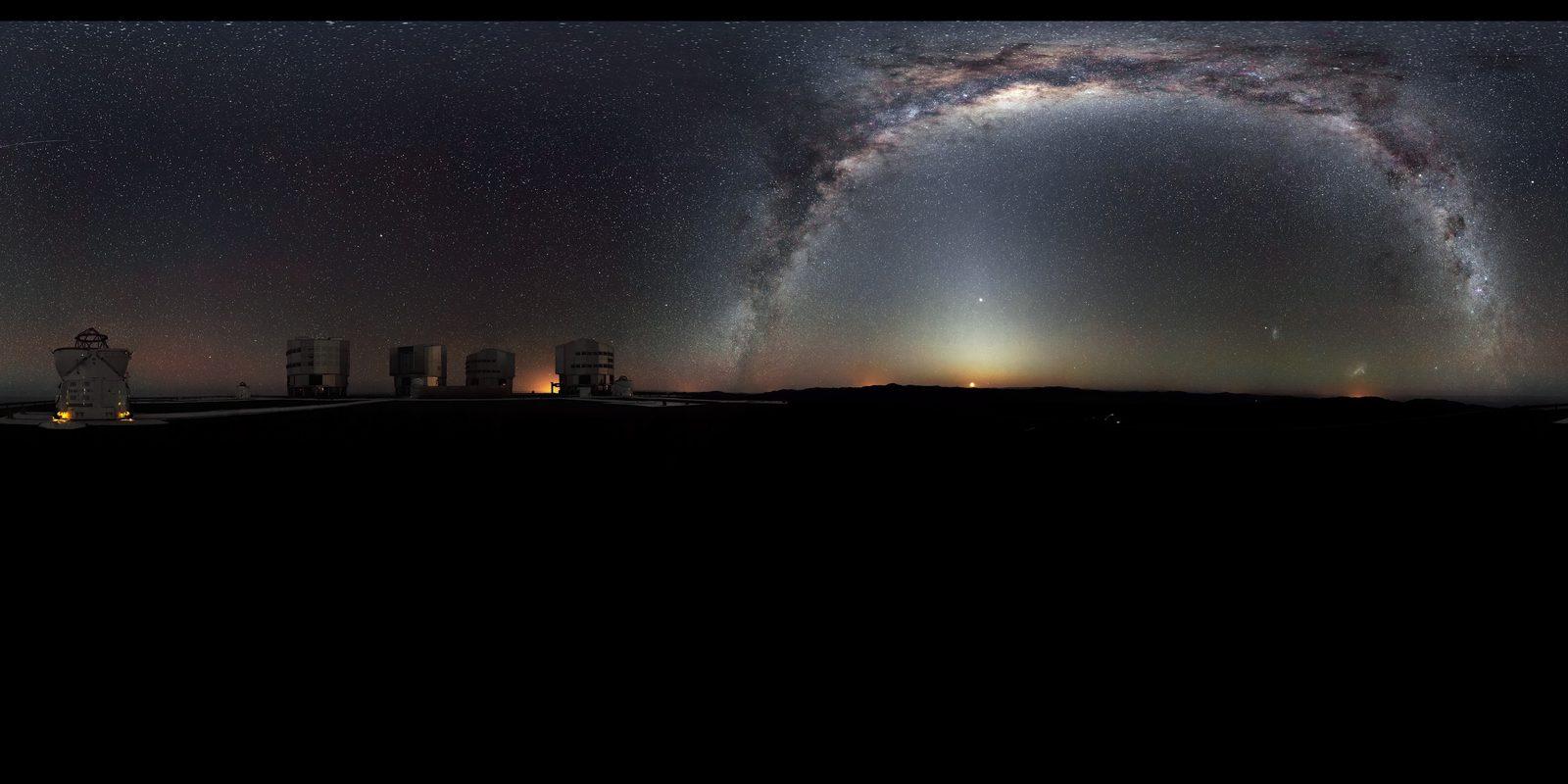
Northern Chile gathers a unique concentration of instruments, because the air is dry, steady and the sky almost always clear. The Coquimbo region hosts the Cerro Tololo Inter-American Observatory and the Gemini South telescope, both on neighbouring peaks, the Vera C. Rubin Observatory on the ridge of Cerro Pachón, and ESO's La Silla site. Further north, the Antofagasta region holds the Paranal Observatory, home to the Very Large Telescope (VLT). On the neighbouring summit of Cerro Armazones rises the Extremely Large Telescope (ELT), the largest optical telescope ever built, with a 39-metre main mirror.
Halfway between them, in the Atacama region, the Las Campanas Observatory carries two 6.5-metre Magellan telescopes and hosts the construction of the Giant Magellan Telescope (GMT), a 25.4-metre instrument built from seven 8.4-metre mirrors, expected to open in the 2030s.
These facilities are not merely large. They are built for measurements of extreme sensitivity. The ELT will observe in infrared, the invisible light given off by cold, distant objects, to study the atmospheres of rocky planets around other stars and the first galaxies. The VLT, for its part, combines its four 8.2-metre telescopes into an interferometer, an array that resolves detail finer than any single telescope could see alone.
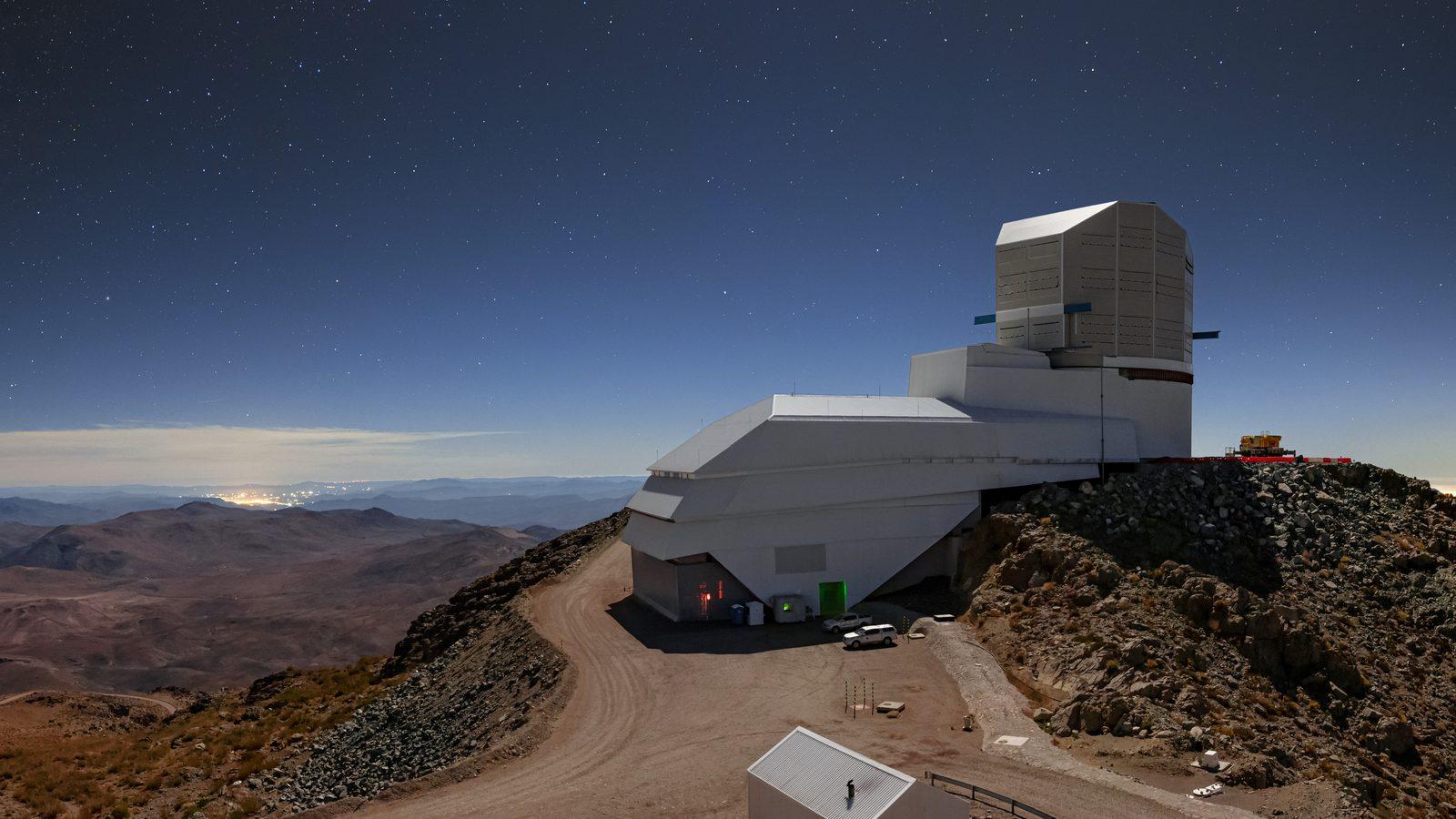
For these instruments, a brighter sky translates straight into lost science. A more luminous sky background washes out the faintest objects, precisely the targets of the big surveys: distant galaxies, dark asteroids, tiny planets around nearby stars. Stray light does not simply spoil images, it narrows how deep a measurement can reach.
What the standard cannot yet guarantee
One limit remains untouched by the text, and astronomers say so openly. The standard applies source by source, fitting by fitting. What telescopes actually endure is the sum of every source. A site can therefore comply at every lamp and still see its sky brighten, if the number of lamps around it grows.
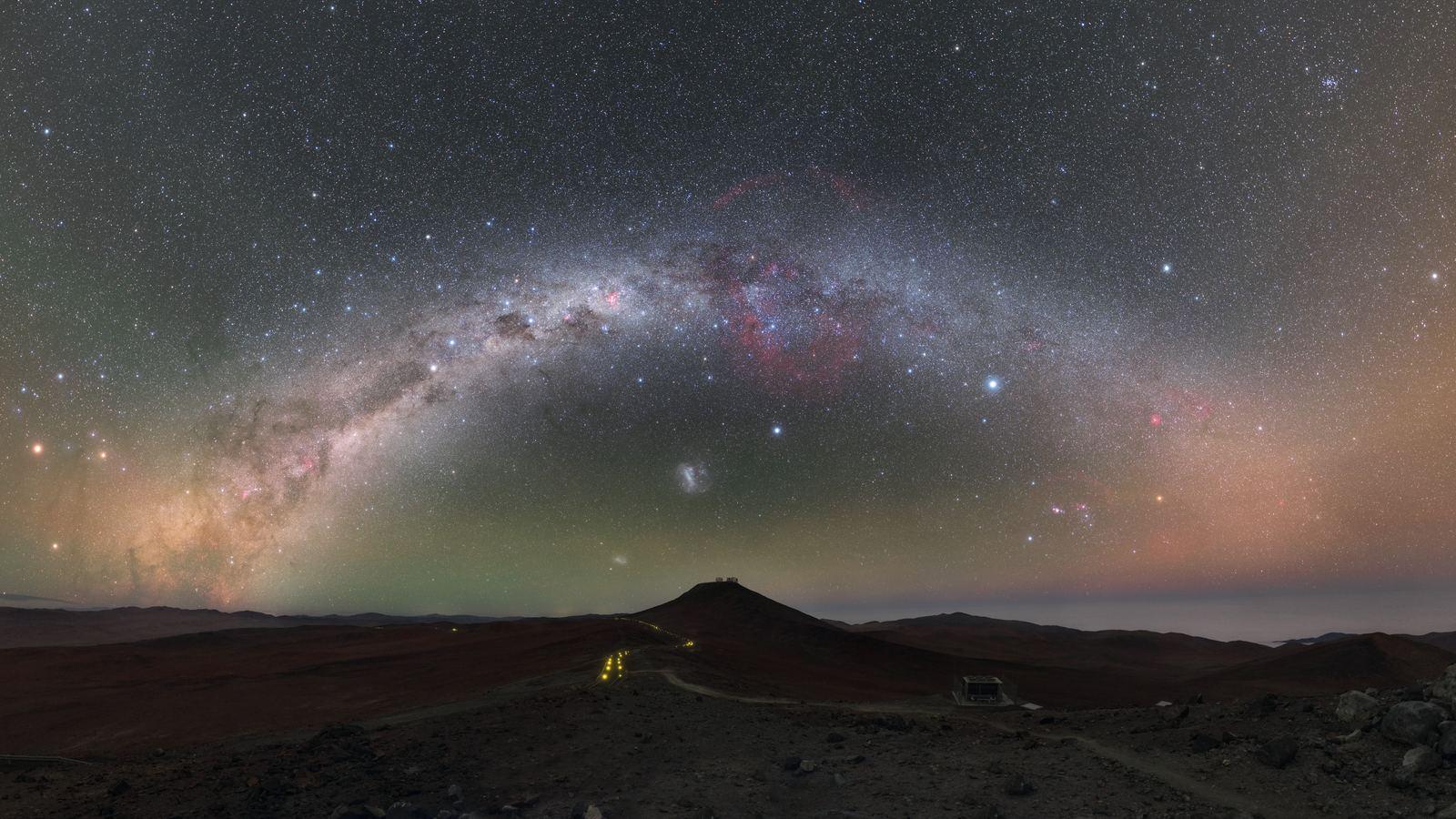
The clearest example comes from Paranal. An industrial and energy complex called INNA is planned a few kilometres from the telescopes, over more than 3,000 hectares. An ESO technical analysis published in March 2025 concludes that the project would raise light pollution above the VLT by at least 35%, and by more than 50% above the southern site of the CTAO gamma-ray observatory, just 5 km away. The project would also weigh on the steady air the site owes its value to, and its wind turbines could add vibrations troublesome for the VLT and the ELT. For ESO, the only fix is to relocate the complex.
Then comes enforcement. Compliance is checked by the Superintendencia del Medio Ambiente, which answers to the Environment Ministry. The same authority decides how far the text really reaches. A well-written rule, poorly applied, changes no sky. What is new in 2026 is therefore not only the thresholds, but the fact that they now apply everywhere, not just around the observatories.
One methodological point remains too. Astronomers cannot yet easily measure the law's effect on how dark the sky becomes, because such measurements take time and depend on the weather. The rule takes effect, the assessment will follow.
Going further
- To find sites with preserved skies: our light pollution map shows dark-sky areas and their Bortle scale, useful for comparing a protected site with a city sky.
- To observe from home despite the lights: the sky map shows what is visible from your location, and the observing guide brings together weather, local light pollution and upcoming events.
- The notions behind this article: the atmosphere, the layer that scatters blue light, and infrared, the band the ELT and the GMT are designed to observe.
- The view from orbit: what large ground telescopes gain, space instruments achieve by leaving the atmosphere behind. The James Webb Space Telescope observes in infrared from the L2 Lagrange point, shielded from all terrestrial light, but with a 6.5-metre mirror where the ELT will aim for 39 metres.
- The satellite side, the other front in sky pollution: our article on the IAU brightness limit already crossed.
- The official text: the Norma Lumínica (D.S. N°1/2022) and its compliance deadlines on Chile's Environment Ministry site, along with ESO's analysis of the INNA project.
- The images: the Paranal sky by Petr Horálek, the ELT construction site by ESO/G. Vecchia, the Cerro Pachón sky by Tomáš Slovinský and the Rubin Observatory at night by B. Quint, all credited to ESO or NOIRLab.