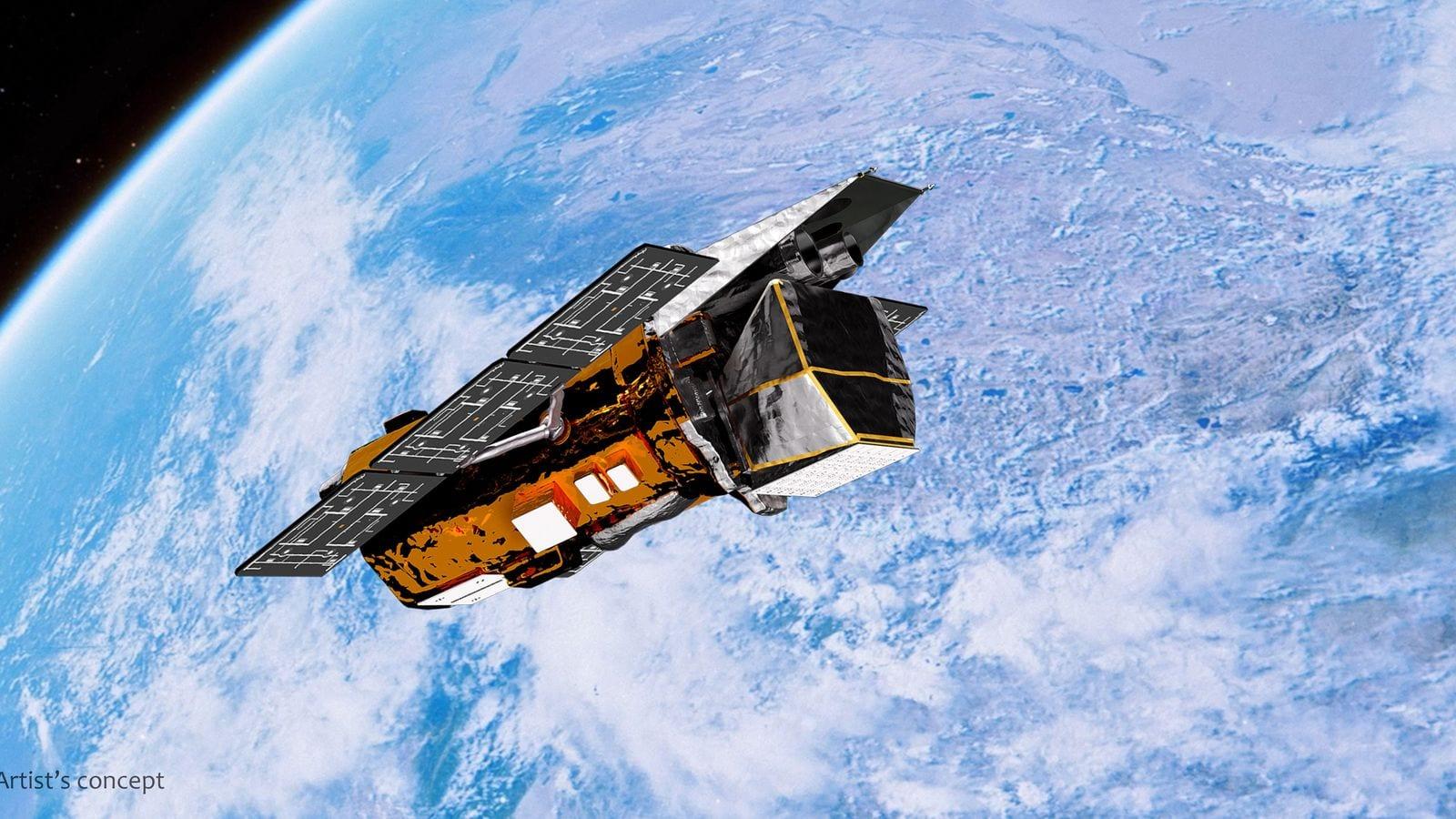
On July 6, 2022, NASA's Swift space telescope caught a flash of gamma rays from a distant galaxy. Four years later, the accumulated data describe an extreme case: the central engine of GRB 220706A kept firing X-ray flares for 27 days on its galaxy's own clock, about 21 days beyond the previous record. A very bright supernova appears to ride along with the explosion, and that is where the story gets complicated. The study appeared on arXiv on September 18, 2026, and it has not yet been peer reviewed.
Fifty-one days for us, twenty-seven for the galaxy
Start with the measurement behind the headline. X-ray instruments followed the glow of GRB 220706A for about 51 days after the initial flash. That glow was not a smooth decline. It carried flares, secondary bursts of X-rays, like hiccups from the engine. The last flare detected falls at the end of that window, when the signal stops looking like a simple afterglow.
One detail changes how that number reads. The host galaxy is moving away from us, and its redshift is 0.8577. That figure is not a distance. It is a record of the expansion of the universe. The farther away a galaxy sits, the longer its light has been stretched toward the red on the way to us. Time is stretched along with the light. An event lasting 27 days inside the galaxy appears to last 1.858 times longer on Earth, or about 51 days. Picture a film shot over there and screened here in slow motion, not because of the projector but because space itself stretched in between.
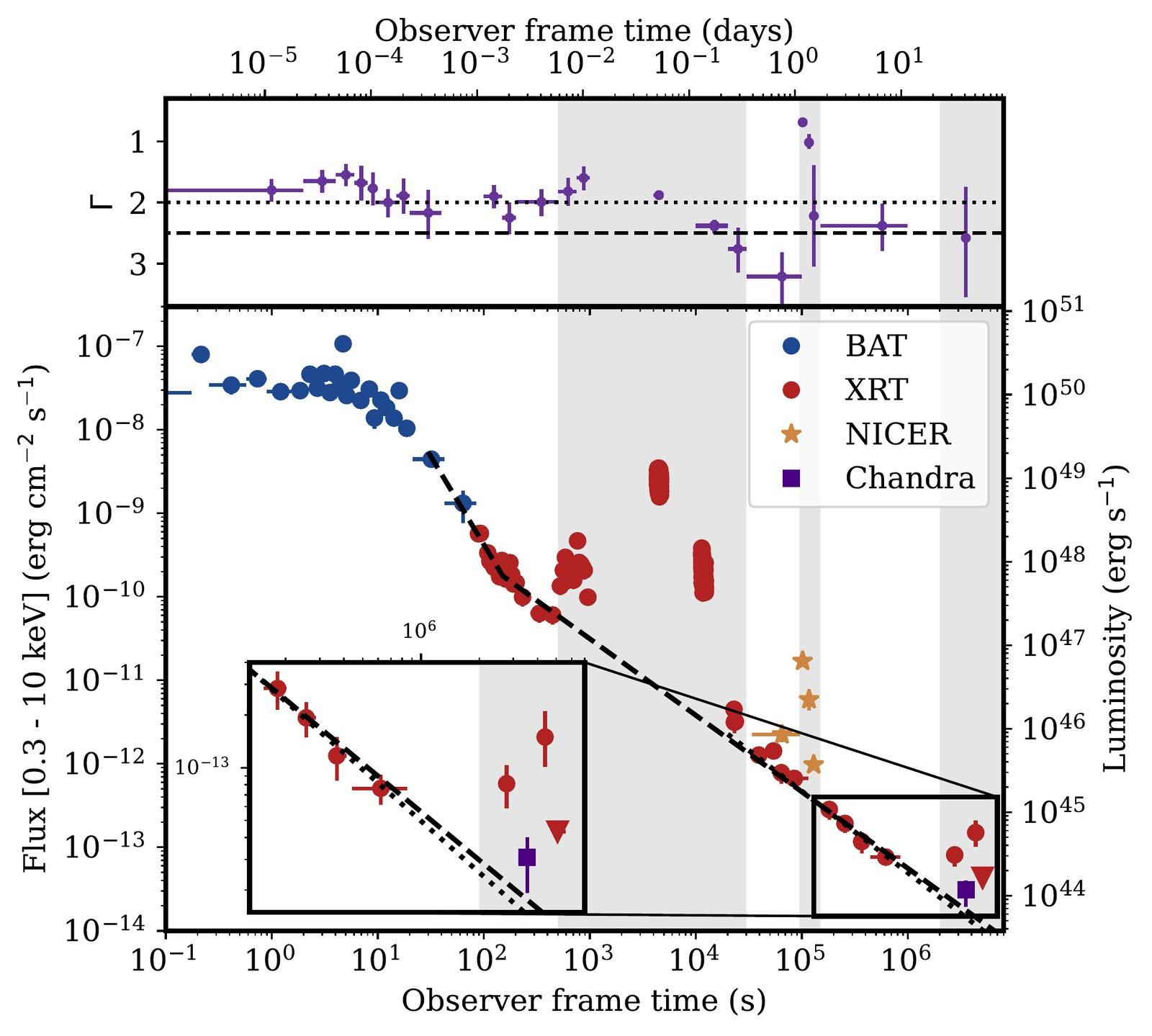
The precise timing of the last flare comes out at 27.25 days, with a margin of 1.95 days above and 0.03 day below. The comparison with the old record is stark. The latest flares known before this belonged to GRB 210204A, and they stopped after about 6.6 days. GRB 220706A therefore adds roughly another twenty days. The team measures the central engine as still active about 20.6 days later than any previously observed flares.
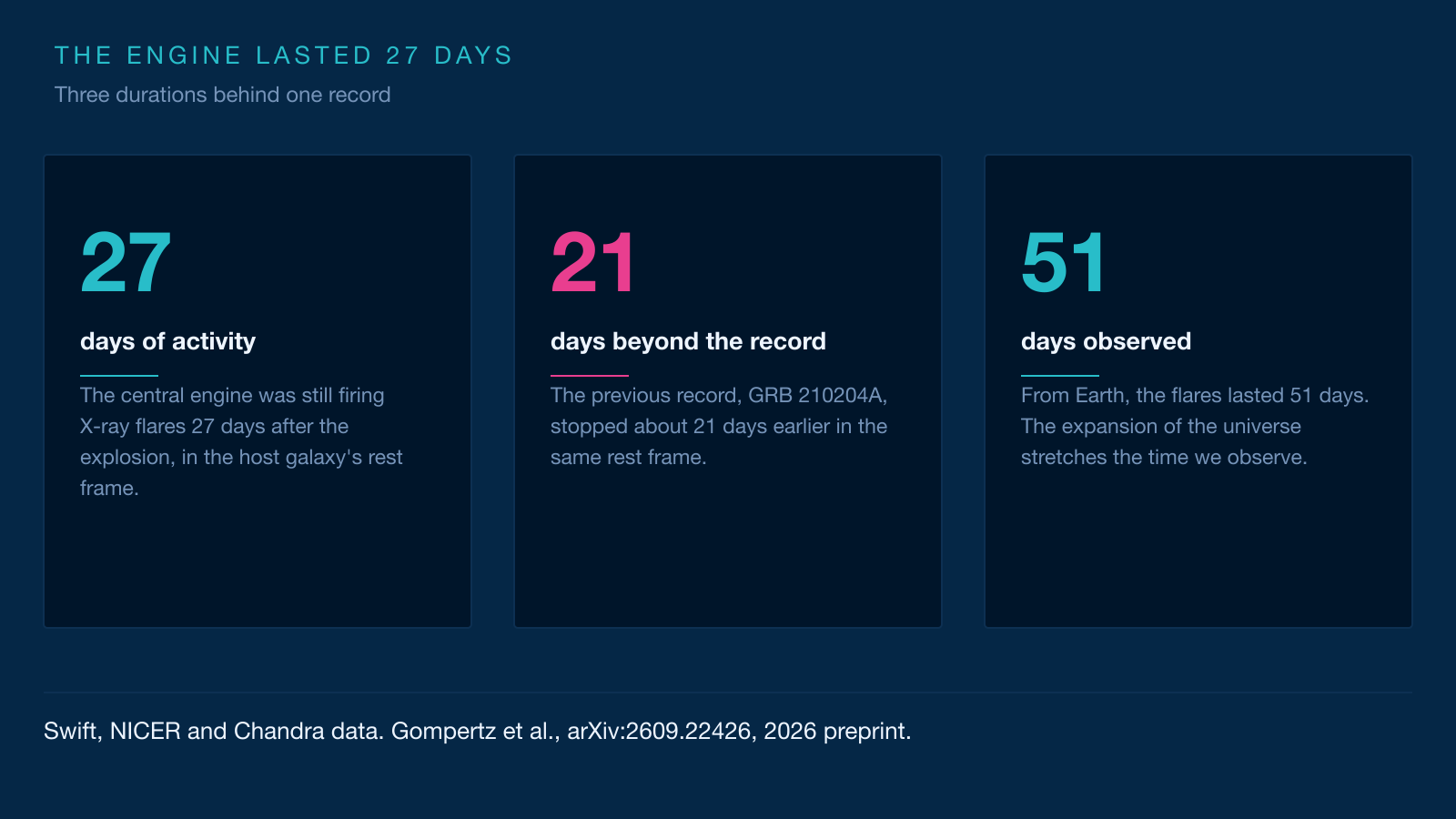
Two durations need to be kept apart. The gamma flash, the one Swift caught on July 6, 2022, lasted 87 seconds, give or take 18 seconds. That is ordinary for a long gamma-ray burst. The engine's duration shows up in the late X-rays instead. An engine active for 27 days is 2.3 million seconds. The record is not about how bright the explosion was, it is about how long it kept going.
An engine that should stop within minutes
To see what this upsets, open the hood. A long gamma-ray burst is born when a very massive star collapses. The star's core gives way and becomes a black hole or a neutron star. The matter of the envelope then falls toward that compact remnant and piles into a disk. Part of it is flung out along the rotation axis, in a jet travelling close to the speed of light. The gamma flash is light from that jet when it points at Earth. The afterglow that follows comes from the shock between the jet and the surrounding gas.
The word engine refers to that core, the part that supplies the energy. How long it lasts depends on how fast matter falls in. For an ordinary star, collapse and accretion take seconds to minutes. Classic long gamma-ray bursts last between 2 and 100 seconds. A minority, called ultra-long, lasts thousands of seconds, sometimes several hours. GRB 220706A belongs to that family: its engine duration, measured on the light curve, reaches 56,000 seconds, about 15.6 hours. That is the eighth longest in a sample of 550 bursts the team analysed.
Twenty-seven days is about forty times longer than those fifteen hours. For accretion to keep going that long, the star has to be much bigger than usual. Free-fall time, the time matter needs to drop toward the centre under gravity, grows with the star's radius. The team's calculations indicate that a star of about 10 solar masses and a radius near 10¹³ centimetres, almost 140 times the radius of the Sun, can still feed the black hole after 27 days. So we are talking about a supergiant, a star blown up like a balloon before its end.
A variant exists. Some very massive, unstable stars shed their outer layers in pulses before collapsing. Their envelope can reach 10¹⁴ centimetres, ten times wider. These are pair-instability stars, named for what drives the pulses: electrons and their antimatter twins appear in the core as pairs, the pressure drops, and the star swings between collapse and rebound. Pair-instability stars had already been proposed for ultralong bursts, but the model had never been tested against flares this late. And the supernova complicates matters. It means the star did explode, which interrupts the picture of a steady fall of matter.
A very bright supernova, hidden by dust
There is likely a supernova, though. The first optical images of GRB 220706A showed nothing. Then, around 17 days after the explosion, a source appeared, with a flux ten times higher than what the afterglow alone predicted. Ground telescopes tracked its evolution, and the shape of that light matches a supernova.
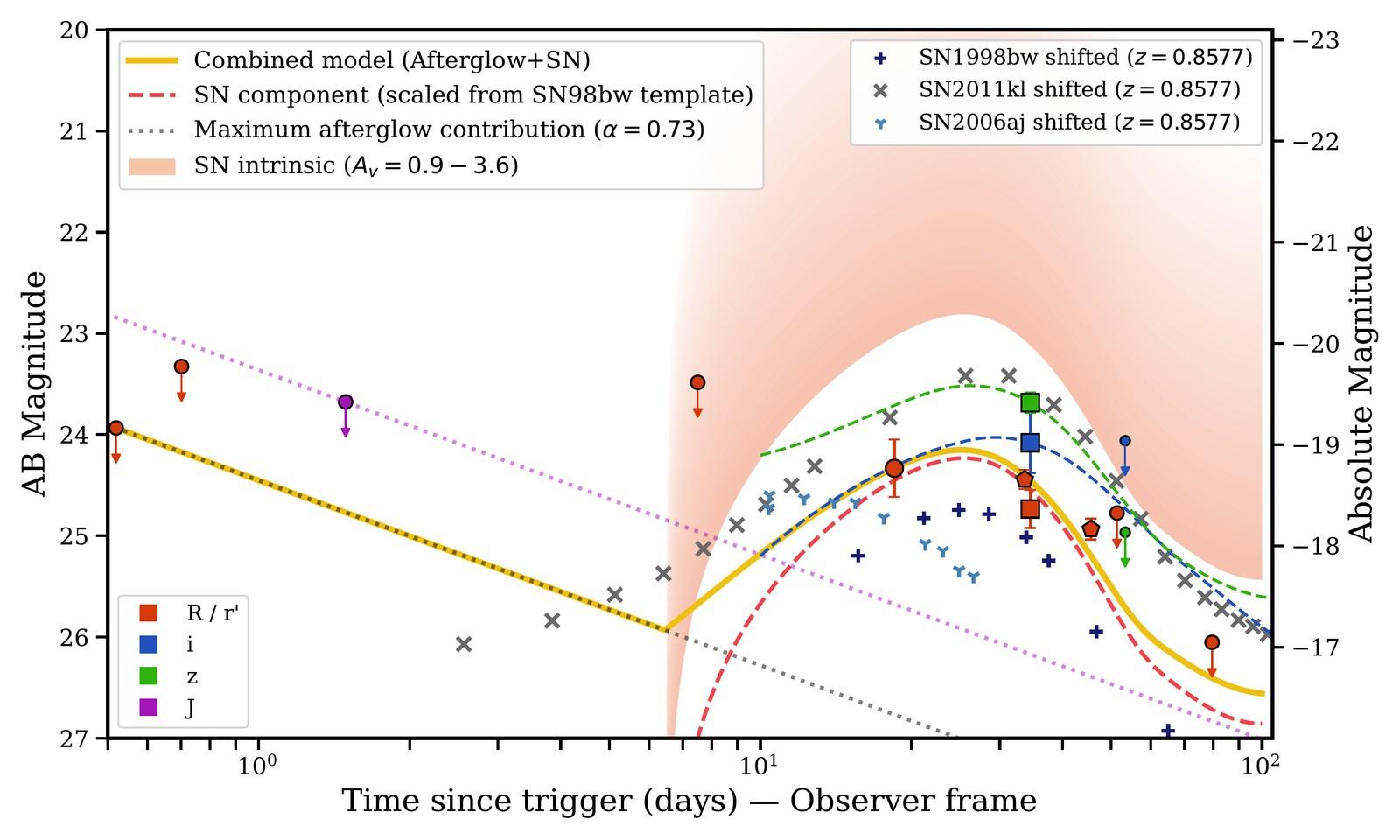
The modelling gives a supernova 1.58 times the luminosity of SN 1998bw, the benchmark for supernovae tied to gamma-ray bursts. That corresponds to an absolute magnitude of -18.85. Except that this value is measured through the dust of the host galaxy. The burst is what astronomers call a dark burst: its visible light is strongly absorbed by that dust. X-ray spectra indicate a hydrogen column of 2.43 × 10²² atoms per square centimetre, and conversion models give an extinction A_V between 0.9 and 3.6 magnitudes. Extinction is the toll dust charges on light, measured on the same scale as brightness.
Once that correction is applied, the supernova becomes much brighter. Its absolute magnitude reaches at least -20.25, and would reach -21.56 if the extinction is 1.7 magnitudes. For scale, a more negative absolute magnitude means a brighter object. The Sun's absolute magnitude is 4.8. Ordinary supernovae peak between -17 and -19. Superluminous supernovae go past -21. GRB 220706A therefore sits at the edge of that rare class.
If the supernova is confirmed, this would be the first event where a gamma-ray burst and a superluminous supernova are seen together. The most telling comparison is SN 2011kl, the very bright supernova tied to the ultralong GRB 111209A. That precedent matters, because it had been read as the signature of a magnetar. The team stays cautious. The light attributed to the supernova could also be the optical counterpart of the X-ray flares, at a time when the X-rays were not being monitored.
Supergiant, magnetar or shredded star: three leads
The team explores three families of explanations, plus one variant, without picking a winner. The first is the supergiant described above: a star big enough that matter takes weeks to fall in. The problem is twofold. It requires an exceptionally extended star, and the supernova explosion must leave enough matter behind to keep feeding the engine afterwards.
The second lead is a magnetar. That is a neutron star born in the collapse, with a magnetic field about a thousand trillion times stronger than Earth's. Spinning very fast, it releases its energy into the ejecta and can power a jet for a long time. The observations allow a magnetar spinning in under 2 milliseconds, with a field between 5 × 10¹⁴ and 10¹⁵ gauss. But it would take fine tuning to hide its characteristic energy plateau beneath the flares, and the split of energy between the burst and the supernova does not quite match what is seen in GRB 111209A.
One variant: the flares do not come from the engine but from the jet slamming into shells of matter shed by the star before it died. The idea is appealing because it eases the demands on the engine. But the flares observed are too brief for their delay to fit a shock of that kind. The team computes a ratio of about 0.34 between the duration of a flare and the time it appears, where a shock against a shell would give a ratio above 1. An interaction between a late jet and the sheath of gas carved out by the main jet remains possible, but it still needs an engine alive at that point.
Third lead, more radical: a star torn apart by the supermassive black hole at the centre of its galaxy. In this tidal disruption scenario, or TDE, the black hole pulls harder on the near side of the star than on the far side and stretches it until it breaks. The process predicts a jet and light that can mimic a supernova. GRB 220706A sits at a position compatible with the nucleus of its galaxy, which makes the lead credible. But its X-rays follow the population of gamma-ray bursts, not that of jetted TDEs, and its visible light does not look like AT2022cmc, a well-monitored TDE. The recent discovery of GRB 250702B revived the debate, and the team acknowledges that the question stays open.
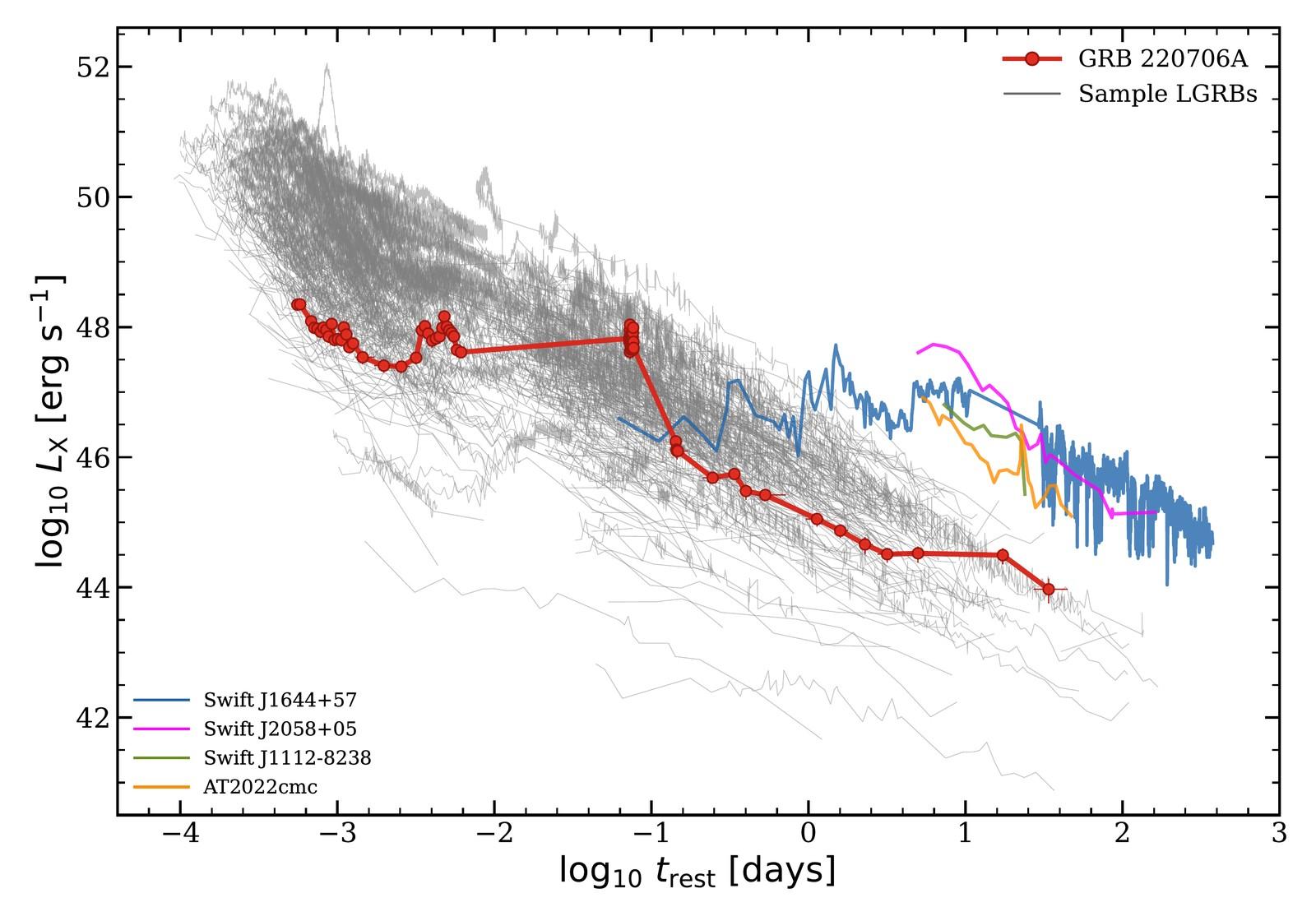
The honest conclusion fits in one sentence: the supernova points to the collapse of a massive star, but no model accounts for the 27 days in a simple way. The authors say so themselves, and more events of this kind are needed to settle the scenarios.
Why these explosions slip under the radar
One question stays open. If gamma-ray bursts can last weeks, why were none seen earlier? Part of the answer lies with the instruments. Most satellites that hunt gamma-ray bursts fly in low orbit and lose their target for about 90 minutes on every lap around Earth. For a flash of 10 to 100 seconds, that does not matter. For an event spread over weeks, those coverage gaps become a handicap.
Benjamin Gompertz, the first author of the study, summed up the problem in an interview with Space.com: bursts this long are hard to detect, and they seem more active in X-rays than in gamma rays. Recent missions built for X-rays, such as Einstein Probe, could therefore find more of them. The study calls for a systematic hunt for late flares in the archives, because the record held by GRB 220706A may only be a first. Nothing says it is the longest possible.
This case also shows what is changing in how we search. For twenty years, gamma-ray bursts were sorted by the length of their gamma flash. GRB 220706A has an 87-second flash, perfectly ordinary. All of its originality sits in the X-rays, sometimes weeks later. Looking for the strongest signal is not always looking for the most interesting one. Sometimes the record hides in the data already on disk.
Going further
- The telescope that triggered the alert: Swift, and the one that followed the late X-ray glow: Chandra.
- The key notions for following this article: the X-rays, the supernova and the black hole in our glossary.
- To observe the sky from your own home: the interactive sky map and the astrophotography gallery.
- The sources for this article: the study by Gompertz et al., arXiv:2609.22426, a preprint from September 18, 2026 under a CC BY 4.0 licence, and the Space.com report from October 26, 2026.