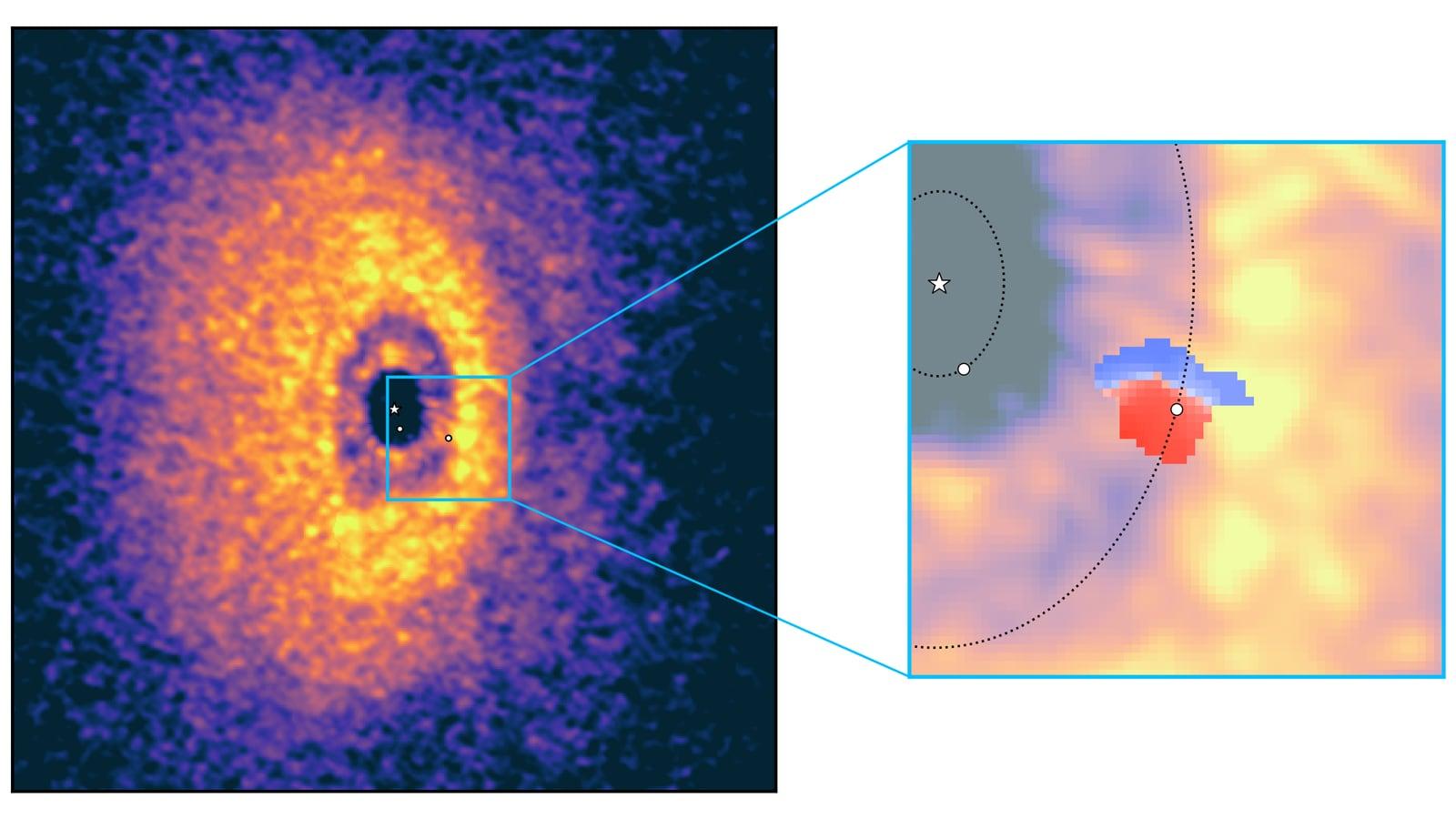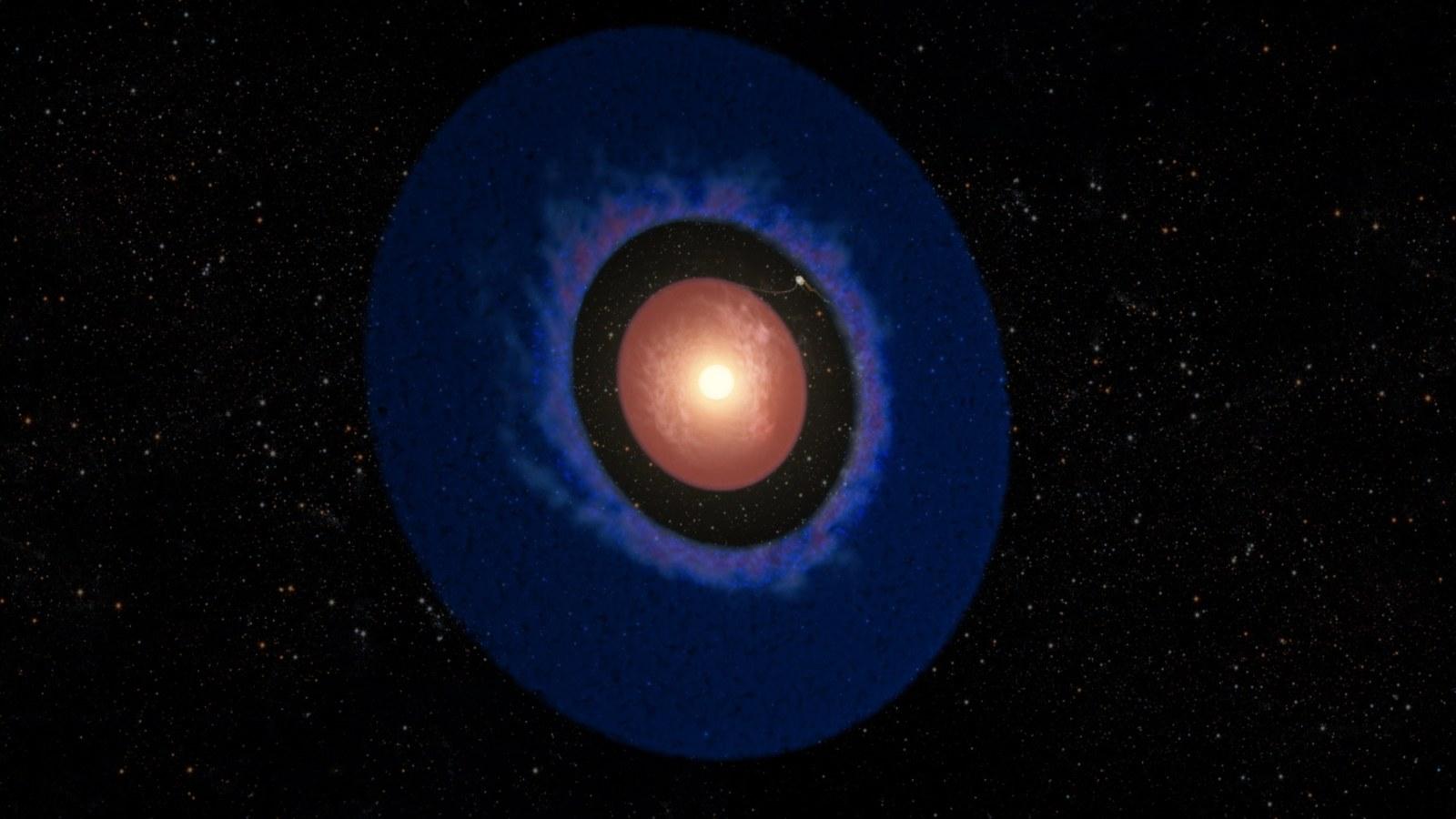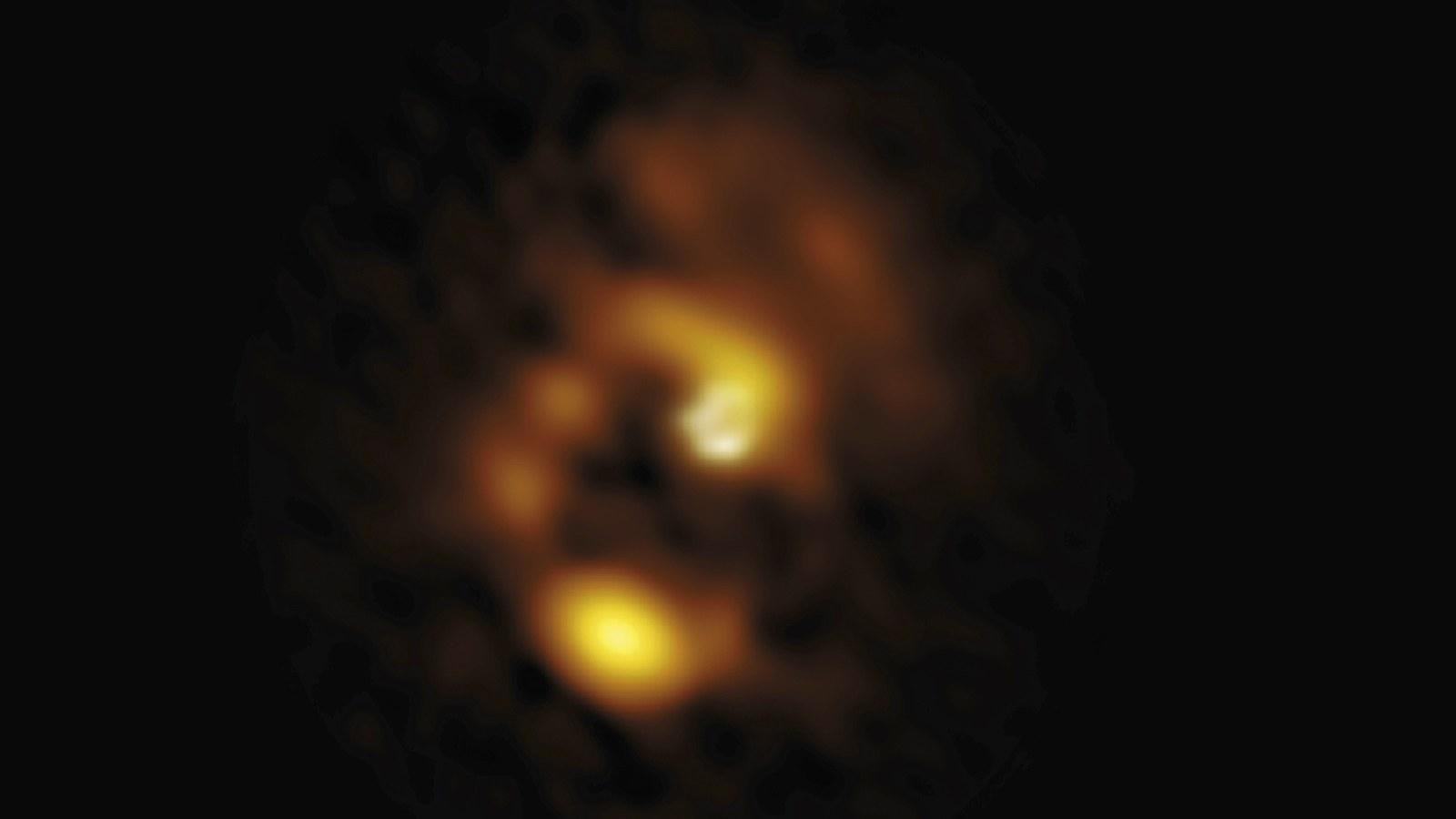
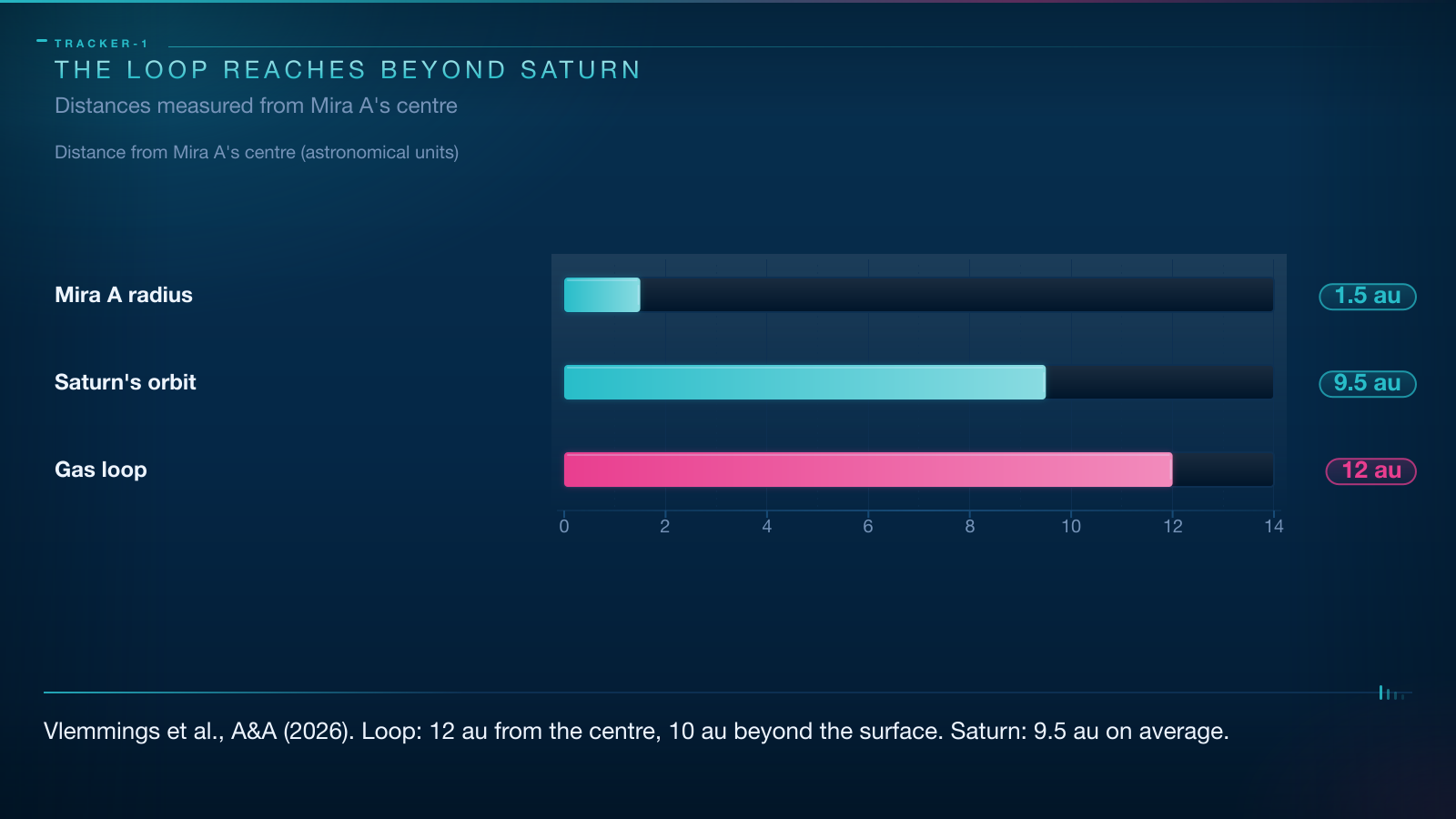
Mira A sits about 330 light-years away in the constellation Cetus. It is a star near the end of its life, swollen and pulsating, and it is shedding its outer layers into space. That gas will eventually help form new stars and rocky planets. In 2025, the ALMA radio telescope imaged a loop of gas ejected two years earlier. The loop stretches 12 astronomical units from the star's center, a little farther than Saturn's orbit. Its polarized light tells a story that a gentle dusty wind cannot.
A loop wider than Saturn's orbit
Mira A is a red giant. Its radius reaches 1.5 astronomical units, about one and a half times the average distance from Earth to the Sun. It has a companion, Mira B, a white dwarf, the bare core of a dead star. The two are close, with a projected separation of about 0.4 arcseconds.
On August 10, 2025, ALMA turned its array of antennas toward the pair. ALMA, the Atacama Large Millimeter/submillimeter Array, is a radio observatory in Chile. It observes millimeter and submillimeter waves, longer than the light our eyes can see. Its strength is resolution. At Mira A, it reached 1.5 to 2.6 astronomical units, fine enough to resolve structures in the star's atmosphere.
The observation belongs to a joint program with the VLA, the Very Large Array, a radio telescope network in New Mexico. The two instruments complement each other, one in millimeter waves, the other in centimeter waves.
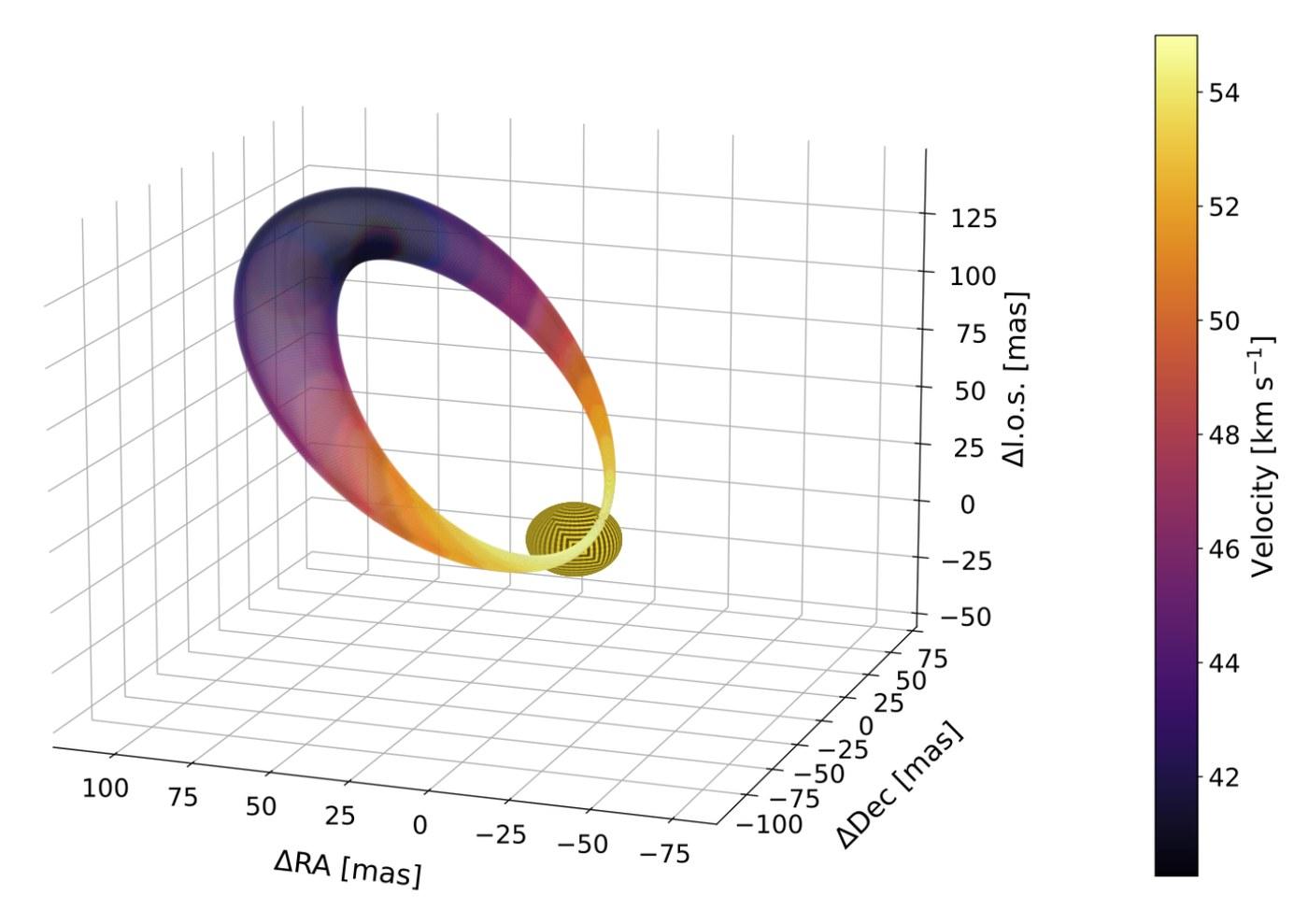
In the image, silicon monoxide masers outline a loop. A maser is an amplification of light by stimulated emission, the radio cousin of a laser. Excited SiO molecules in the hot gas shine at a precise frequency, and that light acts as a tracer. It extends to 120 milliarcseconds from the center, about 12 astronomical units, or eight stellar radii. The loop therefore lies roughly 10 astronomical units beyond the star's surface. That is slightly more than the distance from the Sun to Saturn, which orbits at 9.5 astronomical units.
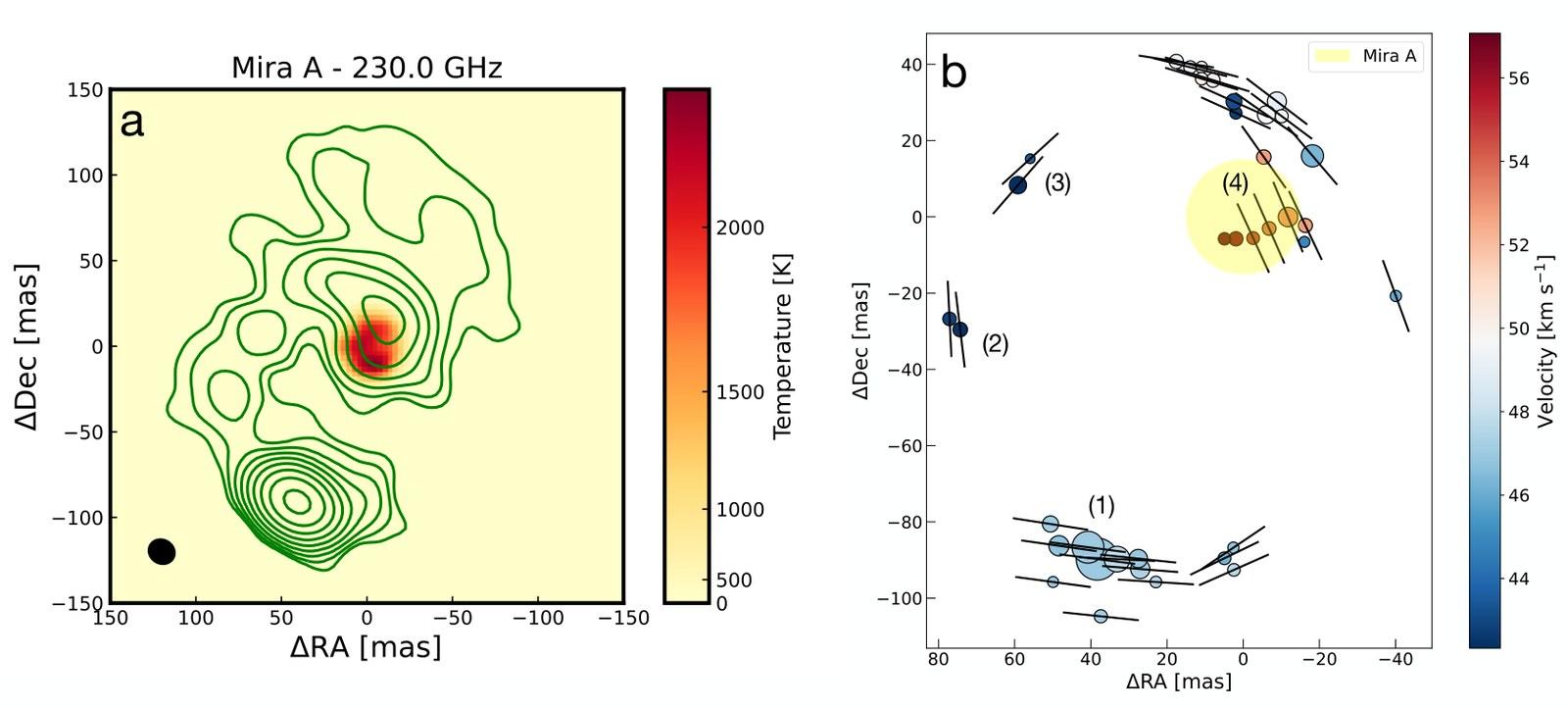
The authors do not see a round cloud. They see an elliptical structure, anchored at the star's surface and rising to an apex. Its shape resembles the magnetic loops on the Sun that carry solar eruptions. The difference is scale. The entire Sun would fit in a small corner of this structure.
The timeline matches a hot spot. In June 2023, submillimeter observations found a bright patch in the southwest quadrant of the star, running 4,200 kelvins (7,560 °F) hotter than the surface. Assuming a ballistic launch at escape velocity, the eruption left between mid-2023 and early 2024. That is one to two years before the 2025 image.
This was not the first event. A similar ejection launched in late 2010 or early 2011 and showed up in 2014 data. Mira A goes through repeated episodes, not a single outburst.
A magnetic field of at least 0.7 gauss
A loop of gas alone does not prove a magnetic field. The signature lies in polarization, the orientation of the light's vibration.
Mira A's masers are polarized, both linearly and circularly. Linear polarization gives a preferred direction. Circular polarization gives a rotation, like a corkscrew. Combining the two lets astronomers reconstruct the field's geometry and strength.
The result is a lower limit. For the polarization to be controlled by the field rather than by the maser amplification, the field must be strong enough. The authors derive a floor of 0.7 gauss. The gauss is a unit of magnetic field, on the order of Earth's surface field.
The circular polarization of the brightest line suggests much more, about 80 gauss, if read as a pure Zeeman effect, the splitting of spectral lines by a magnetic field. The authors distrust that number. In a saturated maser, other effects can inflate circular polarization. They keep 0.7 gauss as a cautious limit.
That limit is enough to change the picture. The magnetic energy stored in the loop is at least 0.6 × 10⁴⁰ ergs. The kinetic energy of the moving gas is 1.4 × 10⁴⁰ ergs, the same order. The erg is the energy unit used by astrophysicists. The field is not a passive detail. It carries a significant share of the eruption's energy.
The mass in motion points the same way. The authors estimate that at least 1.1 millionth of a solar mass was ejected. The gas leaves at about 35 kilometers per second, close to the star's escape velocity of 30 to 37 kilometers per second. About 30 percent of the material never reaches escape speed and falls back. The rest gets away.
Dust-driven winds no longer explain it
For decades, astrophysicists explained red giant mass loss with a simple chain. The star's pulsations and convection lift gas. At some distance, the gas cools and forms dust. Starlight pushes the grains, and the grains drag the gas along. The stellar wind, a continuous flow of matter, leaves the star.
That model has a problem. Some red giants lose a lot of mass without enough dust to drive the wind. Others show directional ejections, in lobes or loops, that a steady wind does not predict. Mira A has both anomalies.
The 2025 eruption provides a scale. Its total energy exceeds typical stellar superflares by several orders of magnitude. A superflare is a giant eruption on a star's surface, far stronger than a solar flare. A dusty wind, however steady, does not concentrate that much energy into a loop.
The authors propose another engine. The loop resembles a coronal mass ejection, the solar eruptions that hurl plasma into space. On Mira A, the phenomenon is cooler and weakly ionized, but it shares the essential traits. A localized magnetic footpoint, a large loop, a rapid launch, and then an almost ballistic flight.
The origin of the field is still unknown. Three ideas are on the table. A turbulent dynamo in the star's thick convective envelope could sustain a baseline field. Differential rotation between the core and the envelope could amplify it. The engulfment of a companion or a giant planet could also strengthen the dynamo. Mira A shows no measurable rotation, so the question stays open.
Atoms from a dying star
The stakes go beyond Mira A. Red giants are chemical factories. They forge carbon, oxygen and nitrogen in their deep layers, then spread them into the interstellar medium. Those atoms end up in gas clouds, new stars, rocky planets and living things.
Mira A's mass-loss rate is estimated at a few times 10⁻⁷ solar masses per year. The number remains uncertain because the star's surroundings are complex. But the order of magnitude shows the scale of the process. A star like Mira A can change the chemical makeup of its region of the Galaxy.
If some of that material leaves in magnetic eruptions, the models must change. Mass loss would not be a continuous trickle. It would come in bursts, with preferred directions and clumps. That could explain several observations that remain unexplained, such as the asymmetry of red giant envelopes and the tortured shapes of some planetary nebulae, the shells of gas left by a dead star.
X-rays add a piece to the case. In 2003, the Chandra satellite detected an X-ray outburst from Mira A. It was the first time such a red giant had been seen in X-rays. Mira A's activity is not just a slow outflow. It has fits and starts.
The link to the Sun is striking. Solar flares are born in magnetic loops, and coronal mass ejections hurl plasma outward. Mira A does the same thing with a cooler, larger, older star. Our Sun will become a red giant in several billion years. It may experience similar eruptions. The atoms that make us may have passed through such an episode before they ended up here.
What the observation does not prove
The paper does not claim that every red giant wind is magnetic. It shows one case, with a solid lower limit and a plausible mechanism. The authors describe a force that must enter the models, not a finished theory.
Several caveats remain. The loop is not observed in three dimensions, and its geometry is a reconstruction. The authors present it as an idealized representation, not a unique physical solution. The 0.7-gauss field is a lower bound. The field's origin is unknown. The rate of these eruptions, and their real contribution to mass loss over a star's lifetime, still need measurements.
More red giants will have to be followed with ALMA and the VLA to see whether the phenomenon is common. The answer will tell us whether Mira A is a spectacular exception or a representative of a class. Either way, the 2025 image has already changed the question. It is no longer only about how a dying star breathes. It is also about how it erupts.
Going further
- The physics of magnetic eruptions, compared with solar flares and the solar wind.
- Earth's magnetic field shields the planet from solar eruptions, but it is not the same as the far larger field around Mira A.
- Observe the sky from home with our interactive sky map, our observation guide and the astrophotography gallery.
- The study: Vlemmings et al., A giant magnetic eruption from the asymptotic giant branch star Mira A, Astronomy & Astrophysics, 2026, open access.
- The ESO image: Mira lives up to its name, Picture of the Week for November 23, 2026.