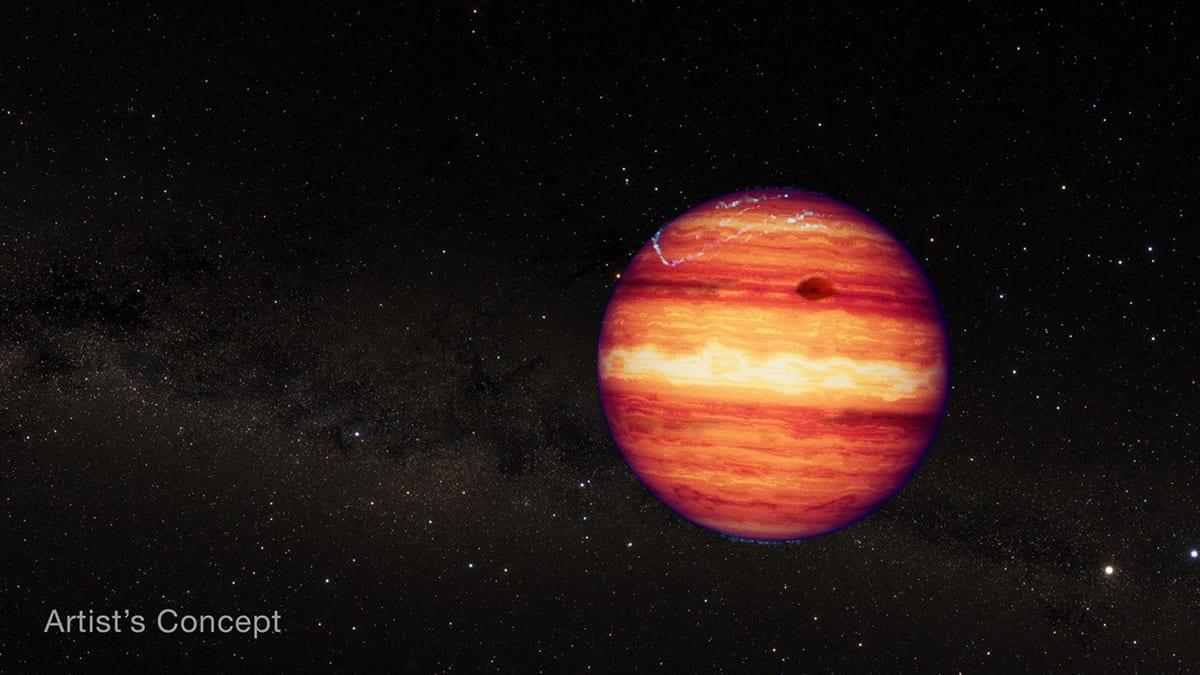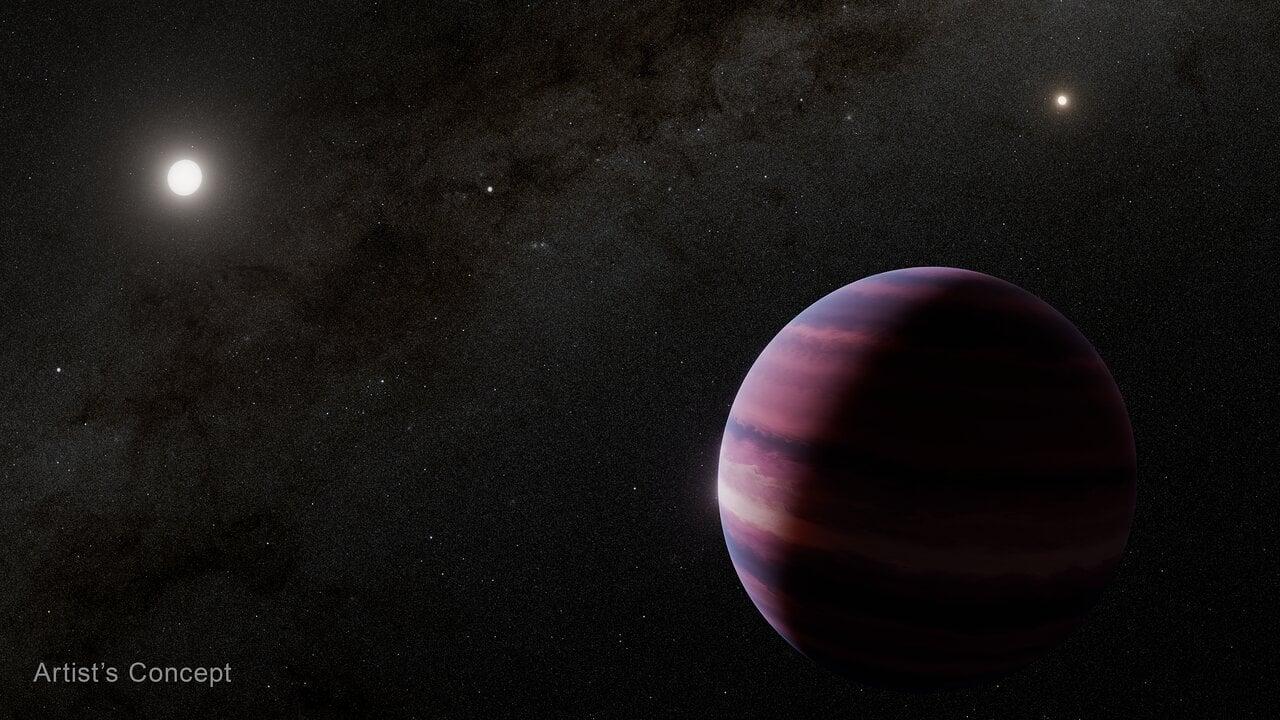
A planet less than a million years old, still growing in its cradle of dust, has been confirmed about 450 light-years from Earth. Its name is Elias 2-24 b, and it is now the youngest known exoplanet. On September 16, 2026, Andrea Bernardi's team published the confirmation in The Astrophysical Journal Letters. The planet turned up when the researchers reopened coronagraph images from the Keck telescope taken in 2018 and 2020, and the result leaves planet-formation models with a problem.
A "baby" less than a million years old
The record comes down to a single number. Elias 2-24 b is less than a million years old. At that scale, Earth is an old-timer at 4.5 billion years, and even our Sun is well past its troublesome teenage years. The planet now holds the title of youngest ever observed, and it owes that to a star system even younger than itself.
Where is it? In the constellation Ophiuchus, about 450 light-years away. A light-year is the distance light covers in a year, roughly 9.5 trillion kilometres. The light we catch today left Elias 2-24 around 450 years ago, back when Galileo was first pointing his telescopes at the sky.
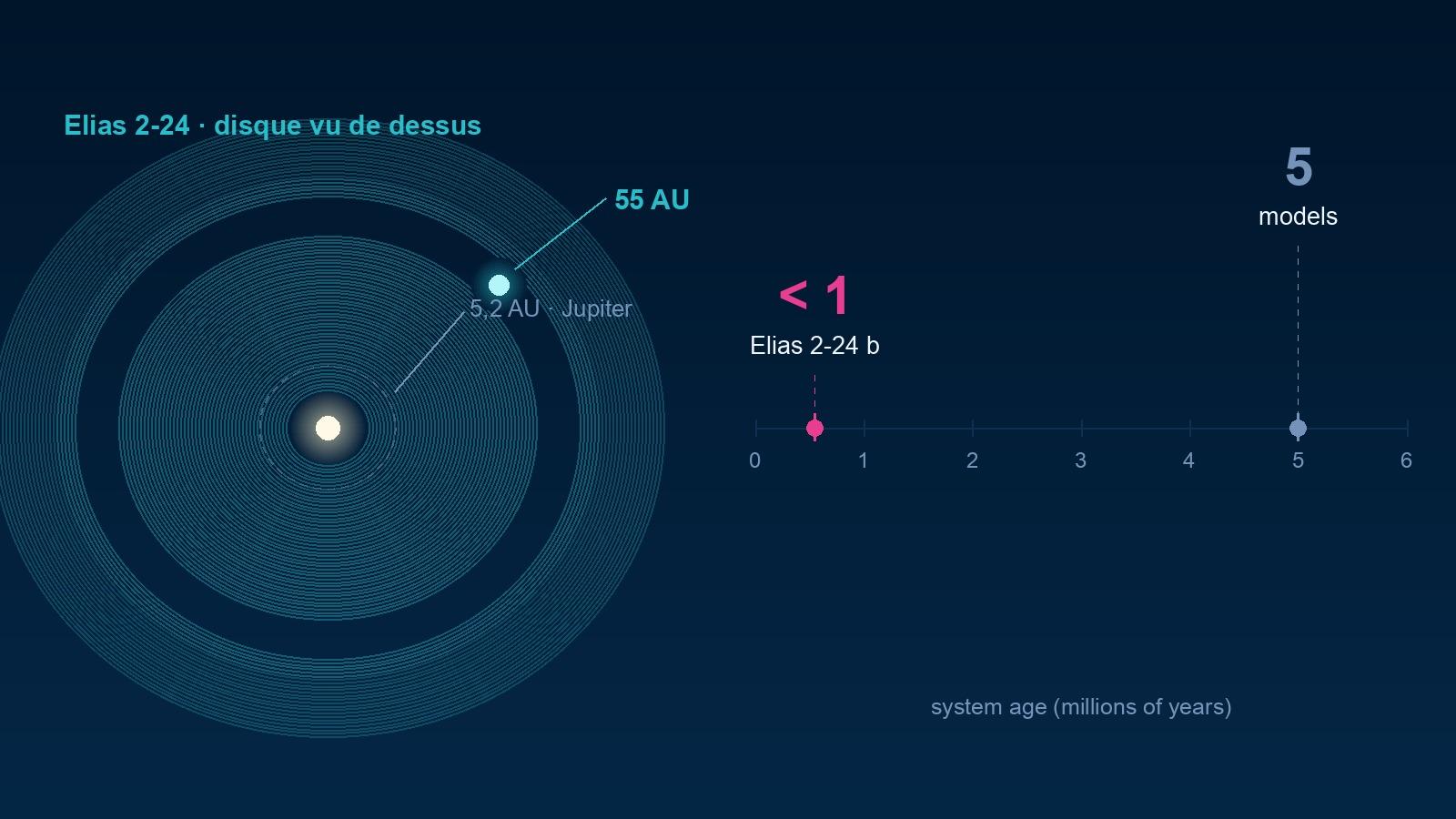
Its mass is still an open question. By comparing its light with models of how young planets evolve, the team arrives at a range of 1.9 to 4.0 Jupiter masses. The NASA release keeps it simple and calls the planet Jupiter-mass. Its distance from its star is better pinned down: 55 astronomical units. One astronomical unit is the Earth-Sun distance, about 150 million kilometres. Elias 2-24 b therefore orbits 55 times farther from its star than Earth does from the Sun, out in the distant suburbs of the system.
That is not its only departure from our neighbourhood. Jupiter sits 5.2 astronomical units from the Sun. Elias 2-24 b is ten times farther out from its own star.
How to photograph a planet lost in the glare
Most of the roughly 6,000 known exoplanets were found another way, through transits: the planet crosses in front of its star and makes it dip slightly in brightness. That method is no use here. A planet still buried in dust, or orbiting far from its star, produces no measurable dip. Baby planets have to be photographed directly.
Looking for a planet around a star then becomes like looking for a firefly perched on a cinema projector. For Elias 2-24 b, the star shines about nine thousand times brighter than the planet, and that light spills everywhere. The Keck telescope, perched at 4,200 metres on the summit of Mauna Kea in Hawaii, uses a coronagraph for the job: a mask that blocks the heart of the star so that whatever hides right beside it can come through. The idea is the one behind holding a hand in front of a lamp. The hand covers the blinding source, and the objects on the table finally become visible.
Blocking the star is only half the work. A halo of leftover light remains, grainy as salt and easily mistaken for ghost stars. Astronomers strip it away by subtracting, frame after frame, everything that does not move with the sky. That processing step changed between 2018 and today, and it is what reopened the case.
The instrument mounted on Keck, NIRC2, observes in the mid-infrared, at a wavelength of 3.8 micrometres. That is far redder than our eyes can see, and dust in the disk lets it through more easily than visible light. An arcsecond, the unit used to measure these separations, is about 1/3,600 of a degree.
The gap in the disk finally speaks
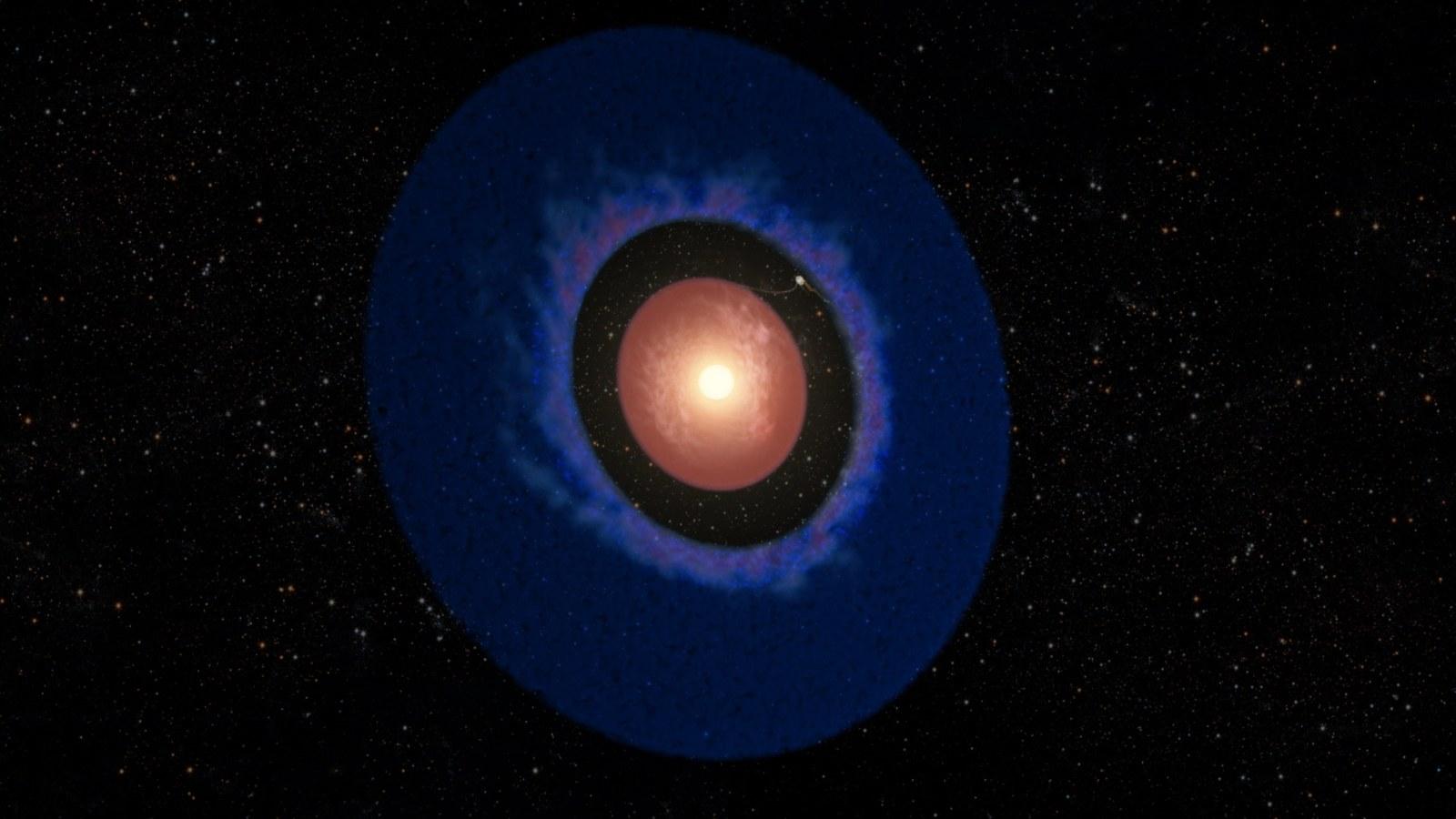
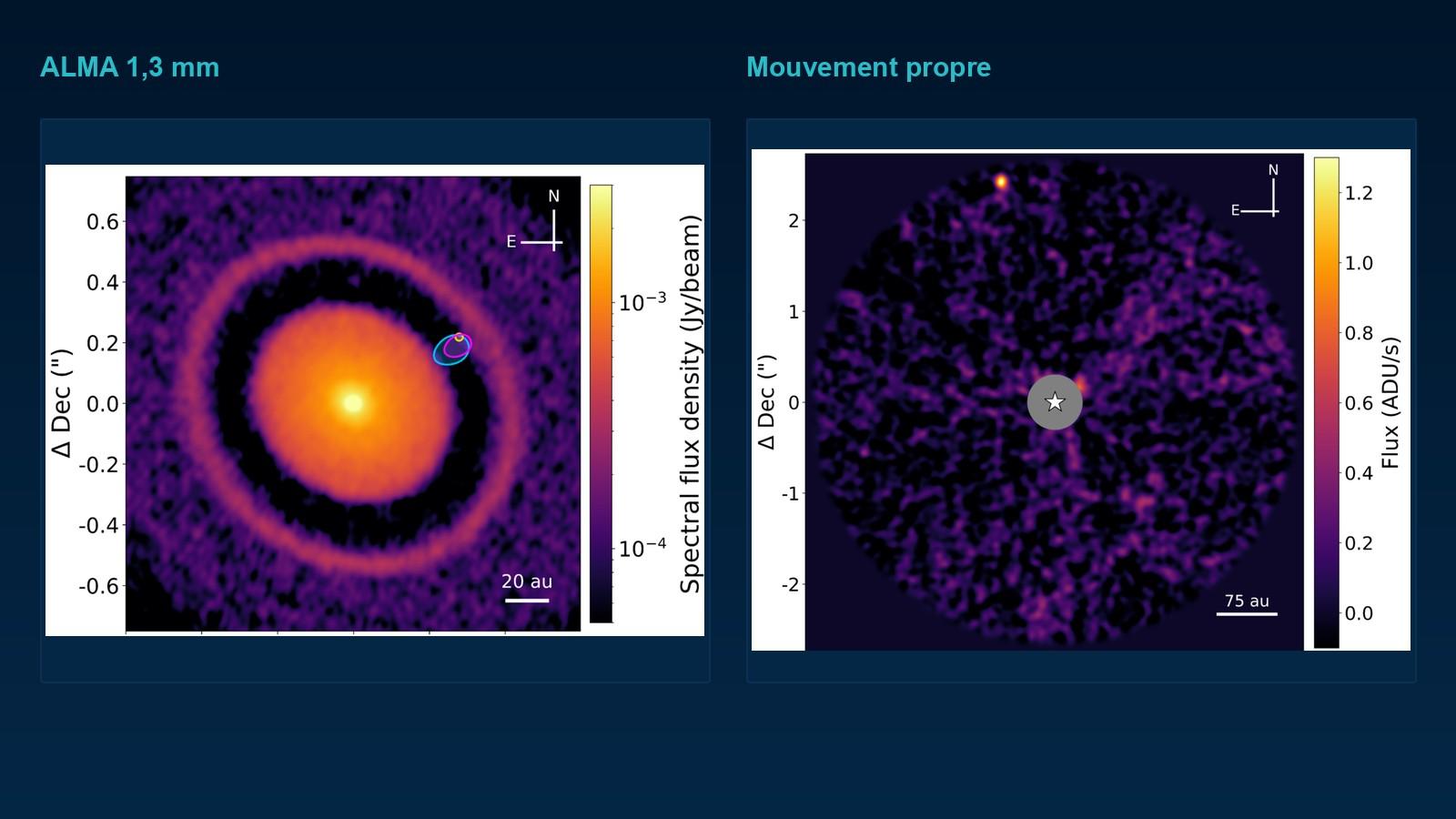
The story starts in 2017. That year, ALMA, an array of radio dishes sitting at 5,000 metres in Chile's Atacama desert, published an image of the disk around Elias 2-24. It showed three concentric gaps, dark rings carved out of the disk's dust, including a wide gap in the middle. Astronomers had long suspected that forming planets dig these furrows by sweeping material aside, but direct proof was missing. "The planets should be found within the gaps, since they are carving them, and that's exactly where we found Elias 2-24 b," Bernardi sums up.
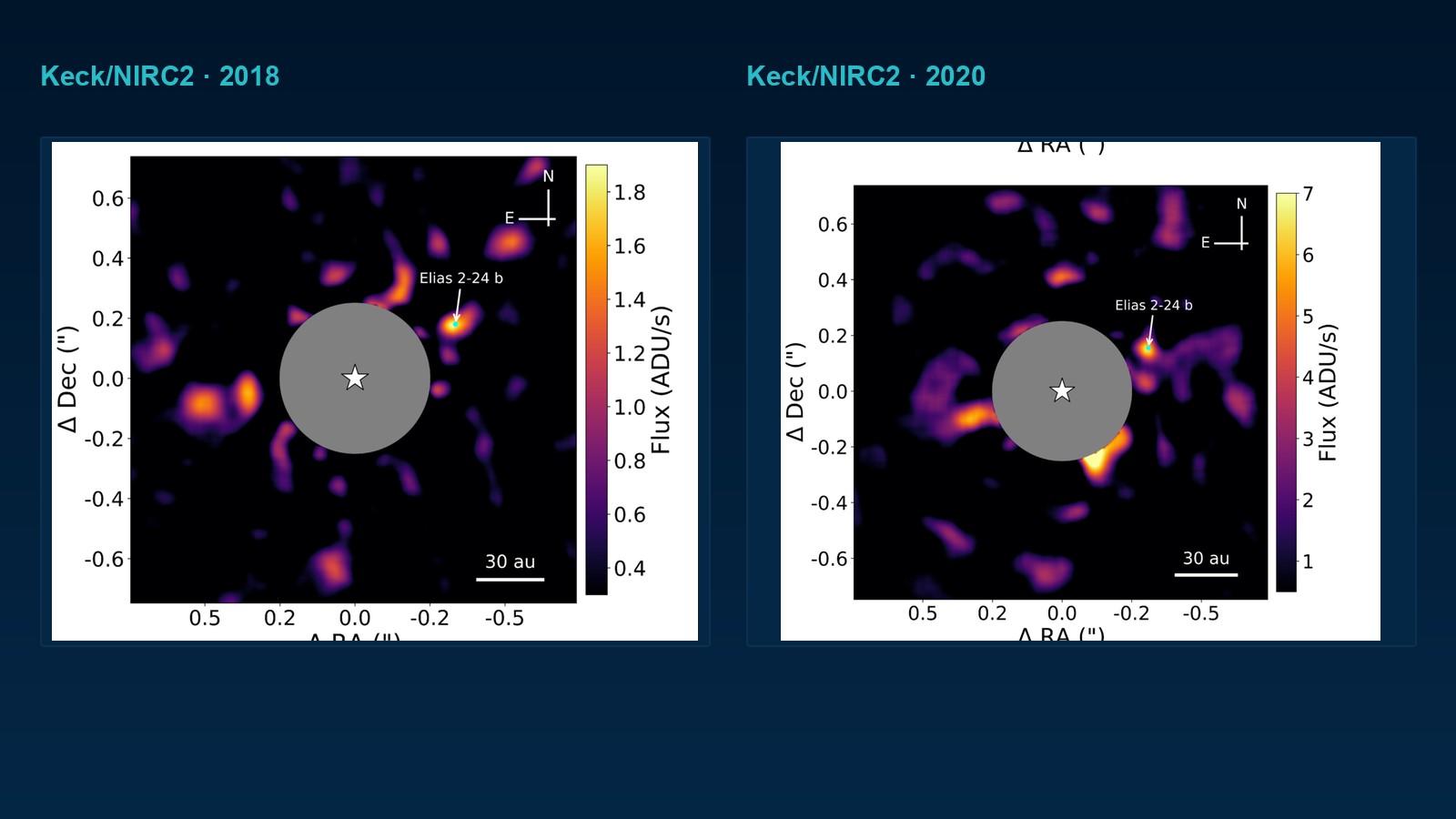
In 2018, Alice Zurlo, a co-author of the study, observed Elias 2-24 with the Keck coronagraph. A faint signal showed up, too weak to settle the question. The file then sat untouched for years. In 2021 and 2023, two independent studies also spotted a bright dot inside the gap, but neither could fully rule out an image artifact or a star in the background.
The archive is what changed the game. The Keck Observatory Archive keeps every observation made with the telescope, through a NASA-funded partnership with the Exoplanet Science Institute at Caltech. Bernardi went back to it, pulled out the same 2018 observation, then a second one from 2020, and analysed both with newer processing methods. The bright dot is there in both.
One decisive question remained: is the object bound to the star, or simply a distant star that happened to sit in the field of view? Motion answers it. An object in orbit moves around its star, while a background star moves quite differently. Between the two observations, the measured position follows the path of a companion bound to Elias 2-24. The background-star option is ruled out with a confidence of 3.2 sigma, roughly a one-in-a-thousand chance that random luck would produce that motion.
What it changes for planet formation
A gap in a disk works like a clock. Its shape and width tell you how long a planet has been carving it. And this clock shows an impossible time.
Models predict that building a Jupiter-size planet at Jupiter's distance from the Sun takes about 5 million years, and longer still farther out. The Elias 2-24 gap sits at 55 astronomical units, ten times farther out than Jupiter, and it is already there in a system that has not reached its millionth year. "Our planet-formation models already struggled to explain the previous record holders for the youngest known planet, a four-way tie between two planets orbiting the star PDS 70 and two planets orbiting the star WISPIT 2, which are all more than 5 million years old," says co-author Lucas Cieza, a professor at Universidad Diego Portales. "Elias 2-24 b shows us that even our best planet-formation models are still missing some important processes."
The result does not overturn the leading picture for giant planets, core accretion. In that scenario, a rocky core first grows by gathering pebbles, then becomes massive enough to pull in the huge envelope of gas around it. That is exactly the phase Elias 2-24 b is going through, still drawing material from its disk. The problem is not the mechanism, it is the time available to carry it out.
What is missing is a population. A single object cannot say whether the case is rare or routine. That is where the Nancy Grace Roman Space Telescope comes in. Launched on August 30, 2026, it carries a coronagraph far more capable than Keck's and should pick out planets current instruments cannot separate. In the meantime, the Keck survey scanned seven young stars ringed by structured disks, and Elias 2-24 is the only one that delivered a confirmation. Comparing populations across systems of different ages will show whether Elias 2-24 b is an anomaly or the rule.
Going further
- The ideas behind the story: exoplanet, coronagraph, star formation, transit and solar system in our glossary.
- The telescope set to take over: Nancy Grace Roman, with its coronagraph and its hunt for giant planets. Also worth reading, our article on its launch on August 30, 2026.
- Want to spot Jupiter, ten times closer to its star than Elias 2-24 b is to its own? Our interactive sky map shows where to point tonight, and our observing guide helps you plan the session.
- Sources for this article: the Bernardi et al. study in The Astrophysical Journal Letters (September 16, 2026), the NASA release and the Keck Observatory release.