For the first time, astronomers have linked a wake in a stream of gas to a planet in formation that had already been photographed directly. The finding concerns WISPIT 2b, a gas giant close to five times the mass of Jupiter, about 430 light-years from Earth. The team led by Myriam Benisty, who heads the Planet Formation and Exoplanets department at the Max Planck Institute for Astronomy in Heidelberg, published its map in The Astrophysical Journal Letters. The preprint went up on arXiv on September 4, 2026.
A wake in the gas, and the planet that goes with it
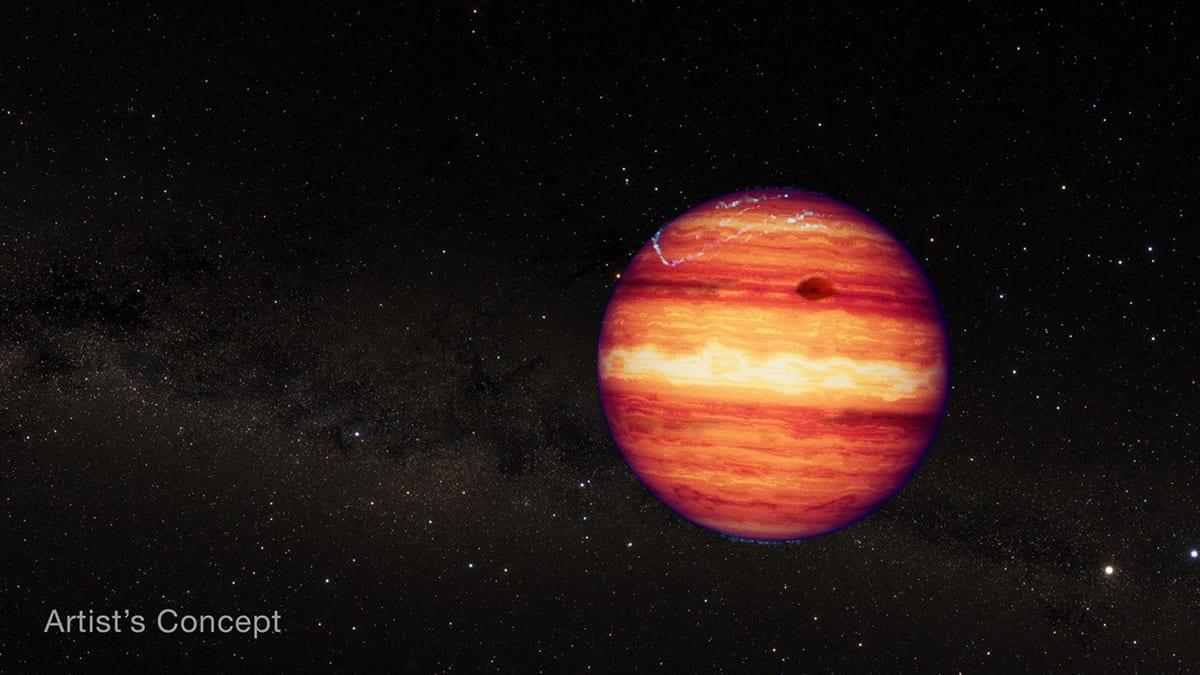
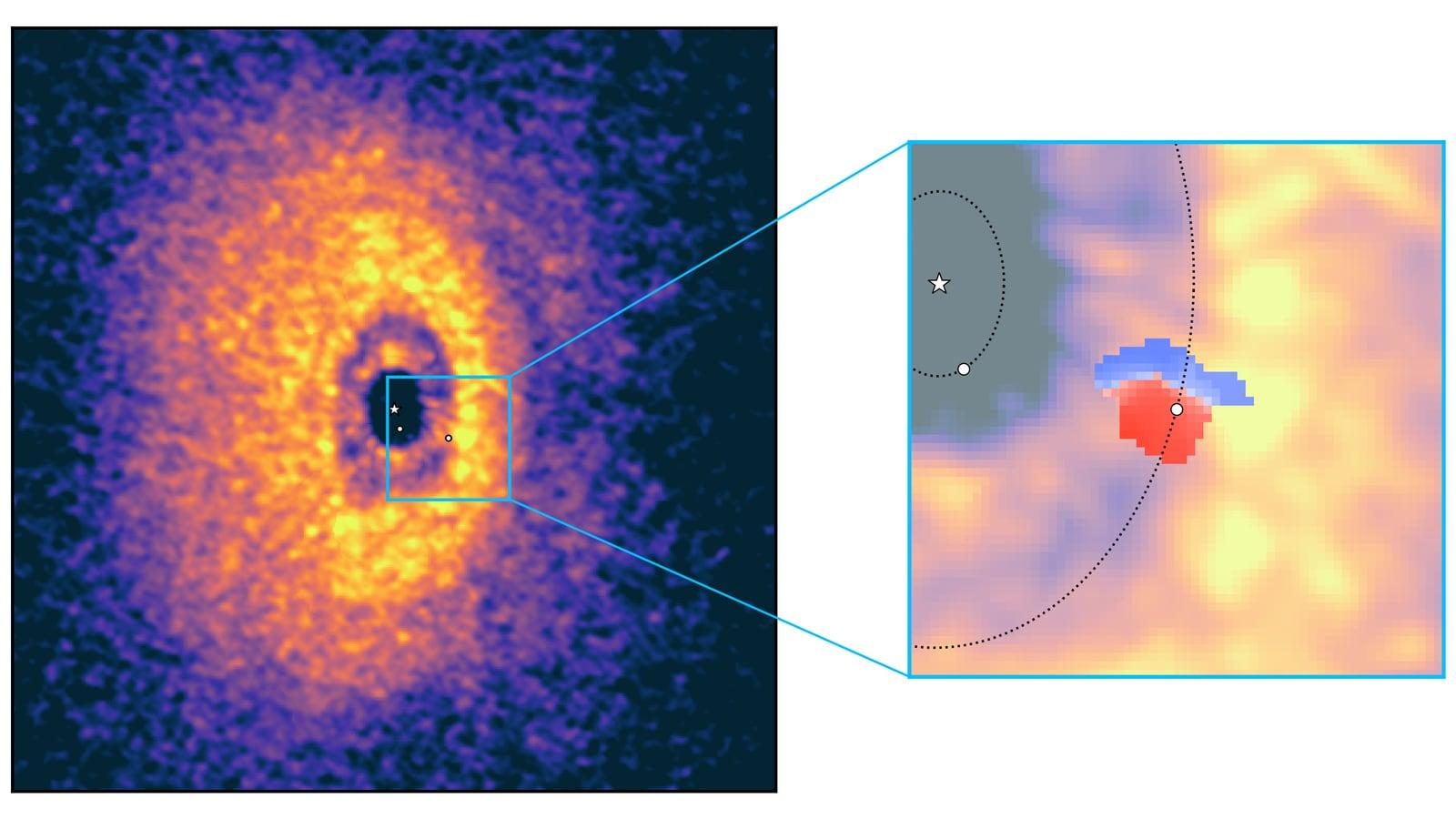
Start with the strongest fact. Around the star WISPIT 2, the map of gas velocities carries a lightning-bolt-shaped distortion at a very specific spot: the orbit of the planet WISPIT 2b. And this distortion could be matched against the planet itself, imaged since 2025 by the VLT, the European Southern Observatory's Very Large Telescope in Chile. Never before had a signature of this kind been confirmed on a planet that can also be seen.
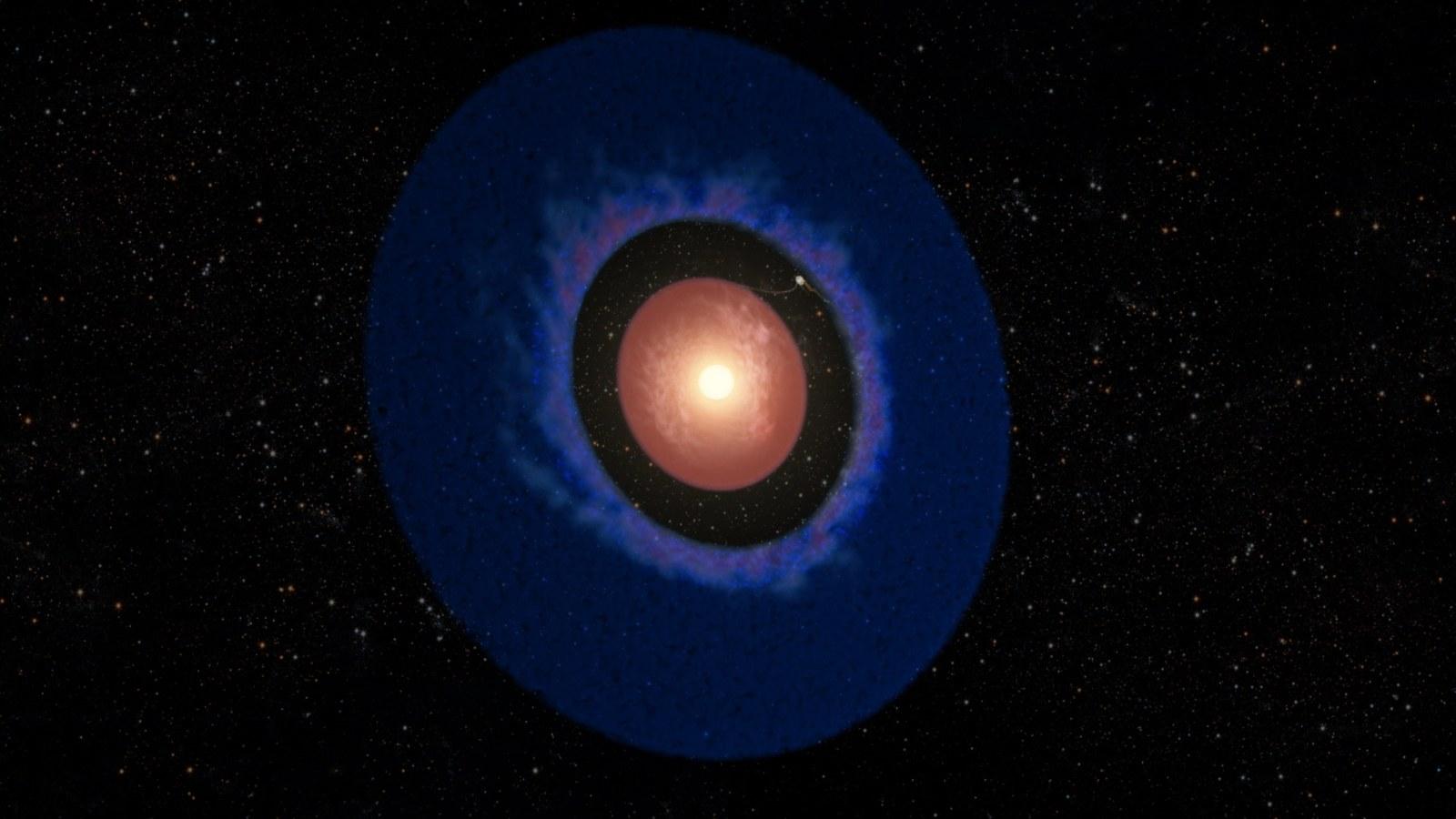
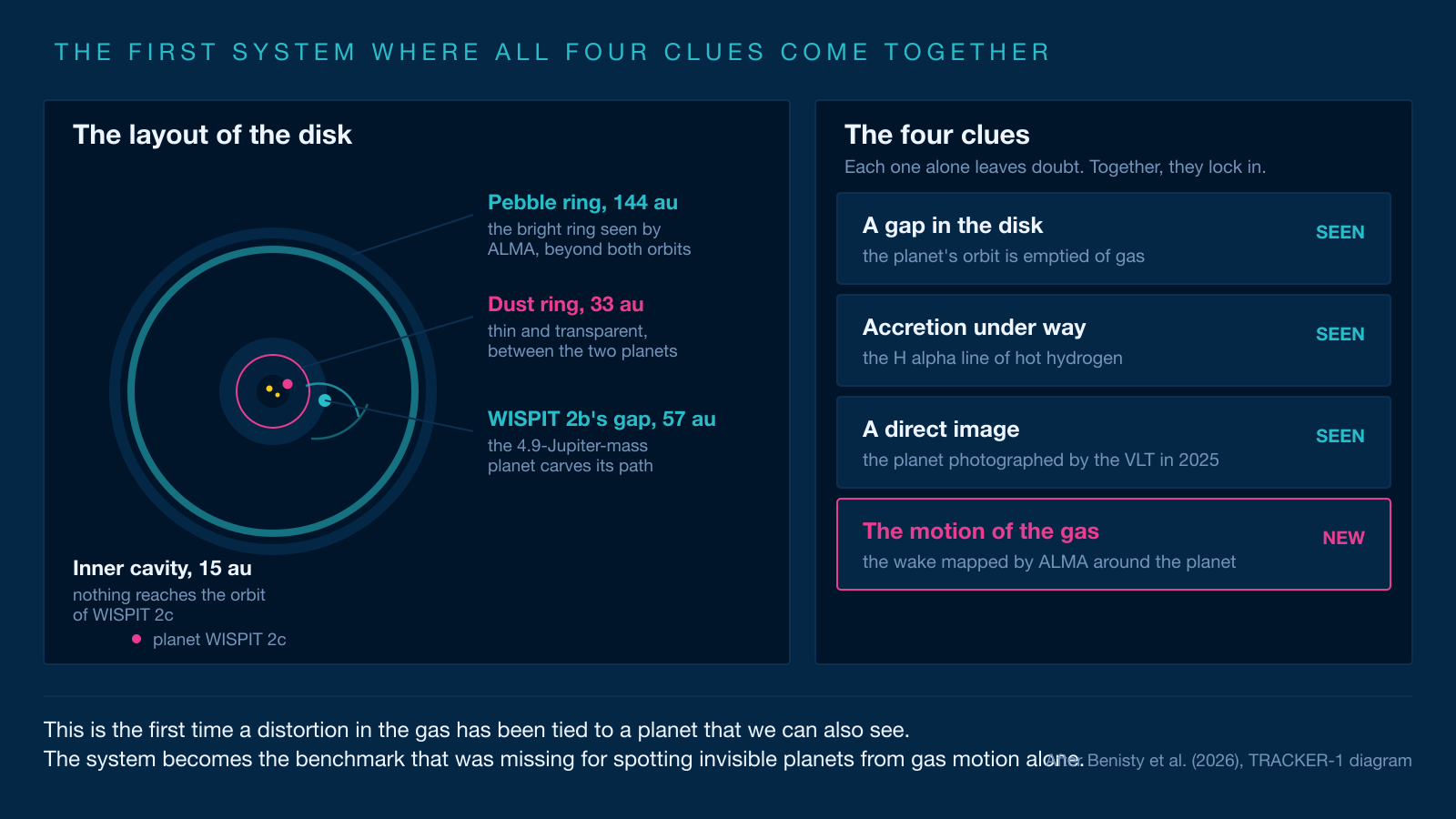
The WISPIT 2 system is a rare case. Its star is five million years old, against 4.6 billion for the Sun. On the same scale, it is a newborn. It is wrapped in a disk of gas and dust, the raw material of planets, and that disk counts among the most finely structured ever observed, with four dust rings at roughly 38, 97, 163 and 316 astronomical units from the star. One astronomical unit is the Earth-Sun distance, about 150 million kilometres.
Two planets have turned up there. WISPIT 2b, the first, weighs 4.9 times Jupiter and orbits at 57 astronomical units, nearly twice as far out as Neptune is from the Sun. WISPIT 2c, confirmed in March 2026, is heavier still, between 8 and 12 Jupiter masses, but sits four times closer, at 15 astronomical units. The disk keeps a record of their work: a gap where WISPIT 2b passes, and a fully cleared cavity where WISPIT 2c does.
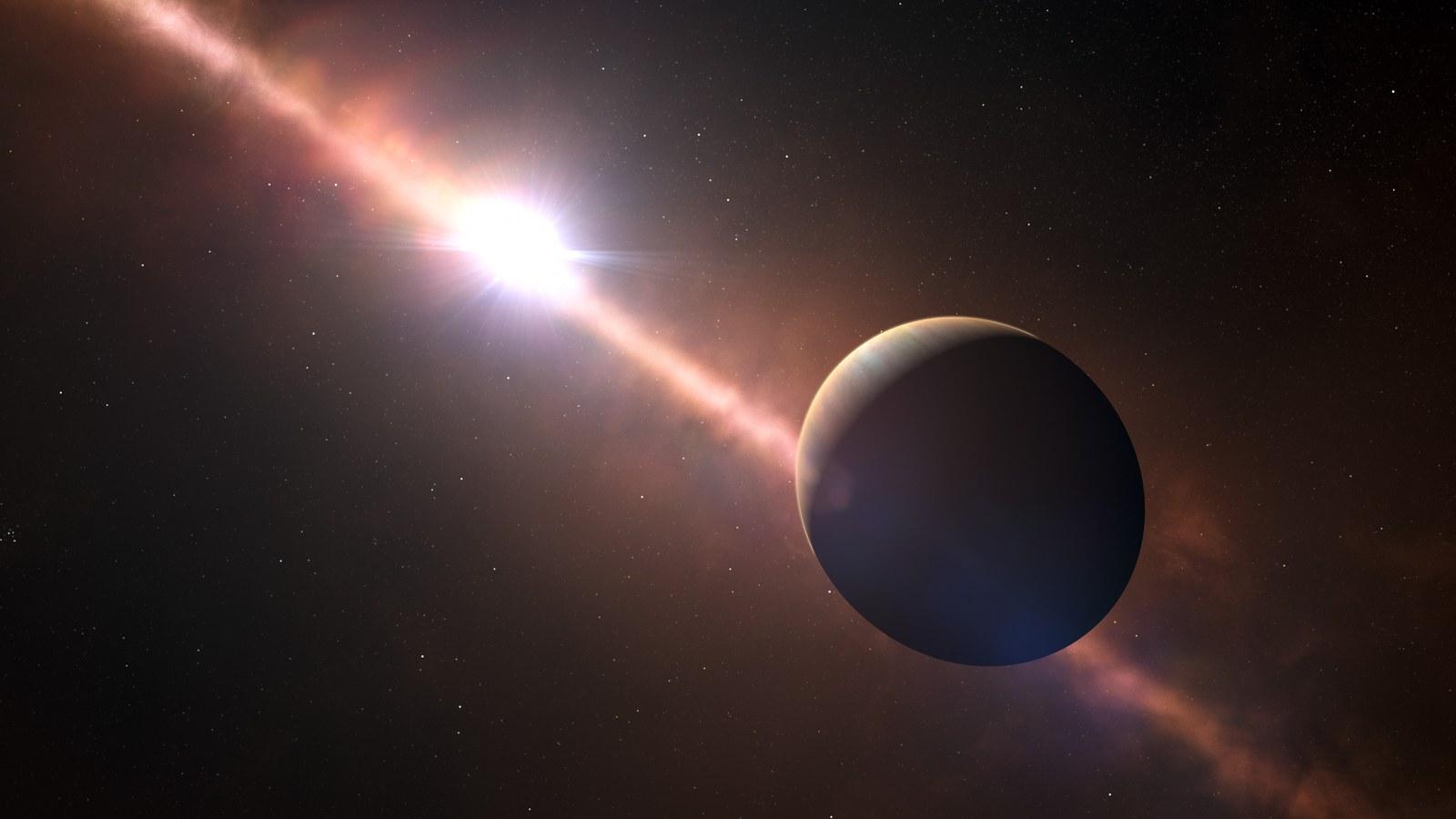
One more twist: WISPIT 2 is not a single star. Work published in August 2026 shows it is two stars in a very tight embrace, less than a tenth of an astronomical unit apart, completing an orbit in 4.7 days. The planets therefore circle a stellar pair, not a lone star.
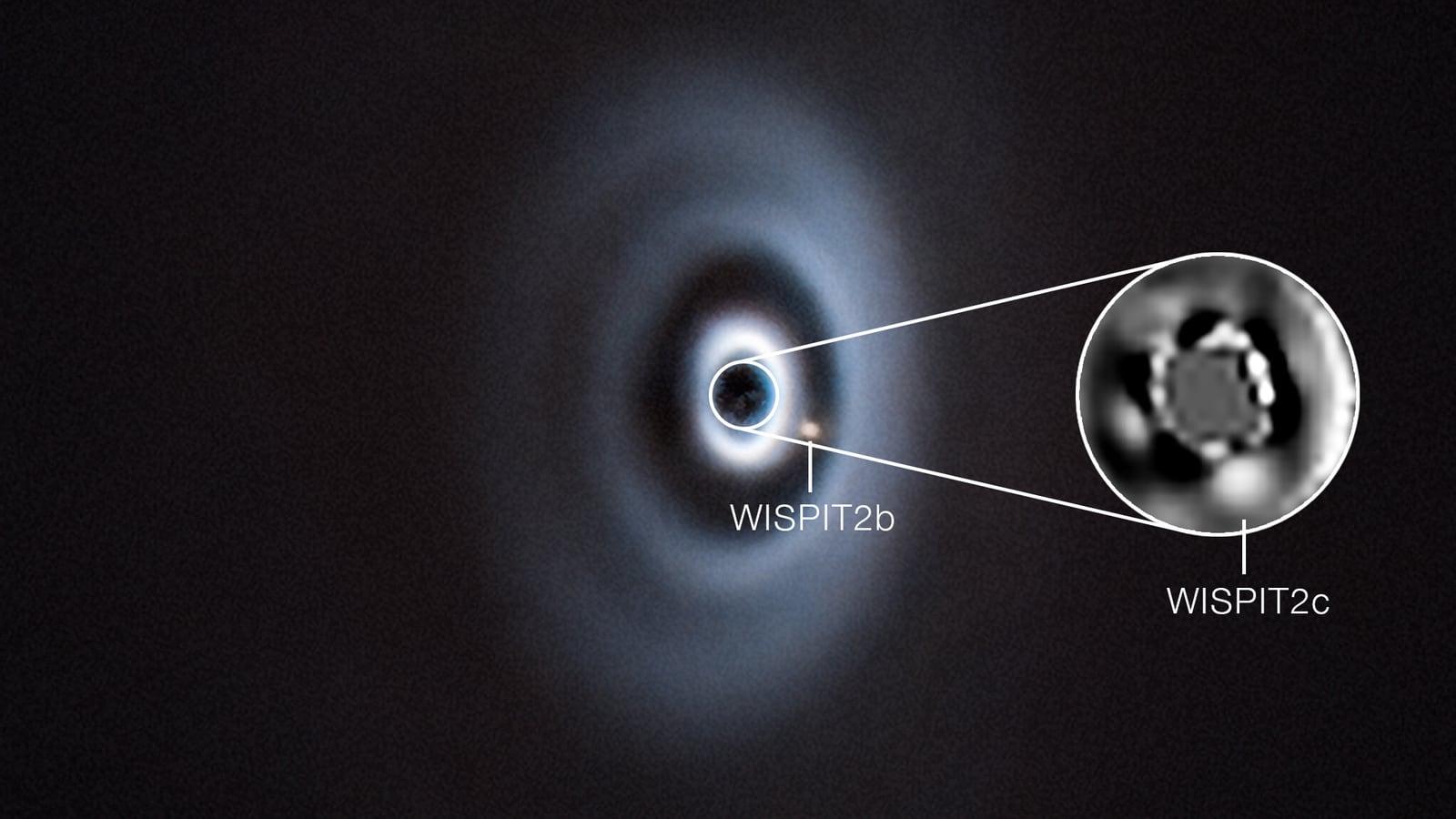
How to photograph a stream of gas
Stay with the practical problem. The gas in a disk cannot be seen. It is too cold and too diffuse to glow, and it is 99 percent hydrogen, a molecule that emits almost nothing in this setting. So astronomers found a tracer: carbon monoxide. This molecule, written CO, emits at a very precise wavelength in the millimetre range, between infrared and radio waves. It plays the part of food colouring dropped into water. The gas is what flows, but the colouring is what makes the motion visible.
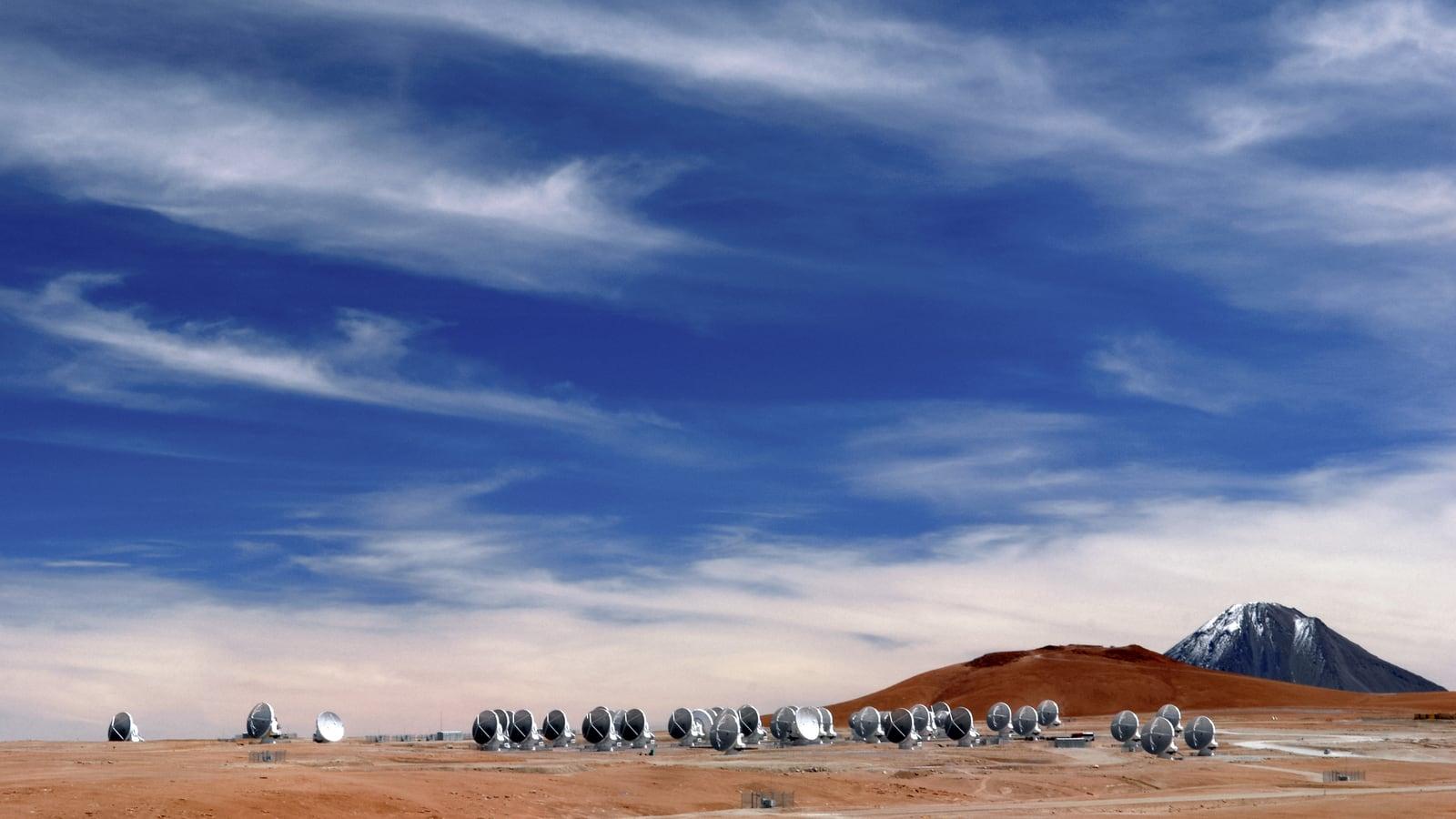
The instrument that catches this light is ALMA, the Atacama Large Millimeter/submillimeter Array. Sixty-six dish antennas sit on the Chajnantor plateau, 5,000 metres up in the Chilean Andes, a spot so high and so dry that water vapour in the air no longer blurs millimetre waves. The antennas do not work on their own. They are combined into a single virtual telescope. The farther apart they are spread, the sharper that giant telescope becomes.
The hard part is the size of what you want to see. The Max Planck Institute sums up the challenge with a picture: at the distance of WISPIT 2, imaging a structure as wide as the Earth-Sun distance is like trying to read an ordinary book held 5 kilometres away. ALMA reaches that level of detail on dust, with a sharpness of 19 milliarcseconds, which works out to 2.5 astronomical units at the system's distance. One arcsecond is 1/3,600 of a degree.
Then comes the trickiest part: measuring a speed, not just a position. ALMA gets there by sorting light according to velocity. Think of sorting the cars on a motorway by how fast they are going: one image keeps only those travelling within 5 km/h of a set speed, the next image keeps the next bracket, and so on. Each slice therefore shows gas at one given velocity. Stitched together, the slices trace a butterfly-wing pattern, the hallmark of a rotating disk.
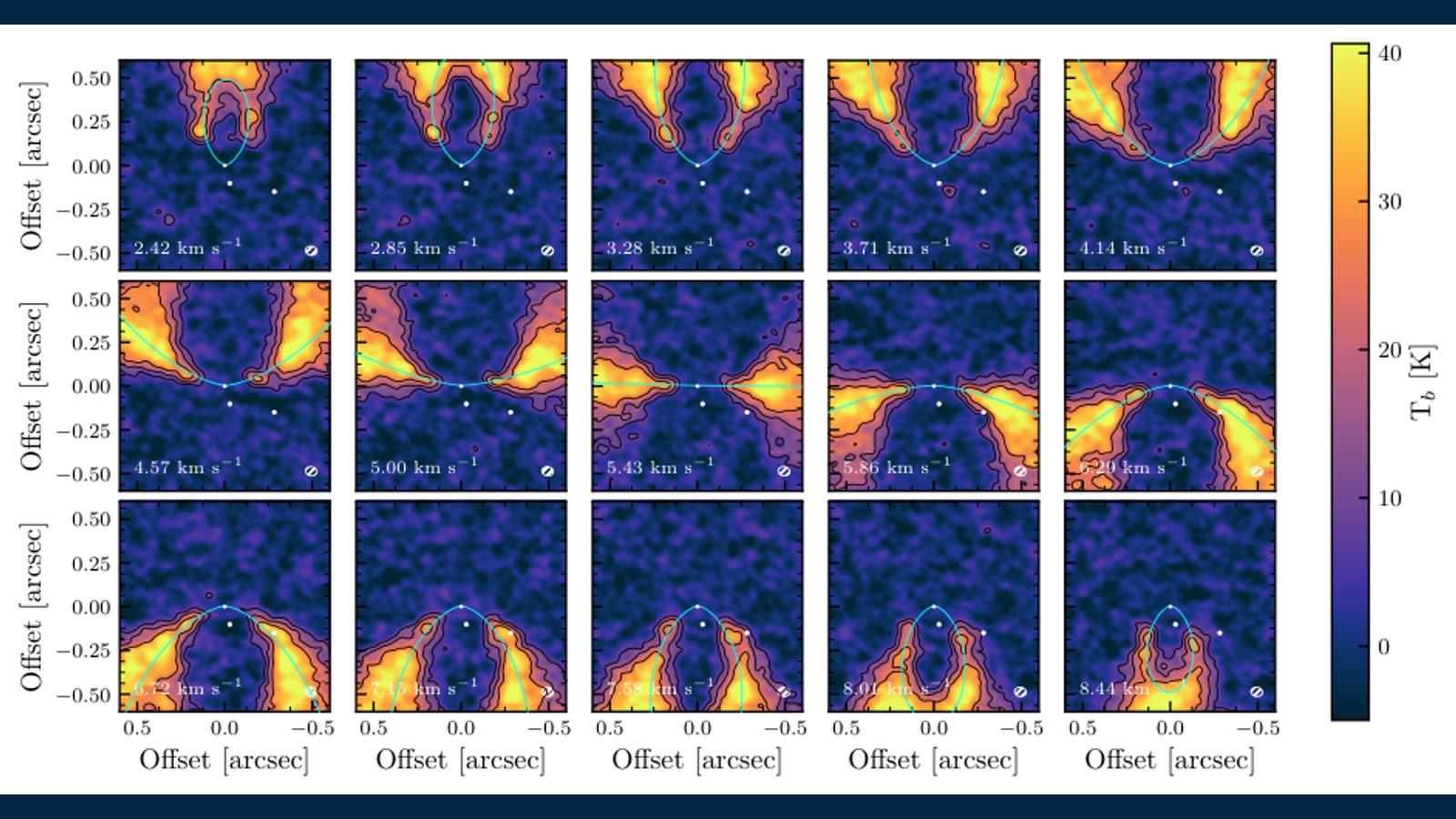
That is where a reading trick comes in. In a rotating disk, one side moves toward us and the other away. The two halves are therefore mirror images of each other. The team took each velocity slice and subtracted it from its reflection. Everything turning normally cancels out. What remains is whatever departs from smooth rotation, much as a boat's wake would appear on a swell once the swell itself is removed.
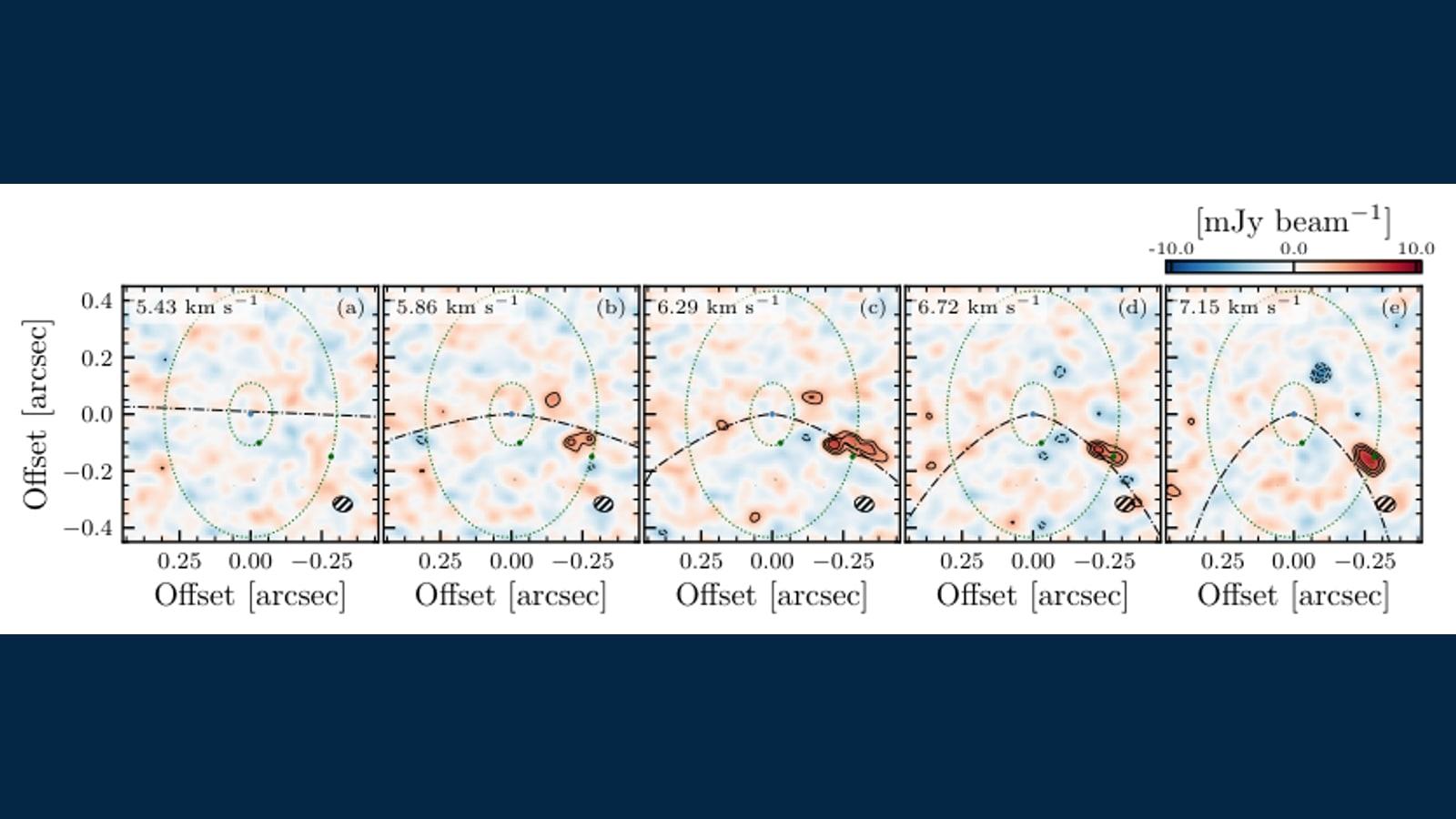
That leftover is more spread out than expected. It reaches across the planet's entire Hill sphere, the 3.9-astronomical-unit-wide zone where WISPIT 2b's gravity wins over the star's. A circumplanetary disk, the small platter of gas and dust turning directly around the planet and where its future moons would take shape, would fill only a third of that width. The signal stretches far beyond it, which rules out that source on its own.
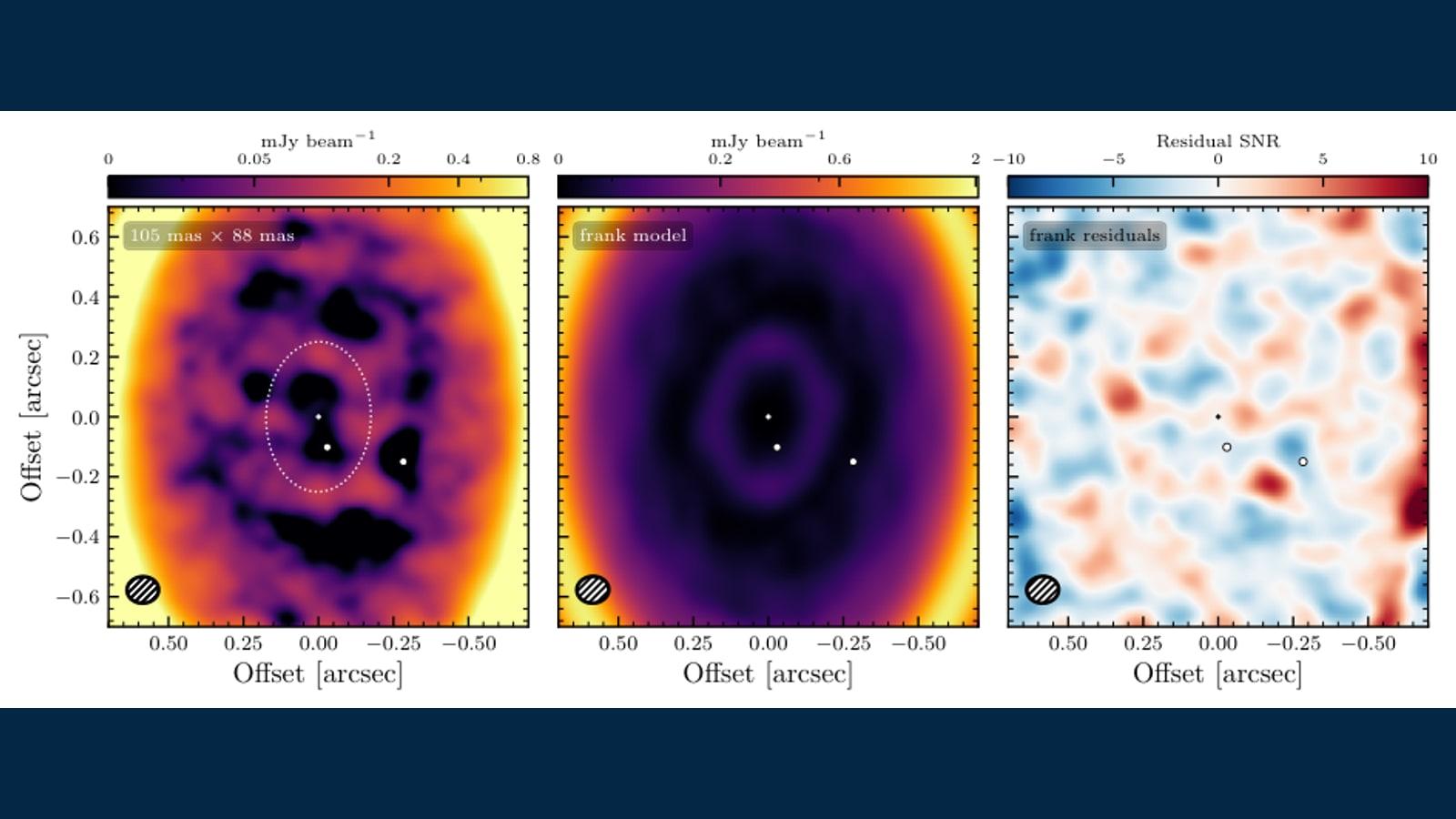
The dust tells the same story from the other direction. ALMA found a thin, transparent ring between the two planets, at 33 astronomical units. To astronomers that is precise information: material does pass through the gap carved by WISPIT 2b, meaning the planet does not block everything in its path. Yet nothing reaches inside the orbit of WISPIT 2c, where the cavity is complete. Material is being stopped short. The setup fits what is seen elsewhere: WISPIT 2b shines in H-alpha because it is swallowing gas, while WISPIT 2c shows no sign of accreting at all.
Four clues in one system, a benchmark for what comes next
This is why the system becomes a reference point. For decades, astronomers have built a solid account of how giant planets form. Dust in the disk clumps into pebbles, pebbles into rocky bodies a few kilometres across, and once one of them grows heavy enough, it draws in the thick envelope of gas around it. The mechanism holds together, the simulations run, but the scene had almost never been filmed.
WISPIT 2 is the first system where all four clues are gathered on the same planet. Its gap shows in the disk, its accretion shows in the H-alpha line, its direct image exists from the VLT, and now its effect on the motion of the gas has been measured. Each clue on its own leaves the door open to doubt. A gap can come from something else. An H-alpha line can be misread. A distortion in the gas can be nothing more than turbulence, or an illusion created by the disk's own relief.
Together, they lock in. And that is exactly what the field needed. Comparable wakes had been spotted in other disks with no planet attached. Some astronomers read them as the trace of a hidden world, others as plain turbulence. There was no way to settle it without a case where both are visible. WISPIT 2 supplies that case. "We clearly see both planets shaping their environment," Myriam Benisty says in the MPIA release. "Around WISPIT 2b, we find swirls of gas that had been predicted by simulations of disk-planet interactions, but never actually seen before. Now there is an image of them!"
The wake opens a door. Models indicate that the size of the gas distortion grows with a planet's mass. If that link holds, measuring an odd velocity would one day be enough to weigh a planet without ever seeing it. For now, researchers can measure the distortion but cannot yet turn it into a number. WISPIT 2b will serve as the yardstick that lets them calibrate the method elsewhere.
One last figure shows how fast the case is moving. While analysing the gas motion in the central cavity, the team recovered the star's mass: about 1.3 solar masses, 20 percent more than the estimate drawn from its colour and brightness. The gap most likely comes from the hidden stellar companion, which skews calculations based on visible light alone. It is the kind of check that only a direct measurement of motion can provide.
The next steps are already planned. WISPIT 2b's wake clears the way for the next generation of instruments, ESO's 39-metre Extremely Large Telescope and a planned upgrade that will make ALMA more sensitive. Within a decade or so, those tools could produce the equivalent of this image for a gas giant orbiting as far from its star as Jupiter sits from the Sun. Only then would we watch, live, how a giant shapes the system where it is born.
Going further
- The ideas behind the story: an exoplanet, an interferometer, star formation, a coronagraph and our solar system in our glossary.
- The satellite that supplied the reference point for the observations: Gaia. The ALMA images were anchored to the position of WISPIT 2 in its catalogues, to within four milliarcseconds.
- Two related reads: Elias 2-24 b, the youngest planet ever seen and the first radio signal from an exoplanet, two more cases where a single piece moved the whole picture forward.
- Want to spot Jupiter, the giant every other giant gets compared to? Our interactive sky map shows where to point tonight, and our observing guide helps you plan the session. The astrophotography gallery shows what amateurs capture in the same neighbourhood.
- Sources for this article: the Benisty et al. study in The Astrophysical Journal Letters (preprint posted on September 4, 2026), the Max Planck Institute for Astronomy release and AAS Nova's write-up of the study.