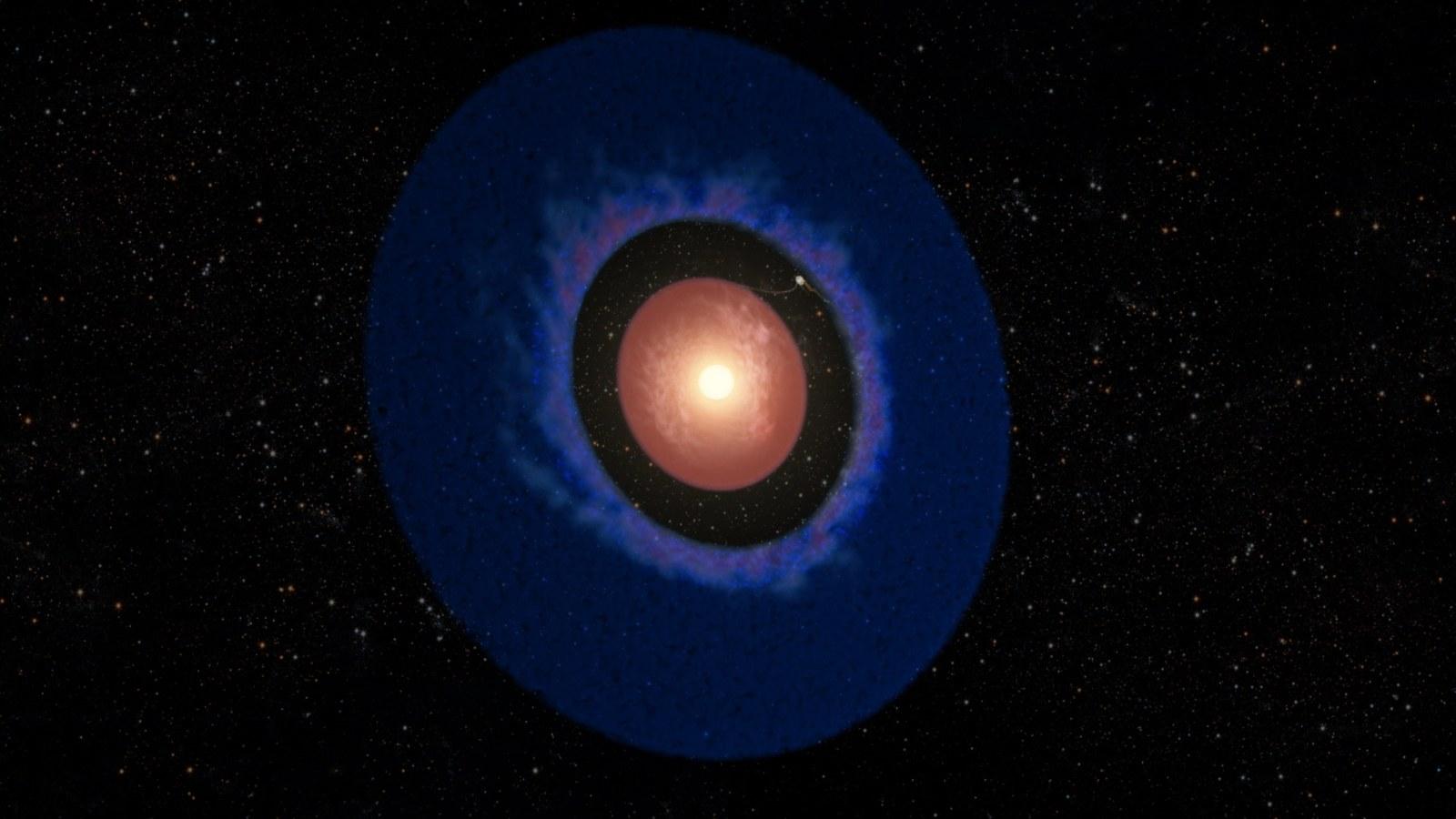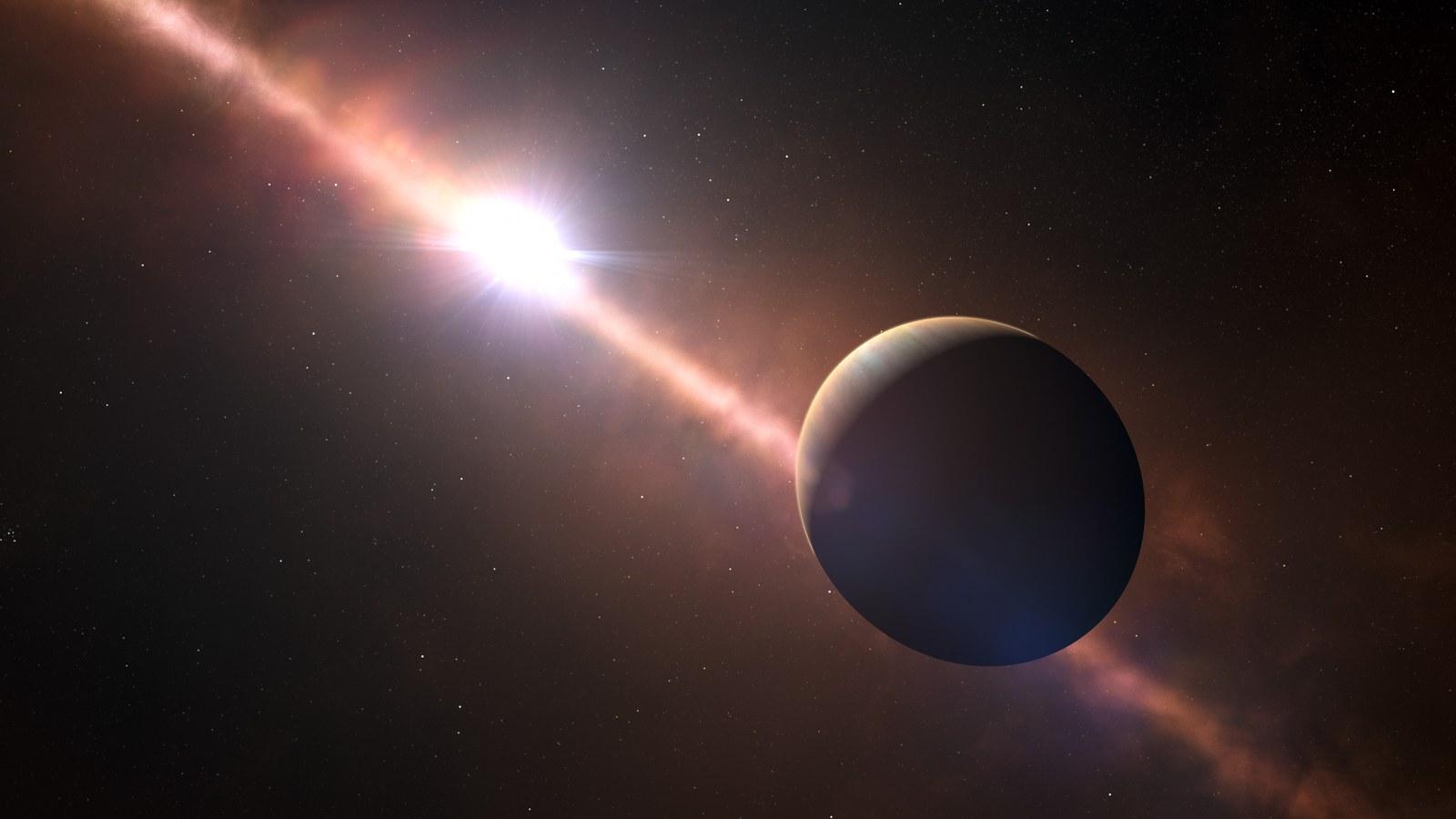
For the first time, astronomers have picked up a radio signal coming straight from a planet beyond the Solar System. On September 15, 2026, the team led by Kevin Ortiz Ceballos at the Harvard-Smithsonian Center for Astrophysics posted a study on arXiv that pins repeating radio bursts on Beta Pictoris b, a gas giant 64 light-years away, rather than on its star. The authors draw the first direct measurement of an exoplanet's magnetic field from it: at least 1,250 gauss. One caveat: the study has not yet been peer-reviewed.
An aurora that works like a radio transmitter
Start with the strongest fact. Something in the Beta Pictoris system is throwing out radio bursts that are fast, recurring and strongly polarized. Catching that kind of signal was never the hard part. Proving where it comes from was. A star can produce radio bursts on its own, and when a planet and its star fall inside the same pixel, there is no way to tell them apart.
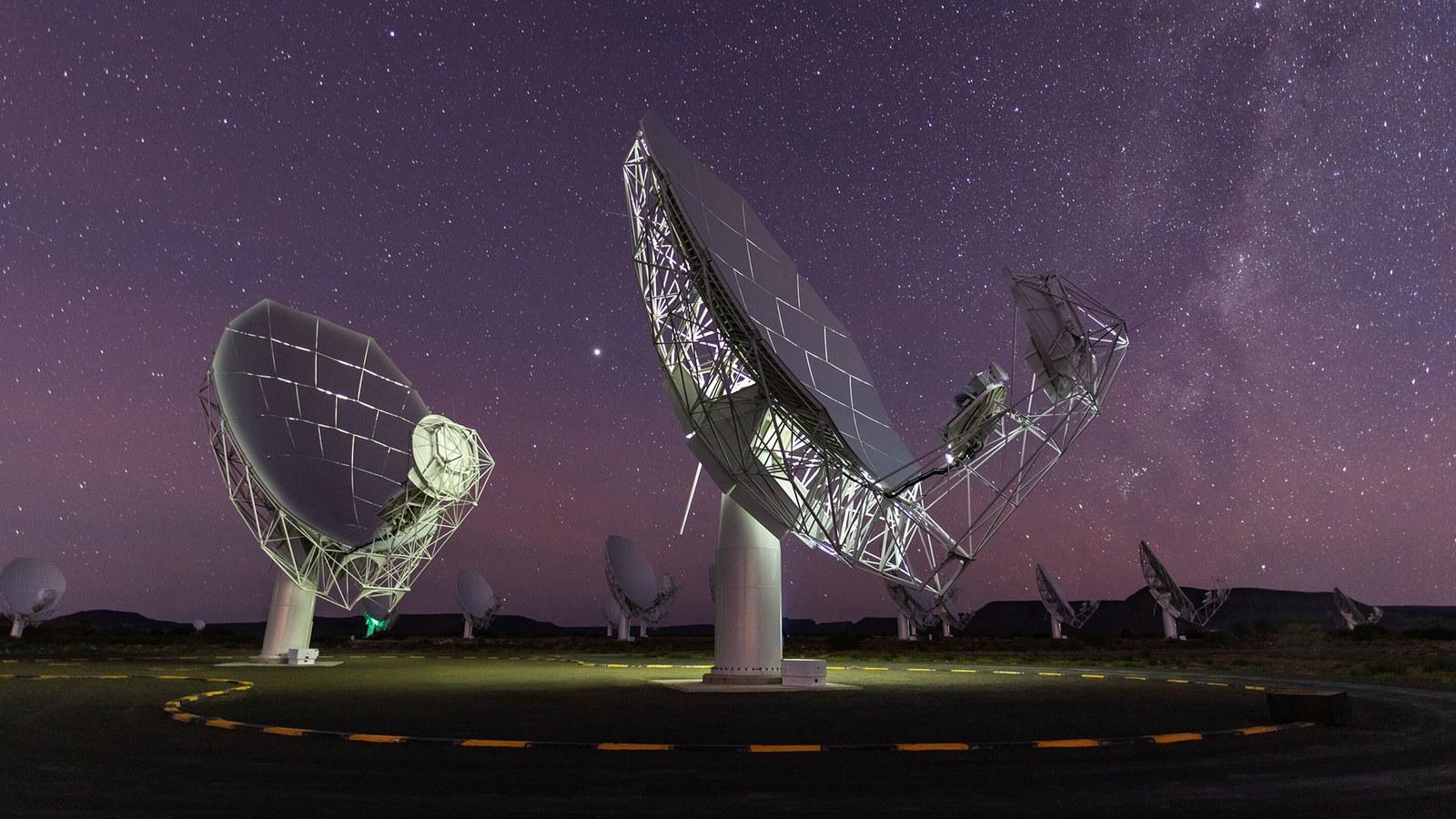
The team broke the deadlock by changing scale. It observed the system four times between February 2025 and May 2026 with MeerKAT, an array of 64 dishes spread over 8 kilometres in South Africa's Northern Cape. It then anchored its radio images to fixed landmarks in the sky: nine quasars, distant galaxies with radio-bright cores whose positions the Gaia satellite knows to a billionth of a degree. Once the image was locked onto that reference grid, the radio source landed right on the position of the planet Beta Pictoris b, and came out incompatible with the star at 4.4 sigma confidence.
Then comes the question of what produces the waves. The answer lies in a detail astronomers have known how to read since the 1950s: polarization. Radio light can vibrate along a preferred direction, a little like a rope spun in a circle instead of shaken up and down. The bursts from Beta Pictoris b are 40 to 70 percent circularly polarized. That rate points to one specific mechanism, in which electrons spiral along a planet's magnetic field lines before plunging into its upper atmosphere. It is exactly what lights up Jupiter's auroras.
The frequency that reads the magnetic field
The discovery rests on a physical relation that is startlingly simple, and it is what turns a radio signal into a measuring instrument.
When an electron loops around a magnetic field line, it emits a radio wave at a frequency that depends on one thing only: the strength of the field right there. A stronger field spins the electron faster, and the frequency climbs. The rule fits in a single line: about 2.8 GHz for a field of 1 kilogauss. So measuring the highest frequency is the same as reading the field strength directly, at the exact spot where the electrons dive in.
The team pushed that logic to its limit. MeerKAT detected emission up to 3.5 GHz, the very top of its observing band. If an electron could spin fast enough to radiate at that frequency, the local field is at least 1,250 gauss. That is a lower bound, not an exact figure: a stronger field would produce even higher-pitched waves, beyond MeerKAT's reach. Theorists call this a conservative measurement, and that is precisely what makes it solid.
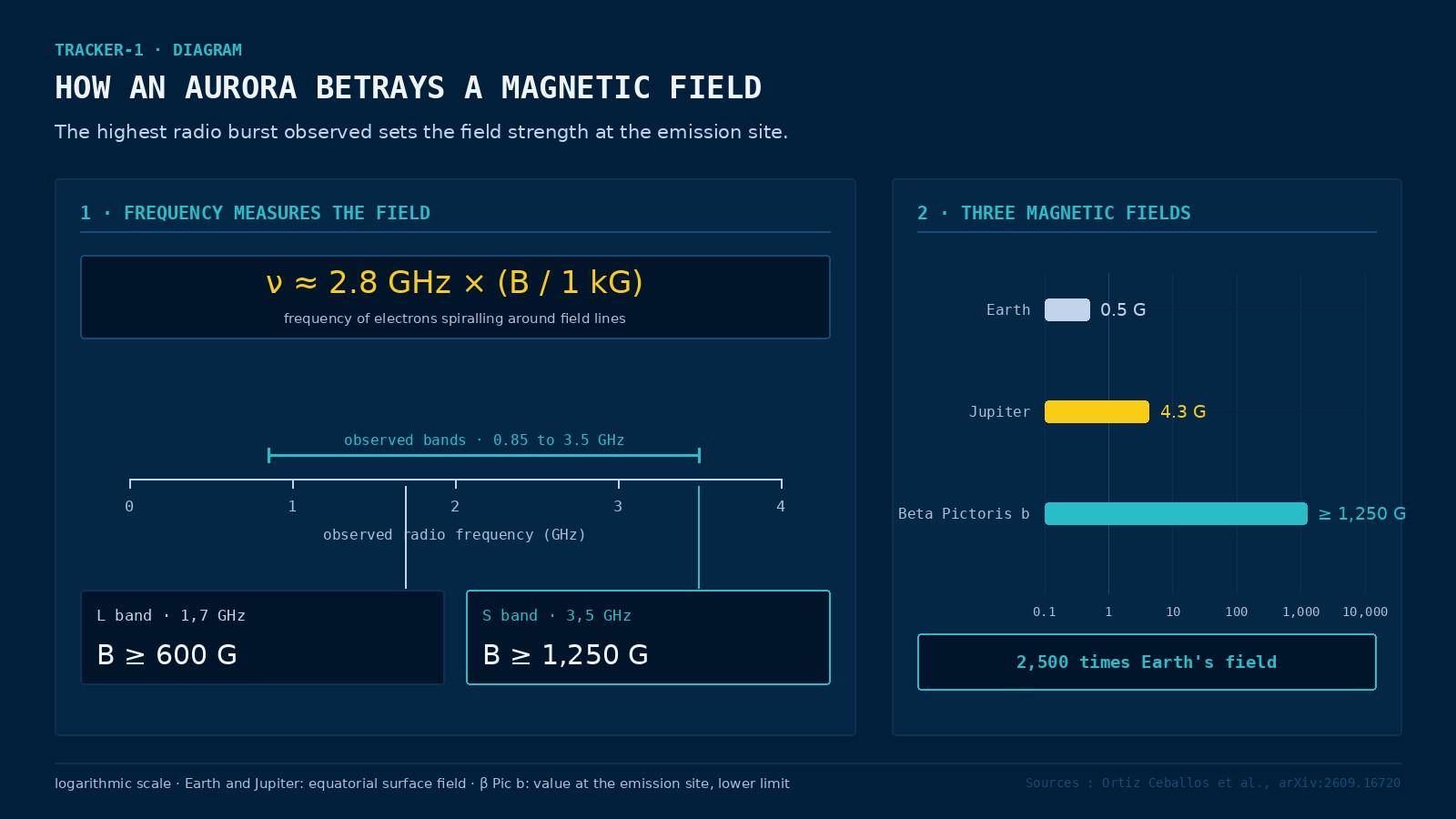
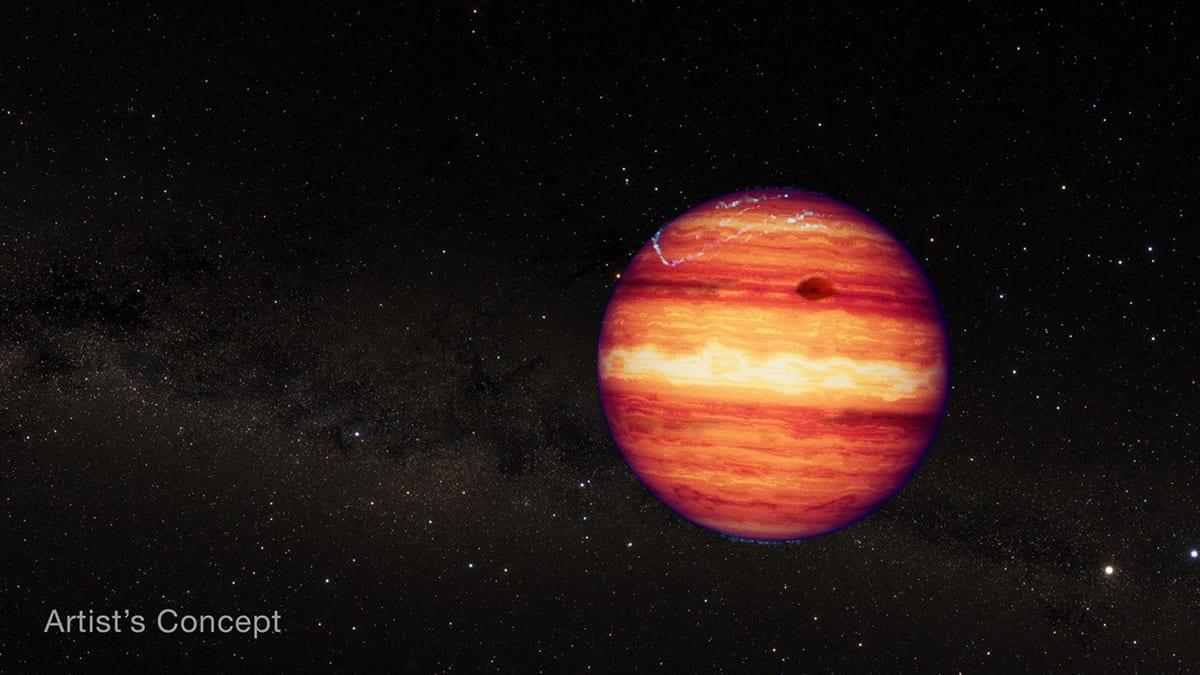
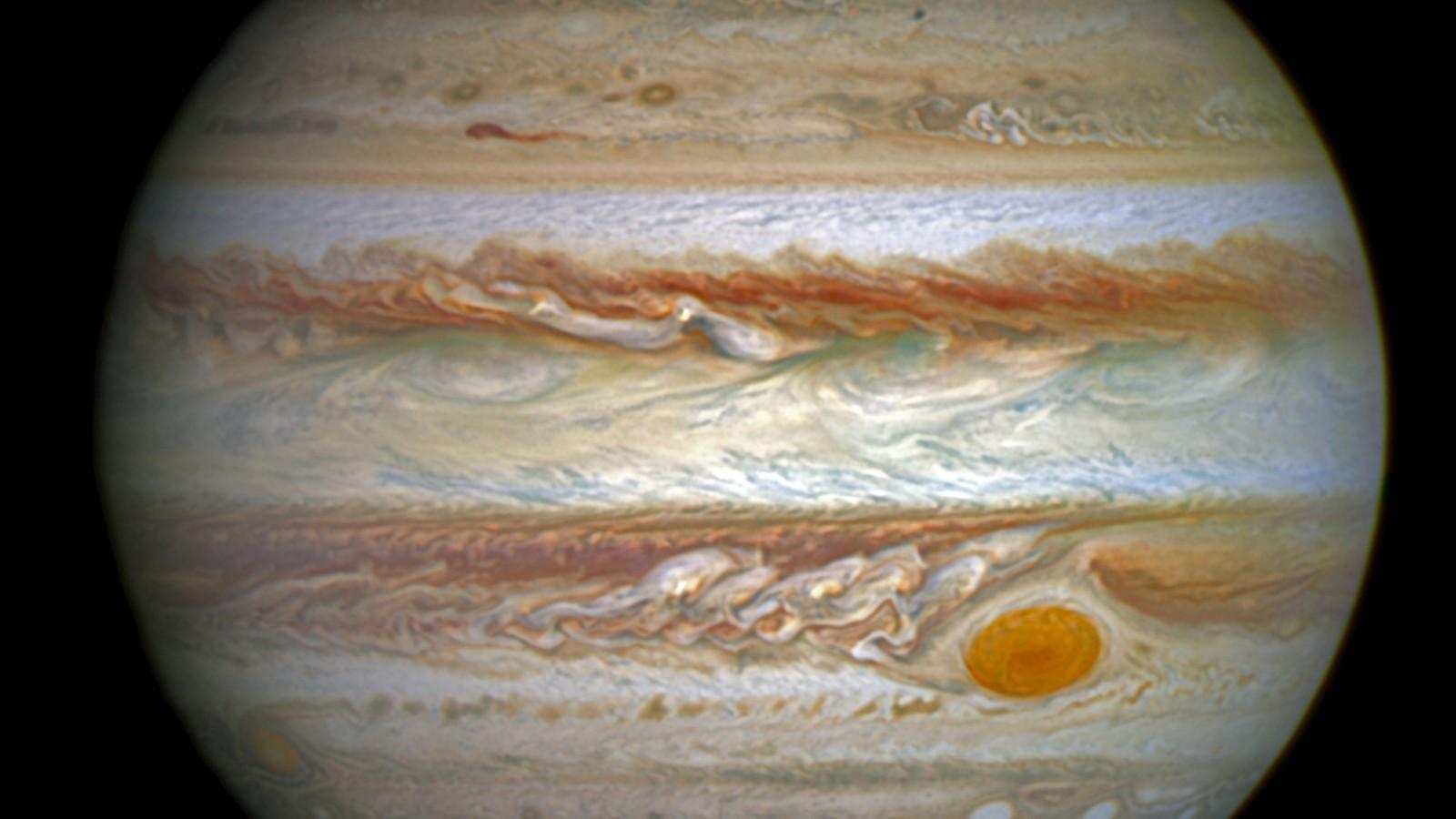
Comparing the number with its neighbours shows how far out it sits. Jupiter, the largest planet in the Solar System and the one with its most powerful field, peaks at 4.3 gauss. Earth, whose field deflects the solar wind and guards our atmosphere, makes do with 0.5 gauss. Beta Pictoris b would carry at least 1,250, roughly 2,500 times Earth's field.
That is not as absurd as it sounds. The planet is very young, barely twenty million years old, and youth changes everything here. A planetary magnetic field is generated by the motion of hot material inside a world, a process called a dynamo, the same principle that drives the magnet lighting up a bicycle lamp. The hotter a planet is inside, the faster that engine runs. Back in 2009, one team calibrated this rule against Solar System planets and small stars and predicted that a young, massive giant should reach the kilogauss range. The burst from Beta Pictoris b lands right on that prediction.
Why a detour through an aurora matters
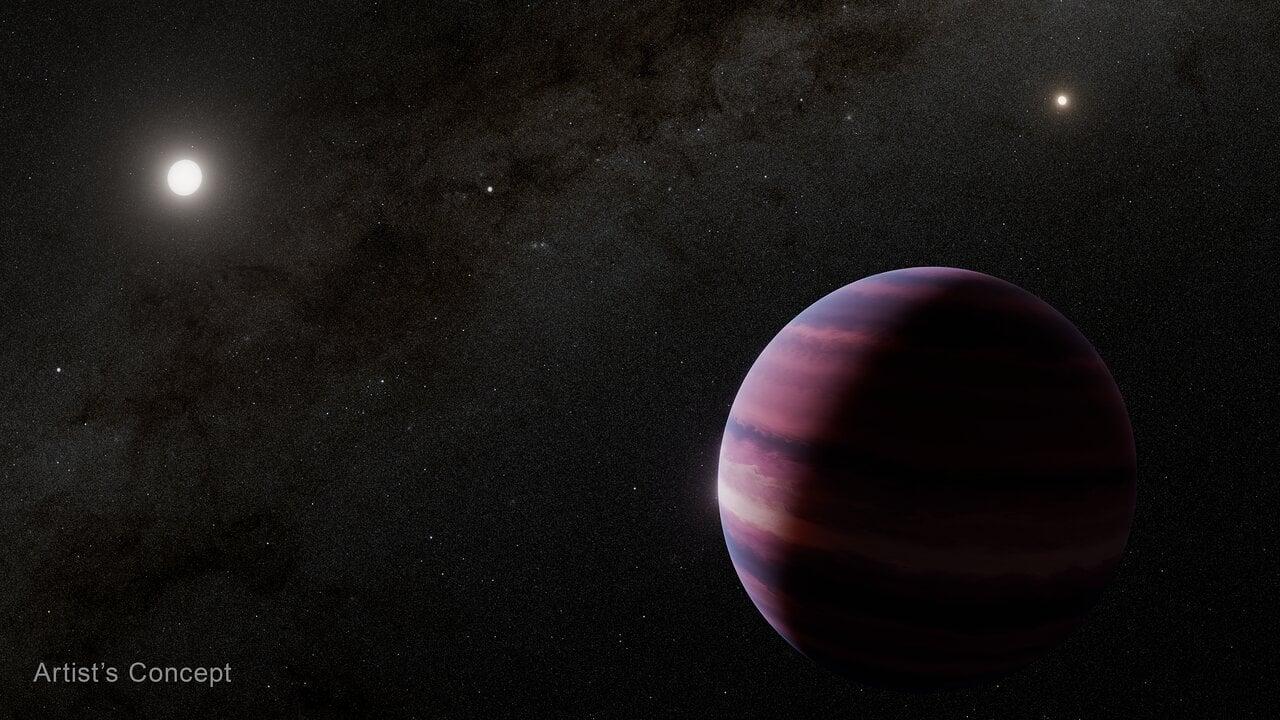
This planet is not a promising home for life, and that is not the point. With about 10 Jupiter masses, an orbit at 10 astronomical units, ten times the Earth-Sun distance, and a surface temperature near 1,500 °C, Beta Pictoris b is a scorching world with no solid ground. Its value lies elsewhere: it opens up a method.
Until now, astronomers measured an exoplanet's mass from the wobble it induces in its star's orbit, and inferred its interior from models. The magnetic field stayed out of reach, even though it holds the key to a simple question: can a planet keep its atmosphere? The stream of charged particles blowing off a star gnaws at it without pause, and the magnetic field acts as a shield. On Earth, that shield played a major role in keeping our air and water. If this technique holds up, it will one day let us ask the same question about smaller planets, where habitability becomes the real prize.
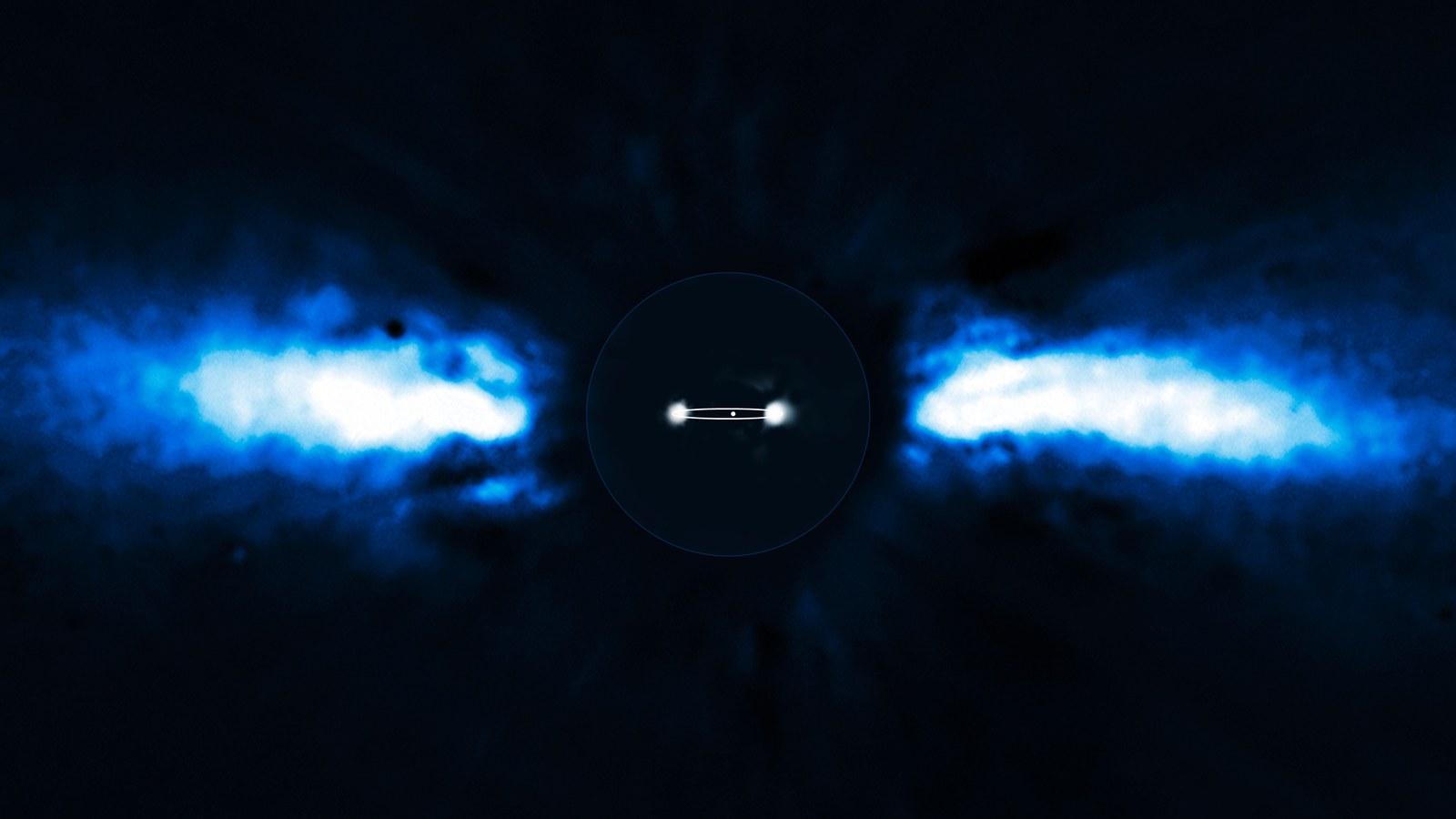
That family resemblance is visible in the images. Since 2003, the VLT has photographed Beta Pictoris b directly, first on one side of its star, then on the other, an angular separation that is precisely what let MeerKAT settle which of the two was emitting. What astronomers once saw as a single bright dot is now a characterised radio source.
The Beta Pictoris system makes the exercise easier because its star is calm. Its large-scale magnetic field stays below 300 gauss, nowhere near the 1,250 gauss the detected signal demands. That combination is what makes the attribution credible.
The road ahead is already clear. MeerKAT is only the pathfinder for a much larger instrument, the Square Kilometre Array, whose first dishes are coming online. Seven more directly imaged gas giants, spread across five systems within 45 light-years, sit far enough from their stars for the same method to apply. A five- to sevenfold gain in sensitivity would bring them within reach. And because auroral emission should follow a planet's rotation, regular monitoring can reveal the tilt and geometry of these fields, the way you would read a compass.
Going further
- The background concepts: exoplanet, magnetosphere and aurora in our glossary.
- The satellite that supplied the position marks: Gaia, a map of a billion stars to a billionth of a degree.
- Another giant seen up close: Juno is measuring Jupiter's magnetic field today, the very yardstick this discovery leans on.
- You do not need a radio telescope to enjoy the sky: spot Jupiter and its auroras on our interactive sky map, then plan your nights with our observing guide.
- Sources for this article: the preprint by Ortiz Ceballos, Berger and Cendes on arXiv (September 15, 2026, not peer-reviewed), the ESO release on the imaging of Beta Pictoris b and NASA's Beta Pictoris b fact sheet.