On October 10, 2026 at 14:34 UTC (Coordinated Universal Time, 16:34 in Paris), the shock wave from two coronal mass ejections, huge clouds of electrified gas thrown out by the Sun on October 7 and 8, reached the probes stationed ahead of Earth. At 17:58 UTC, NOAA, the US National Oceanic and Atmospheric Administration, declared a G3 geomagnetic storm, the "strong" level, when it had expected G2 at most. Auroras followed, all the way to France. And to Spain, as some reports claim? We checked.
A shock at 14:34 UTC, a G3 storm at 17:58
Let's start with the mechanics. A coronal mass ejection, or CME, is a cloud of plasma, a gas so hot its atoms are torn into electrified particles, that the Sun hurls into space. When one of these clouds hits Earth, it squeezes our magnetic field and can set off a geomagnetic storm.
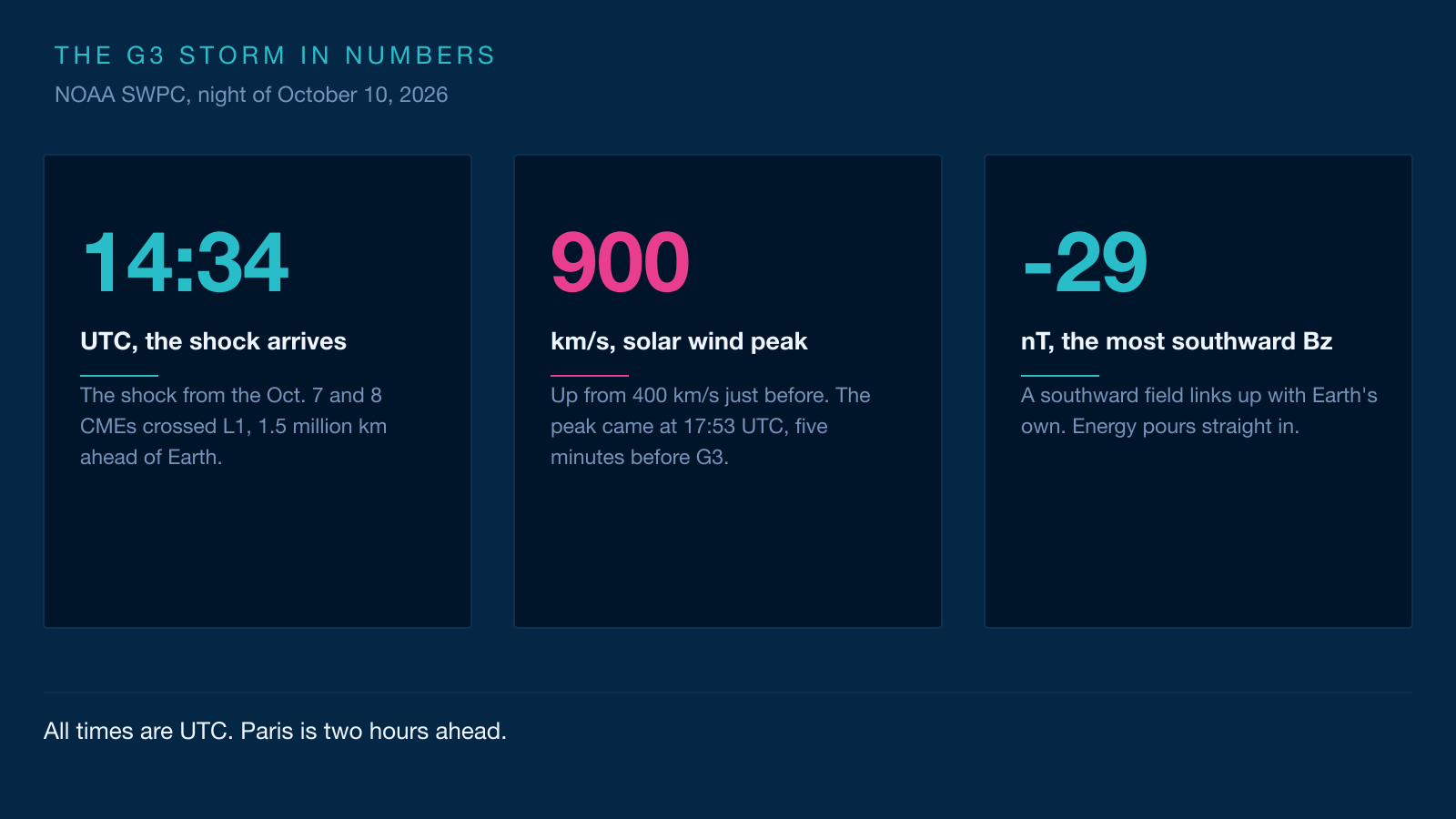
NOAA watches for these clouds from a lookout post. Its probes sit at the L1 point, about 1.5 million km from Earth, on the line between us and the Sun. The shock went through there at 14:34 UTC. Forty-two minutes later, at 15:16 UTC, the Niemegk magnetic station in Germany recorded the jolt on the ground, 56 nT strong. The nanotesla (nT) is the unit that measures the strength of a magnetic field.
The rest of the evening went like this, all in universal time (add 2 hours for Paris and Madrid):
- 14:34: the shock wave crosses L1. The solar wind's magnetic field climbs to 26 nT, then reaches 46 nT at 15:18.
- 15:10: peak of an M6.4 flare on the Sun (more on that below).
- 16:24: the north-south component of the solar wind's field, called Bz, bottoms out at -29 nT.
- 17:53: the solar wind peaks at just over 900 km/s, up from 400 km/s before the shock.
- 17:58: NOAA reports the G3 threshold.
- 19:26: a second G3 alert.
- Late evening: the index settles around Kp 5 (G1), then drops to Kp 4 after midnight UTC.
The Kp index is a score from 0 to 9 that measures, every three hours, how agitated Earth's magnetic field is. G3 matches a Kp of 7. The official index for the 15:00 to 18:00 UTC window did hit 7, then 6.67 in the next one.
Why NOAA aimed too low
On October 9, NOAA forecast G1 for October 9 and 10, then G2 for the 11th. In its 19:45 UTC watch, it wrote that the October 8 CME, the faster of the two, should catch up with the October 7 one and merge with it on the way. So it had the right cause and the right order of magnitude. It missed by a day and a level.
Three ingredients made the difference.
Speed. The solar wind, the steady stream of particles flowing off the Sun, rose from 400 to over 900 km/s. At 900 km/s, a cloud covers the 150 million km between the Sun and Earth in under two days.
Density. It topped 100 particles per cm³. That is a thick cloud, and it pushes hard on Earth's magnetic field.
Field orientation. This is the deciding factor. Earth's magnetic field points north on the front of its protective bubble, the magnetosphere. When the cloud's field points south (a negative Bz), the two lock together like magnets held the right way round, and the solar wind's energy pours in. Bz dropped as low as -29 nT. The longer it stays negative, the longer the door stays open.
The catch is that the field's orientation inside a cloud can only be measured as it flies past the L1 probes, about an hour before impact. It is the big unknown of space weather: we see the cloud leave the Sun, but not which way its field is turned.
The M6.4 flare: same hour, different story
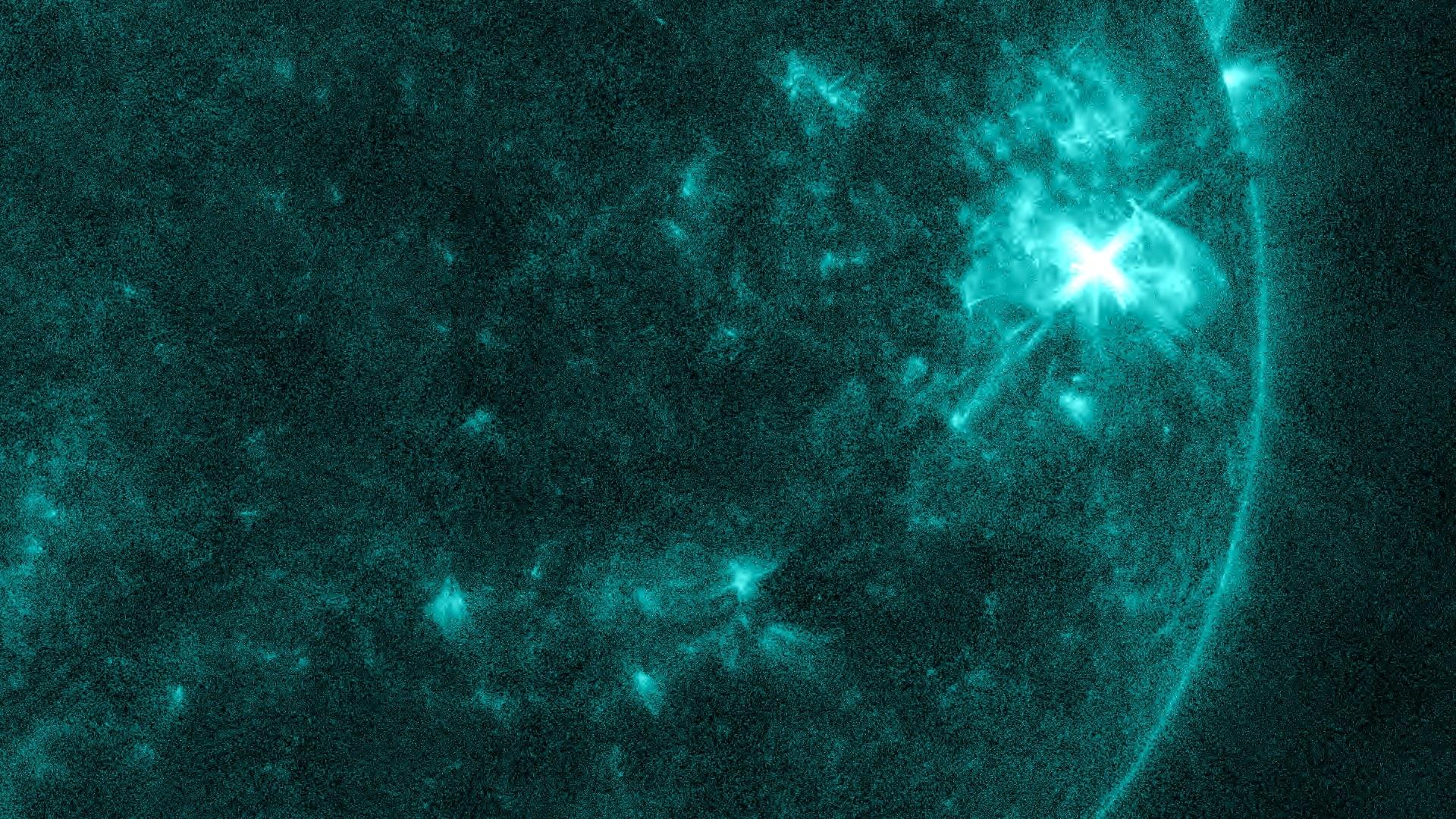
At 15:10 UTC, right in the middle of the shock's arrival, active region AR 4549 produced an M6.4 flare. An active region is a patch of sunspots where the magnetic field is intense. Flares are sorted into classes C, M and X, each letter ten times stronger than the one before. M is mid-sized, but M6.4 clears the M5 mark that triggers NOAA's R2 level.
R2 means a moderate radio blackout. The flare's radiation ionizes the upper atmosphere on the daylit side and disrupts shortwave radio, the kind used by amateur radio operators, ships and aircraft, for a few tens of minutes.
This flare has nothing to do with the storm in progress. It left the Sun minutes earlier, while the cloud hitting Earth had been traveling for two or three days. But it threw out a new CME, spotted at 15:48 UTC by LASCO. LASCO is a camera on the SOHO spacecraft that blocks out the Sun's disk to reveal the gas streaming away from it. A type II radio signal, the signature of a shock wave racing through the solar atmosphere, put its speed at 929 km/s.
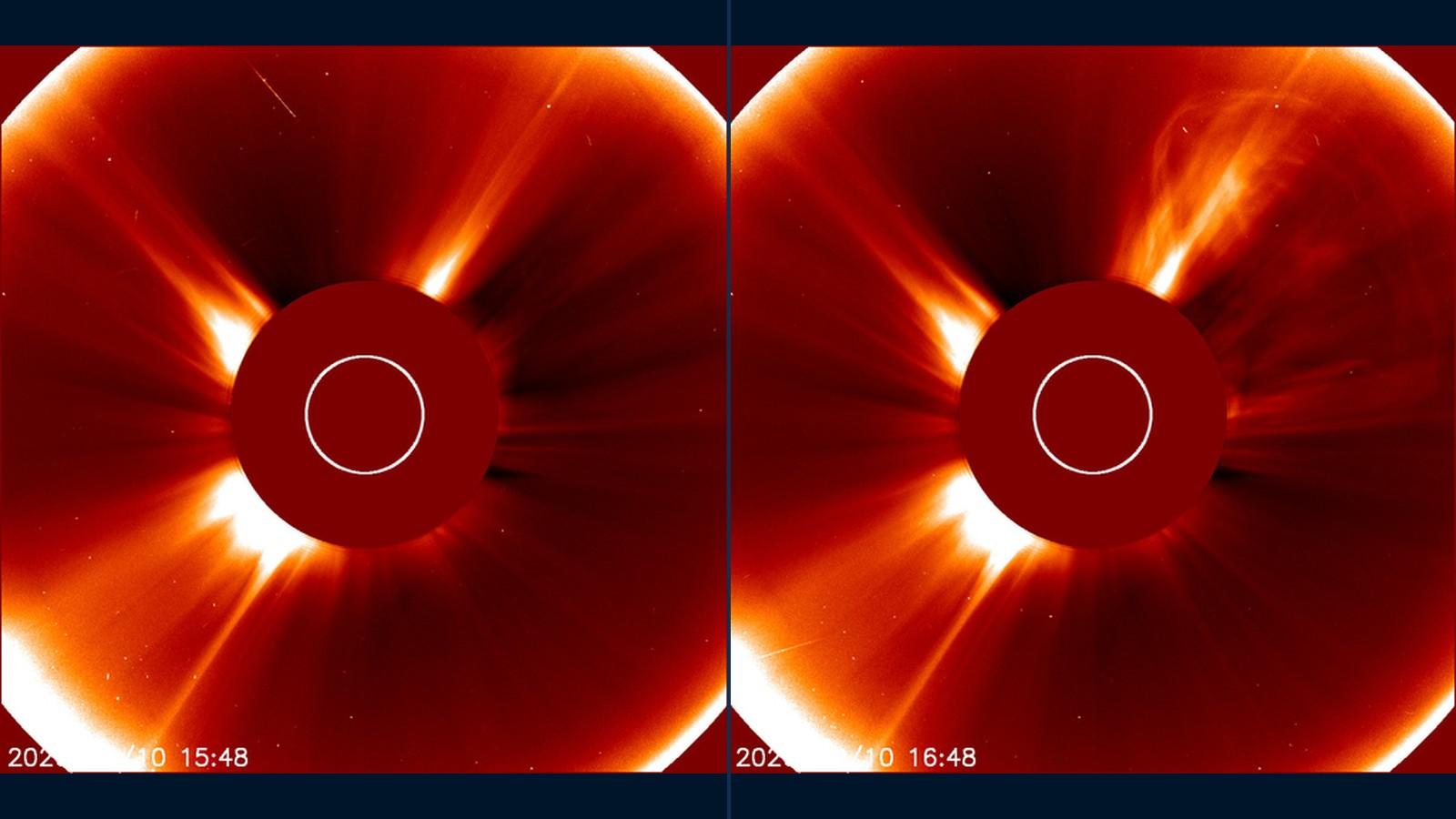
Will this new CME hit Earth? According to NOAA, the first analysis has it passing just ahead of us. But modeling cannot rule out a graze late on October 12, and further analysis is under way. AR 4549 remains complex (astronomers call it a "delta" configuration, with opposite magnetic poles packed tightly together), and NOAA rates M-class flares as likely, at 55 to 65%, through October 13.
The night's auroras, from north to south Europe
Here is what photographers reported. The earliest sightings we found date from about 18:47 UTC, 49 minutes after the G3 threshold. The Moon had been new since 15:50 UTC, so it was missing from the sky and left no stray light.
In France, the naked eye saw little: the colors only showed up in long exposures, on a camera or a phone. Farther north, in Germany and England, the photos are striking.
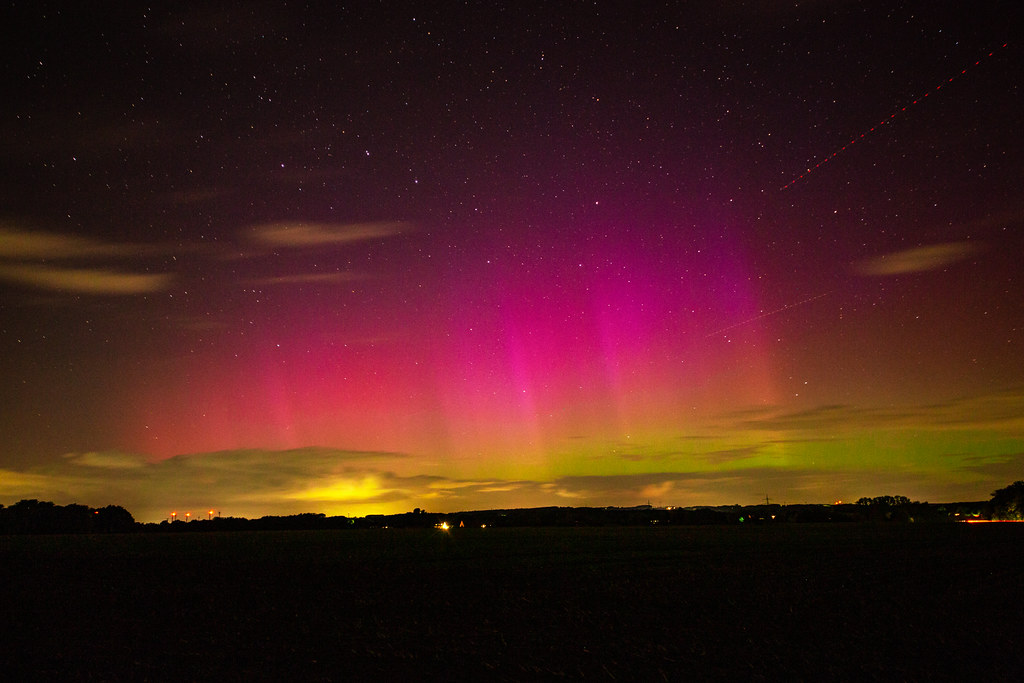

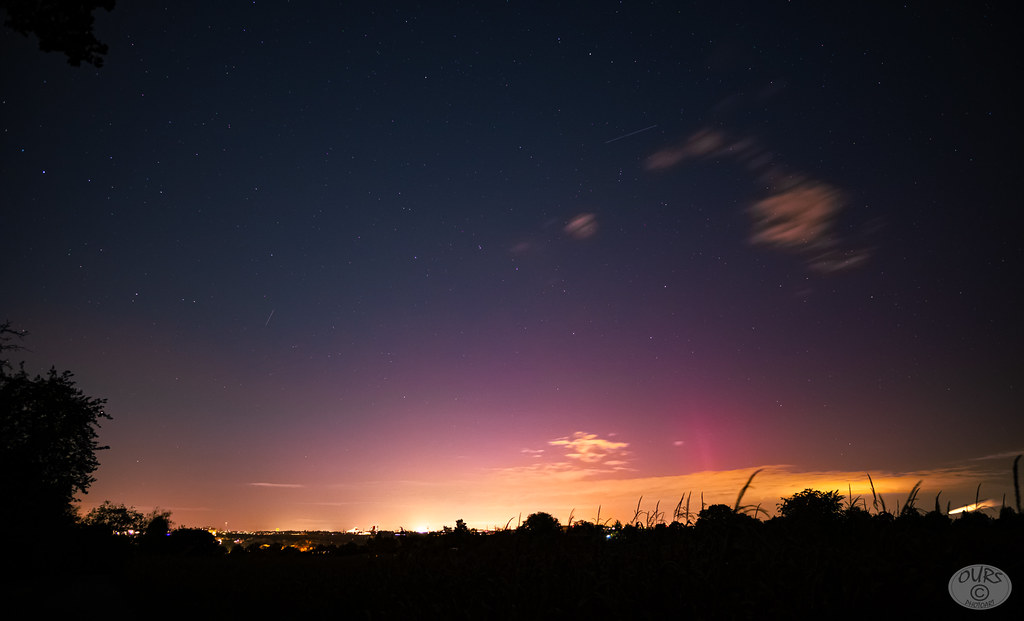
In France, images multiplied around 21:30 local time. They show pink glows toward the north.
Post X · @AssoMeteoCVDL
Association Météo Centre - Val de Loire
Pink glows on the northern horizon near Gombergean, in Loir-et-Cher (47.6° north), mostly visible with a camera. Photo by Émilie Monjure.
Showing the post contacts X's servers. Nothing is loaded until you click.
Post X · @meteo_89
Météo89
Aurora photographed at Pontigny Abbey, in the Yonne (47.9° north), by J. Faillat. The account notes that a long exposure on a phone or camera is needed.
Showing the post contacts X's servers. Nothing is loaded until you click.
Post X · @xploraspace
Xplora
Aurora captured at 20:52 local time by the Alpe d'Huez webcam (45.1° north). The post notes that the G3 threshold has been crossed, but Bz is hovering near zero, which holds the show back.
Showing the post contacts X's servers. Nothing is loaded until you click.
Post X · @StormchaserNL
Wouter van Bernebeek
A colorful aurora over the Netherlands, with a thunderstorm on the horizon and its lightning on the right. 10-second exposure.
Showing the post contacts X's servers. Nothing is loaded until you click.
Farther south, regional French media report fainter glows in the Hérault (according to BFMTV) and a pinkish glow photographed from the Gironde, at 44° north (according to Sud Ouest). These are the southernmost sightings we could cross-check.
How a G3 pushes the aurora as far as the Gironde
Normally, the aurora stays locked in a ring centered on the magnetic pole, between 60 and 75° latitude according to NOAA. That is why people head to Lapland or Iceland. During a big storm, the ring swells and slides toward the equator, like a puddle spreading out.
NOAA gives benchmarks for each level. They are expressed in geomagnetic latitude, a latitude measured from Earth's magnetic axis rather than its rotation axis:
- G3: aurora has been seen down to about 50° geomagnetic latitude.
- G4: about 45°.
- G5: about 40°.
Western Europe sits a bit "higher" on this scale than on an ordinary map, because the north magnetic pole is offset toward Canada. By our estimate, made with a simple model of Earth's field and good to within a degree or two, Paris (48.9° north) sits at about 50° geomagnetic latitude, right on the G3 line. The Gironde (44.8° north) is near 47°, the Hérault near 45°. In those regions the glow is no longer overhead. It is faint and low, at the edge of visibility.
Two effects explain why it can still be seen. The first is height: NOAA places the aurora between 80 and 500 km up. A point 300 km high stays in line of sight from nearly 2,000 km away, like a mountain summit you can spot well beyond the horizon. In practice you mostly see the top of the curtains, the red zone caused by oxygen. The second is the camera: in a long exposure, it records reds and pinks far better than the eye, which is why the pictures look more colorful than the real thing.
The timing helped too. The storm's peak, between 17:58 and 19:26 UTC (19:58 to 21:26 in Paris), landed at dusk and early night, under a Moonless sky.
And Spain? What we know and what we don't
The idea of auroras "as far as Spain" is going around. We checked it, and here is where we stand.
What is established. The storm reached G3. By NOAA's benchmarks, it takes more like G4 or G5 for the aurora to drop to Spanish latitudes. With the same simple model, the Cantabrian coast and Galicia sit at about 46 to 47° geomagnetic latitude, level with the Gironde. The Pyrenees are near 45°. Madrid is near 43°. So northern Spain would need a G4, and Madrid a solid G4 or even a G5.
What is plausible. A very faint glow on the northern horizon, visible only in a long-exposure photo taken from Spain's north coast, was physically possible. That is the same level as the pinkish glow seen from the Gironde.
What we did not find. No verified photo or report from Spain for the night of October 10 to 11, 2026, neither in the press nor in the posts we examined. Until that changes, we cannot write that the aurora was seen in Spain.
Be wary of photos making the rounds. Those from Spain date from much stronger storms: the extreme storm of May 2024 (G5) and the one on October 10 and 11, 2024 (G4). If a reader in Spain photographed something that night, we will update this article.
What's next: NOAA's forecast
According to its forecast of October 11 at 00:30 UTC, the storm is easing. Here are the main lines.
- October 11: G1, with G2 likely early in the day. The peak Kp expected is 5.67, between 09:00 and 12:00 UTC.
- October 12: quiet to unsettled. Late in the day, a fast stream of solar wind from a coronal hole (a region of the Sun whose magnetic field opens out into space) is due to arrive. The possible graze from the latest CME would land around then.
- October 13: mostly active, with a chance of isolated G1.
- Flares: R1 to R2 radio blackouts are likely, at 65% on October 11 and 12, and R3 or higher at 15%.
If you want to try your luck, find a clear northern horizon away from streetlights and let your eyes adapt to the dark. Switch your phone to night mode or set a 5 to 10 second exposure. Our Sun and auroras page tracks the forecast live, and the light pollution map helps you pick a dark spot.
Go further
- The images in this article: SDO (Solar Dynamics Observatory) for the ultraviolet flare, SOHO for the CMEs.
- Key notions: the aurora, the solar flare, the solar wind and the magnetosphere in our glossary.
- Our tools: the Sun and auroras page for the live forecast, the light pollution map and the observing guide.
- Official sources: NOAA's Space Weather Prediction Center forecast discussion and 3-day forecast, the October 10 G3 notice, the October 9 G2 watch, the NOAA storm scales and the aurora page.
- Sightings cited: BFMTV for the Hérault and Sud Ouest for the Gironde.