On October 19, 2026, the European Space Agency announced a first. Its Euclid space telescope had found a comet nobody had ever seen, and the object now carries the name C/2026 S1 (Euclid). The spacecraft, built to map dark matter and dark energy, crossed its path in images taken between September 16 and 24, 2026, when the comet was about 1.3 billion km from Earth. It is active. It follows an orbit that takes thousands of years to close, and its discovery says a lot about the telescope's unexpected talents.
A bright streak among the galaxies
No automatic alert flagged it. The find came from software built to hunt moving objects, and from a PhD student who knew how to read its signal.
Mikko Pöntinen, a doctoral student at the University of Helsinki, wrote a program that compares Euclid images to spot whatever moves. The idea is easy to picture. Stars and galaxies stay in place from one exposure to the next. An asteroid or a comet does not. It shifts. So the software looks for dots that will not stay still and flags them.
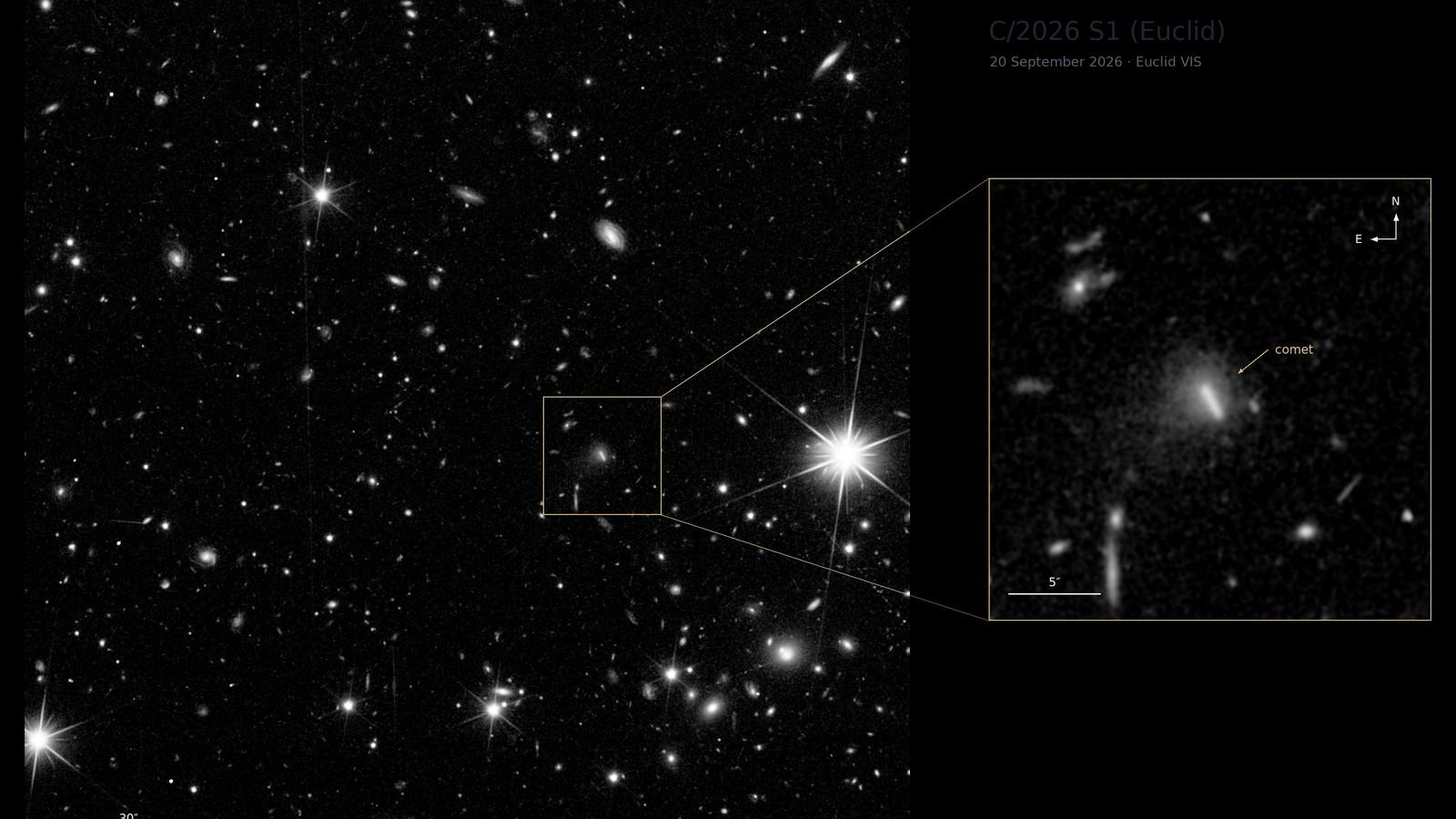
That day, the program flagged something better than a dot. It found a bright streak smeared across several images. An object that leaves a trail while the telescope keeps its shutter open is an object on the move. "I was excited to see my software flag a streak smeared across several images, the result of a fast-moving object," Pöntinen recalls in the ESA release. By predicting its position, he found it again in other exposures, in all five fields of view and 16 exposures.
Then came the detail that changed everything. Around the streak, the astronomer saw a fuzzy cloud. That halo, called a coma, gives away an active comet losing gas and dust. An asteroid would not show that haze, even though it can leave a streak too. A word on what these objects are. Comets are icy, dusty bodies left over from the birth of the Solar System about 4.6 billion years ago. When their ice warms up, it turns into gas and forms that glowing cloud.
One check remained. Was the object already known? Pöntinen compared his find with catalogues of comets and asteroids. No match. So he sent the observations to the Minor Planet Center, the international body that records and confirms small bodies of the Solar System. Think of it as a global switchboard. It collects reports from observatories, cross-checks the data, computes orbits and hands out official designations.
The alert let ground-based astronomers point their telescopes at the comet in turn. The Minor Planet Center confirmed its cometary nature on October 8, 2026. The official name keeps the year and the mission that found it.
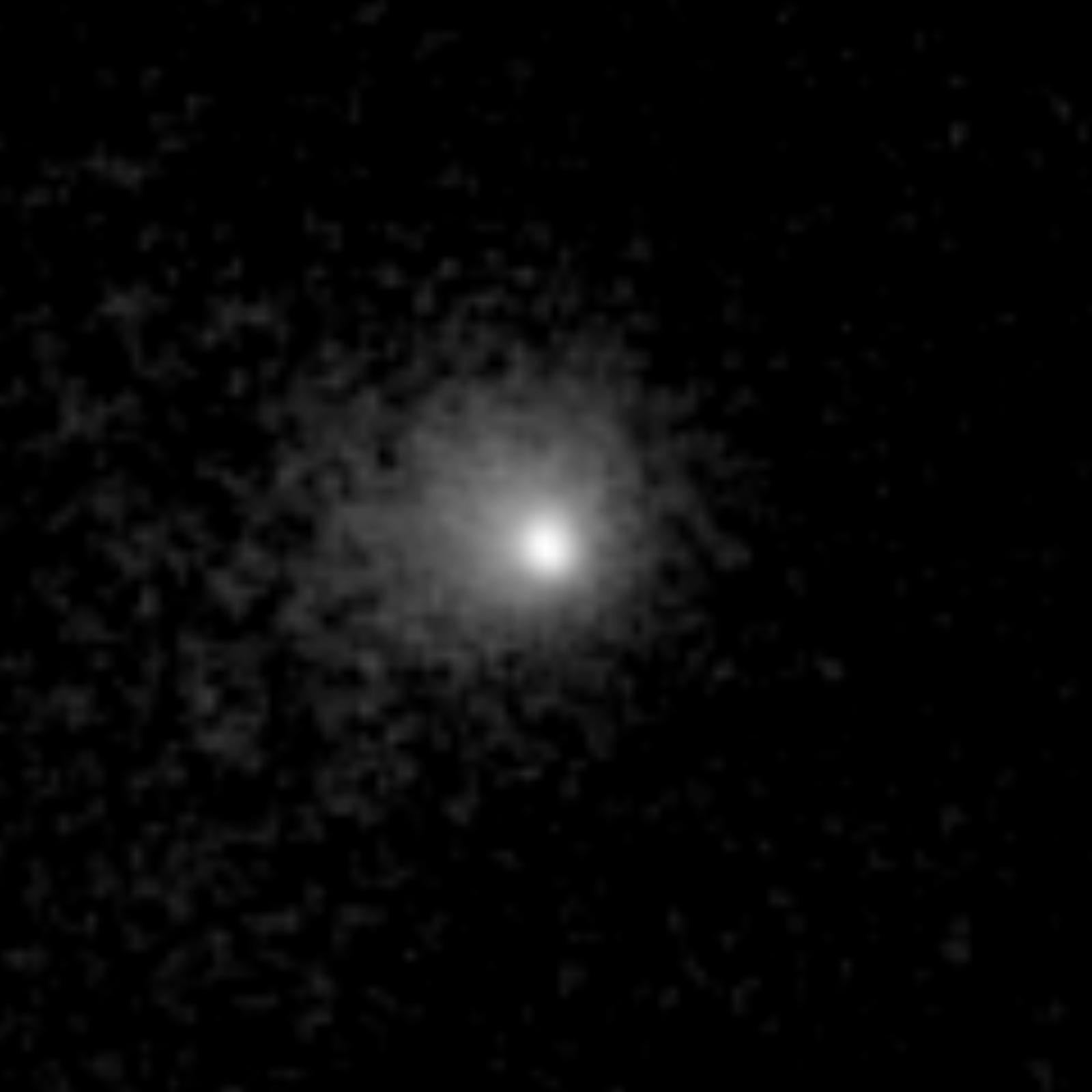
1.3 billion km out, high above the planetary racetrack
At the time of the observations, the comet was about 1.3 billion km from Earth. That is roughly the distance from the Sun to a point between the orbits of Jupiter and Saturn. Scaled to our planet, it comes to nearly nine times the average distance between Earth and the Sun. Light took about 72 minutes to cover the trip.
But its path leaves the racetrack. The planets circle the Sun in one flat plane, like runners on a track. The comet comes in from above. From the Sun's point of view, it currently sits straight up, and its orbit traces an arch over the Solar System. Astronomers call it highly inclined.
One revolution will take several thousand years. That is the definition of a long-period comet. These bodies come from very distant reservoirs, such as the Oort cloud, a halo of ices at the edge of the Solar System. A comet falling from there takes thousands of years to come back near the Sun, and some never return. Future observations will sharpen its orbit and its period. For now, astronomers have only a few days of data.
A telescope built to look the other way
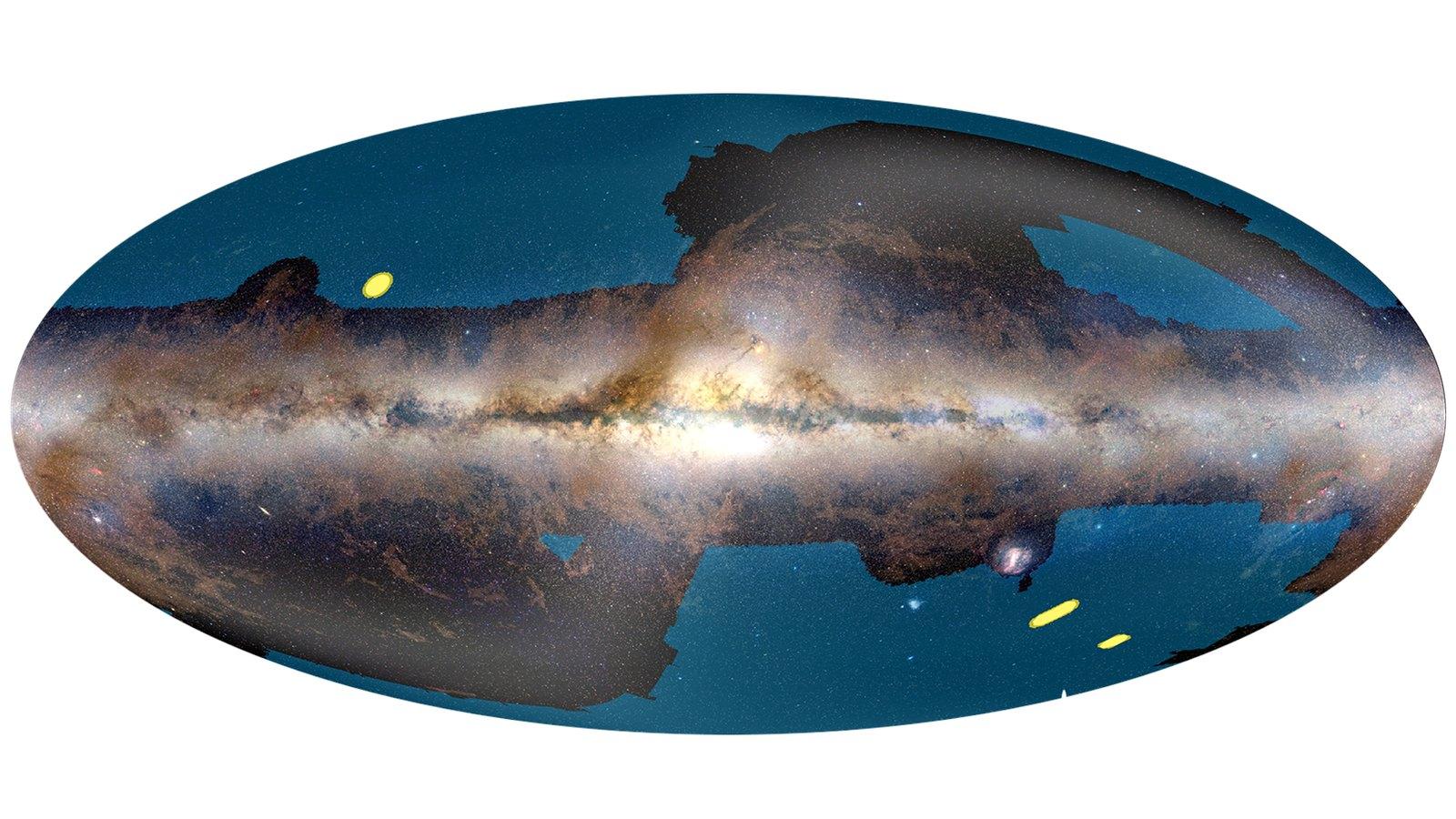
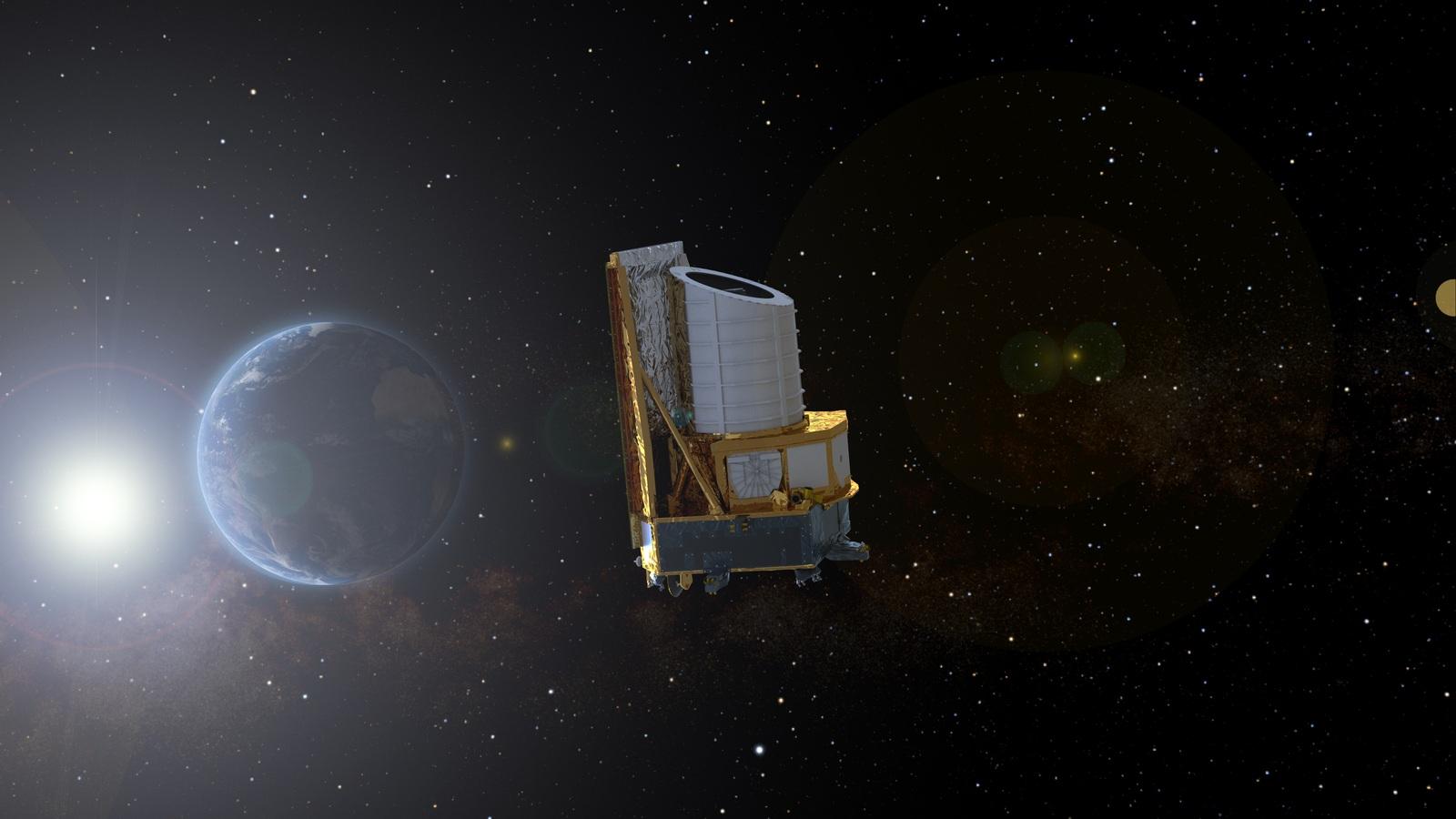
Euclid was not sent to space to chase comets. Its job is to photograph distant galaxies, steady and tiny, for six years, across more than a third of the sky. By measuring their shapes and shifts, it is meant to map dark matter and dark energy, out to 10 billion light-years. Nothing in that program prepares it to catch an object on the move.
The telescope even avoids the zone where comets are most common. Asteroids and comets cluster along the plane of the Solar System, where dust builds up too. That dust scatters sunlight like a lighthouse in fog and blurs distant galaxies. So Euclid prefers to look elsewhere, at cleaner patches of sky.
Its scanning method makes things harder still. Euclid works in steps. It locks on a small patch of sky, photographs it at length, moves one notch, starts again. Each section is visited once. There is no going back to check an object spotted later, while a comet keeps travelling.
That is no reason to ignore them. To clean its images, Euclid needs to know what moves. A forgotten comet trail can skew the measurement of a distant galaxy, or pass for a sensor flaw. A team in the Euclid Consortium therefore monitors small bodies in the images. It found C/2026 S1.
"Very few comets are expected to be discovered by Euclid so it was a happy coincidence that the combination of the comet's orbit and Euclid's scanning over those days captured the object in multiple images," explains Bruno Altieri, Euclid archive scientist and member of the discovery team.
The discovery also interests the planners of Comet Interceptor, a future ESA mission. Its idea is to meet a comet that is still intact, spotted shortly before it passes near the Sun. That requires detecting it early, while it is still far away. A telescope able to spot an object 1.3 billion km out buys that lead time. This particular comet is not a suitable candidate for the mission. But the alert and the confirmation served as a dry run between the two teams. "While this particular comet is not a suitable candidate for Comet Interceptor, the process of discovery and alert gives us a real test case for how our two mission teams will coordinate in the future," says Valeria Pettorino, Euclid project scientist.
What the discovery changes
Three things at least. The first is a proof of capability. Euclid can detect comets still far from the Sun, which leaves astronomers time to follow them. The second is a lesson in method. The telescope's images are not only for galaxies. They also hold the Solar System passing in front, and it takes practice to recognise it.
The third touches on what comets tell us. These icy bodies formed about 4.6 billion years ago, along with the planets, and have changed very little since. Studying them is like opening an archive of the Solar System's birth, with clues about the origin of Earth's water and the ingredients of life. Every new comet is one more chance.
Euclid had already photographed known comets. C/2026 S1 is the first it found itself. Others may follow, as the deep surveys go on. Meanwhile, the Minor Planet Center will keep refining its orbit as observatories around the world point at it.
Going further
- The Euclid mission is in the catalogue. Its Euclid page gathers its goals, instruments and milestones since its launch on July 1, 2023, towards the L2 Lagrange point, 1.5 million km from Earth.
- The concepts in this article: comet, Solar System and dark matter.
- To observe the sky yourself: the sky map and the observing guide.
- Sources: ESA release, October 19, 2026, Euclid mission page, the comet in context, the composite of eight exposures and the survey map.