On 24 November 2026, the European Space Agency announced the most distant quasar ever seen. It is called J1504+6252, nicknamed Dún Aonghasa, and it sits at redshift 8.13. Its light left when the Universe was 630 million years old, just 5% of its present age. Euclid has beaten its own record by 40 million years. The strange part is not the distance. The black hole behind the quasar holds about 360 million solar masses, yet it is barely eating today.
A red dot pulled from 18 months of images
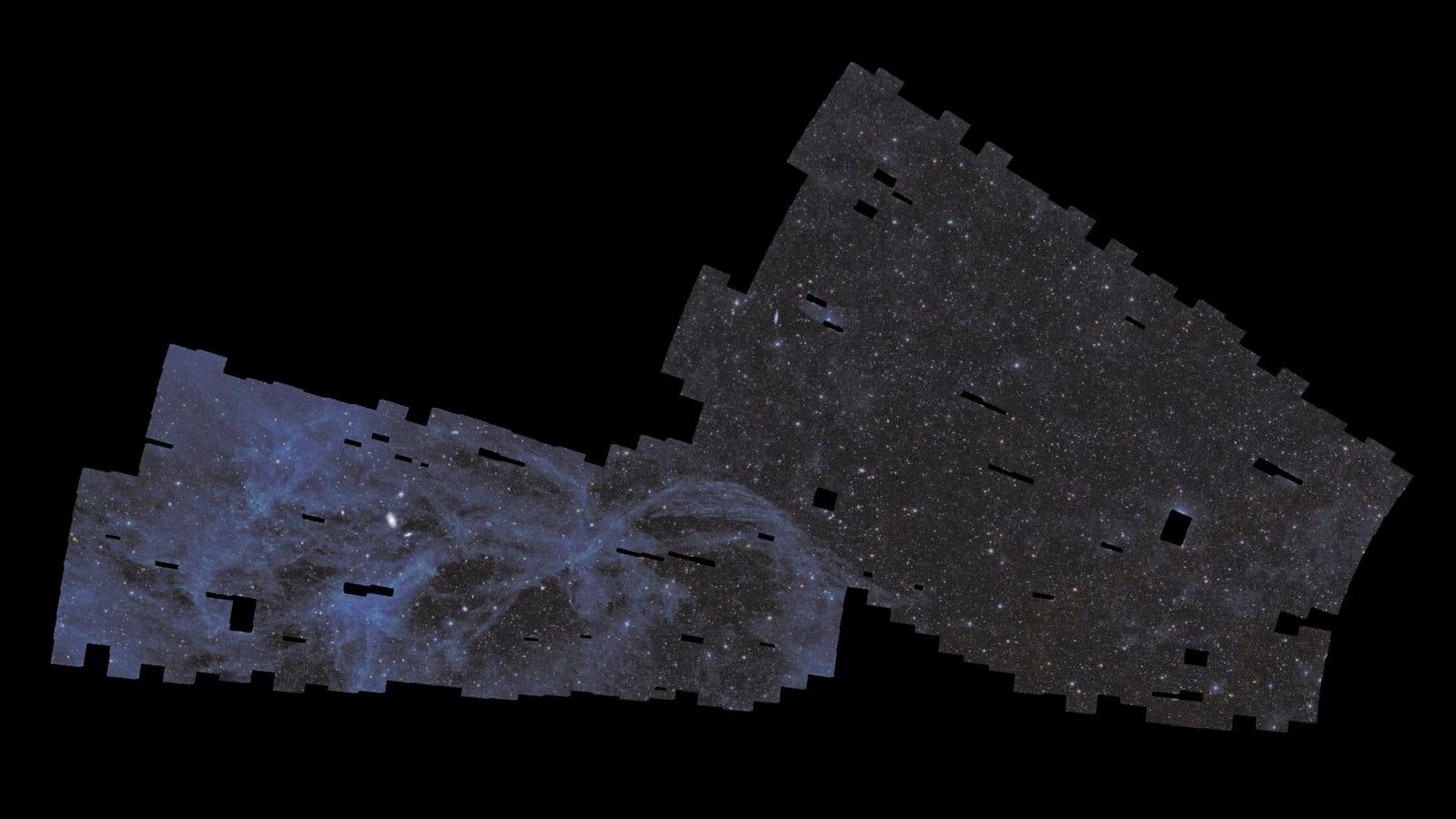
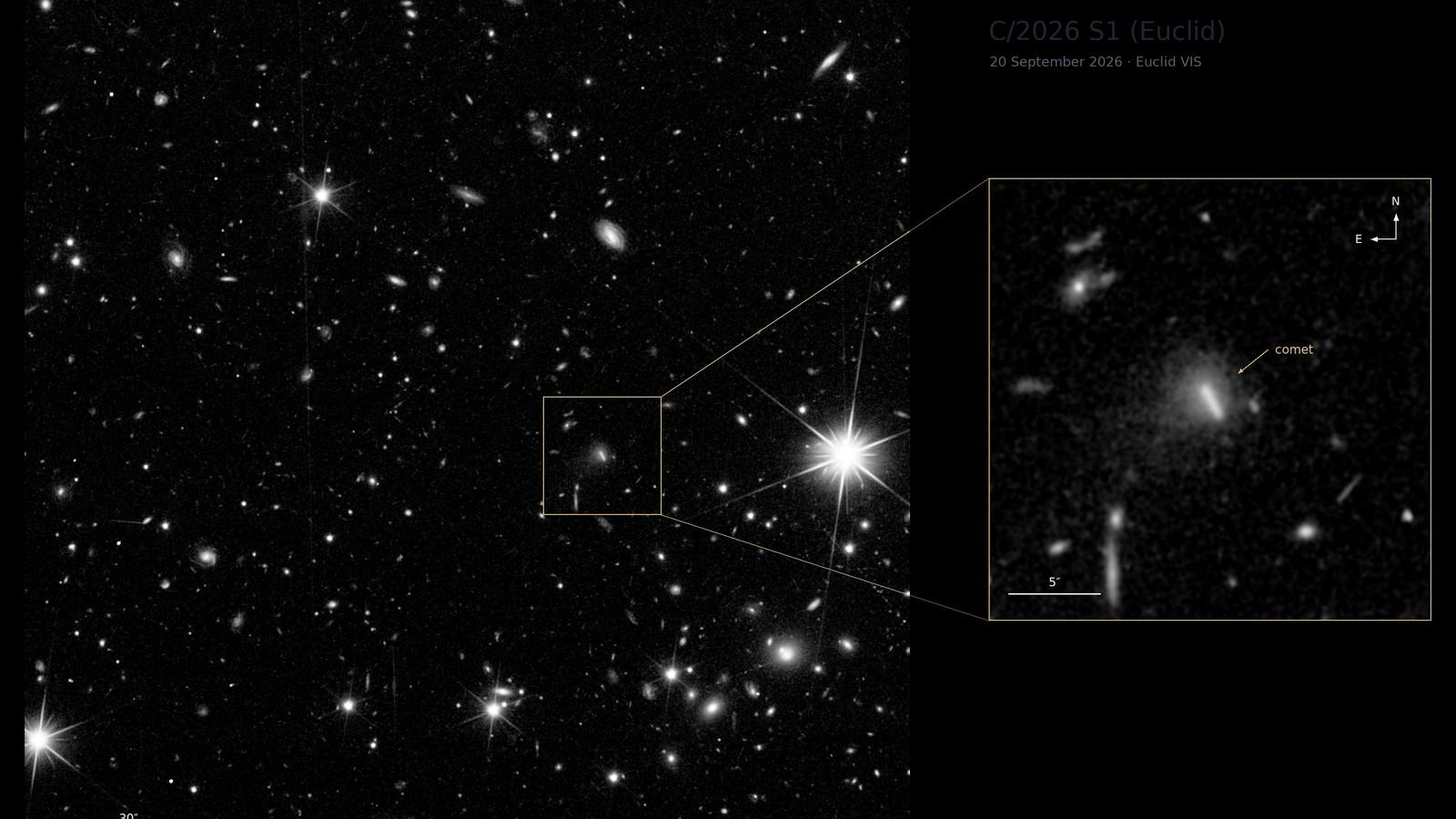
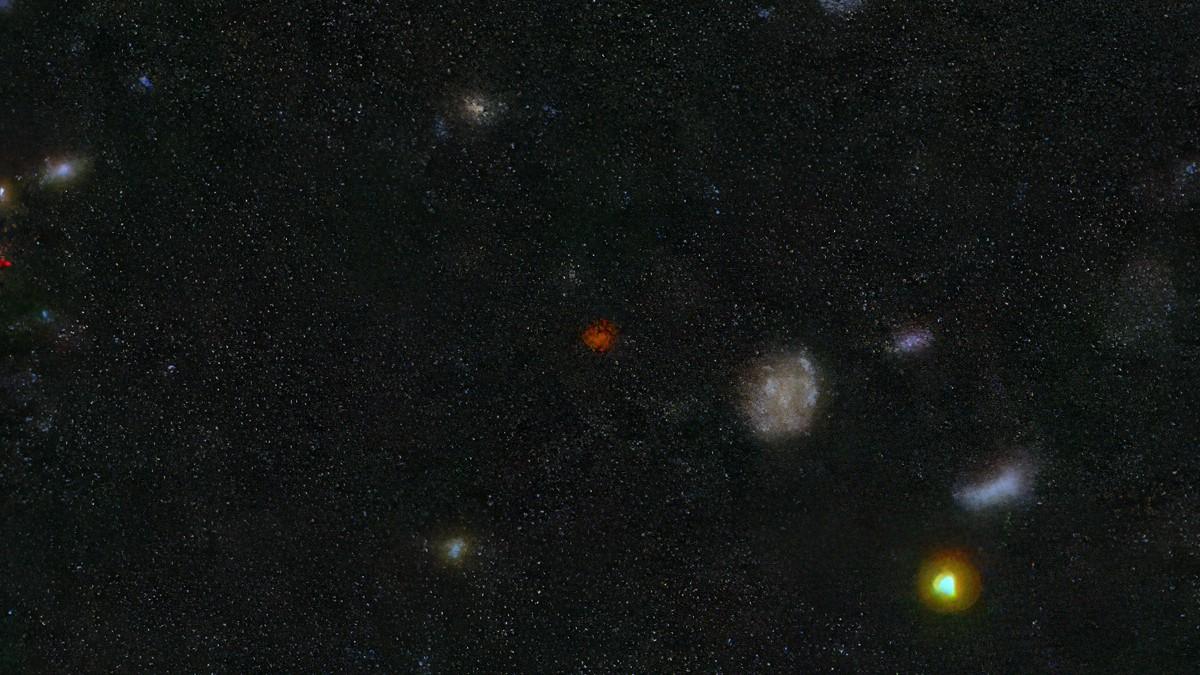
Euclid launched in July 2023. Its wide survey began in February 2024. In about 18 months, the telescope gathered images of millions of objects. J1504+6252 showed up as a red dot near the centre of one image, lost among thousands of other smudges.
The selection relies on colour. At these distances, neutral hydrogen in the space between galaxies absorbs blue light. A distant quasar therefore vanishes from the visible range and reappears in the infrared. Astronomers call it a dropout. Euclid sees through one visible filter and three infrared filters. The candidate shows nothing in the visible band and shines in the infrared.
Three independent algorithms flagged J1504+6252 as a high-priority target. One models the quasar and contaminant populations, one is a classifier trained on simulations, and one compares the light with models of galaxies, stars and quasars. All three kept it. Photometry puts the object at redshift 8.13, with an uncertainty of 0.10.
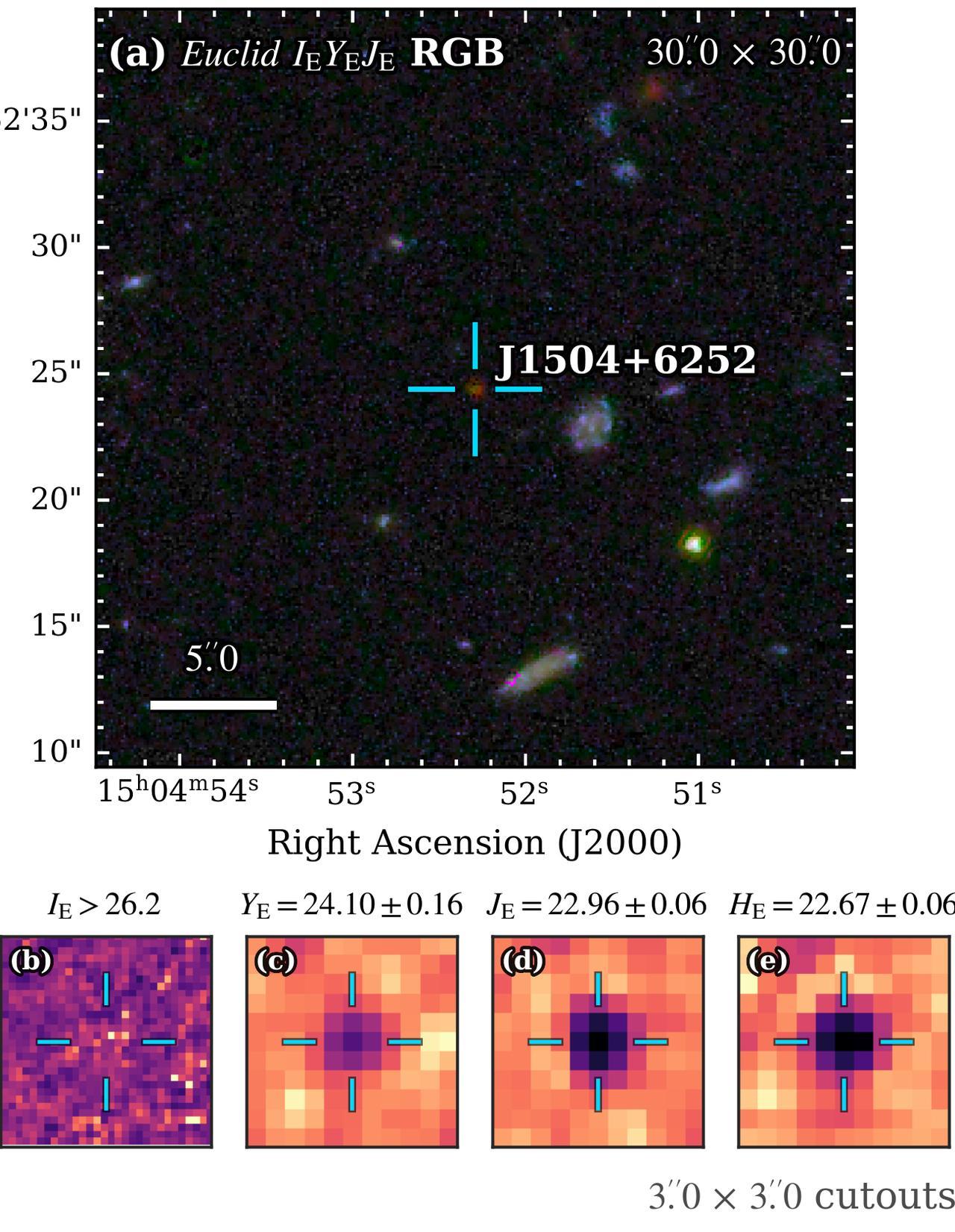
What does that number mean? Redshift measures how much cosmic expansion has stretched the light. The farther a source, the more its wavelengths are pushed towards the red. At 8.13, they are 9.13 times longer than when they were emitted. The light has travelled for about 13.1 billion years. It shows the Universe as it was 630 million years after the Big Bang, when it had reached only 5% of its current age.
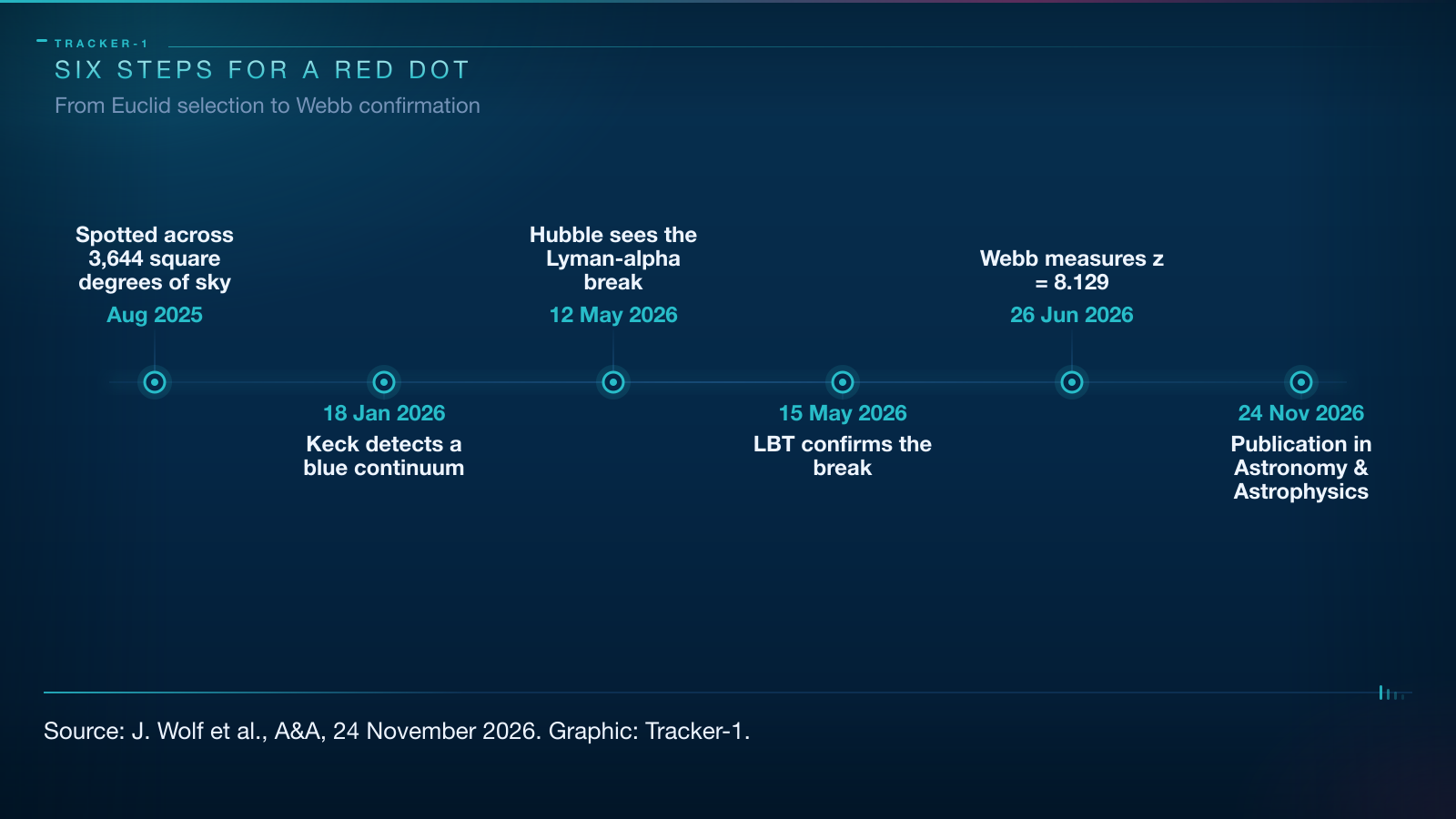
What followed was a campaign in steps. Keck, on the ground, detected a blue continuum in January 2026, a smooth background of light with no marked lines. Hubble saw the expected break in the light in May. The Large Binocular Telescope confirmed that break a few days later. Webb then measured the spectral shift with its NIRSpec spectrograph, which splits light into colours: 8.129, give or take 0.005. The previous record, also set by Euclid, was 7.77, about 660 million years after the Big Bang. The newcomer gains roughly 40 million years.
Euclid is not done. In a year and a half, the mission has announced 31 ancient quasars. Twelve sit beyond redshift 7, a threshold that took fifteen years to reach with earlier surveys. One object cannot map a population. It does give models a very precise target.
A 360-million-solar-mass black hole with a small appetite
Mass shows up in the width of certain emission lines. A line is a precise wavelength where an atom releases light. As gas orbits the black hole, each cloud moves at a different speed. The mix of shifts broadens the line, the way a choir singing slightly off-key produces a wider sound than a single voice. The more massive the black hole, the faster the gas moves at a given distance. The hydrogen-beta and ionised magnesium lines are broadened by amounts equivalent to 3,160 and 3,740 kilometres per second.
The calibrations that turn those widths into mass give a reference value of about 360 million solar masses. Depending on the method, the range runs from about 210 to 780 million. One solar mass is the mass of the Sun. The black hole in J1504+6252 therefore holds several hundred million times the mass of the Sun.
The number that surprises astronomers lies elsewhere. A black hole cannot swallow an unlimited flow. Above a certain rate, the light from the infalling matter pushes the remaining gas away. This is the Eddington limit, the equivalent of a funnel that can pass only so much water, however hard you pour. J1504+6252 now accretes at about 26% of that limit, with a range of 12 to 44% depending on the calibration. It is massive, but it eats slowly.
That slow pace is itself a clue. If the black hole had grown steadily until today, it should be swallowing far more gas. Its current calm suggests that most of its mass was already in place. The fast growth phase happened earlier and is over. The quasar we see is a giant at rest, or nearly so.
Why it had to grow faster than the limit allows
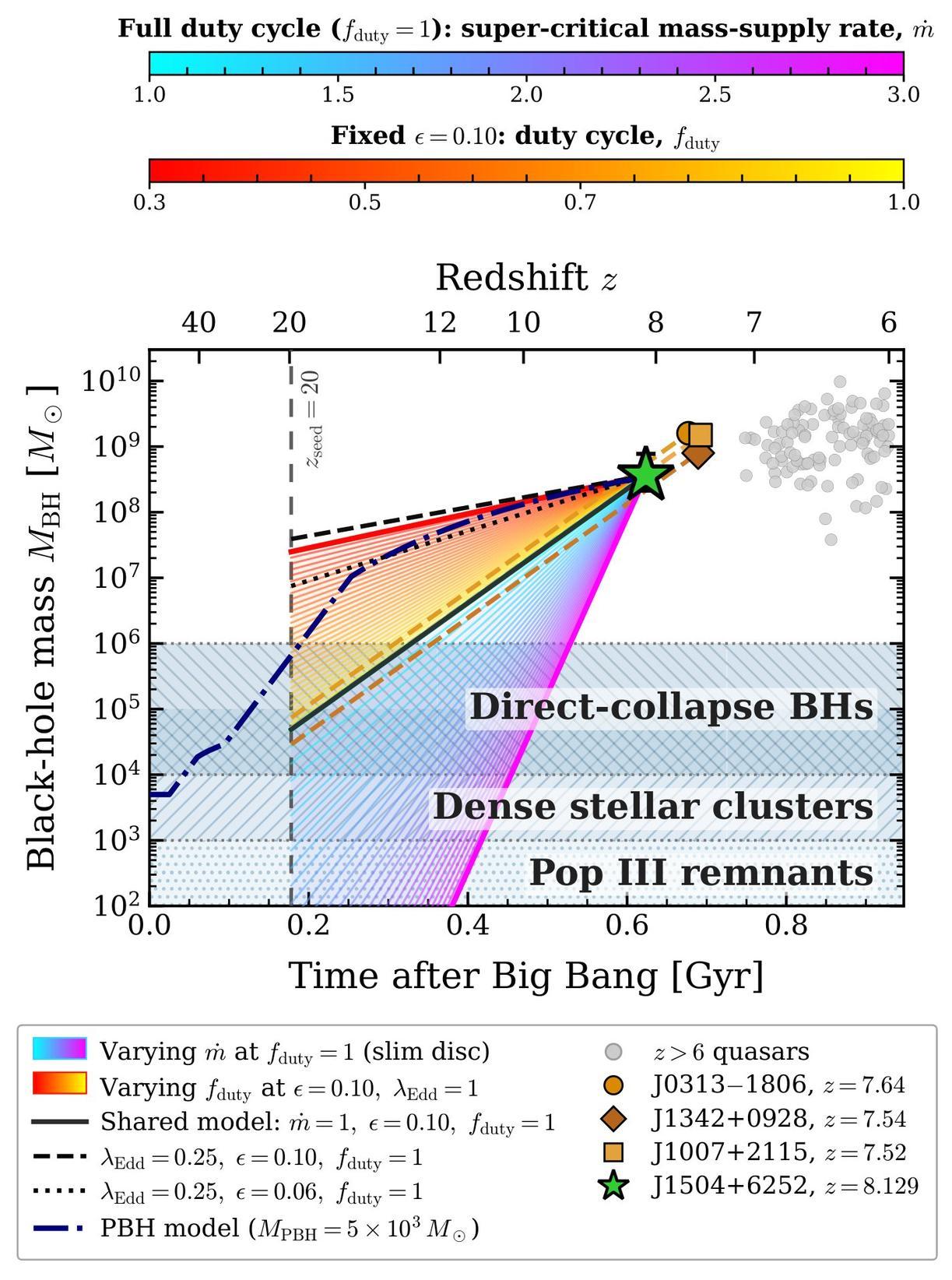
A black hole accreting at the Eddington limit doubles its mass in a few tens of millions of years. With a radiative efficiency of 10%, meaning the share of energy that escapes as light, the doubling time is about 35 million years. A 100-solar-mass seed, the typical remnant of a first-generation star, would need about 22 doublings to reach 360 million solar masses. That would take more than 750 million years. The object already exists 630 million years after the Big Bang, and its growth could not have started at the very first instant.
Models run into that calendar. A 100-solar-mass seed is not enough if it grows at the Eddington limit. It would need almost uninterrupted growth, without the pauses that simulations expect. The team's calculation agrees. To reach the observed mass through continuous Eddington accretion, the seed must weigh about 100,000 solar masses. If growth is intermittent, with a duty cycle below 0.5, the seed must be heavier still.
Hence the alternative routes. Heavy seeds could form from the direct collapse of primordial gas clouds, without passing through a star. Other models invoke supercritical accretion, where gas falls so fast that light can no longer push it back efficiently. A primordial black hole, formed long before the first stars, could also serve as a starting point. Galaxy mergers happen, but they are not enough. The team expects one to three major mergers between redshift 20 and 8.13, and their combined effect remains too small to build such a giant unless the progenitors were already massive.
None of these scenarios is ruled out. The discovery does not choose between them. It tightens the clock and makes the constraint harder to meet for light seeds. That is already a lot.
What this record changes for the first black holes
J1504+6252 is the first quasar confirmed beyond redshift 8. Objects known at that distance were mostly galaxies or black holes growing behind thick dust, hard to classify. Here the spectrum, the breakdown of its light, shows a blue continuum and broad lines, the marks of a classic quasar. Webb measured a mature object, not a borderline case.
That maturity changes how we read the population. The brightest quasars found so far may have been the tip of an iceberg. A massive black hole accreting at a quarter of its limit shines less than an identical black hole feeding at full capacity. The team calculates that, for the same mass, an Eddington-limited J1504+6252 would be about 3.8 times brighter, or 1.46 magnitudes brighter, magnitude being a unit of apparent brightness. It would be easier to spot. If such objects exist, Euclid can find them.
The mission even offers a sense of scale. Forecasts called for 8 to 23 quasars beyond redshift 8 across the full 14,000 square degrees of the survey, or 2 to 6 in the 3,644 square degrees analysed so far. Euclid has found one. The count is still consistent with the forecasts, but time and spectra will be needed to learn whether the population is rare or merely quiet.
The real stakes lie in the formation of the first black holes. Models must explain how a few hundred million solar masses appear in less than a billion years. J1504+6252 adds one measurement, with a mass, a redshift and an accretion rate. It does not close the debate. It forces the debate to start earlier.
Going further
- The Euclid mission page, to follow the telescope and its survey.
- The basics: a supermassive black hole and spectroscopy in our glossary.
- To plan an observing session, Tracker-1's observing guide.
- The ESA release: Euclid breaks own quasar record by 40 million years.
- The science paper: J. Wolf et al., Astronomy & Astrophysics, 2026.