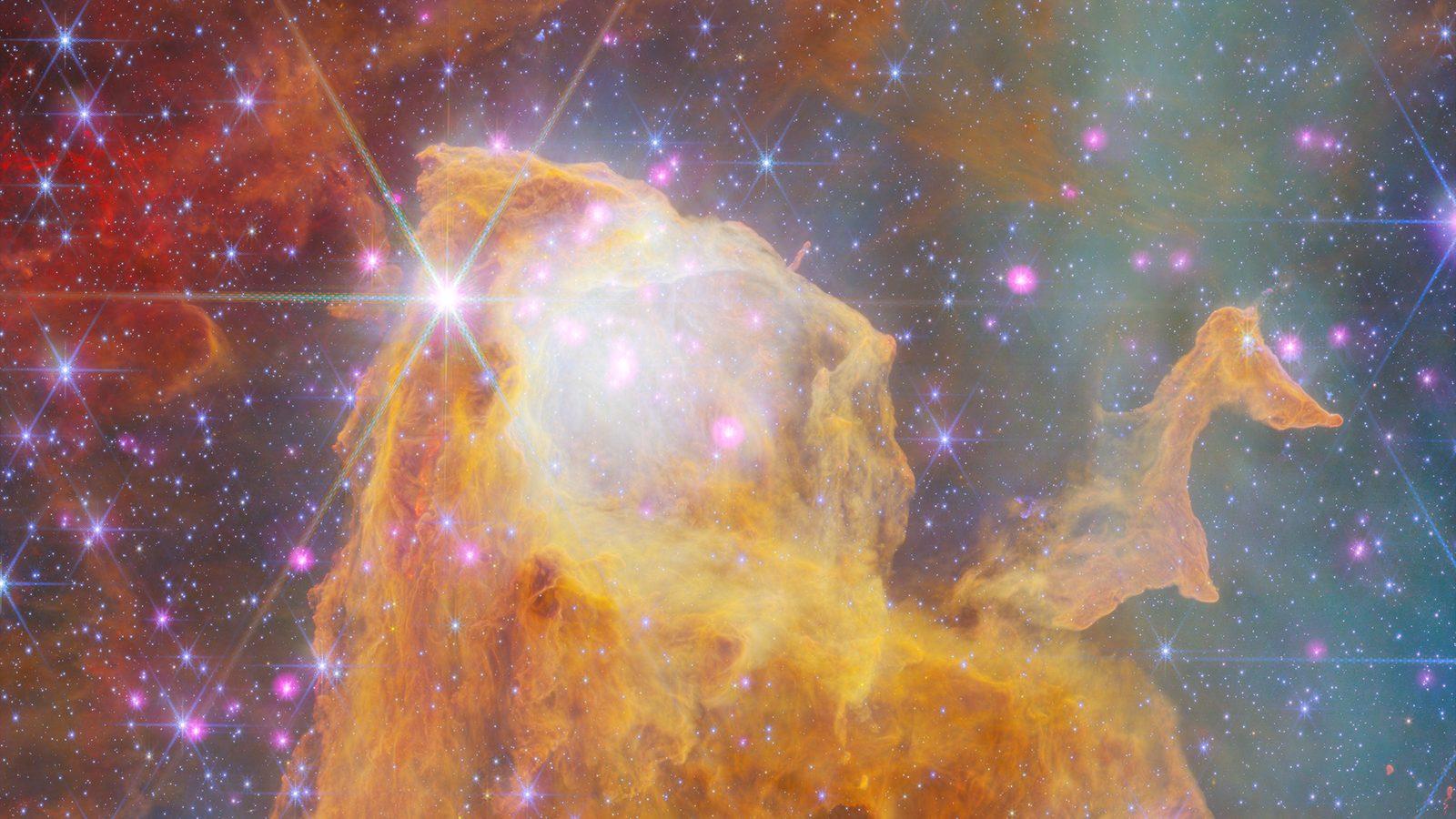
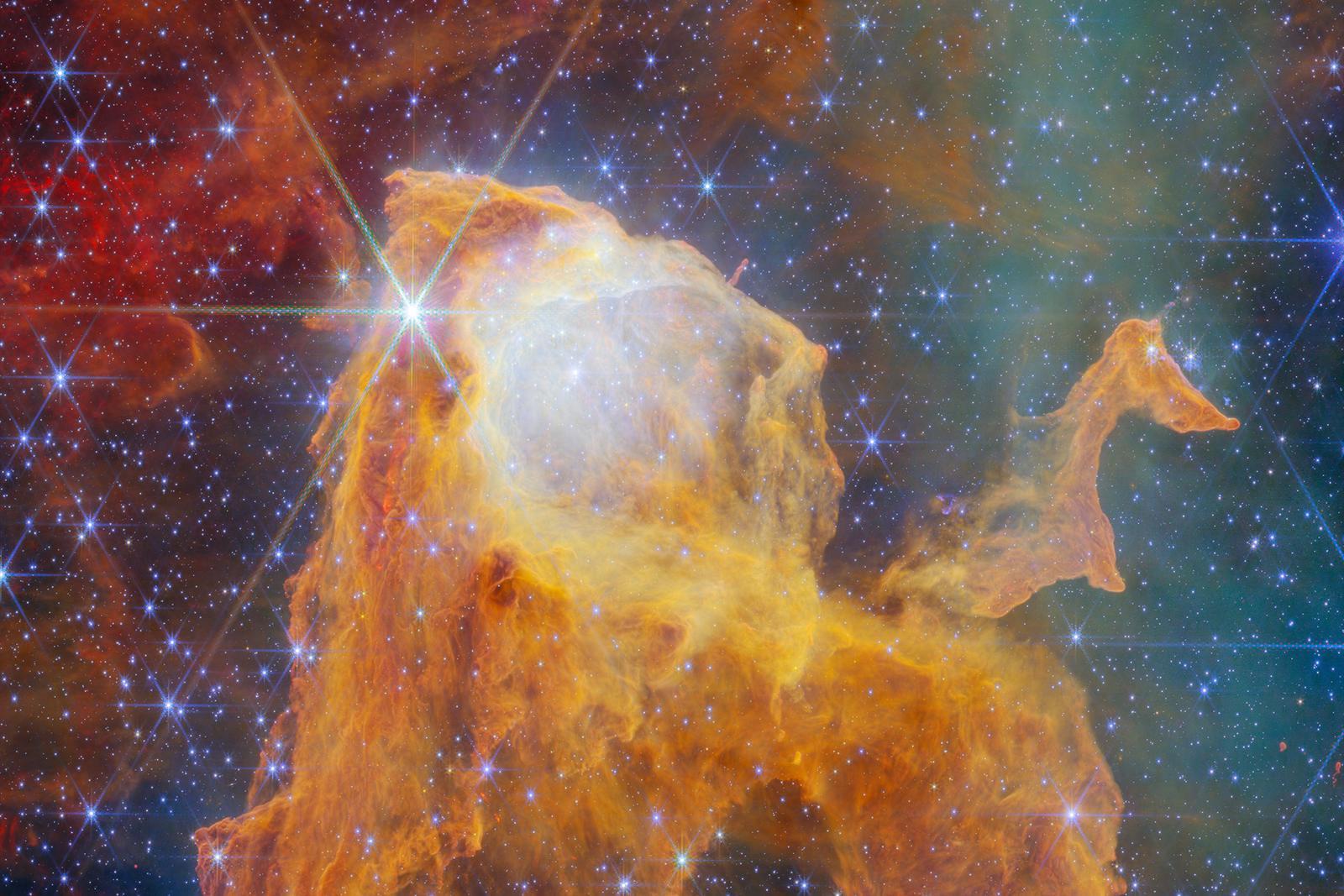
A ghost floats in the Carina Nebula. Round, smooth head, long trailing cape, the cloud stands out against a field of stars. The Chandra X-ray Observatory and the James Webb Space Telescope photographed it together, and the image was published on October 28, 2026, just before Halloween. The story it tells has nothing to do with a revenant. This ghost is not the leftover of a dead star, it is a nursery where stars are being born.
7,500 light-years away, a cloud 9.4 light-years wide
The Carina Nebula is one of the largest stellar nurseries in the Milky Way. It holds some of the most massive stars in our galaxy, including the Eta Carinae system. The ghost fills only one corner of that scene, about 7,500 light-years from Earth.
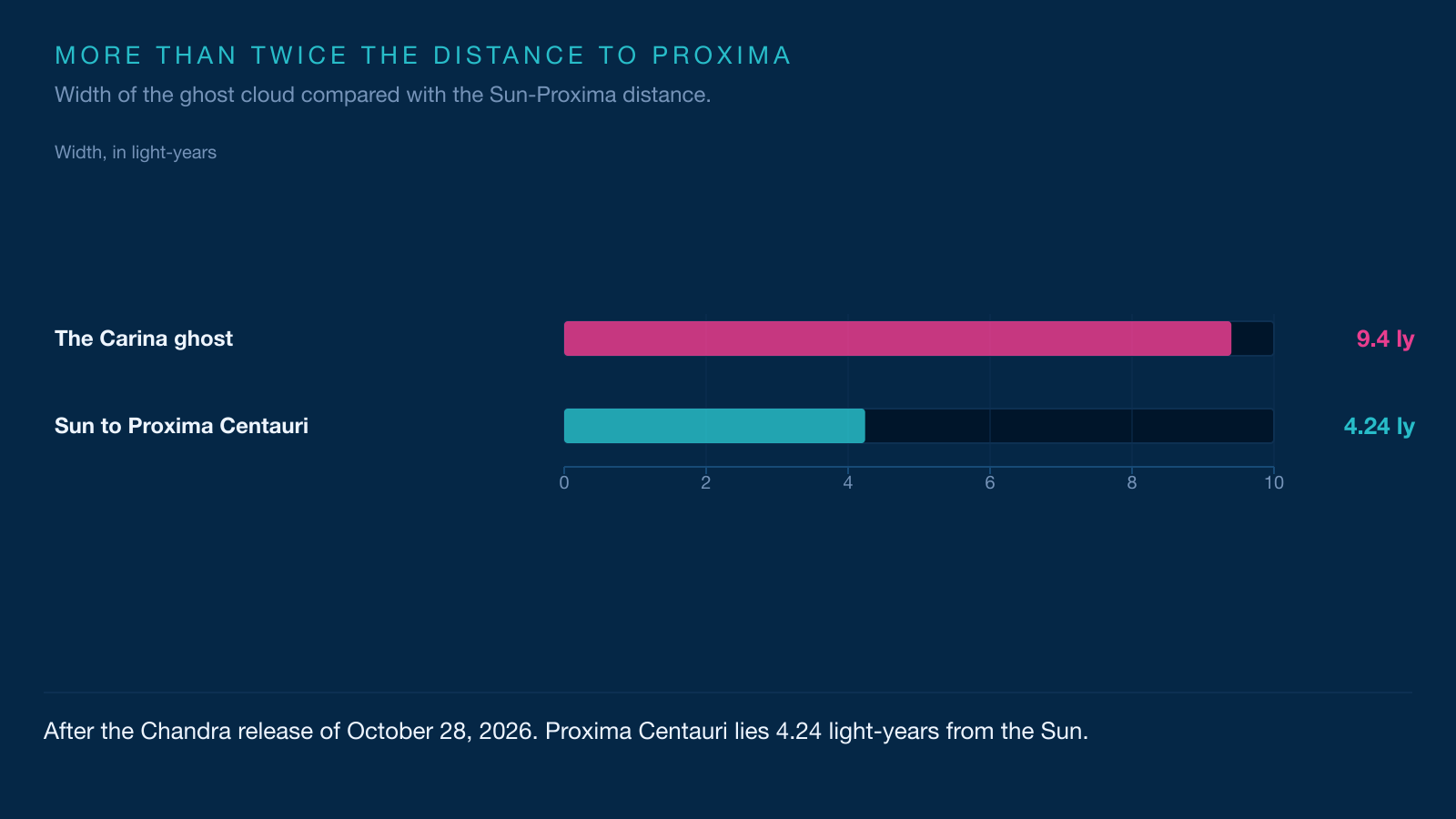
The silhouette itself is simple: a round, bright head, like a hood, extended by a tail that frays into wisps. The whole thing covers 4.3 arcminutes of sky, which works out to 9.4 light-years across at that distance. A light-year is about 9.46 trillion kilometers, the distance light covers in one year. An arcminute is a sixtieth of a degree, and the full Moon spans 31 of them.
For scale, the cloud is wider than the gap between the Sun and Proxima Centauri, the closest star to us, at 4.24 light-years.
This kind of object carries a misleading name: cometary globule. Astronomers named it after the comet-like head and tail. It is not a comet at all. A comet is a lump of ice and dust traveling around the Sun. A globule is a pocket of gas and dust sitting inside a nebula, a region denser than its surroundings where matter has gathered.
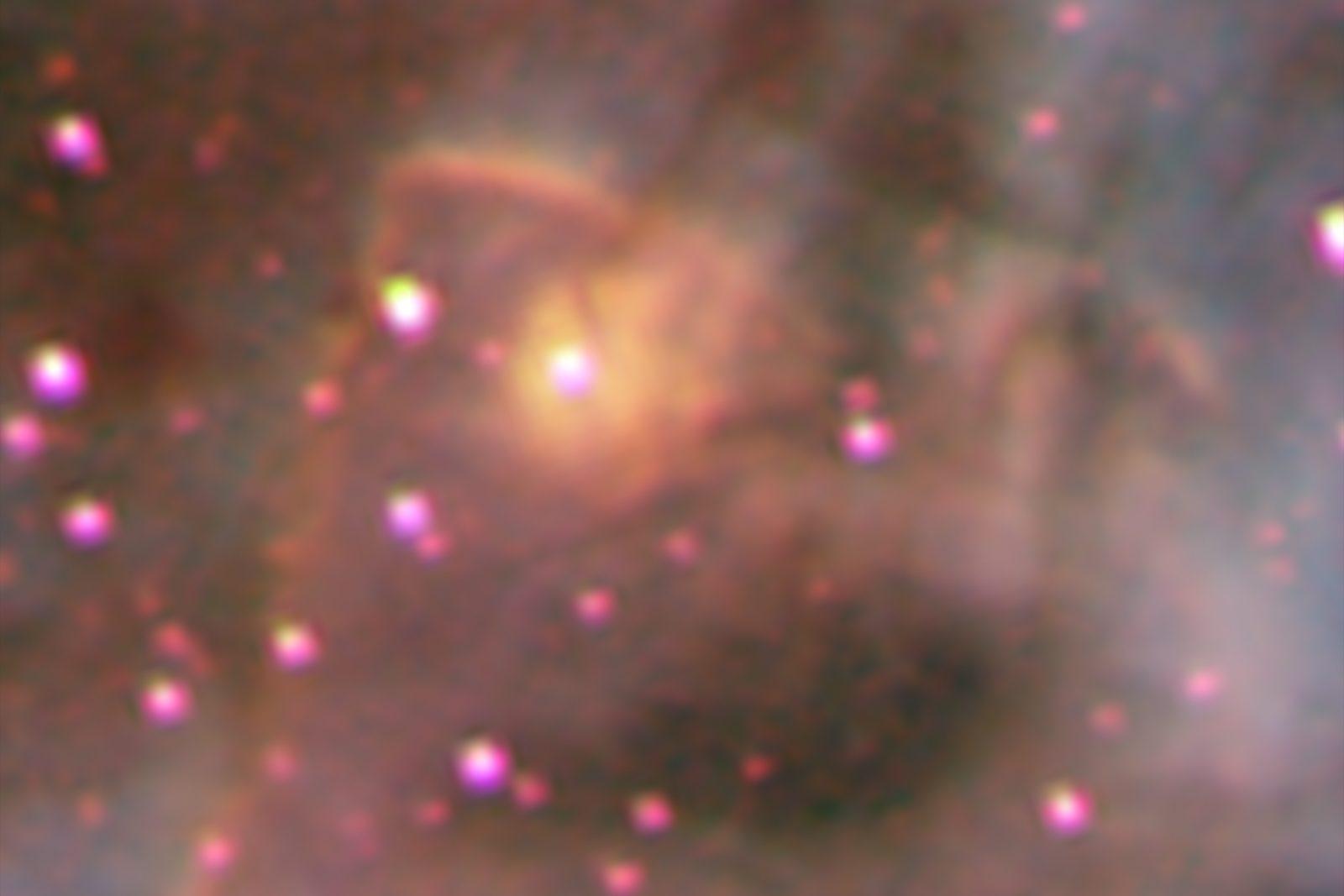
The pink dots are newborn stars
The most valuable part of the image sits in small pink dots scattered across the cloud. Those are the X-rays Chandra collected. They point to young stars.
Here is how it works. A star that has just formed spins fast on its axis. Its magnetic field winds up and heats the corona, the halo of gas around the star, until that gas shines in X-rays. A medical X-ray does the same job on a smaller scale, passing through soft tissue to show the bone behind. Chandra was built to catch that signal, and the result reads like an X-ray of the nursery: where visible light shows an opaque mass, X-rays expose the baby stars hidden inside it.
The observation itself is old. Chandra pointed at this field on August 28, 2008, for 16 hours and 30 minutes, using its ACIS camera. The data had been sitting in public archives ever since. What is new is the blend with Webb's infrared light, which reveals the structure of the cloud in fine detail.
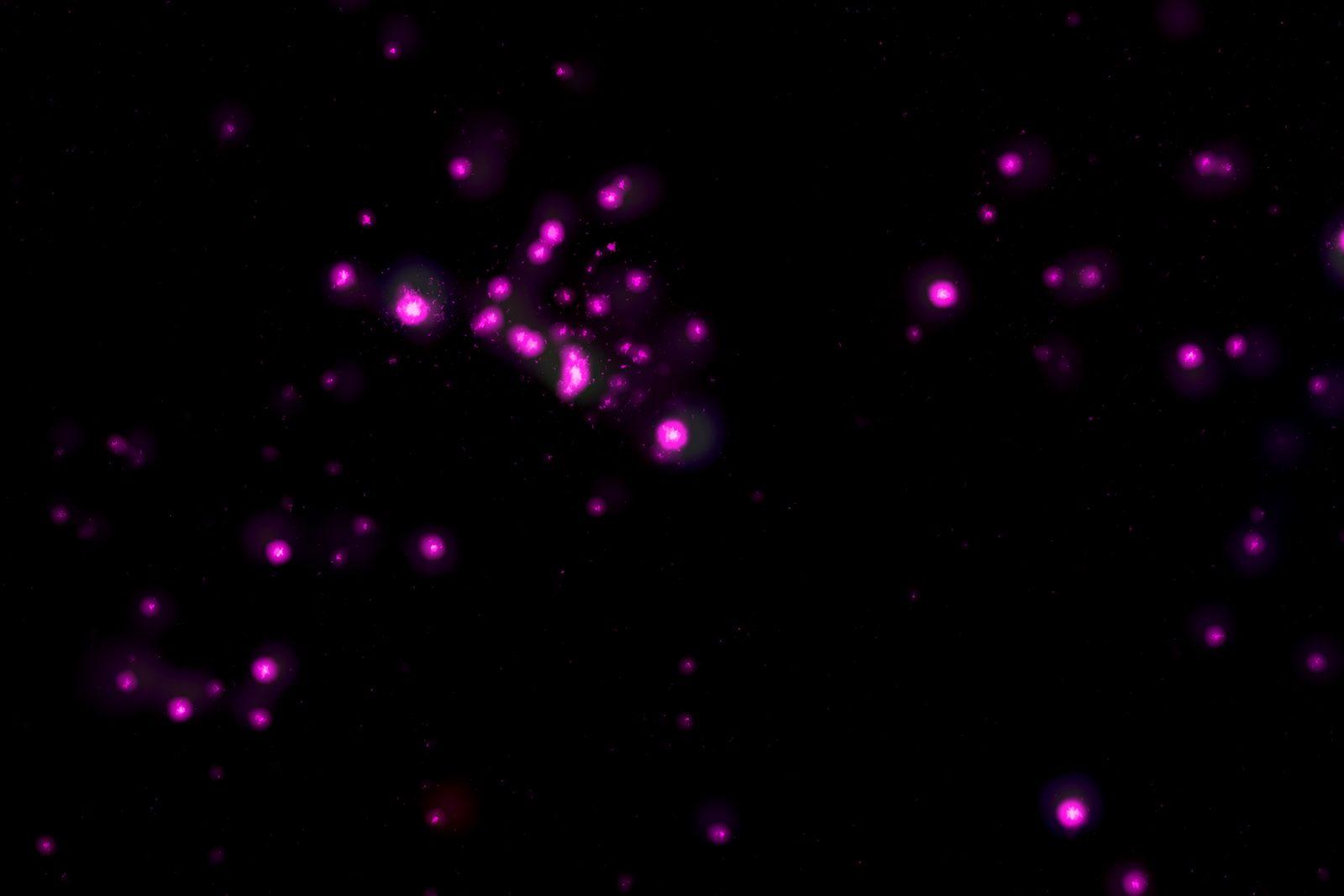
Infrared light plays a supporting role. The dust in the cloud blocks visible light, but it lets infrared through and gives off infrared of its own, all the more strongly as the gas warms. Webb therefore sees the dust wisps and gas shells that never reach the visible range. In the composite, X-rays are pink and infrared is red, green and blue.
Eta Carinae carves the cloud from outside the frame
The most interesting question is the shape itself. The answer probably lies in radiation arriving from outside the frame. The region hosts massive stars, far hotter and brighter than the Sun, Eta Carinae among them. Their ultraviolet light strips electrons from the gas, ionizes it, and drives matter outward. The cloud holds because it is dense, but its edges evaporate little by little.
That erosion draws the silhouette. The bright head faces the stars that bombard it, and the tail stretches the other way, where matter is less protected. The same mechanism sculpts snowdrifts: wind pushes the powder along and leaves a tongue behind any obstacle. Astronomers see cometary globules elsewhere too, including in planetary nebulae, the shells of gas thrown off by dying stars.
Eta Carinae is a special case. It is not a single star but a pair, with a combined brightness about 5 million times that of the Sun. In 1840 the system went through a major eruption, the Great Eruption, which threw a large amount of gas and dust into space. Smaller outbursts followed. The system remains unstable, and astronomers expect it to end as a supernova.
The immediate neighborhood is just as busy. The nebula holds Trumpler 14, a cluster 6 light-years wide with more than 2,000 stars of type O and B, the hottest and most massive classes, only 300,000 to 500,000 years old. It also holds the Keyhole Nebula, a cold, dark cloud about 7 light-years across that the radiation of Eta Carinae is eating away as well.
A nursery that will become a graveyard
Most stars born here are very massive. Their lives are intense and short by astronomical standards, a few million years, against ten billion for the Sun. They will end as supernovae and scatter their ashes into space, where those ashes feed the next generation. The nursery will become a graveyard, then a nursery again.
That cycle is the real subject of the image. By stacking X-rays and infrared light, astronomers see both the stars already born and the material still to be used. When Eta Carinae explodes, its shock waves will cross the nebula and could set off new waves of star birth. Today's ghost is only one step in that story.
To see it, you have to travel. The constellation Carina is a southern one, and it stays below the horizon from mainland France and from most of the northern hemisphere. From the south it is easy to find, not far from the Southern Cross. Our sky map helps you locate it once you are at those latitudes, and our observing guide gives the landmarks for planning a night out.
Further reading
- The Chandra image page: Helpful Cosmic Ghost Brings Stellar Birth, Not Death.
- The Universe Today article, which puts the find back in the context of the Carina Nebula: It's a Ghost! No, It's a Stellar Crèche!.
- The mission pages for Chandra and James Webb.
- On this site, our article on the 84 X-ray sources Chandra found and the ideas of star formation and nebulae.