No one has ever launched a spacecraft toward another star. The Voyagers did leave the solar system behind, but they are racing into the void with no star to aim for. On September 1, 2026, a US nonprofit, the Fermi Explorer Mission, announced it wants to fix that: departure before the end of 2029, arrival at Alpha Centauri in 80,000 years, and a budget capped at $15M.
The bet: a minimum viable spacecraft, not a fortress
Here are the four objectives posted on the official website. One number says it all: $15M, less than the production budget of a superhero movie.
- Target: cover at least 99% of the way to Alpha Centauri, 4.4 light-years away, within 80,000 years.
- Payload: at least 1 kg in a 10 x 10 x 10 cm cube, reserved for science payloads, art and donors.
- Schedule: launch before the end of 2029.
- Budget: under $15M to design, build, launch and operate.
The mission does not aim for Proxima, even though it is 3% closer, but for Alpha Centauri A and B, the system's twin suns. More precisely their barycenter, the balance point the two stars orbit around, like the fixed pivot at the center of a two-person seesaw. Why this choice? They are the closest sun-like stars, 2,000 times brighter than a red dwarf like Proxima. The team is betting future generations would rather build a base around true suns.
"Where is everybody?": why the name Enrico Fermi
The mission is named after Italian physicist Enrico Fermi, Nobel laureate in 1938, father of astronomy's most famous question: "Where is everybody?" In 1950, over lunch with colleagues at Los Alamos, Fermi set two facts against each other: hundreds of billions of stars in the Galaxy, and a total lack of evidence of extraterrestrial civilizations. The gap between the two carries his name, the Fermi paradox.
Three explanations are possible: technological intelligences are exceedingly rare, they do not last long, or they exist but stay hidden. The mission attacks this dilemma head-on. Among the "great filters" that could block galactic expansion, two have never been tested: it is impossible to leave for another star, or no species ever tries. A single launch strikes two off the list. If we can do it for $15M, the idea that we are alone becomes even more unsettling. And if intelligent life is rare, our role as stewards of consciousness becomes more urgent.
The mission's FAQ also cites the Voyagers' Golden Record, a digital copy of which will fly aboard Fermi Explorer. An assumed parallel: the spacecraft is as much a message as a feasibility test.
The physics of the plan: "pumping" fuel near the Sun
Let's walk through the flight plan step by step. Step one: don't fly alone. The spacecraft hitches a ride on a rocket carrying several satellites at once, a "rideshare" that slashes launch costs. The rocket drops it in a high orbit 35,000 km up, called a geostationary transfer orbit, far closer to the exit door of the solar system than the 400 km altitude of space stations. Starting high saves fuel: 4.24 km/s of acceleration left to provide, instead of 7.6 from low orbit. For scale, 4.24 km/s is ten times the speed of a rifle bullet.
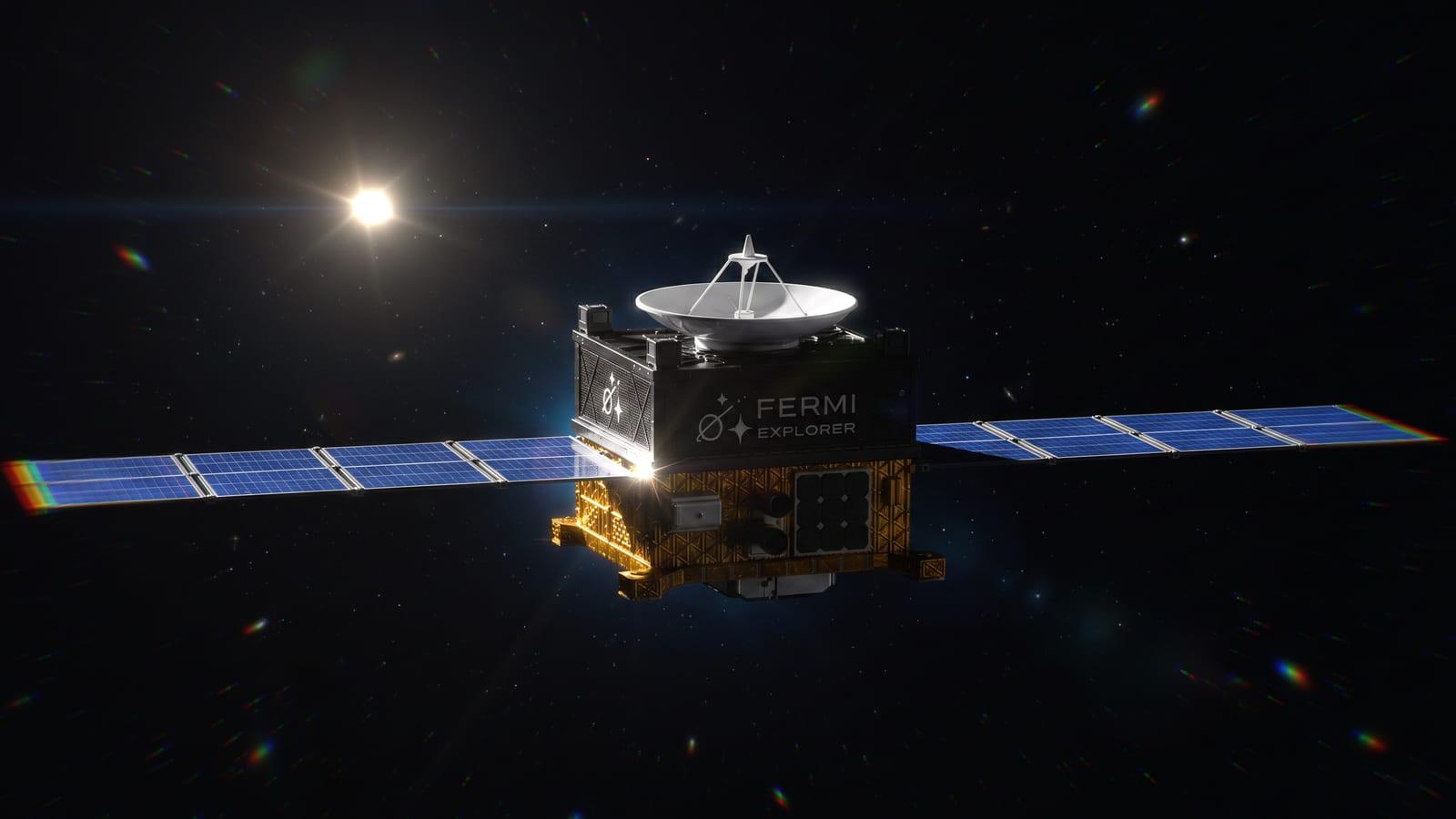
The roughly 100 kg spacecraft, two-thirds of it xenon, a heavy gas that serves as fuel for ion engines, then begins a slow 1.5-year spiral away from Earth, crossing the radiation belts, two rings of charged particles wrapped around our planet.
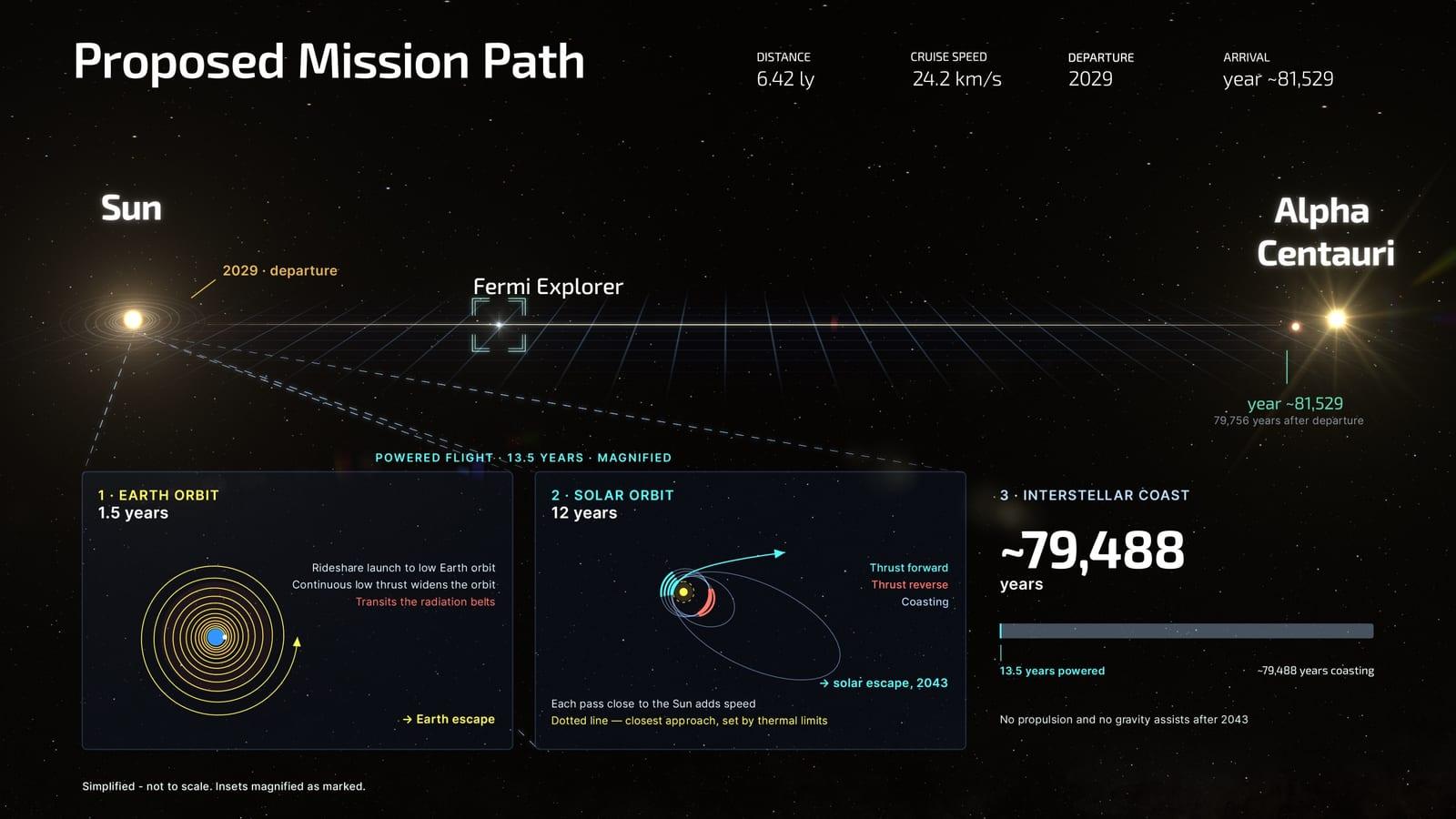
Then comes the cleverest idea in the file: perihelion pumping. The problem: a solar panel's output drops brutally with distance from the Sun, in proportion to the square of that distance. Double the distance, divide the power by 4. Thirty times farther out, almost nothing is left. Electric engines, dead in the water. The workaround: instead of heading straight outward, the spacecraft zigzags. It flies loops against the direction of its orbit, shedding sideways speed, and its orbit stretches like a sling being drawn back. Its closest point to the Sun, the perihelion, drops to 0.42 AU, 63 million km, a third of the Earth-Sun distance. That close, the panel catches 4 times more sunlight than near Earth. The spacecraft fires its engine at every close pass and gains speed. Total: 23.97 km/s gained over 12 years, only 1.3 of them with the engine on. The best image for it: a playground swing. To swing high you don't push continuously, you give a small nudge at just the right moment, on every pass, and the arc grows wider each time.
After this climb, the spacecraft leaves the solar system around 2043 and shuts everything down. What follows is a long free fall, like a thrown stone: no engine needed, its 23.64 km/s (about 85,000 km/h) does the work. Its path aims for a point 2.48° below the plane of the ecliptic, the flat disk where all the planets orbit. A tiny tilt, less than 3 degrees, but a decisive one: in 73,000 years, that is where Alpha Centauri will be.
A guaranteed 98%? Almost. The engineers ran a Monte Carlo simulation, named after Monaco's casino. The idea: replay the trip 20,000 times on a computer, each time slipping in small realistic errors (an engine a bit stronger or weaker, a trajectory shifted by a few millimeters). At the end, count how many runs pass within 2,600 AU of the target, a distance equal to 65 times Earth's orbit. Result: 98% of the runs hit the target. The remaining 2%? An acceptable margin of uncertainty for a $15M mission.
What the independent feasibility study says
The mission did not leave its plan on the table: it handed it to PSI, a lab applying artificial intelligence to physics, based in Cambridge, Massachusetts, for an independent check published in July 2026. Their job: redo every calculation from scratch, with their own tools, and say whether the plan holds up. The verdict comes in four points, from most certain to least.
- The flight plan holds up. Electric engines fed by solar panels are enough, provided you use the Sun-boosting trick described above. No nuclear reactor needed. An independent recomputation lands on the same trajectories, with a spread of only 0.29%.
- You have to start high. From low orbit (the 400 km altitude of space stations), a 100 kg spacecraft cannot make it: it would need 1 to 3% more fuel, and every gram counts. The fix fits in one sentence: get dropped off higher by the rocket (the 35,000 km orbit described above). That one change of address solves the problem, and the study recommends it.
- The aiming is reliable. In the simulations, 98% of the runs pass at the right distance from the target. A second calculation, using a completely different method, reproduces the figure to within 0.011%. One caveat: if the engines prove twice less accurate than assumed, that rate falls below 90%. Engine precision is the project's critical point.
- The budget overruns, for the wrong reasons. The median cost, the value that splits the scenarios half and half, lands between $15.7M and $16.6M, above the $10M initially hoped for. The surprise: the rocket and the engines cost less than expected. The hole is elsewhere: in the spacecraft's structure (the "bus," the platform carrying instruments and fuel), in ground operations and in safety margins, about $12M against $3M budgeted. In other words, physics is not the problem, organization is. The savings path: automate operations as much as possible and compress testing.
One last notable point: the study was produced by autonomous AI agents, with cross-checks at every step, and the report states no human expert reviewed it end to end. Take it for what it is: a solid assessment, not a guarantee.
What it changes for those of us following this
A first spacecraft to another star with no technology revolution, that is what changes the game. Gridded ion engines, electric thrusters that accelerate a gas to insane speeds between two charged plates, have already proven themselves in flight. The physics of the plan checks out. And a US satellite manufacturer has reportedly already submitted a bid under $15M. The classic uncertainties remain: making the engines flight-ready, holding the 2029 schedule, and a volunteer team that still has to pick its manufacturer.
The mission will soon open a three-month call for proposals for science instruments and artworks. One unprecedented constraint: the data will not come back for 80,000 years, and most instruments will fall silent once the link is lost. On the list of ideas under consideration: plates that record cosmic-ray impacts like footprints in plastic, radioactive clocks whose carbon-14 or nickel-63 decays at a known rate, so that whoever finds them can date the journey, and aerogel traps, a glass foam so light and porous that stardust embeds itself without breaking. All of it for a one-way trip.
As for messages from the world's children, 300 characters in their own language, it is a nod to the Apollo plaques. The FAQ says selection will go through national space agencies and ministries of education.
Going further
- The mission page of Voyager 1, the only human-made object to have entered interstellar space, with no target star.
- Useful definitions to follow the story: space probe, exoplanet and the Sun.
- To spot Alpha Centauri in the sky, head to the interactive sky map and the observing guide.
- The main sources for this article: the mission's official website, the PSI report and the launch announcement on X.
- The full concept video: The Fermi Explorer Mission, Humanity's first journey to another star.