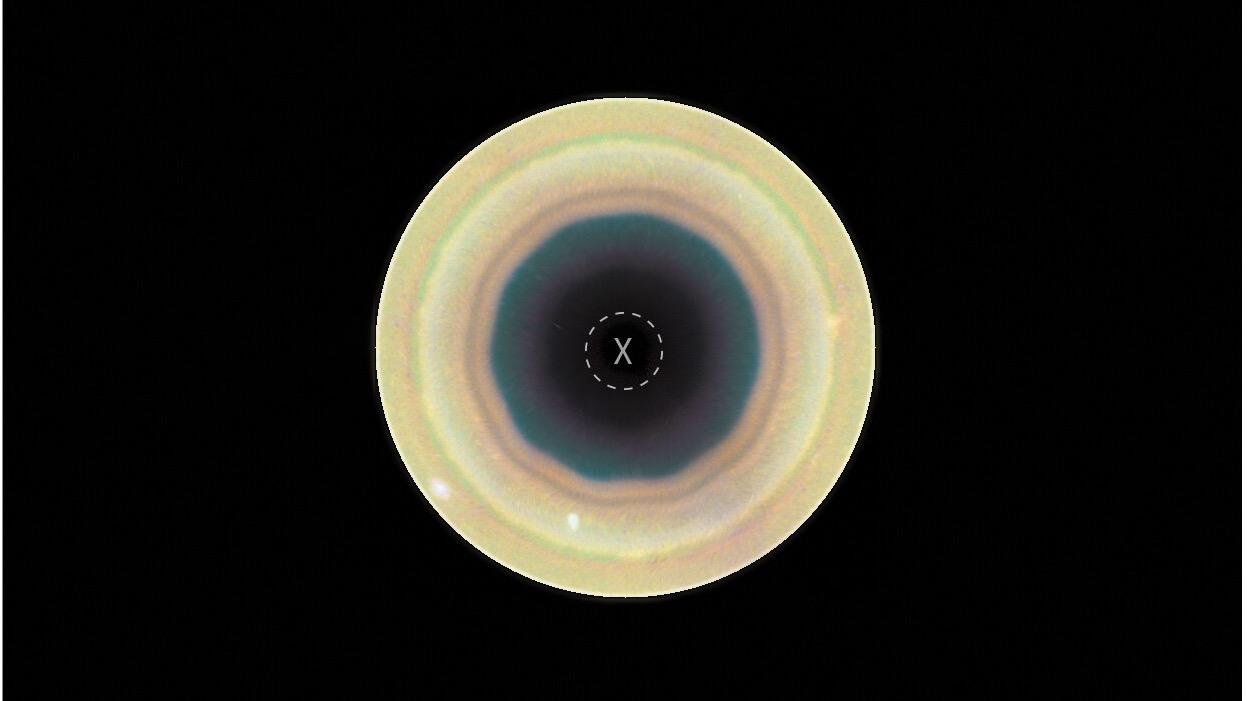
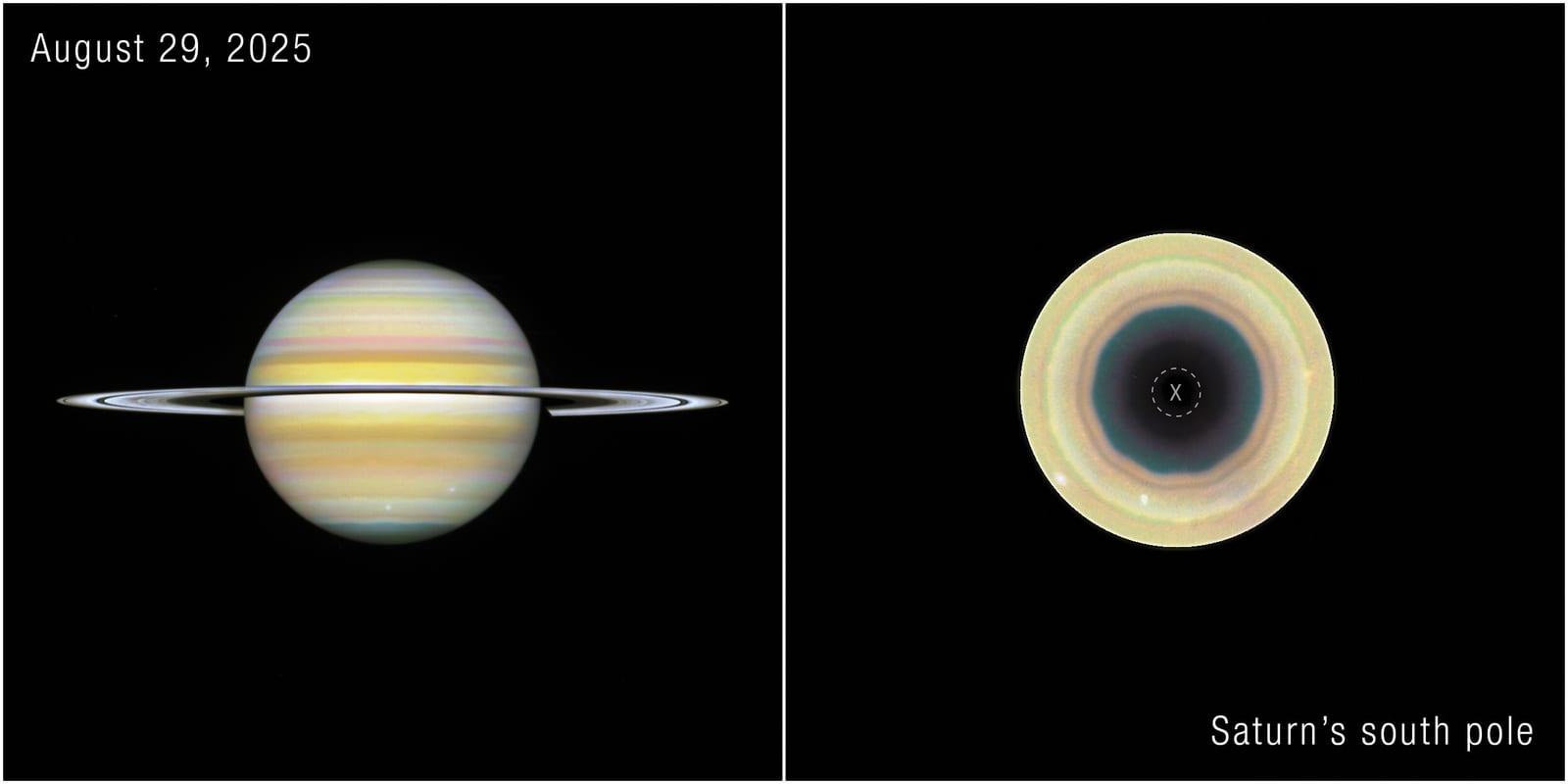
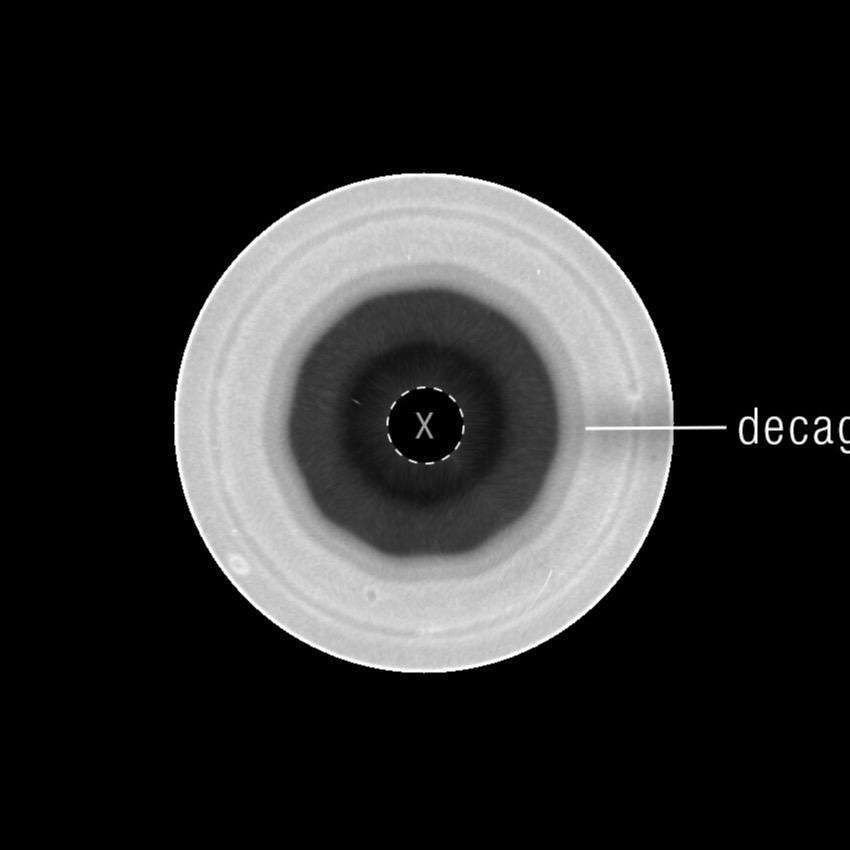
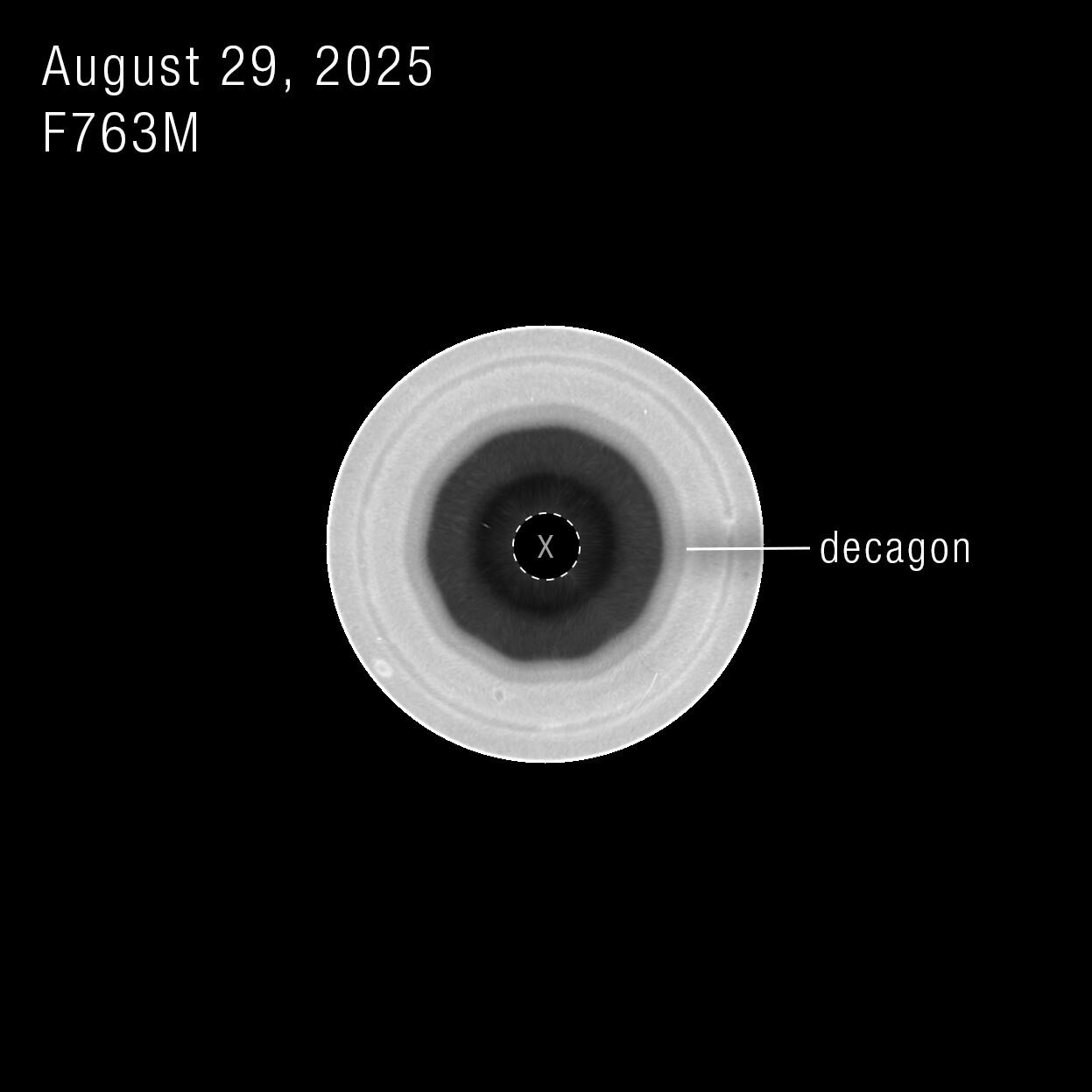
Saturn just grew a decagon. On September 2, 2026, an international team announces in the journal Science Advances the discovery of a giant, 10-sided atmospheric wave encircling the planet's south pole, revealed by Hubble. And the structure appears to be forming right before our eyes.
Here is what the images show, and why this birth is a rare treat for planetary scientists.
10 sides at the south pole: a first for Saturn
Saturn already owns a famous oddity: a hexagon, a six-sided pattern circling its north pole, watched by astronomers without interruption for more than 40 years. The south now has its counterpart. A team led by Agustín Sánchez-Lavega of the University of the Basque Country reports in Science Advances the discovery of a decagon, a 10-sided polygon, around the south pole. Nothing this regular has ever been seen in that half of the planet.
And it puzzles researchers, because it resembles the hexagon while standing apart from it. The feature is really a wave, a giant ripple in the air. It also seems to be strengthening year after year, according to Amy Simon, study co-author at NASA's Goddard Space Flight Center. Watching a giant atmospheric pattern take shape in real time: the team itself calls that a rare opportunity.
Amateur astronomers spotted it before the space telescopes
The story starts on the ground. Saturn's seasons have gradually brought the planet's south pole back into view for Earth-based telescopes. On a website run by the University of the Basque Country, the Planetary Virtual Observatory Laboratory, which collects planet images submitted by observers around the world, Sánchez-Lavega and two amateur astronomers, Trevor Barry and Jean-Paul Oger, noticed a subtle undulating band along the south pole in 2024. Ground-based images taken in 2025 pointed even more strongly toward a 10-sided structure.
That is when Hubble stepped in. Perched above Earth's atmosphere, the telescope follows full rotations of Saturn with a sharpness no ground-based instrument can match. Digging through its archives, researchers confirmed the decagon's presence back to 2023, with faint hints well before the pattern became obvious.
The hunt for a southern twin of the hexagon is not new: Sánchez-Lavega and colleagues have searched Hubble images for one since 1990, betting on the symmetry of the planet's north-south jet streams. The Cassini spacecraft, which orbited Saturn from 2004 to 2017, showed no sign of a long-lived formation either. Which makes the find all the more striking: the decagon looks young.
What the images say: a wave in a river of air
10 sides, several layers of atmosphere and a powerful air current: that is the decagon's profile. The structure is not a cloud sitting on the planet. It rides a jet stream, a fast-flowing river of air circling the pole, like an ocean current, but in the atmosphere. And it is a wave: the current oscillates, and the distortion travels around the pole the way the crest of a wave moves across the water without the water circling the lake.
Crucially, the structure reaches up in altitude. Hubble observes Saturn at several wavelengths, shades of light invisible to our eyes, and each shade probes a different depth, like successive slices through a layered cake. The decagon's apparent position shifts slightly from one image to the next: the structure therefore spans several layers, from cloud level on up. A vertical structure, not a surface decoration.
Watching a giant pattern be born: a rare opportunity
The northern hexagon was already there when astronomers found it. The decagon is building itself in front of us: faint traces in 2023, an increasingly sharp pattern in 2024 and 2025. The question gripping the team: why now, when nothing like it had appeared before?
The follow-up is already scheduled. Hubble will keep monitoring Saturn, complementary observations are expected from the James Webb Space Telescope, and computer models will replay the physics of the atmosphere to work out how the decagon formed, how long it may last and what sets it apart from its hexagonal twin up north.
At stake is far more than a polar curiosity. Understanding what powers this wave would shed light on the atmospheric dynamics of every giant planet in the solar system, and possibly on phenomena seen here on Earth. One unknown remains: will the decagon settle down like the hexagon, or keep changing?
Going further
- The mission page of Hubble, the telescope that photographs the giant planets every year through the OPAL program.
- Key ideas to follow the story: the atmosphere and the solar system.
- To find Saturn in the sky, the interactive sky map and the observing guide tell you when and where to look. The astrophotography gallery shows what a well-equipped amateur can capture.
- Official sources: the NASA press release, the ESA/Hubble release and the scientific paper in Science Advances.