How large can the Universe build a single galaxy? The question sounds simple, yet until now nobody had a solid answer. A team at the Instituto de Astrofísica de Canarias (IAC) has just measured IC 1101, the giant at the centre of the Abell 2029 cluster, with unprecedented precision. The verdict: a diameter of about 520 kiloparsecs, close to 1.7 million light-years, for roughly 3.4 trillion solar masses in stars. And its outskirts reveal that it is still growing.
A giant that had never given up its boundaries
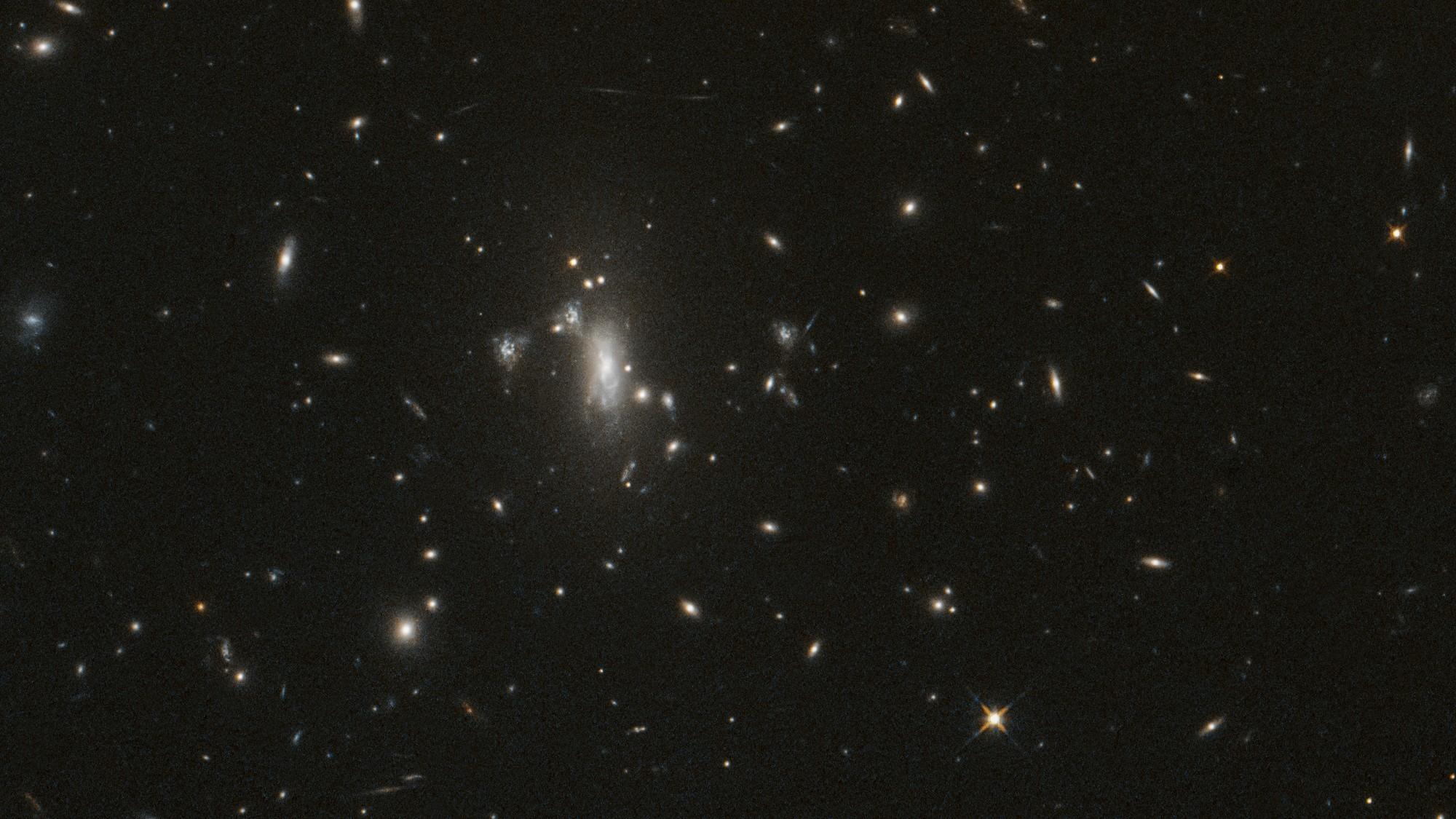
IC 1101 is no stranger. For decades astronomers have ranked it among the largest known galaxies. It sits at the centre of Abell 2029, a galaxy cluster about 1 billion light-years away. A galaxy in that position has a name: the brightest cluster galaxy, or BCG. These are the most extreme products of galaxy formation, and the biggest ones.
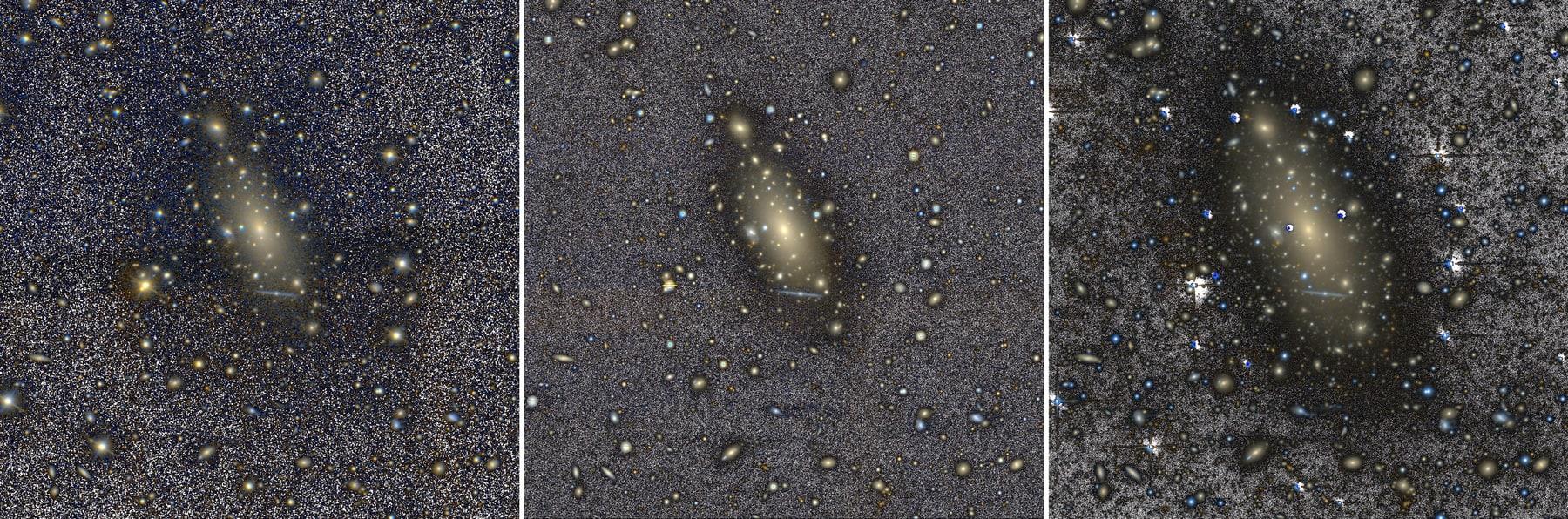
The catch is that galaxies have no clean edge. Their light spreads out and fades with distance from the centre. To quote a diameter, you have to decide where the galaxy stops. That decision depends on how deep the images go: the longer the exposure, the farther you can trace the faint halo. In 1991, images captured starlight out to 607 kiloparsecs from the centre. But nobody could say where the galaxy's true body ended.
Over eight hours of exposure to find the edge
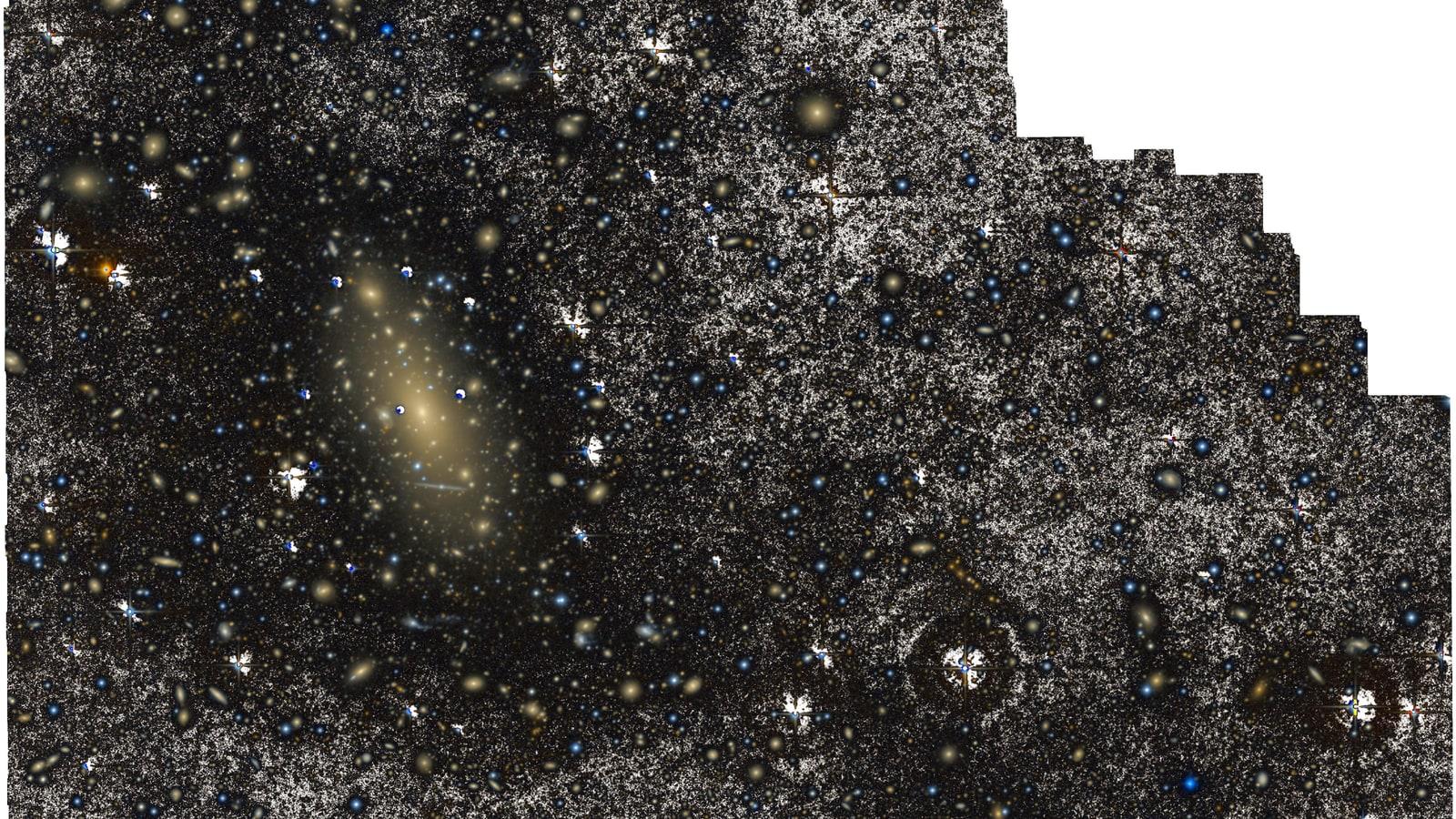
To settle the question, the team turned to the wide-field camera on the Isaac Newton Telescope (INT), a 2.5-metre instrument at the Roque de los Muchachos Observatory on the island of La Palma. The astronomers stacked 79 exposures of 180 seconds in the green and 53 exposures of 300 seconds in the red, about 4 hours in one colour and 4.4 hours in the other. Long exposures, added frame by frame, that bring out light thousands of times fainter than the human eye can detect.
The technical challenge is severe. A telescope is not perfect: light from a bright star spreads into a diffuse halo that can drown the galaxy's signal. Those stray halos have to be modelled and subtracted one by one. The team built a model of that halo from standard stars, combining stars of different brightness depending on their distance from the centre, and relying on the highly precise positions measured by the Gaia satellite.
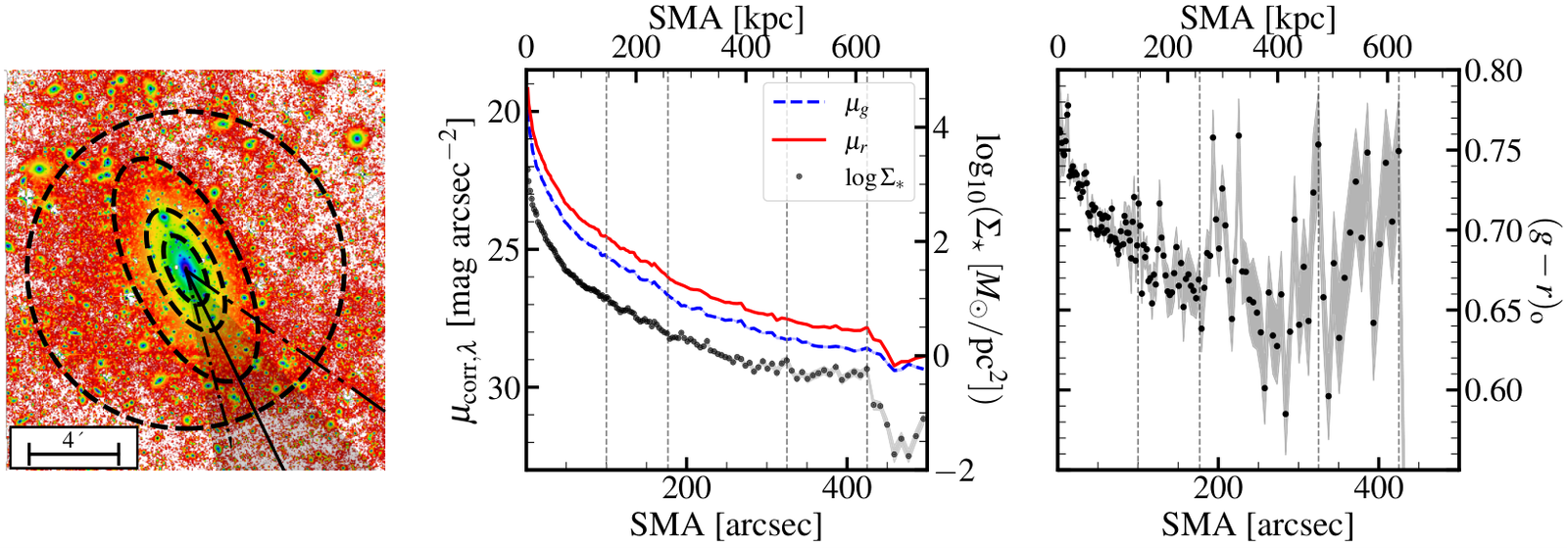
Once the stray light is removed, the hunt for the transition begins. The measurements show a simultaneous shift in several properties of the galaxy, its shape, colour and stellar mass density, at a radius of 260 kiloparsecs. That is the signal: the point where the main body gives way to the diffuse halo. It implies a diameter of about 520 kiloparsecs, close to 1.7 million light-years.
That transition is not a wall. As co-author Ignacio Trujillo explains, it is a gradual passage: beyond it, stars are no longer really bound to the galaxy and instead scatter into the diffuse stellar material of the cluster. The galaxy thins into its surroundings rather than stopping dead.
70 Milky Ways, and still growing
Inside that boundary, the galaxy holds about 3.4 trillion solar masses in stars. To picture the number, compare it with our Milky Way, which packs roughly 50 billion solar masses of stars into 100,000 light-years. IC 1101 is therefore nearly 70 times heavier in stars, within a body about 17 times wider.
That figure keeps climbing, depending on where you draw the line. The mass reaches about 3.9 trillion solar masses when integrated out to 475 kiloparsecs, then 4.2 trillion out to 620 kiloparsecs. The extra comes from the cluster's diffuse light, the glow of stars stripped from neighbouring galaxies.
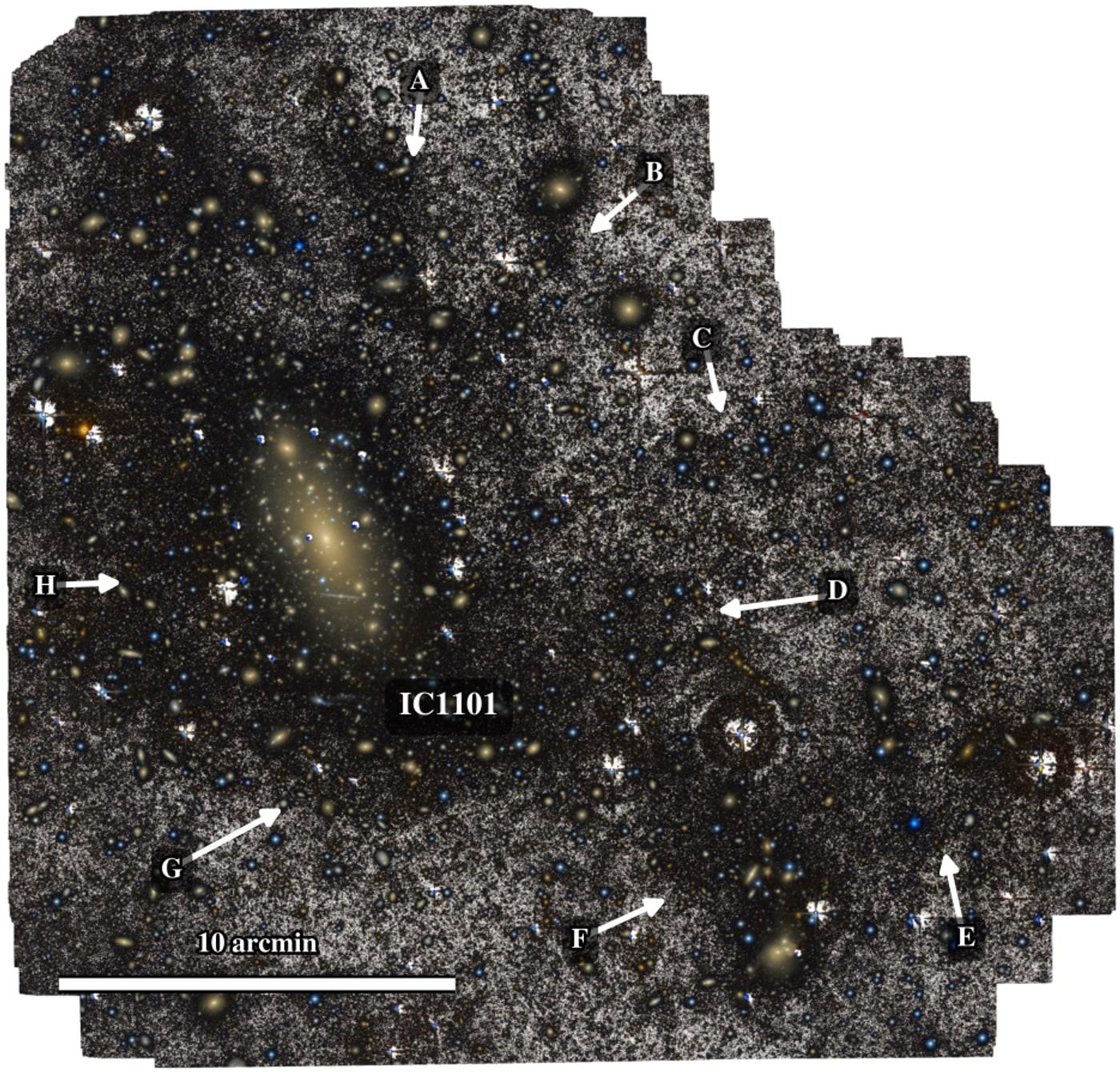
IC 1101 is not finished growing. The deep images reveal a network of extremely faint structures all around it, trails, plumes and lopsided envelopes reaching about 2 million light-years from the centre. Those shapes are the signature of ongoing mergers: smaller galaxies, drawn in by the gravity of the giant and of the cluster, are torn apart as their stars are absorbed.
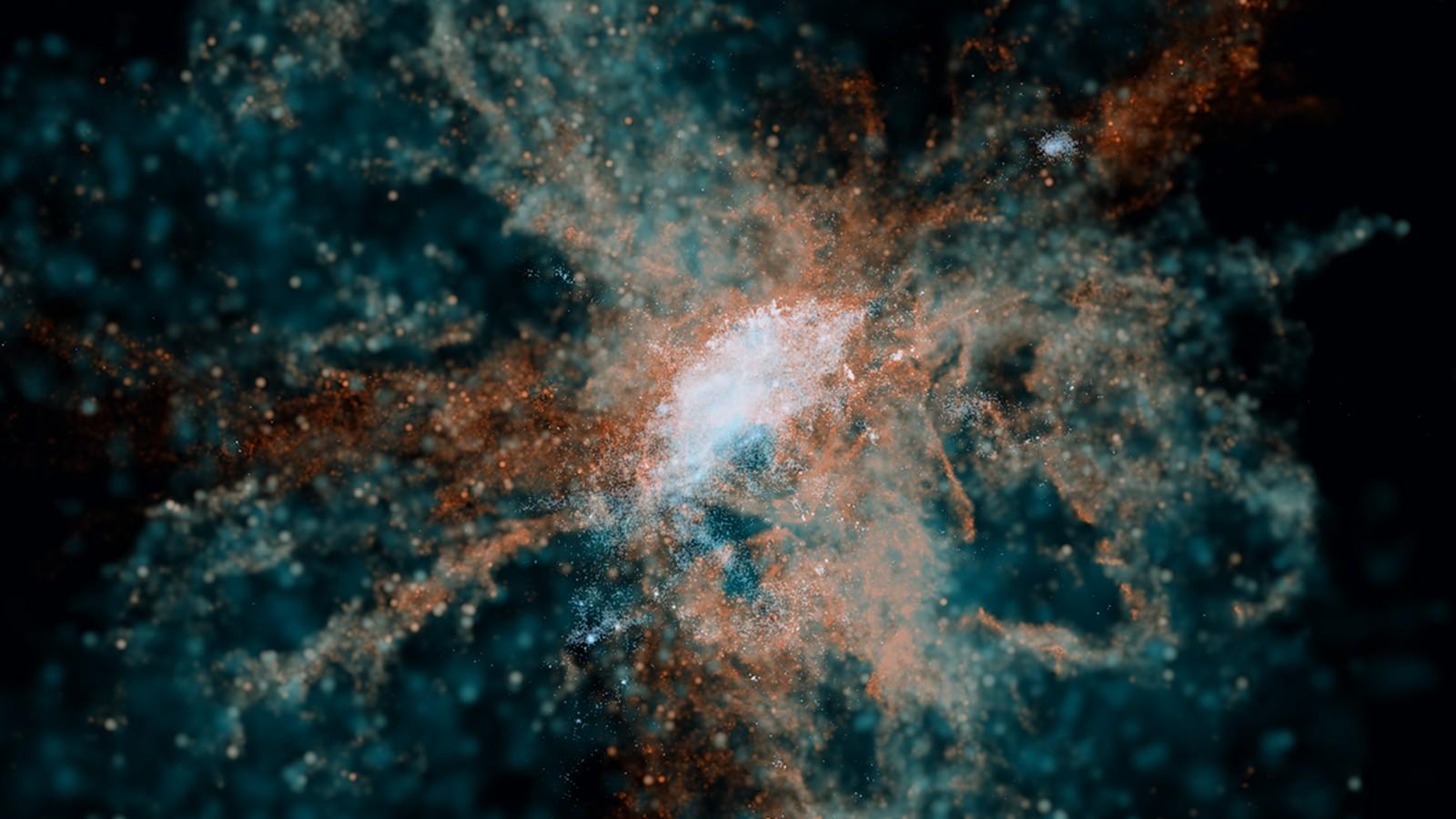
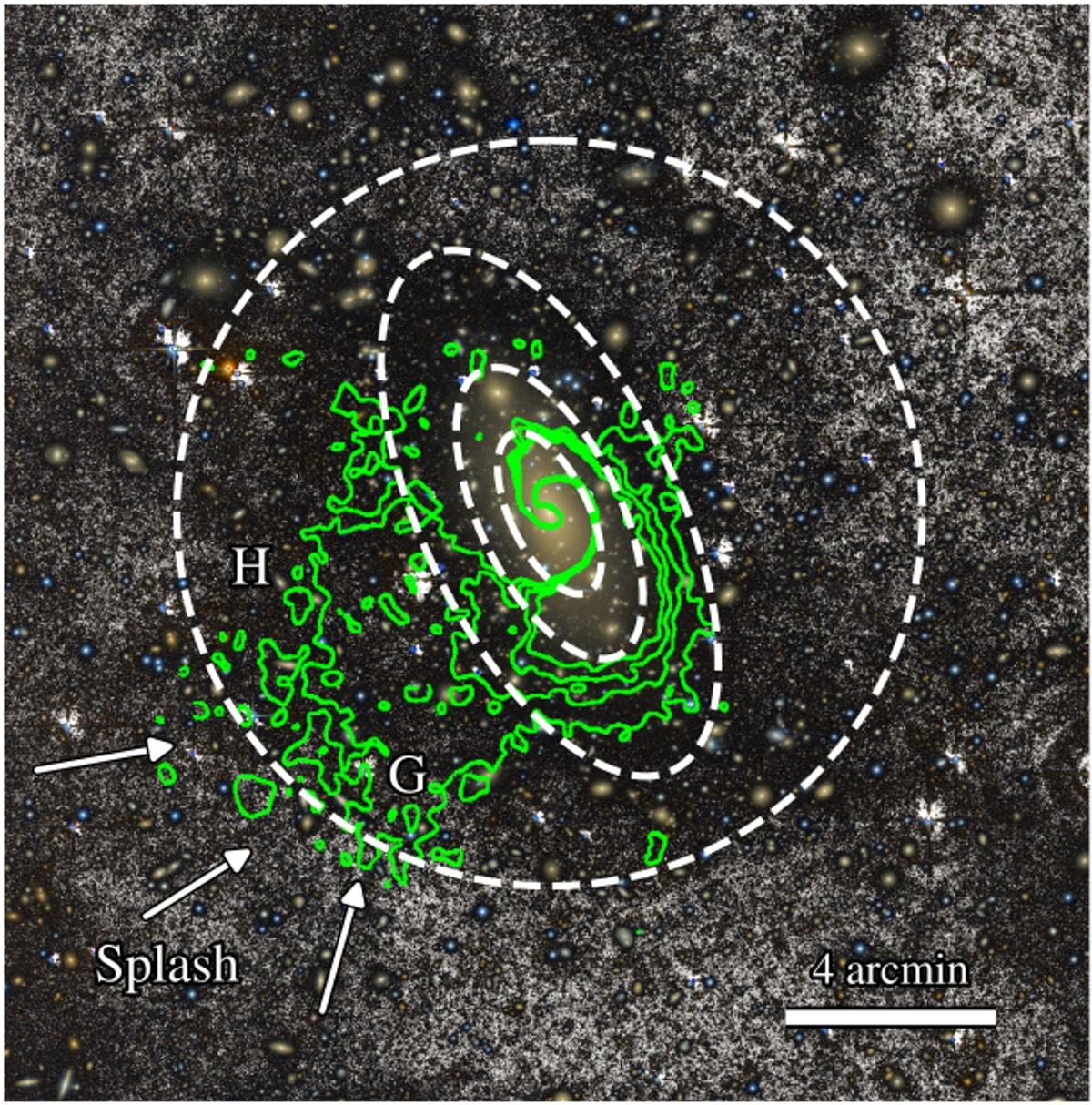
The same story played out, 2 to 3 billion years ago, on the scale of the whole cluster. X-ray observations capture Abell 2029's vast churn of hot gas, a spiral wake about 600 kiloparsecs across attributed to a collision with a small group of galaxies. That disturbance of the gas and the stellar trails seen by the INT line up in space: both tell of the same upheaval, one in the gas, the other in the stars.
What the record teaches us
The real stake goes beyond the title of largest galaxy. IC 1101 poses a question to the models that describe how galaxies assemble since the Big Bang. The Universe is 13.7 billion years old: that is the time it had to forge a monster of this size. If simulations cannot reproduce such a giant within that span, they are missing a piece of the growth mechanism.
In the leading picture, galaxies grow through successive mergers, the biggest swallowing the smallest. An object like IC 1101 is the most finished product of that process, boosted by the density of its cluster where galaxies constantly cross paths. In that sense, the giant of Abell 2029 offers a glimpse of what many massive galaxies could become in the distant future.
And the story is not over. With an edge measured at 520 kiloparsecs and debris visible out to 2 million light-years, IC 1101 is a galaxy under construction. Its diameter today is only a stage.
Going further
- The key ideas behind the story: galaxy, Milky Way and X-rays in our glossary.
- To understand how such distant objects are observed, our observing guide and the astrophotography gallery.
- The official sources: the Instituto de Astrofísica de Canarias release and the research paper Marrero-de la Rosa et al., Astronomy & Astrophysics (2026), open access on A&A and as an arXiv preprint.