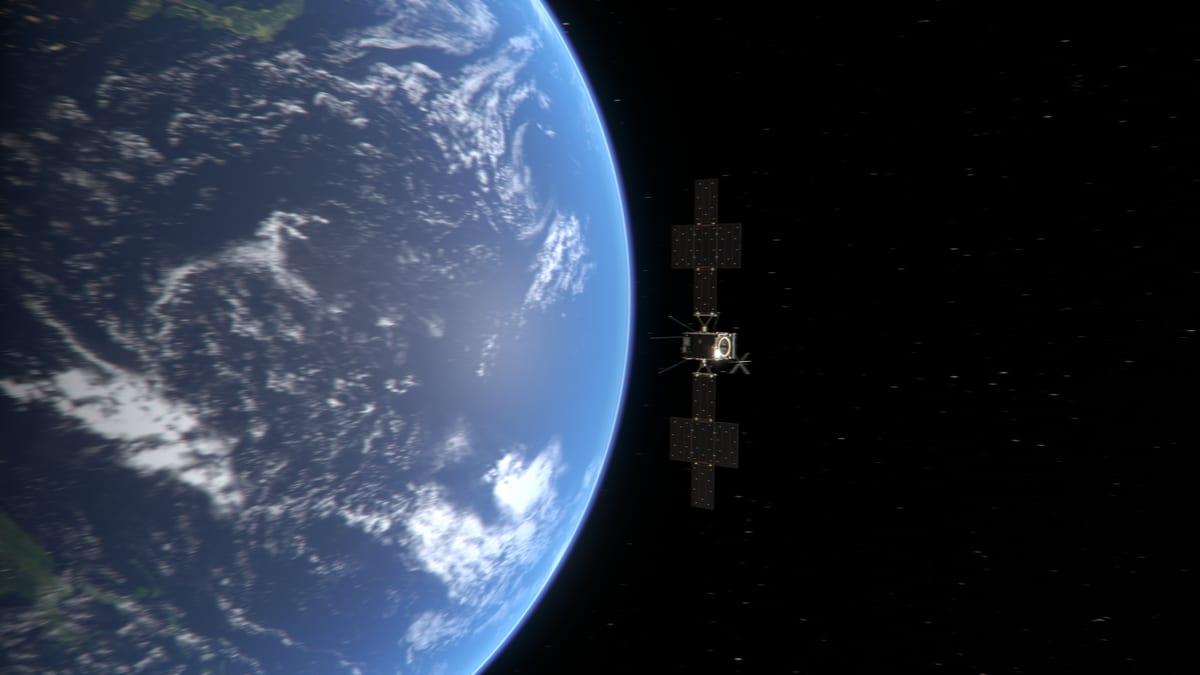
ESA's JUICE spacecraft is back for a farewell wave at its home planet. On September 28, 2026, it crosses Earth's neighborhood, flying 8,641 km overhead, a bit less than the distance from New York to Los Angeles. This is no homecoming: it's a gravity assist, an orbital boost that Earth lends the probe on its way to Jupiter. Here's what to know about the flyby, and above all how this gravitational slingshot works. It has already carried most of the great spacecraft of the solar system to their destinations.
The headline first: surgical precision, scheduled two years out
September 28, 2026, 11:45 UTC. That rendezvous is locked into the official flight plan of ESA's mission control, validated months in advance. Consider the challenge: hitting a passage point 8,641 km above a planet racing along its orbit at 107,000 km/h, launched from a probe three years earlier and still tens of millions of kilometers away. It's like a darts player hitting the bullseye while aiming at another player who is running.
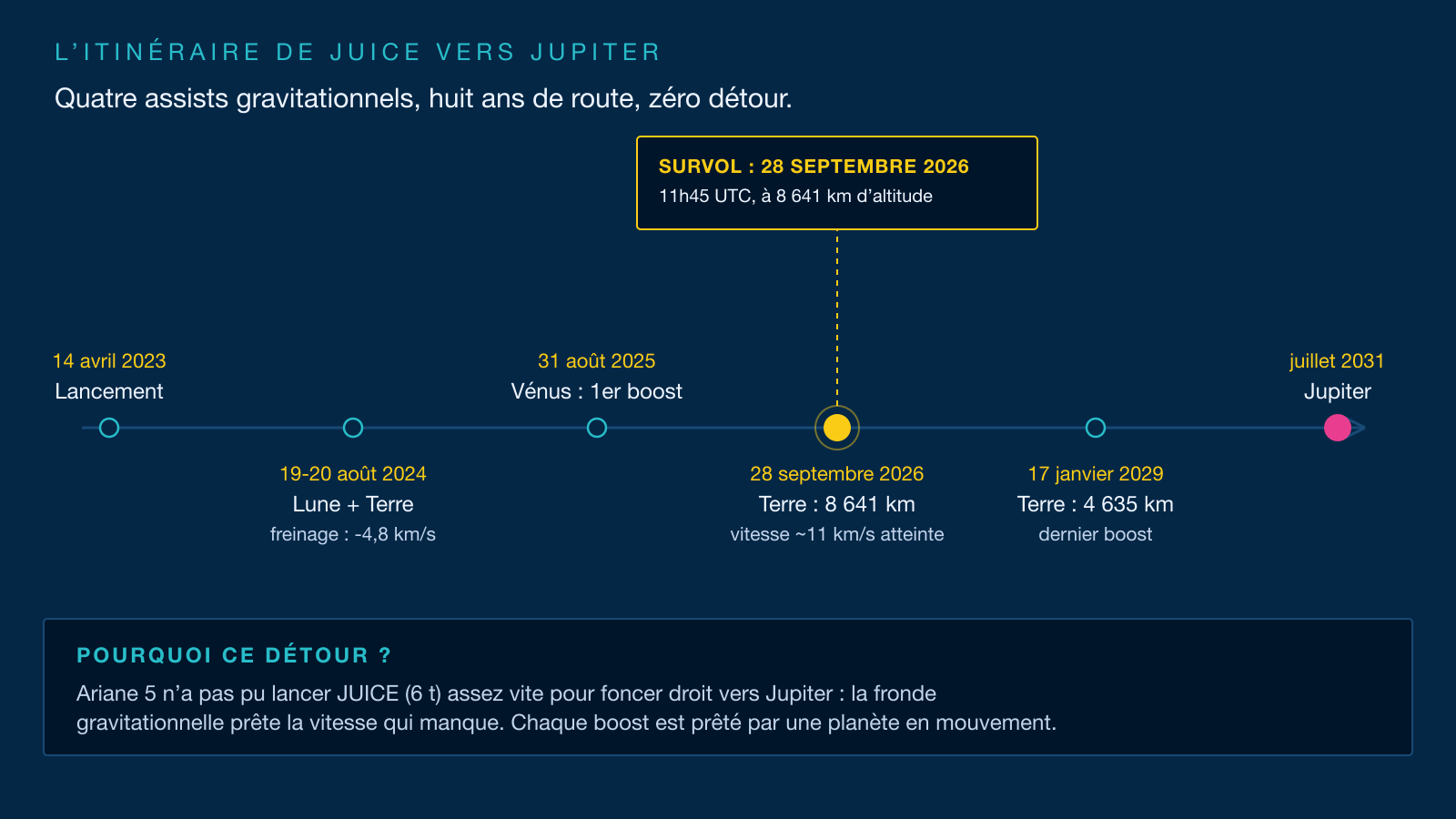
The exact flyby altitude, 8,641 km, appears in the flight plan published by the Juice Science Operations Centre, the hub coordinating the mission's science. The times of the next encounters, in 2029 and at arrival in 2031, are pinned to the same document. Nothing about this trip is improvised: every maneuver is computed years ahead, and ESA's teams nudge the trajectory along the way with small engine burns to stay inside the corridor.
So why is JUICE going to Jupiter in the first place?
Let's back up. JUICE, for Jupiter Icy Moons Explorer, is ESA's largest planetary mission. Launched on April 14, 2023 from Kourou on an Ariane 5, it carries ten science instruments and unfolds 85 square meters of solar panels. Its target: Jupiter and three of its large moons, Ganymede, Europa and Callisto, which astronomers call the Galilean moons, after Galileo, who spotted them in 1610.
The core science question fits in one line: do these icy moons hide oceans of liquid water, and could those oceans host life? The probe will map the surfaces, measure the thickness of the ice shells, probe the moons' interiors and study their magnetic environments. Ganymede, the largest moon in the solar system, bigger than the planet Mercury, is the star target: in December 2034, JUICE will become the first spacecraft ever to orbit a moon other than our own.
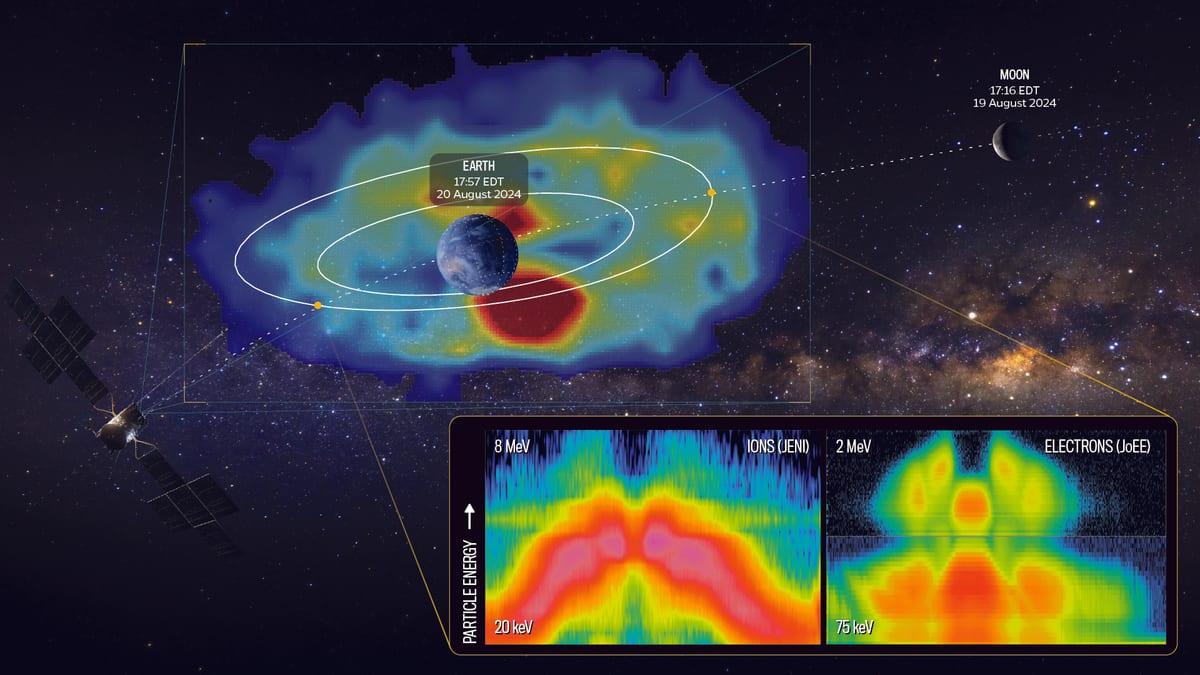
And the flybys do double duty for science. During the 2024 flyby, JUICE captured the sharpest image ever obtained of the cloud of charged particles Earth traps in its magnetic field. The shot is invisible to the naked eye: the JENI sensor detects energetic atoms rather than light. This year again, all ten instruments will be put to work during the pass.
The gravity assist: a cosmic slingshot, explained with a diagram
The word "slingshot" is everywhere, but it hides the real mechanism. Start with the wrong mental image: a hand-held slingshot, where the force comes from your wrist. The right one is a stretched cord attached to a train running at full speed. The planet is the train, moving around the Sun. The probe grabs onto its gravity, and the train, by moving forward, hands over part of its momentum.
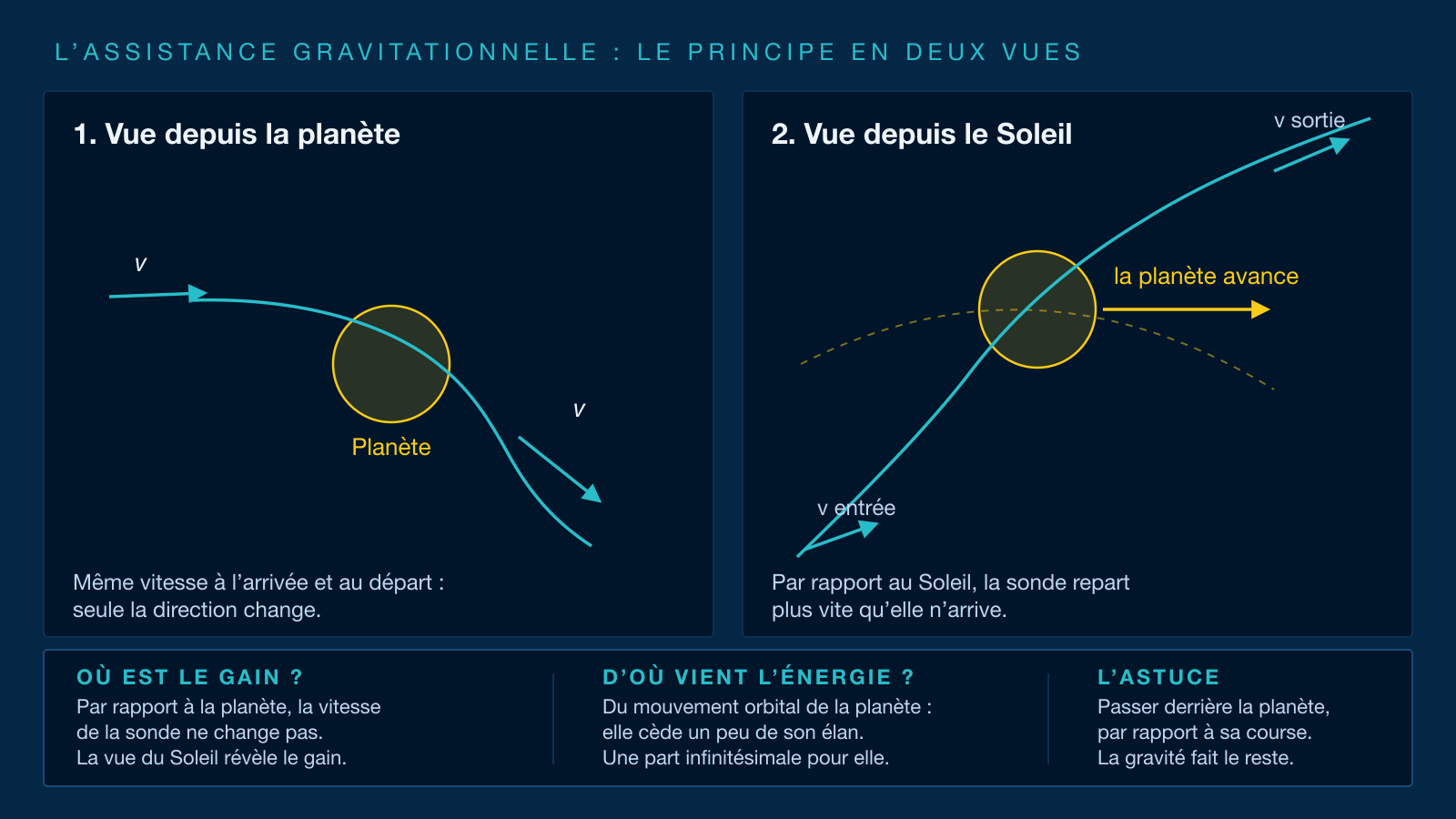
The principle fits in two views, and you need both:
- As seen from the planet (left panel): the spacecraft falls into the gravity well, speeds up at closest approach, then climbs back out and slows down by exactly the same amount. Same speed out as in. Only the direction has turned. If the planet stood still, the balance would be zero.
- As seen from the Sun (right panel): the planet is moving. By passing behind it relative to its course, the spacecraft rides the planet's gravitational wake for the length of the encounter. It leaves with the planet's speed "gifted", and never gives it back.
Conservation of energy holds: the planet slows down, but so little that no instrument could measure it. NASA puts it this way in its flight handbook: even if a spacecraft doubles its speed thanks to a flyby, its crew would feel no acceleration at all, just continuous free fall. The exchange happens between two masses, and the planet is so massive that its share of the trade is invisible.
For JUICE, the arithmetic is stark. The Ariane 5, Europe's most powerful rocket, couldn't fling the 6-tonne spacecraft straight to Jupiter. ESA puts the required transfer speed toward Jupiter at about 11 km/s. JUICE closes that gap with four flybys, burning no propellant for the boosts. ESA even prices the direct route: about 60,000 kg of onboard propellant, plus a braking reserve to enter orbit on arrival. No such onboard rocket exists.
Mariner 10, Voyager, Cassini: the technique that opened the solar system
This gravitational slingshot is the secret behind most of the great planetary missions. A quick tour, in chronological order:
The list makes one point: without this technique, solar system exploration would stop where rocket power ends. Every distant destination is reached by borrowing momentum from the planets, and the propellant saved gets reinvested in science instruments.
How the September 28 flyby will unfold
ESA's flight plan spells out the hours around the rendezvous. About three hours before closest approach, JUICE will adopt a special attitude, with its -X axis pointed at the Sun, a configuration that shields the spacecraft and keeps the solar panels fed. The ground teams at ESA's mission control in Darmstadt, Germany, will stay in near-continuous contact throughout the maneuver. After the flyby, a trajectory that brings JUICE back for one last Earth salute in January 2029, then the big jump to Jupiter.
The 2024 braking maneuver is the best example: sometimes the fastest way to go far is to start by slowing down. JUICE took the shortcut through the inner solar system, letting Venus fling it back outward. It's not a detour for fun: it's the fuel-cheapest route, computed over 20 years by ESA's trajectory design teams.
Going further
- The mission page of JUICE, in transit to Jupiter, with its objectives and latest news.
- Key concepts: Jupiter and spacecraft in our glossary.
- To observe the sky tonight: the interactive sky map, the observing guide and the astrophotography gallery.
- The official sources for this article: the Juice SOC cruise plan, the ESA mission factsheet, the ESA page on the lunar-Earth flyby, the trajectories chapter of NASA's flight handbook, and the NASA page on Cassini's gravity assists.
- On the same theme: Europa Clipper, NASA's sister mission that will fly past Earth in turn on December 3, 2026, and BepiColombo, the ESA-JAXA mission that wrapped up its 9 assists in January 2025.