A black hole in our galaxy is aiming its jet straight at Earth. On September 22, 2026, an international team led by the University of Jaén in Spain announced the first microblazar in the Milky Way: IRAS 18293-0941, a binary system about 12,000 light-years away. The result, accepted for publication in Astronomy & Astrophysics, relies on the EVN and MeerKAT radio telescopes and on the Gaia satellite. It may shed light on one of the most energetic gamma-ray sources in the Galaxy.
One jet aimed at us, one invisible twin
Start with the strongest fact. Some objects fire a beam of matter almost straight at Earth, and those objects have a name: blazars. They are supermassive black holes, millions to billions of times the mass of the Sun, lurking in the hearts of distant galaxies. When their jet comes at us down the line of sight, it looks far brighter than it really is, and the object becomes one of the most luminous in the sky.
Since the 1990s, theorists have argued that the same trick should exist in miniature, inside our own galaxy. They call them microblazars. Thirty years of searching produced only candidates that crumbled under scrutiny. IRAS 18293-0941 is the first to survive, according to the team announcing it.
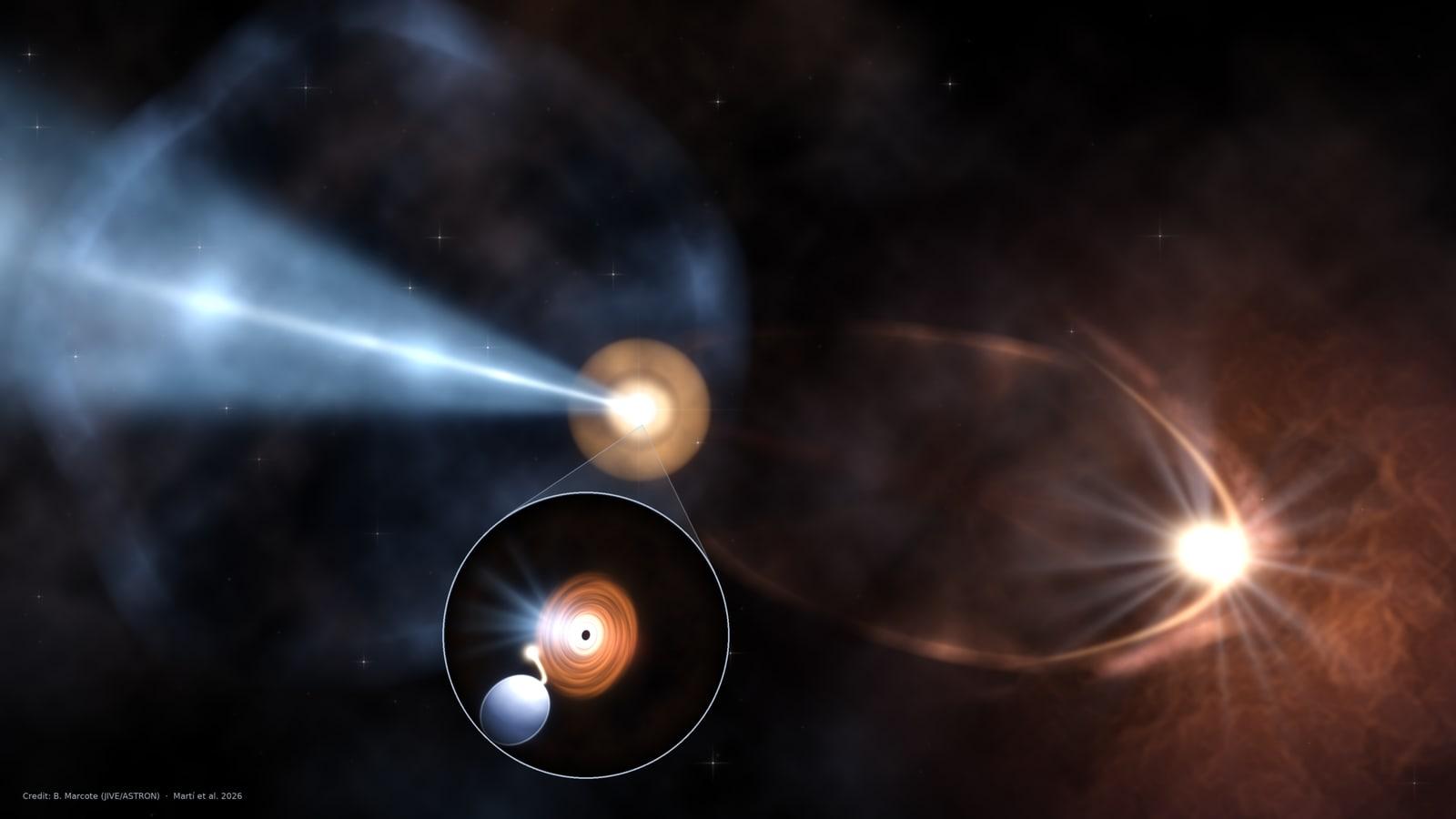
The system comes down to two players. A hot, massive star, and a stellar black hole of about ten solar masses orbiting it every 11.38 days. Material from the star falls toward the black hole, part of it is swallowed, and the rest is flung out along two opposing jets at three-quarters the speed of light. What makes the system remarkable is where those jets point: the visible one looks almost straight at Earth.
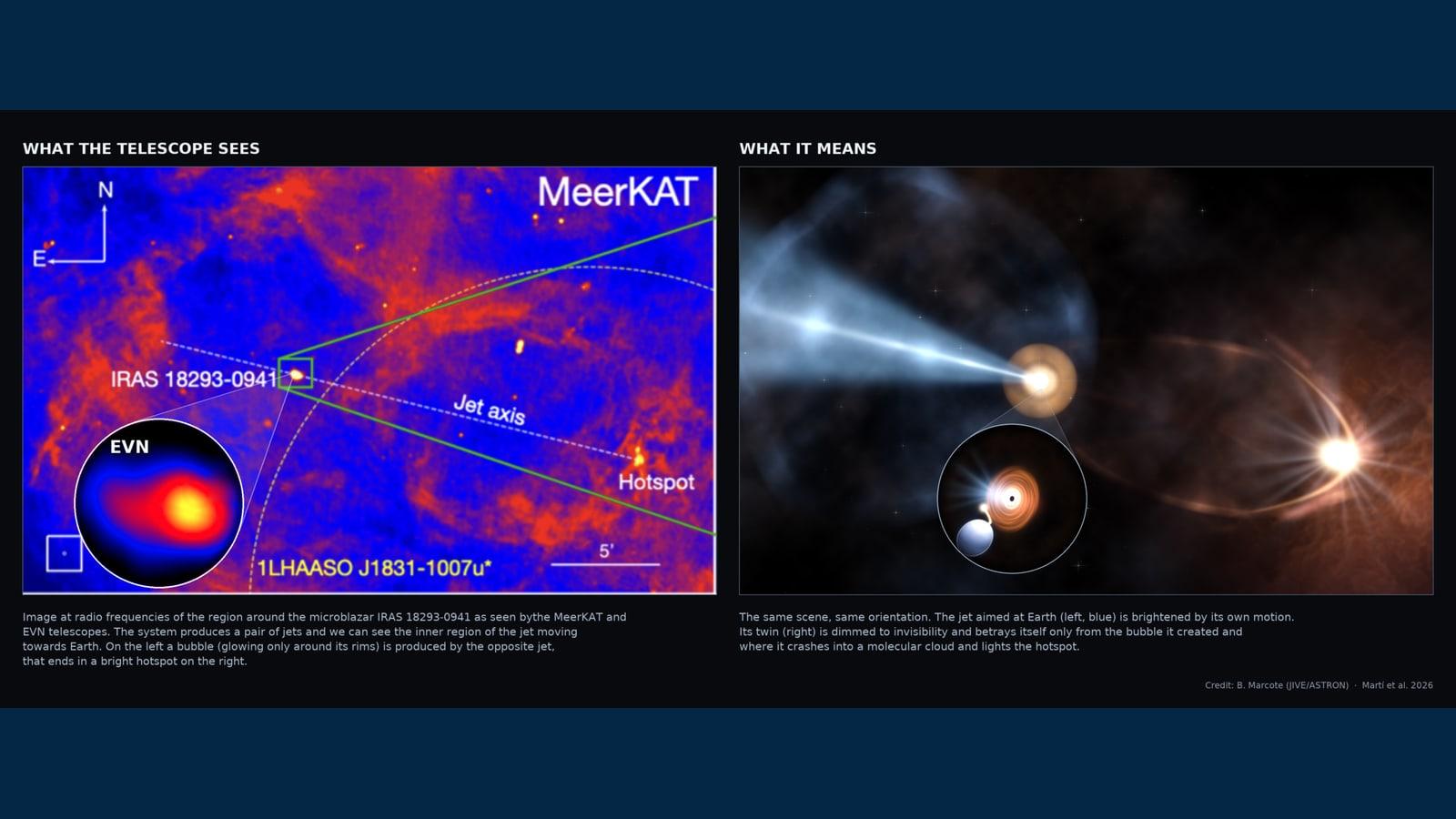
That effect comes at a price, and the price is what proves the discovery. When a jet heads toward us, its light gets concentrated, much like a torch beam pointed at your eye looks more blinding than one pointed at the wall. The opposite jet recedes and slips out of sight entirely. As a result, radio telescopes see a single jet, on one side only. That sharp asymmetry is the fingerprint of relativistic motion, the physics of objects racing close to the speed of light.
A curtain of dust and a forgotten clue
So why did nobody see it before? For a simple reason: dust. The system hides behind such a curtain that ordinary optical telescopes make out almost nothing. Astronomers gauge that opacity through extinction, which reaches about 6 to 7 magnitudes here, meaning the dust absorbs a huge share of the star's light. The IRAS satellite did spot the object in the 1980s, which is where the name comes from, before it faded back into oblivion.
One tiny wobble restarted the investigation. Years of monitoring from the Calar Alto and Montsec observatories and the University of Jaén telescope showed that the star's light flickered faintly. A regular tremor, betraying a 11.38-day modulation. In a pair this tight, that rhythm reveals the star's deformation under its companion's gravity, like a foam ball squeezed between two fingers. And the tiny amplitude of that modulation, around 0.02 magnitude, points to a pair seen nearly face-on.
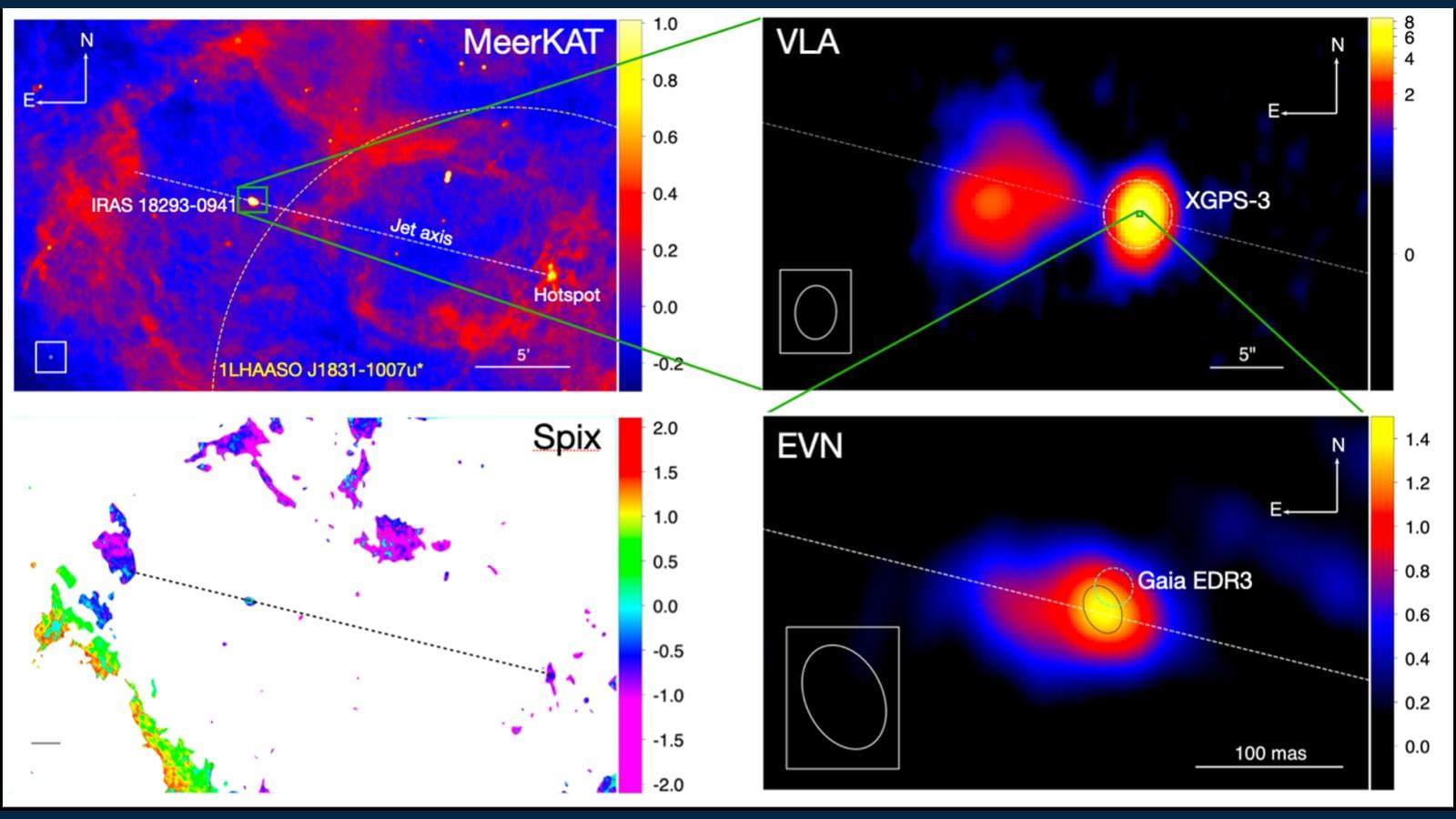
The team still had to prove the jet belonged to that pair, and not to a distant galaxy that happens to sit in the same direction. They settled it with the EVN, the European VLBI Network, a set of radio telescopes spread across continents that work together as a single dish the size of a continent. Its resolution is so fine that it reaches a billionth of a degree. By matching the radio position against the star's position measured by Gaia, the most precise sky map ever made, the team showed the jet really comes out of the stellar system.
An accelerator in one place, a target in another
The jet receding from us is invisible, yet it leaves a mark. Turning the MeerKAT radio telescope, in South Africa, on the field, the team found an enormous bubble about 100 light-years across, carved by the jet into interstellar gas. At the rim of that bubble stands a hotspot, a compact knot of radio emission. That is where the jet slams into a dense molecular cloud, a wall of cold, dusty gas.
The shock has a precise signature. The hotspot's spectral index, the way its emission varies with frequency, sits around minus 0.7. That value reveals non-thermal radiation, produced by charged particles hurled at enormous speed through a magnetic field, rather than by gas that is merely hot. So the jet is accelerating particles at the very spot where it crashes.
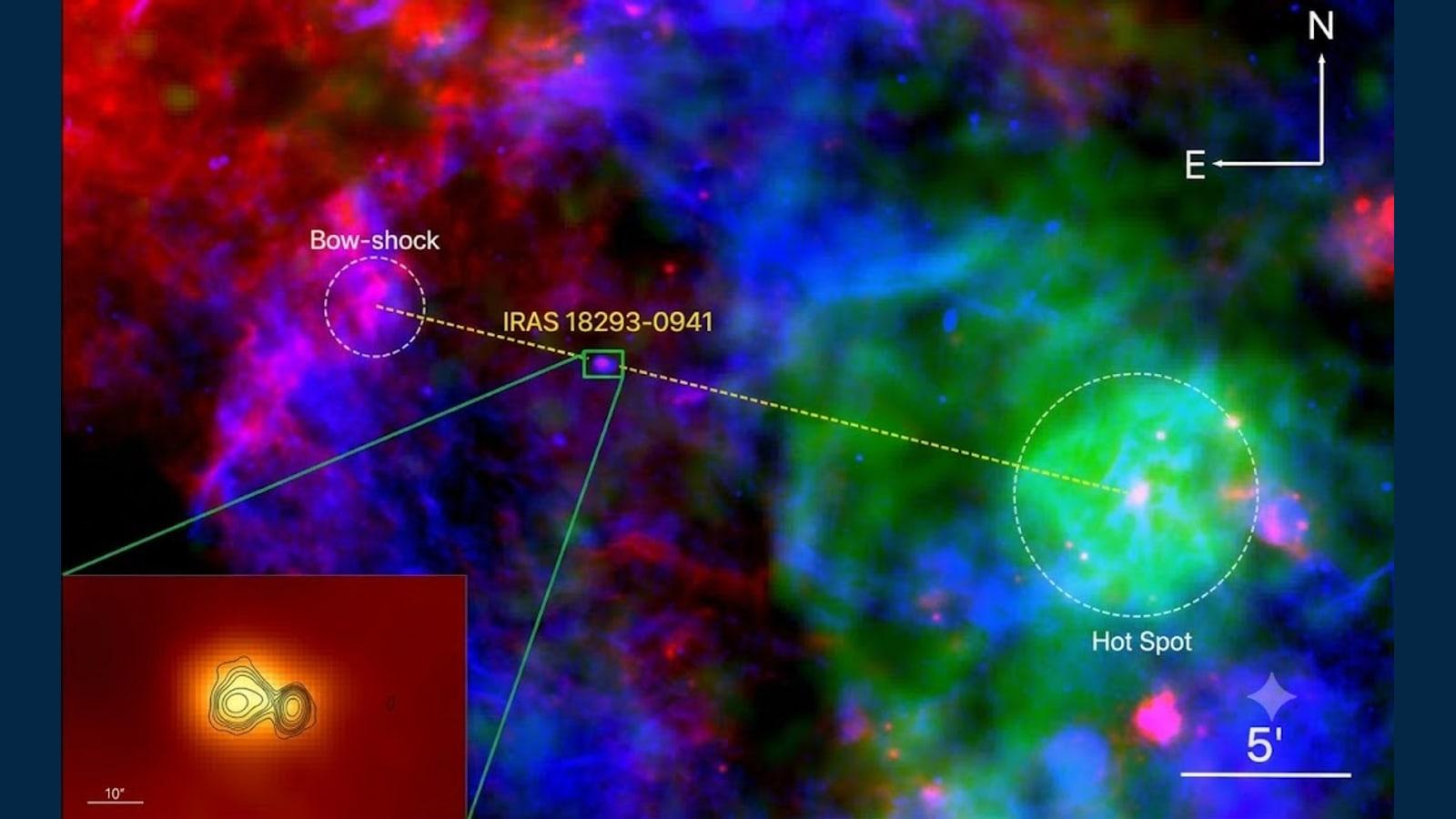
That hotspot is what makes the discovery valuable. The jet's power there is colossal, about 500,000 times the energy the Sun radiates. Such a reserve, packed into a small volume, can drive protons up to a petaelectronvolt, or a thousand teraelectronvolts. For comparison, the most powerful accelerator on Earth hands a single particle a few teraelectronvolts.
And right at that spot, gamma-ray observatories such as LHAASO in China, HAWC in Mexico and H.E.S.S. in Namibia have detected a source of extreme photons, each carrying more than 100 teraelectronvolts, over ten times the energy the Large Hadron Collider gives a single proton. These sources of ultra-high-energy photons go by the name PeVatrons, and where they draw their power from is one of the open questions of modern astrophysics. The positional match between the hotspot and the source LHAASO J1831-1007u* drives the team's hypothesis.
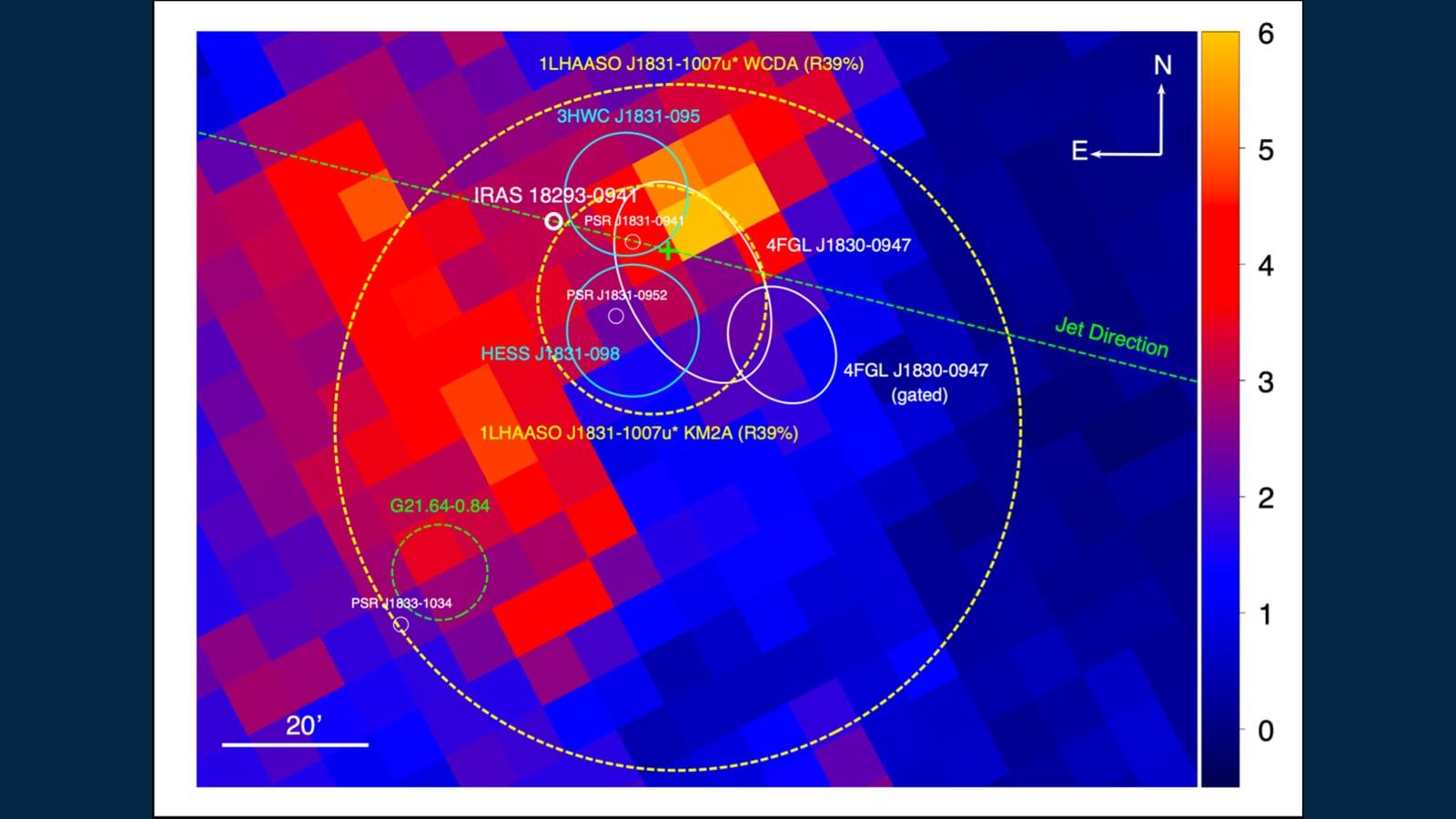
This scenario has an elegance the authors point out themselves. The engine and the target are two separate objects, tens of parsecs apart. The jet does the accelerating on one side, the cloud does the shining on the other. Protons flung out at full speed leave the hotspot, strike the dense gas, and the collisions immediately produce gamma rays. No other known object in this field combines both conditions so well.
Then there is the broader reach. For the first time, the Milky Way offers a miniature cousin of distant blazars, close enough for detailed study. Jets from these systems carry a black hole's energy out into the galaxy that hosts it, a process called feedback, and this hotspot is a direct demonstration of it on the scale of a molecular cloud. The team is now pushing on three fronts: repeating high-resolution observations to watch the jet evolve, studying the encounter with the cloud in finer detail, and hunting for more systems of this kind across the Galaxy. We will soon know more about how many of these hidden accelerators sit in our galactic neighbourhood.
Going further
- The key notions: black holes, the Milky Way and X-rays in our glossary.
- The satellite that supplied the reference position, without which the jet could have belonged to any distant galaxy: Gaia.
- The sky hides its own faint objects: find the Milky Way and its nebulae with our interactive sky map, then plan your nights with our observing guide.
- The sources for this article: the paper by J. Martí, P. L. Luque-Escamilla, B. Marcote et al., "A Galactic microblazar as a potential accelerator of ultra-high-energy particles", accepted in Astronomy & Astrophysics and available as a preprint on arXiv, along with the releases from the SARAO radio observatory and the Calar Alto observatory.