On September 8, 2026, Physical Review Letters published a seven-page paper that hands a bit-part player top billing again. Rishav Roshan of the University of Southampton and Sudipta Show of the Indian Institute of Technology Kanpur argue that a heavy neutrino, almost always left out of the arithmetic, could have dominated the early universe and moved the point where matter takes the upper hand over antimatter. No observation backs the idea yet. The machinery holds together, though, and it would leave a mark in gravitational waves.
The neutrino nobody wanted
A neutrino is a particle with no electric charge and almost no mass. It crosses ordinary matter the way a bullet crosses fog. The Sun makes them in astronomical numbers: about 65 billion pass through every square centimetre of Earth every second. Nearly all of them go straight through without leaving a trace.
For a long time, physicists thought the neutrino carried no mass at all. Oscillation experiments changed that. A neutrino can change flavour in flight, sliding from one family to another, and that trick only works if the particle has a mass. The three families are the electron, muon and tau neutrinos, each named after the charged particle it travels with. What remained was explaining why the mass is so small, millions of times lighter than the electron's.
The most elegant answer has a picture-book name. The seesaw mechanism adds heavy partners to the standard model, the catalogue of known particles and their interactions. Those partners are the right-handed neutrinos. They have never shown up in any experiment. For now they exist only on paper. And the heavier they are, the lighter the visible neutrino becomes. Think of a counterweight on a lever: an enormous mass on one side lifts the pan on the other with almost no effort.
It so happens that two of those heavy neutrinos are enough to reproduce the mass gaps that have been measured. Theorists therefore work with a minimal model, two partners and no more. The third, labelled N₃, couples so weakly to everything else that it drops out of the calculation. It gets erased from the equations, filed away as a harmless detail. That is the bit-part player the two researchers bring back.
Their argument fits in one sentence. A tiny coupling does not merely make a particle discreet, it also makes it very hard to destroy. A neutrino that is nearly invisible is a neutrino that lives a long time. "This decoupled heavy neutrino has long been dismissed as an irrelevant background detail in particle physics," Roshan says in his university's press release.
One part in a billion, and the universe we got
The problem the paper attacks is the oldest in modern cosmology. Matter and antimatter should have been produced in almost equal amounts at the start. Those two families annihilate on contact and release energy. Had the balance been perfect, only light would have been left. Not one star.
Reality is kinder. For every matter particle that survived, the universe holds about a billion photons. An imbalance of one part in a billion was enough to people the cosmos. Without it: no galaxies, no planets, no us.
In 1967, Andrei Sakharov listed the three ingredients needed to cook up such an excess. First, an interaction that does not conserve baryon number, the tally of the heavy particles that make up atomic nuclei. Second, a difference in behaviour between matter and antimatter, which physicists call CP violation. The name refers to a symmetry that would swap every particle for its antiparticle and mirror space, and nature breaks it slightly. Third, an out-of-equilibrium stage, a moment when the plasma can no longer compensate for what is being produced.
Leptogenesis, proposed in 1986 by Masataka Fukugita and Tsutomu Yanagida, brings the three together. Heavy neutrinos decay out of equilibrium and produce slightly more leptons than antileptons, leptons being the family of light particles that includes the electron and the neutrino. Collective rearrangements of the primordial plasma, known as sphalerons, then convert about a third of that excess into baryons. The recipe works, provided you know how to dose the ingredients.
The switch that decides a particle's flavour
The charged leptons, meaning the electron, the muon and the tau, interact with the Higgs boson, the particle that gives them their mass. That interaction, known as Yukawa, is not always switched on. Its rate depends on temperature, and it has to be compared with the expansion rate of the universe, which sets the tempo for everything else.
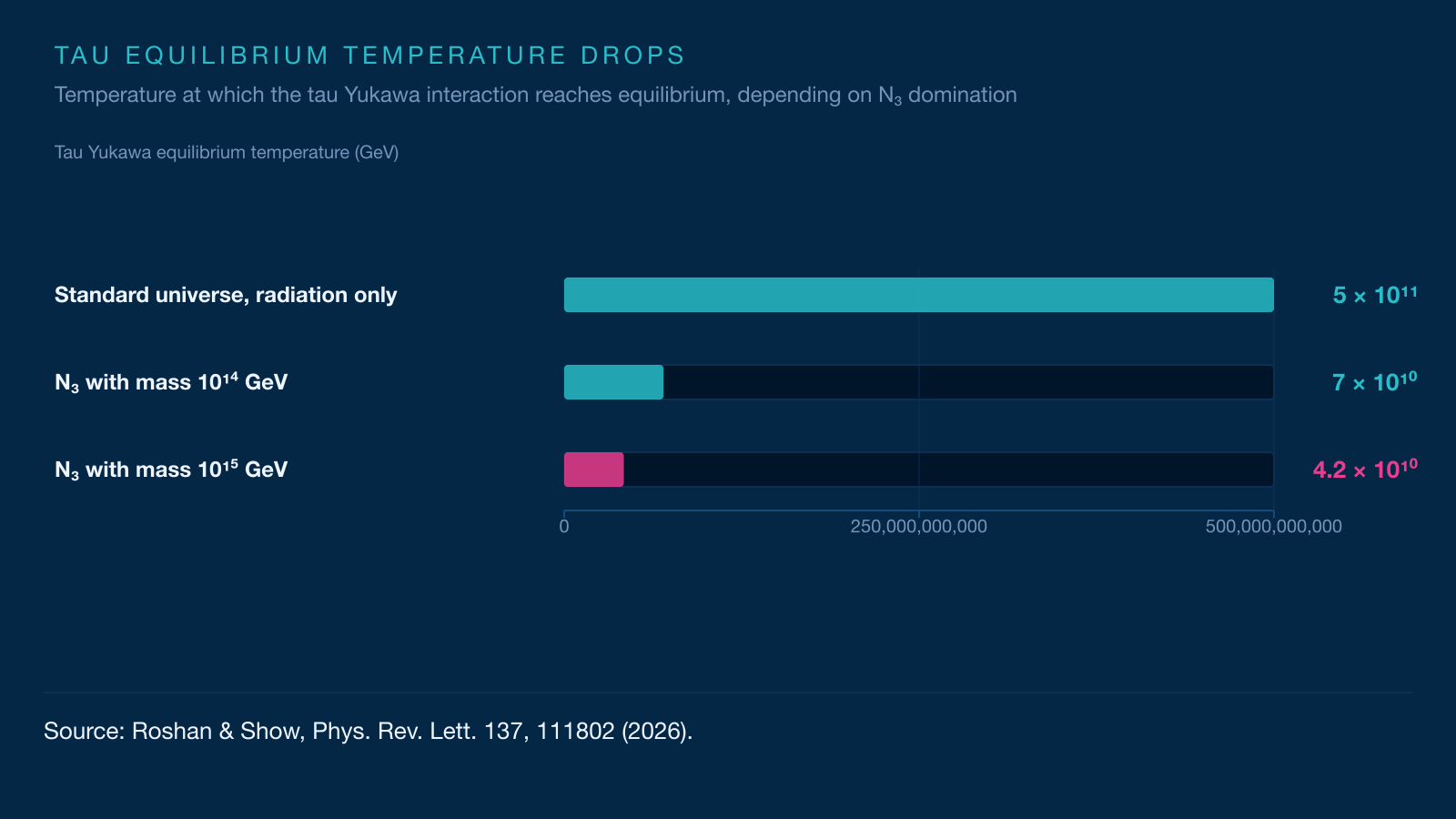
Out comes a switch. Above a certain temperature, the interaction is too slow to follow the expansion, so it stays off. Below it, the interaction wins and the flavours separate. The flip does not happen at the same moment for the three families, because their couplings are not equally strong. For the tau, it comes around 5 × 10¹¹ GeV. For the muon, around 10⁹ GeV. For the electron, around 5 × 10⁴ GeV.
Those numbers are read as energies, a convention among particle physicists. One GeV is a billion electronvolts, and one electronvolt is the energy a single electron gains when pushed across one volt. A temperature of 5 × 10¹¹ GeV corresponds to an energy per particle more than thirty million times higher than in the collisions of the LHC, the Large Hadron Collider at CERN.
Here is the paper's key move. If N₃ dominated the universe for a while, the expansion ran faster than expected at any given temperature. The switch then flips later, at a lower temperature. A faster expansion means every temperature is reached sooner, when the plasma has had less time to settle. The authors work out the shift. For an N₃ of 10¹⁴ GeV and a light neutrino of 5 × 10⁻¹² eV, the tau threshold falls to 7 × 10¹⁰ GeV. For 10¹⁵ GeV and a neutrino of 5 × 10⁻¹³ eV, it drops to 4.2 × 10¹⁰ GeV. A factor of ten, on a scale where every factor counts.
The consequence is concrete. A heavy neutrino N₁ of 10¹¹ GeV, the one that builds the asymmetry as it decays, ends up on one side of the threshold or the other depending on the scenario. In the standard picture, the tau interaction is already on when the decay happens, so the flavour of every lepton has to be tracked. With N₃, it is not on yet. While nothing measures flavour, the particle remains a blend of the three families. The moment the interaction switches on, it acts as a measuring instrument, and each family lives its own life.
So the same N₁, at the same mass, no longer tells the same story. The shifted threshold changes how physicists must keep their books, and the final tally of matter produced.
Rewriting the recipe for matter
The scenario closes like a puzzle. One tiny coupling sets the lifetime of N₃, the length of its domination and the mass of the lightest neutrino, all at once. Three effects from a single dial. That is what sets this model apart from theories that add a dark field to dominate the early universe. Here the particle is already in the model, and its action stays tied to a quantity that experiments can measure.
The authors check the arithmetic on one parameter set. With N₃ at 10¹⁴ GeV, N₁ at 10¹¹ GeV and a light neutrino of 5 × 10⁻¹² eV, the calculation lands on the amount of matter we observe. The mechanism pulls in two opposite directions. On one side, the shifted threshold allows leptogenesis that ignores flavour, which is more efficient. On the other, the late decay of N₃ reheats the plasma and dilutes the asymmetry already produced. The longer N₃ lives, the more it dilutes. The final agreement comes from the balance between the two.
Let's be precise about what that is worth. The parameters are tuned to land on the right value. This is not a prediction, it is a feasibility check. The strength of the work lies elsewhere, in the link between quantities that normally have no business sharing an equation.
Three ways to prove the theory wrong
A theory with no grip on observation is worth very little. This one offers at least three.
The first is the mass of the lightest neutrino. The scenario sets it between 10⁻¹² and 10⁻¹⁴ eV. That is between a trillionth and a hundredth of a trillionth of an electronvolt. For scale, oscillation experiments measure mass differences of a few thousandths to a few hundredths of an electronvolt, and they say nothing about the absolute mass. Experiments that weigh it directly, such as KATRIN, which watches the decay of tritium, and Project 8, which measures the cyclotron radiation of an electron, work at the scale of a fraction of an electronvolt. The prediction stays out of reach for now. At least it gives a number to confront, which many cosmological scenarios never do.
The second is the spectrum of gravitational waves. An era of matter domination modifies the expansion, and therefore the way primordial waves are stretched and diluted. The authors list three possible signatures. Breaks in the slope of the spectrum produced by a network of cosmic strings, the topological defects left over from phase transitions in the young universe. A cosmic background of gravitational microwaves, the gravitational counterpart of the cosmic microwave background, the relic glow left by the young universe. And bremsstrahlung, the radiation a fast charge sheds when it is deflected, emitted here at very high frequency by heavy particles as they decay. Low frequencies fall to pulsar timing arrays, networks of collapsed stars whose ticks are timed to the nanosecond, and to future space interferometers, while frequencies around the gigahertz call for detectors still on the drawing board. According to the authors, catching such a signature would prove that massive particles existed and decayed in the early universe.
The third is precision cosmology. An early period of domination changes how dark matter is produced and how the expansion unfolds. Surveys that map the structure of the universe, such as those from ESA's Euclid mission, constrain the sum of the neutrino masses through the way those masses shape galaxies. If that sum turns out incompatible with a very light neutrino, the scenario loses its footing. Nothing is settled yet, but the theory is not safe from a refutation.
Going further
- The particle at the heart of the paper: the neutrino in our glossary, along with dark matter, whose production also depends on how the universe expanded.
- The scenario bets on a neutrino with almost no mass. ESA's Euclid mission weighs the sum of the neutrino masses indirectly by mapping billions of galaxies.
- Tonight, the sky is still there to look at. Our interactive sky map and its observing guide bring these dizzying scales down to what fits in an eyepiece.
- Sources for this article: the paper in Physical Review Letters (DOI 10.1103/nfkx-q6z7) and its free version on arXiv.