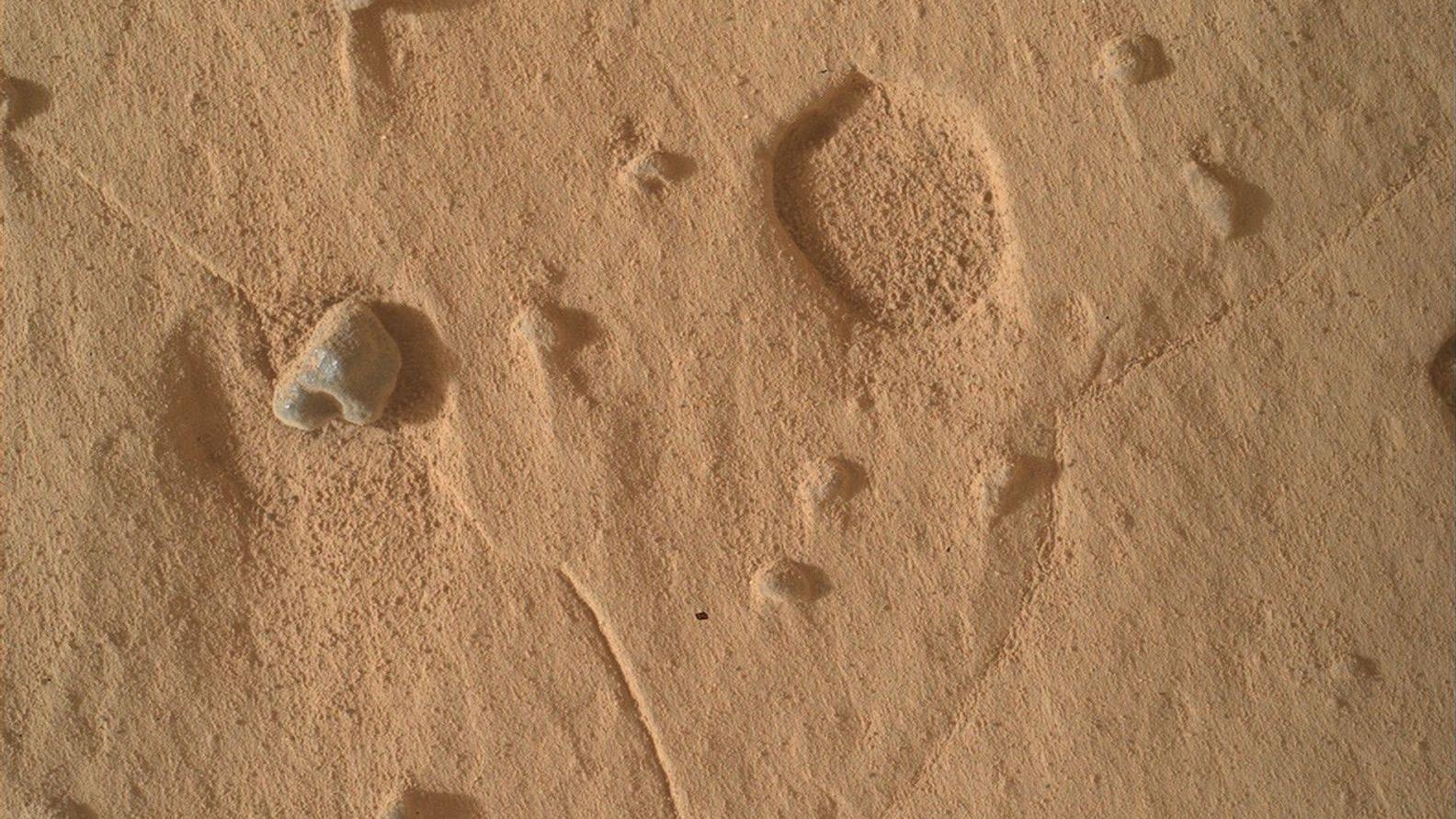
At the inner rim of Jezero crater, NASA's Perseverance rover expected to read the shoreline of an ancient lake in layers of sediment. Instead it found rock crystallized from magma, and that rock had met water at least three times. The findings, published on 21 September 2026 in the journal Communications Earth & Environment, describe a rock that served as a crossroads for several distinct water systems rather than the single lake scientists were looking for.
The rocks were not the ones scientists expected
When Perseverance reached the inner rim of Jezero crater in September 2023, the plan was simple. This strip of rock, which the team named the Margin Unit, follows the shoreline of the lake that once filled the crater. Orbital observations had picked up strong carbonate signals there, and carbonates often form in shallow lake and ocean settings on Earth, environments that can host life. A shoreline plus carbonate meant one likely answer: sedimentary rock, built up from layers of sand and clay.
Sedimentary rock is prized in the search for past life because it stacks up in thin layers that can trap and preserve traces of microbes. Igneous rock, the kind that crystallizes from magma, is a different animal. It forms deep underground or in surface eruptions, and its crystals record the conditions of the magma at the moment they grew.
That is what the rover found. The Margin Unit was emplaced as an igneous rock, one rich in the mineral olivine, and only later did water leave its mark. Candice Bedford, a research scientist at Purdue University in Indiana and lead author of the study, put it plainly in the NASA release: "Before we arrived at the Margin Unit, the main hypothesis was that the carbonate seen from orbit formed from interaction with the lake that existed in Jezero Crater. But now we know that this location became a sort of crossroads for aqueous systems."
Olivine, the mineral that opens the door
To understand what happened here, start with olivine. It is a green mineral built from magnesium and iron, common in the deep rock of Earth's mantle and on Mars. The Margin Unit's olivine formed in a body of magma deep underground. It cooled slowly, giving its grains time to grow large, and only surfaced after the ground above it eroded away. Picture a slow-cooked dish left to set: the slower it cools, the coarser the crystals.
Why does that matter for water? Because olivine reacts easily. On Earth, when water meets it, the reaction produces two useful things: carbonate and silica. It also releases hydrogen, a gas that some microbes use as food. Carbonate and silica are worth following because they can lock in traces of past life, a bit like preserving an insect in amber.
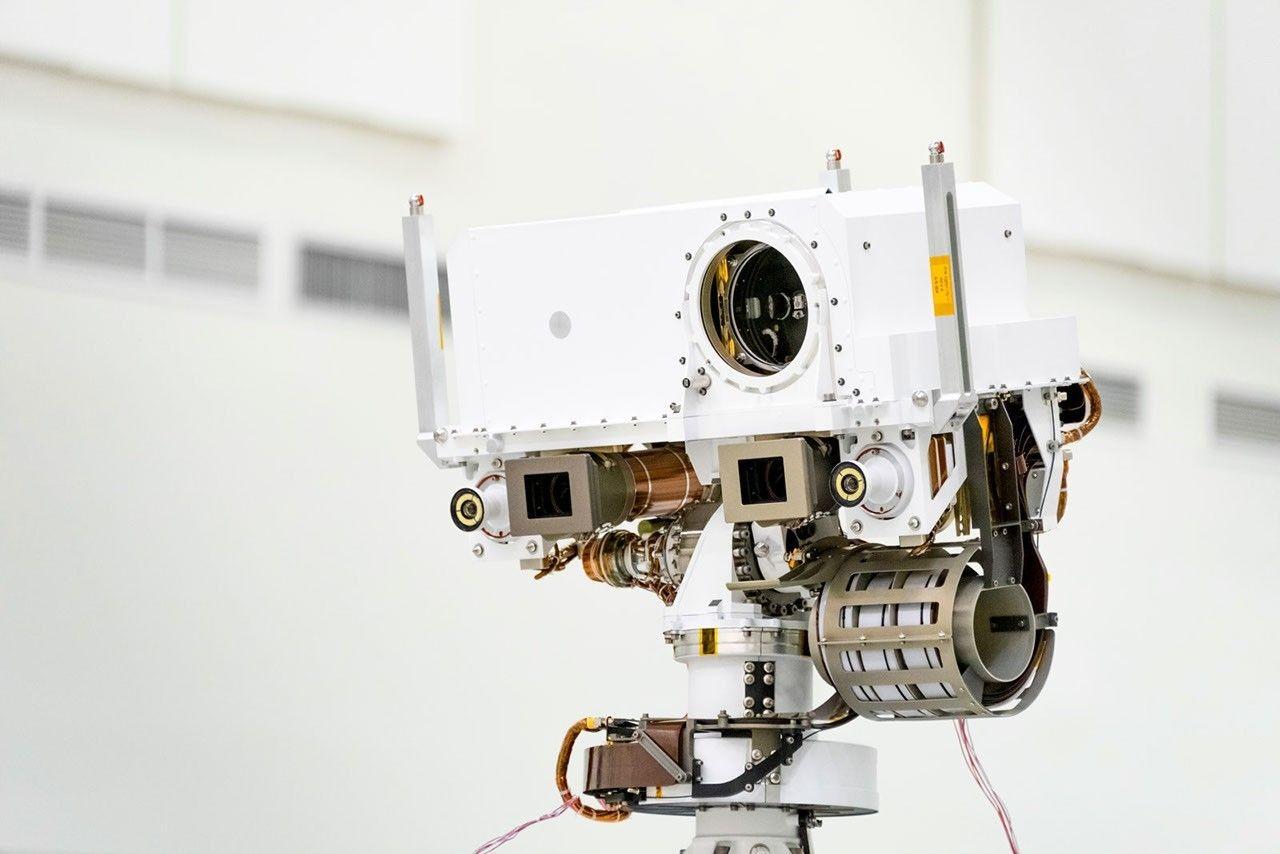
The study's sharpest tool was SuperCam, an instrument perched on the rover's mast. SuperCam fires a laser at a rock target up to 6.5 metres away, turning a pinhead of material into a state of matter called plasma. The light from that plasma reveals the target's chemistry. Using it, Perseverance analysed more than 185 bedrock targets across the Margin Unit, mapping its chemistry from high ground down to the lakebed.
Three separate encounters with water
The rocks preserve the encounters in a readable order, and that order is the heart of the discovery. The team cannot date the episodes, but it can tell which came first.
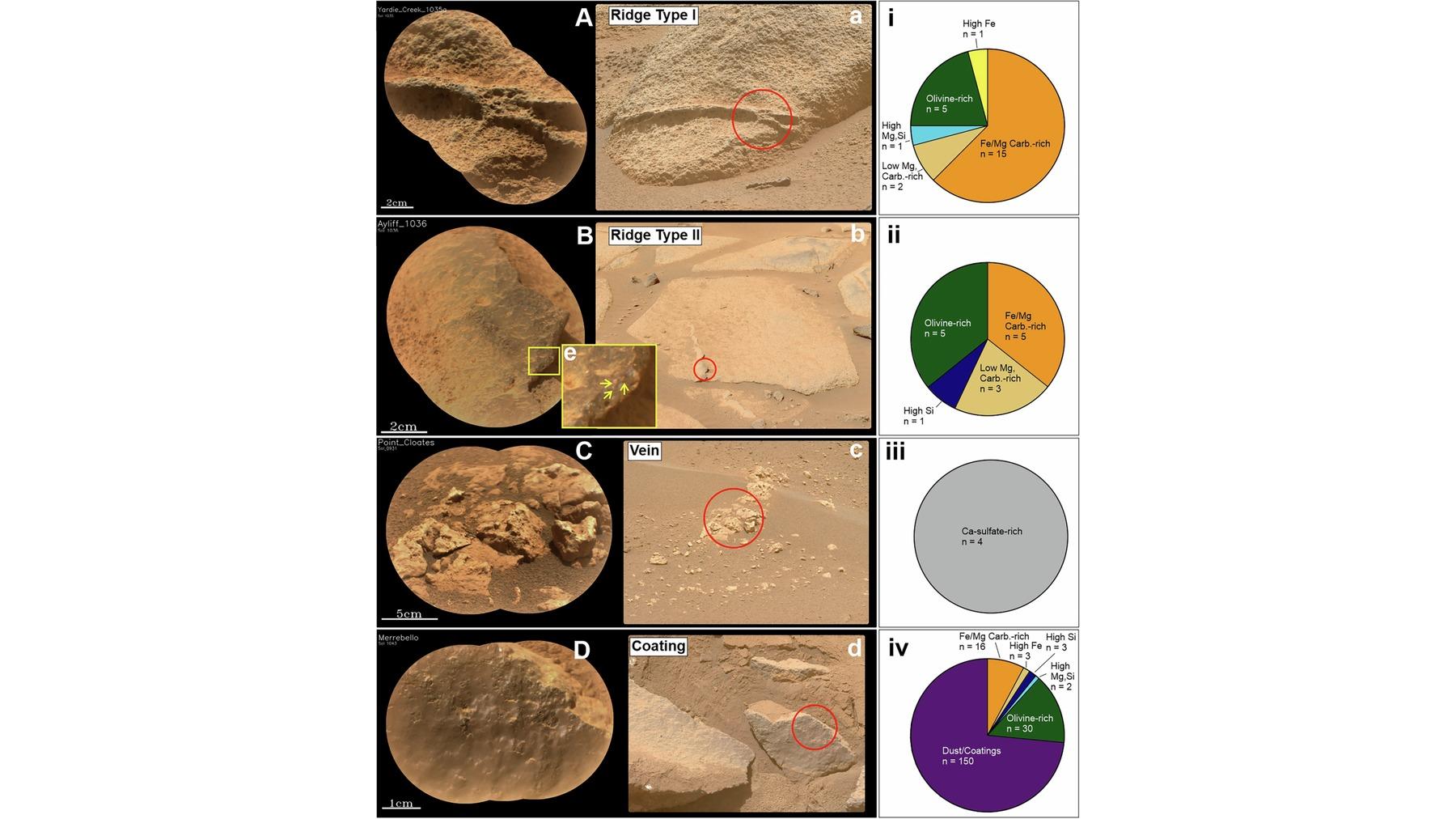
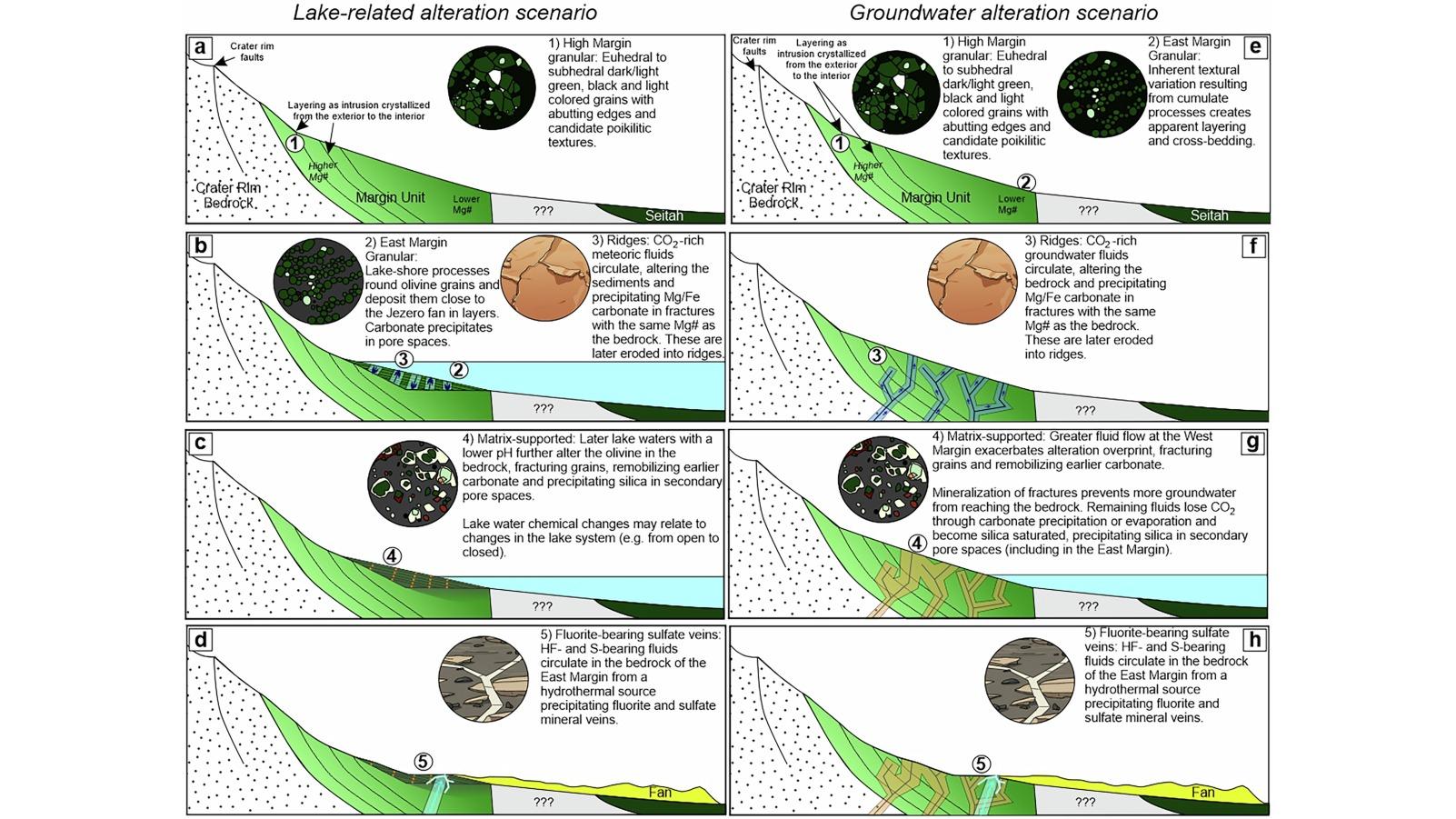
First came carbon-dioxide-rich groundwater, circulating within the bedrock. It reacted with olivine and left carbonate behind, filling fractures in the rock at low elevations. Since then, the softer rock around those fractures has worn away, leaving the carbonate-filled veins standing up as ridges.
Second came fluids tied to the lake. "Some of the Margin Unit rocks also contain silica," said Eleni Ravanis, a planetary scientist at the University of Hawaii at Manoa and a coauthor of the study. "Turning olivine into carbonate can leave silica behind, and we see more of that silica in rocks that sat below the water line." The higher carbonate content of the ridges points the same way: they formed during the early carbonation of the rock, and they concentrate in the parts of the unit lying below the level the lake is thought to have reached.
Third came the hottest episode. In one spot in the eastern Margin Unit, water left a vein about 25 centimetres thick, carrying calcium sulfate and fluorite. Fluorite is the giveaway. It usually forms when hot, fluorine-bearing brines push through igneous rock, and this vein sits among rock of volcanic origin. Elsewhere in Jezero, calcium sulfate appears as small centimetre-scale veins, which points to a late, hot stage of underground-water activity.
Water, then, did not visit this rock once. Different water systems used the same fractures on different occasions, a pattern closer to an old town rebuilt several times on the same streets than to a single lake lapping at a shore.
Where the water came from, and why it is hard to pin down
The new results sharpen an old debate. Carbonate in this region had been attributed to a lake because it sits near the level the water is thought to have reached. But the same carbonate signature also turns up outside Jezero crater, in a wider belt of olivine-bearing rock across the region called Nili Fossae. That suggests groundwater or hot fluids, not a lake alone, drove the alteration here and elsewhere in the area.
In fact, a neighbouring rock tells the opposite story. The Séitah formation, lower down on the crater floor, is much less altered than the Margin Unit, even though both should have been submerged if lake water alone did the work. Séitah also lacks the ridges seen in the Margin Unit. That points to fractures and permeability as the deciding factor: where water could seep in, it changed the rock, and where it could not, the rock stayed nearly untouched.
One more surprise came from the north. There, where the Margin Unit meets a younger formation inside a channel called Neretva Vallis, the rover found a jumble of mixed, angular fragments in a fine matrix. That chaotic mix, with no sorting and no preferred orientation, looks like a debris flow, and a piece of olivine trapped inside it shows the Margin Unit was already there when the debris slid in. The northern rocks also proved richer in iron, with some iron oxide levels as high as 82 percent in one dark patch, the highest of the study's sampling.
Why this matters for the search for life
Astrobiology is the hunt for life beyond Earth, and on Mars it centres on one question: where and when was there water that could have supported microbes? Jezero crater sits inside one of the largest exposures of carbonate on the entire planet, which is why what happens here reaches well beyond this one crater.
A rock that preserves a sequence of distinct water episodes is a rare thing. Each episode brought a different fluid at a different temperature, and each one left minerals that chemists can read. Together they sketch a changing environment: cold groundwater first, then lake or cooler fluids, then heat from below. If any of those windows was habitable, and for how long, is exactly the kind of question a rock like this can help answer.
"The Margin Unit findings are important because Jezero Crater sits inside one of the largest exposures of carbonate on Mars, so what we learn here reaches well beyond this crater," Bedford said. After ten years working with Mars rovers, she added, she has learned that the planet keeps confounding expectations: "It is very rare that things are as we expect them to be from orbital data."
Perseverance has already drilled and stored samples in this area. Those tubes, waiting for a future mission to bring them to Earth, now carry a rock that recorded not one lake but a whole sequence of waters. Laboratories on Earth could date the episodes the rover could only order, and that is the piece still missing.
Going further
- The mission page for Perseverance, on Mars since February 2021.
- The key notion: Mars in our glossary.
- To observe the sky from your own home: the interactive sky map, the observing guide and the astrophotography gallery.
- The official sources for this article: the NASA release and the JPL version, the study by Bedford et al. in Communications Earth & Environment, and the NASA Photojournal entry for the panorama.