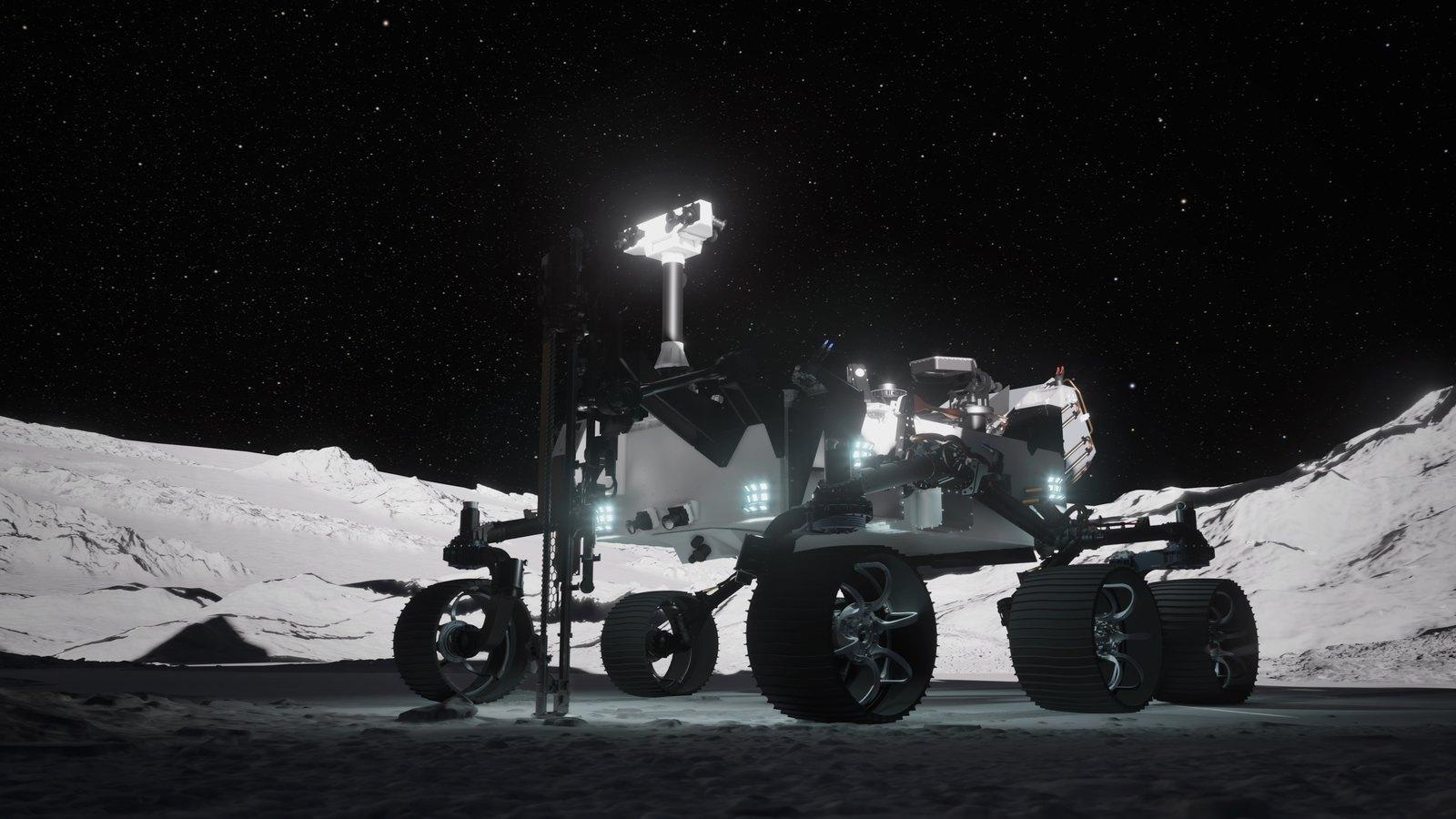
On Nov. 7, 2026, during the MAX POWER aerospace expo at NASA's Kennedy Space Center in Florida, the agency announced PROMISE, a six-wheeled rover built to work at the lunar South Pole. The name stands for Polar Rover for Observation, Mapping, and In-Situ Exploration. NASA's Jet Propulsion Laboratory (JPL) in Southern California, a division of Caltech, will build it from spare flight hardware and engineering test models of the Curiosity and Perseverance Mars rovers. Blue Origin will deliver it in late 2028 under a $94 million contract, using its Mark 1 lander. The same announcement opened the next phase of the Commercial Lunar Payload Services program, or CLPS, to eight companies.
A rover that runs on plutonium, not sunlight
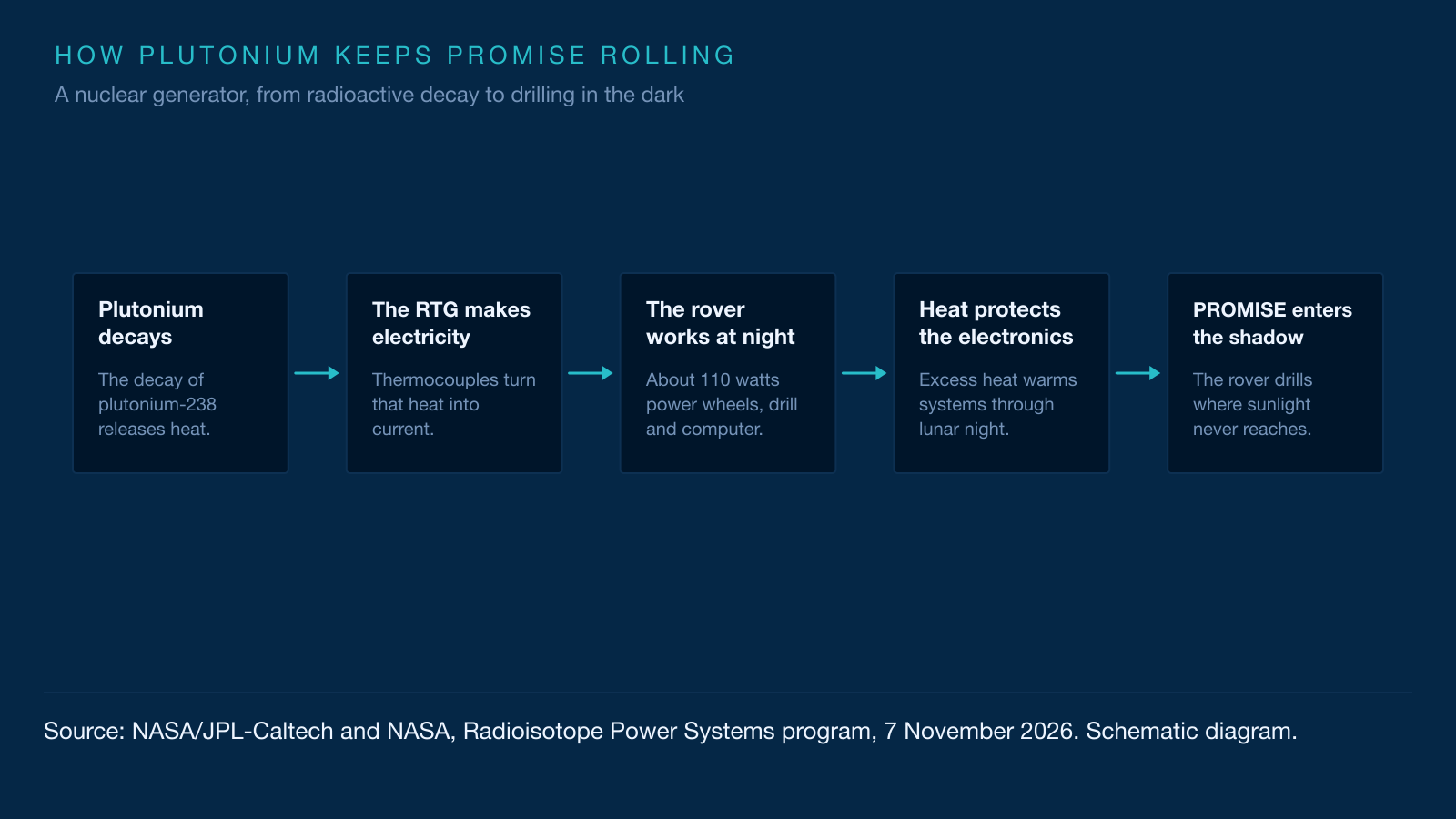
The power source is the part that changes the mission. PROMISE carries a multi-mission radioisotope thermoelectric generator, or MMRTG, which is a nuclear generator in all but name. It burns nothing. The natural radioactive decay of plutonium-238 gives off heat, and thermocouples, pairs of metals that make a current when one end is hotter than the other, turn part of that heat into electricity.
The numbers are modest. They are enough. One MMRTG delivers about 110 watts of electricity at the start of a mission, roughly what a bright desk lamp draws. It drives the wheels, the drill, the computer and the instruments, and it keeps running in the dark, because it needs no sunlight and no clean surfaces.
The generator makes more heat than electricity. Some of that surplus is piped back into the rover to hold the electronics at operating temperature, which matters when the Sun stays below the horizon for a long stretch.
Built from Mars spare parts
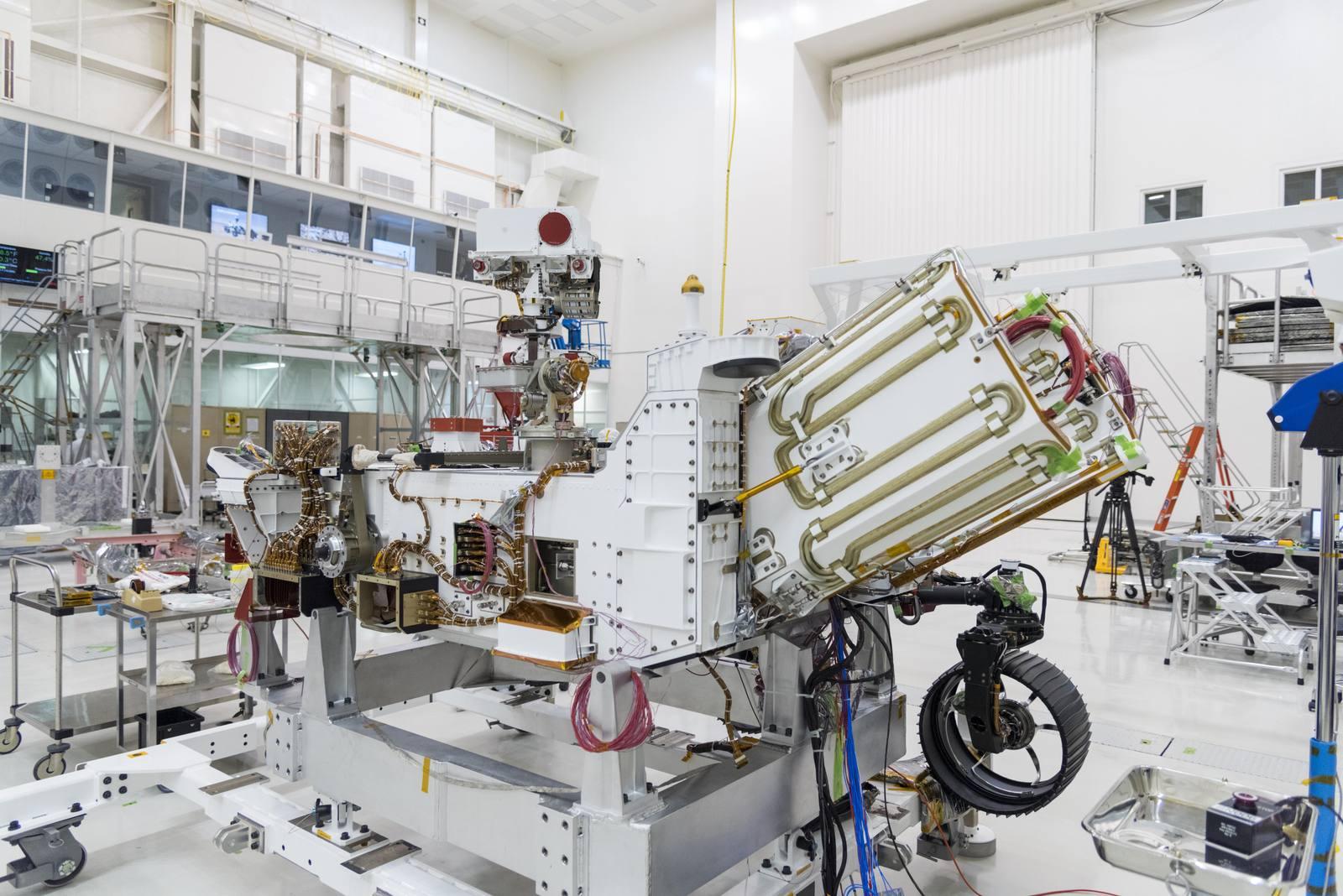
PROMISE is not a clean-sheet design. Engineers at JPL are transforming the electronics, body structure and mobility system of the duplicate Curiosity that served as the vehicle system test bed for the Mars mission. The rest comes from spare flight components and engineering test models kept for Curiosity and Perseverance.
The rover is about the size of an SUV, with six wheels and a mast. NASA says the recycled approach uses proven hardware, software and operating methods, which lowers cost and shortens integration and testing.
The agency also checked whether Martian hardware can survive lunar conditions and concluded that it tolerates the South Pole environment. The Moon still brings its own problems, from dust to long nights without sunlight.
A drill, one meter down, and the ice question
The science target is ice. PROMISE carries a drill that will pull regolith, the loose dust and broken rock that covers the Moon, from about 3 feet (1 meter) below the surface. The sample tells the team what the ice contains.
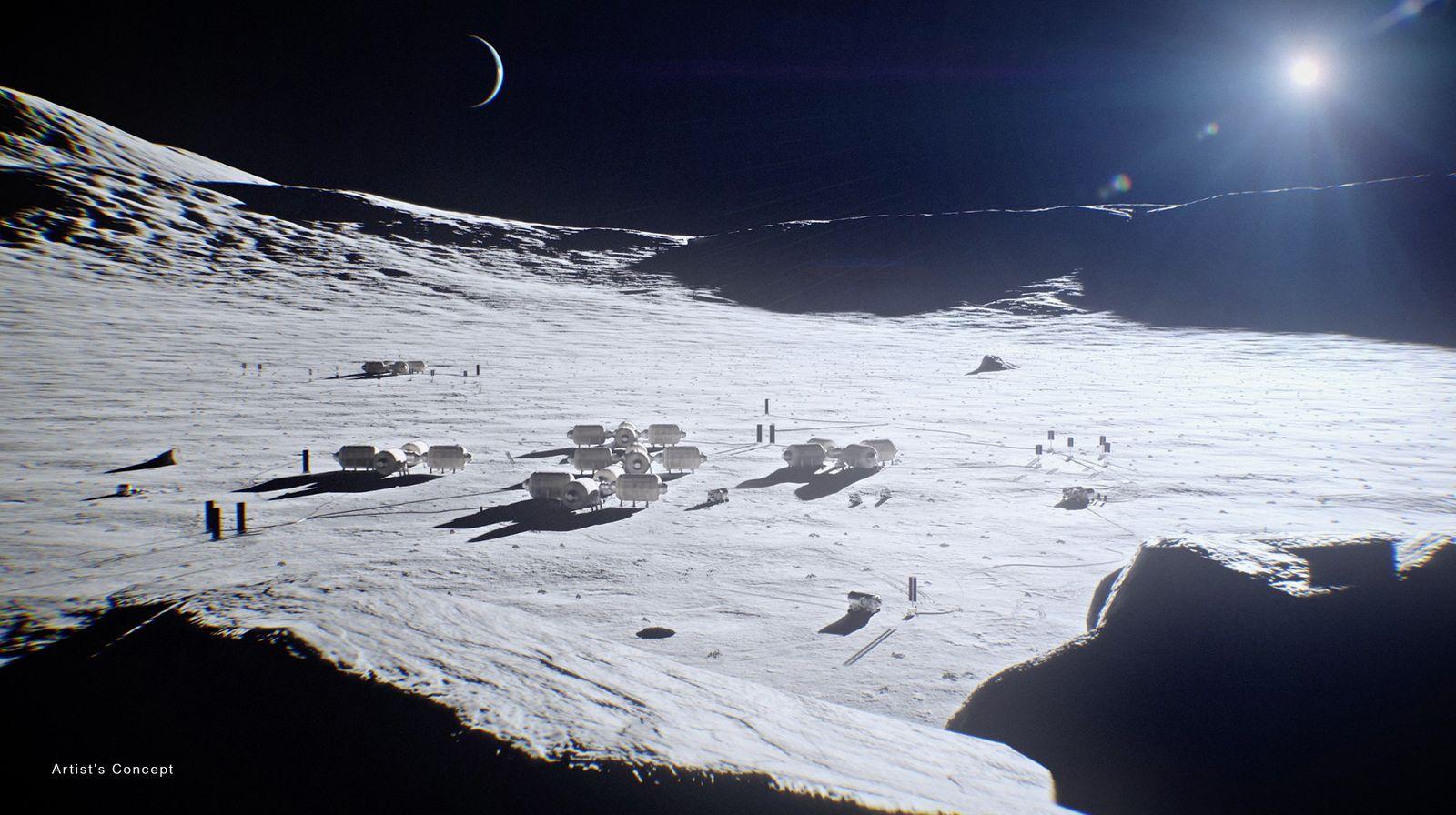
The ground that matters lies in permanently shadowed regions. These are craters and dips near the poles whose floors never see direct sunlight, so ice can stay frozen. PROMISE is built to drive into them, drill and measure, which a solar-powered rover could not do for long. Ice is the resource NASA calls crucial for a sustained human presence on the Moon.
Near the South Pole, the best-known example is Shackleton crater. It is about 13 miles (21 kilometers) wide and 2.5 miles (4 kilometers) deep, and its shadowed interior may hold water ice and other frozen volatiles. Volatiles are compounds that turn into gas easily, and future crews would need them for air, water and fuel.
PROMISE also carries spectrometers, which read the chemical makeup of surface material, temperature and radiation sensors, and visible-light cameras. A passive laser reflector, 2 inches (5 centimeters) across, lets an orbiting spacecraft locate the rover to within a few centimeters. The mast holds a camera system that films stereo panoramas as the rover drives, based on the cameras that captured Perseverance's arrival at Mars.
Some of the rover's instruments also fly on VIPER, NASA's Volatiles Investigating Polar Exploration Rover, so the two machines will work different patches of the South Pole and return comparable datasets.
Blue Origin's $94 million delivery
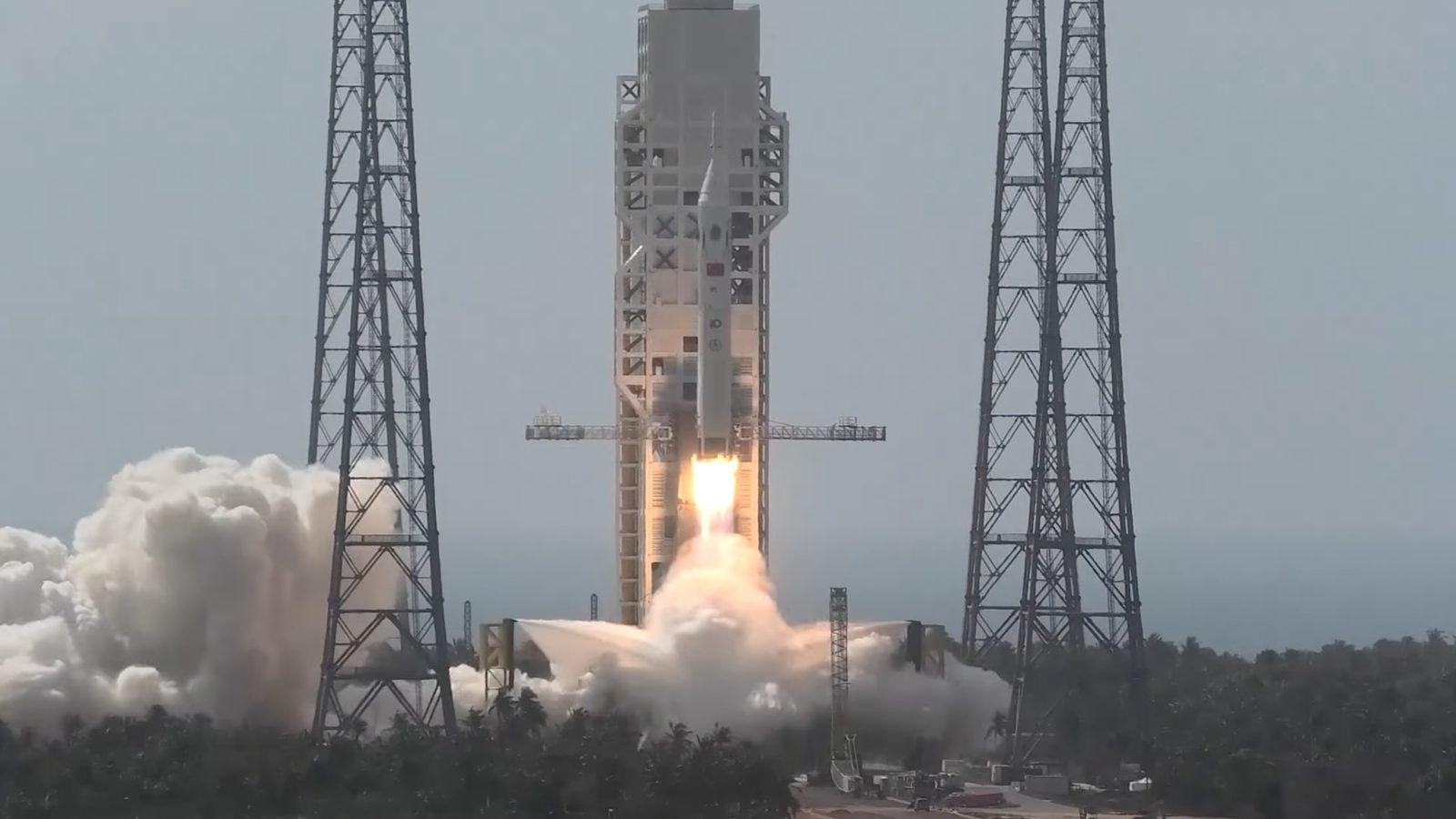
Delivery is a separate contract. NASA awarded Blue Origin a $94 million base contract to carry PROMISE to the South Pole, with an option period worth an additional $140 million based on performance. Blue Origin will use its Mark 1 lander to set the rover down and deploy it as part of the first phase of Moon Base.
The award expands a task order signed in May 2026 to deliver two lunar terrain vehicles. JPL manages the rover for NASA's Human Spaceflight Mission Directorate.
"We are building the Moon Base mission by mission," said NASA Administrator Jared Isaacman. "When our astronauts return to the Moon, they will arrive with the first elements of the Moon Base already waiting for them on the surface."
Eight companies and a $10 billion framework
NASA also rewrote the rules for buying lunar delivery. CLPS is the program where NASA pays private companies to land its instruments instead of owning the landers. On Nov. 7, NASA selected eight companies for the next phase: Blue Origin, Firefly Aerospace, Intuitive Machines, ispace-U.S., Lockheed Martin Space, Northrop Grumman Space Systems, SpaceX and Voyager Technologies.
The new framework, CLPS 2, is a 10-year master contract with multiple awards and a combined maximum value of $10 billion. Think of it as a pre-approved supplier pool: NASA orders missions one at a time, up to the ceiling.
The current contract grew too. NASA raised the value of CLPS 1.0 from $2.6 billion to $4.2 billion to fund the first phase of Moon Base. It stays in place through November 2028, with an additional five-year period to complete awarded deliveries through November 2033.
Launch services come through another channel. Six task orders worth about $1.3 billion combined fall under VADR, NASA's 10-year contract vehicle for commercial launch services, which has a maximum total value of $5 billion across all contracts. The orders cover several jobs, from CAPSTONE 02 navigation and communications tests around the Moon to MoonFall drones mapping the South Pole. SpaceX will send communications satellites to cislunar space, the region between Earth and the Moon, aboard a Starship in 2028.
NASA also plans a separate solicitation for fully integrated power systems, expected in early 2027.
Going further
- The mission pages for Perseverance and Curiosity, whose hardware and test models went into PROMISE.
- Key notions: the Moon, the rover, the lander and NASA in our glossary.
- Before launch, find the Moon with the sky map and prepare a session with the observing guide.
- The official sources: NASA's release on the Moon Base awards and the PROMISE mission page.