In early November 2026, astronomers swapping notes on the public alert stream of the Vera C. Rubin Observatory in Chile found an odd fit: a faint object beyond Neptune whose path is tilted 142.38 degrees, far past the point where an orbit turns backwards. The working label is R631. The distance often quoted for it, about 32 astronomical units, is not the size of its orbit. Its diameter of roughly 100 kilometers is an estimate. Its designation is not official.
A track that runs the wrong way around the Sun
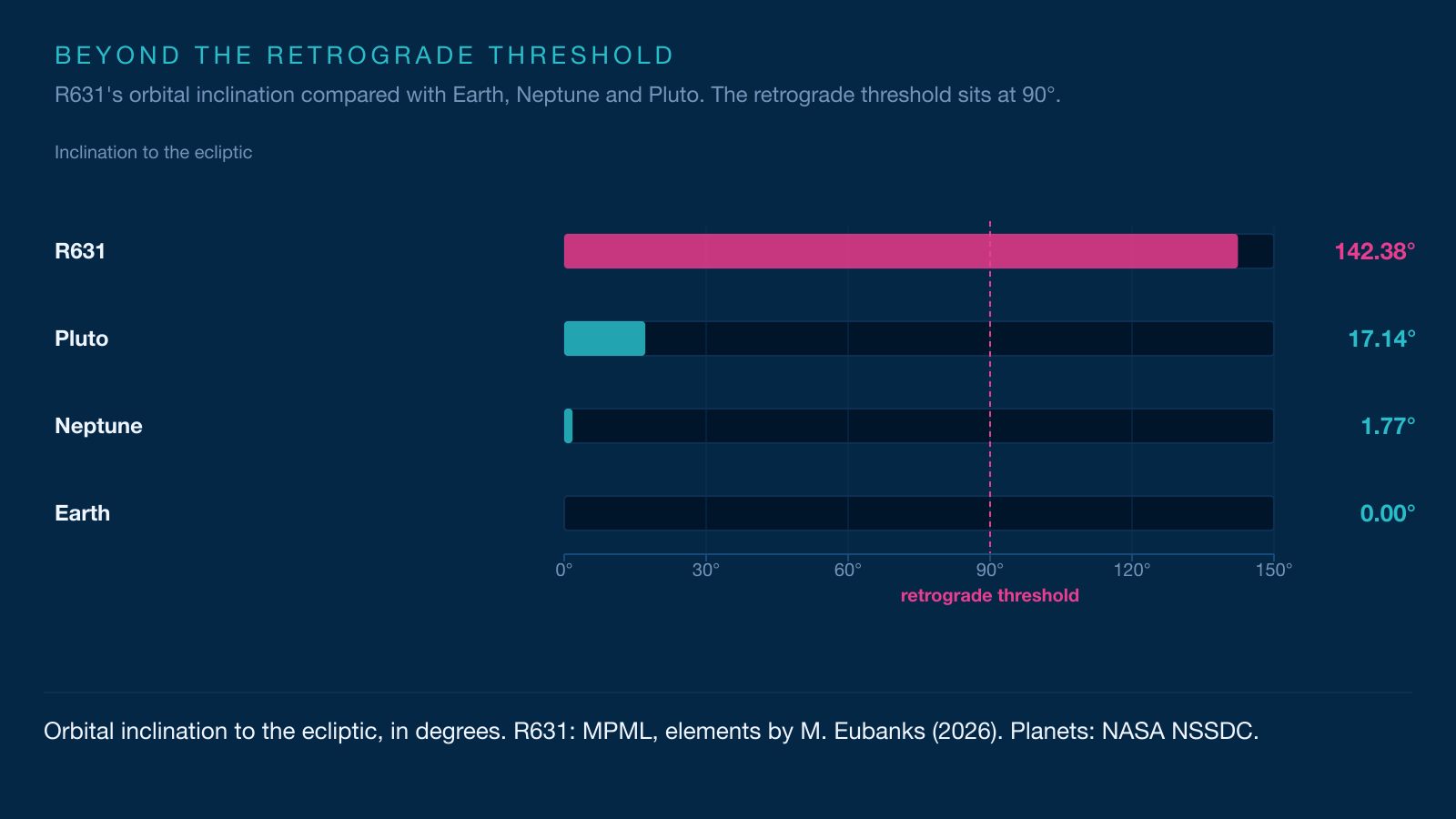
Begin with the tilt. An orbit is a loop around the Sun, and its inclination is the angle between that loop and a reference plane. In the solar system, the reference is the ecliptic, the plane Earth traces as it circles the Sun. Zero degrees is flat and ordinary. Ninety degrees is a polar orbit, rising straight over the poles. Past ninety, the body travels the other way around.
R631 measures 142.38 degrees. For comparison, NASA's fact sheets list Earth at 0.00005 degrees, essentially zero because Earth's orbit defines the plane, Neptune at 1.77 degrees and Pluto at 17.14 degrees. The most tilted of those three is barely tilted at all. R631 is close to upside down.
The vocabulary matters here. Moving in the common direction of the planets is called prograde. Moving against it is retrograde. Most bodies inherited their direction from the spinning disk of gas and dust that formed the Sun, so a backward orbit is a fossil of something that disturbed the object after it formed. Picture runners on a circular track. Almost all of them go counterclockwise. R631 goes clockwise, and its lane is banked so steeply that it crosses over the top of the track.
Why care about a backward orbit? Among the objects past Neptune, retrograde paths are rare enough that each one adds a line to the map of how the outer solar system was stirred. R631 is also a data problem before it is a celestial one, and that is where the rest of this story lies.
32 AU is where R631 is now, not the size of its orbit
Start with the ruler. One astronomical unit, or AU, is the average distance from Earth to the Sun, roughly 93 million miles (150 million kilometers). Past Neptune, astronomers measure everything in AU because miles stop being useful.
The first messages in the thread described the Rubin fit as a retrograde orbit with "a = 32 or so." The letter a stands for the semimajor axis, the standard measure of an orbit's size: half the long axis of the ellipse the object follows. Adrien Coffinet corrected the reading the same day. The 32 AU is where R631 sits today, not its semimajor axis, which the elements put at 66.97 AU. One is a snapshot, the other is the racetrack, and for a while the same number stood for both.
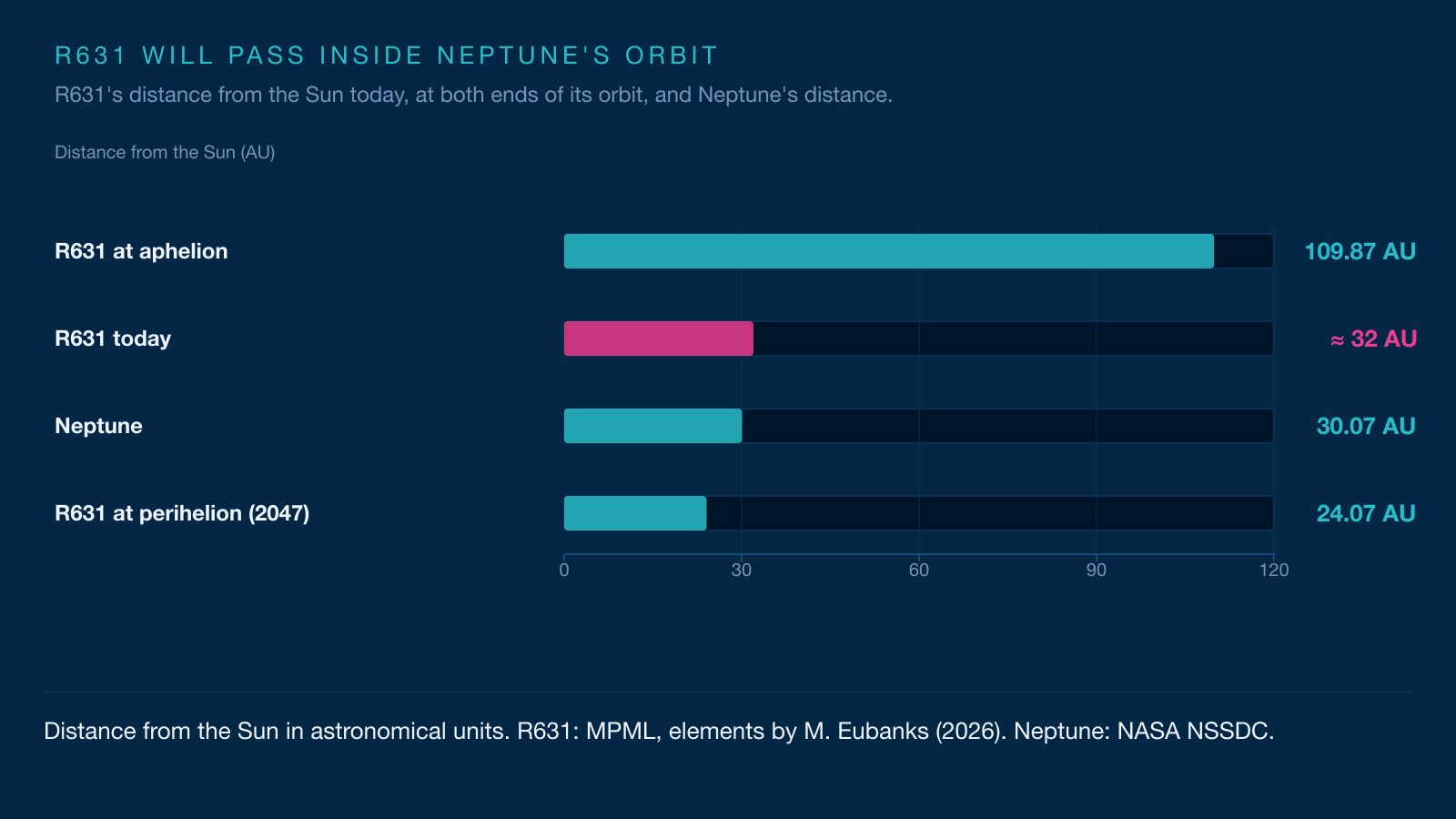
The track itself is a long ellipse. Its eccentricity, a number that runs from 0 for a circle to just below 1 for a stretched path, is 0.64. The closest point to the Sun, the perihelion, is 24.07 AU. The farthest, the aphelion, is 109.87 AU. One lap takes 548.02 years in the first set of elements, and 547.84 years in a later fit that included extra astrometry, the precise measurement of an object's position on the sky, supplied by Anton Sibilev.
The perihelion date carries the same caution. The reference elements put the passage on Oct. 31, 2047. The later fit moves it three days, to Nov. 3, 2047. Both are predictions from a fit, not events that have been watched.
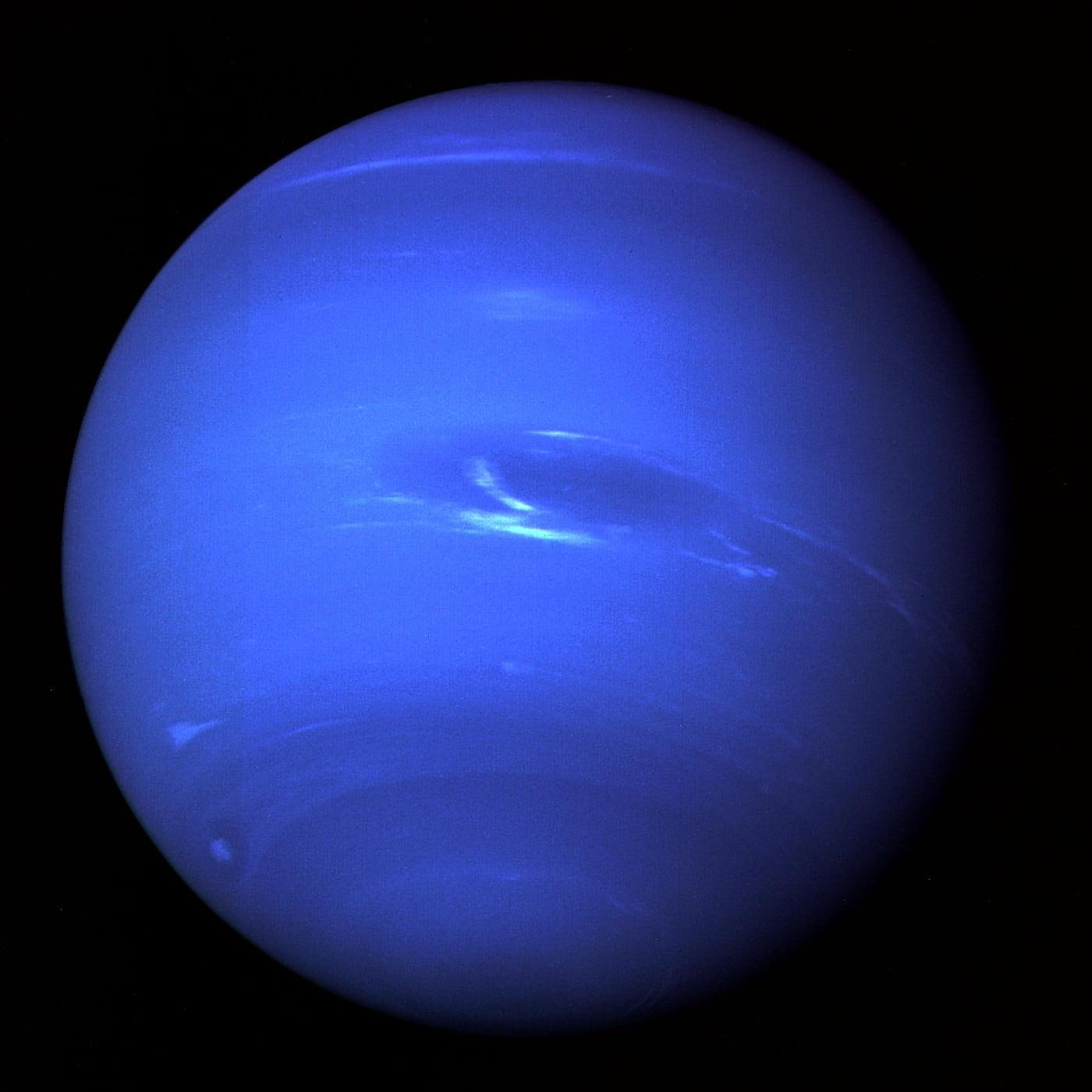
R631 is inbound. It sits at about 32 AU now, will pass within 24.07 AU of the Sun in 2047 and then climb back out toward 109.87 AU. Neptune orbits at 30.07 AU on average, so the closest approach will take the object inside Neptune's average distance. Voyager 2 is still the only spacecraft to have visited Neptune, in August 1989, and its camera produced the portrait below.
955 measurements and a case file that starts in 2018
Rubin is a survey machine, not a hunter of single objects. It photographs the same patches of sky again and again, and software compares each new frame with older ones. When an object has moved or changed brightness, the system issues an alert. Those alerts are public worldwide, delivered through broker services, the relays that redistribute the data so anyone can query them.
The astronomers in the thread looked at alerts spanning about four months, from December 2025 to March 2026. That is where R631 came up. But the orbit rests on far more than four months of data. The first elements posted to the list use 955 observations from May 6, 2018 to March 9, 2026. The object had been sitting in the archive for more than seven years before the alerts brought it into the conversation.
That is the ordinary shape of modern discovery. The light arrives one night, the database stores it, and the recognition comes later, when someone looks at the numbers from the right angle. An orbit is what you get by threading a curve through 955 dots and accepting that each dot carries a small error. Change the weighting and the curve shifts a little.
The Minor Planet Mailing List, or MPML, is where the elements were posted, and the thread reads like a workshop. Adrien Coffinet called the orbit plausible and named the test that would confirm it: a newer observation about a year after the first batch of measurements. A longer arc of data is what tightens a fit.
The name would come from somewhere else. The Minor Planet Center, the body of the International Astronomical Union responsible for identifying, designating and computing the orbits of small bodies, assigns a provisional designation once it holds at least two nights of observations it cannot match to a known object. That population ranges from near-Earth asteroids to the icy bodies past Neptune. Until the center acts, R631 is a working tag, closer to a case number than to a name.
A Kuiper Belt object, about 100 kilometers across
Where does a backward orbit come from? The most detailed proposal in the thread comes from Sam Deen, and it points outward. R631 most likely formed in the Kuiper Belt, the doughnut-shaped region of icy bodies beyond Neptune, and was pushed onto its tilted path by Neptune itself within the past billion years.
The argument turns on proximity. Deen rules out the Oort cloud, the distant shell of comets that surrounds the solar system, because the orbits of R631 and Neptune never come close enough to allow a strong recent interaction. Astronomers call that minimum gap the MOID, short for minimum orbit intersection distance. With the direct route closed, what remains is a body from the Kuiper Belt that was destabilized long ago. Deen describes an orbit that is unstable over hundreds of millions of years, not the path of a body injected yesterday.
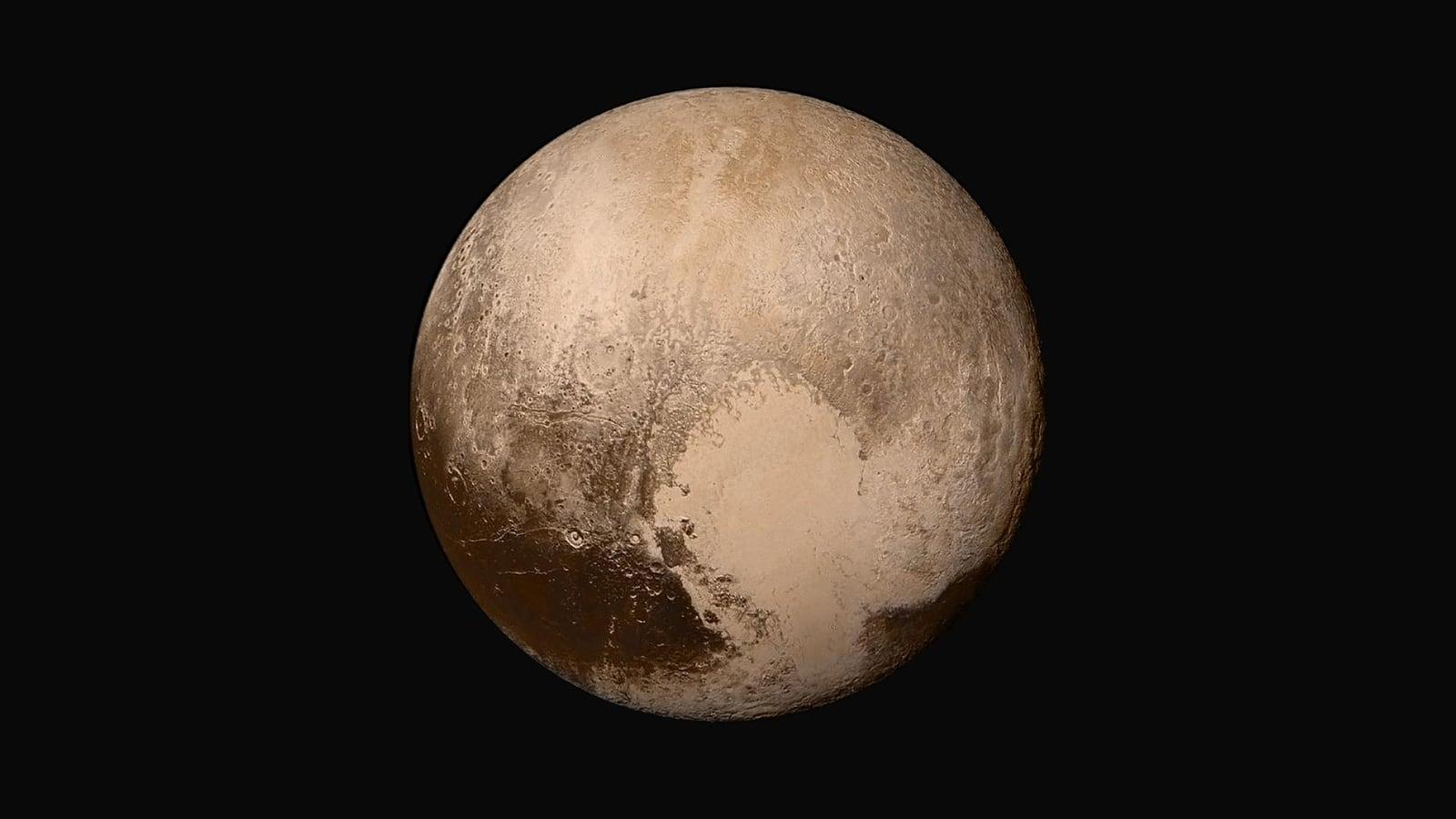
The Kuiper Belt's most famous resident is Pluto, the dwarf planet that New Horizons photographed in July 2015. R631 is far too faint for that kind of portrait.
Which brings up size. Marshall Eubanks estimated a diameter of about 100 kilometers from an absolute magnitude of H = 7.78. Absolute magnitude is a brightness corrected to a standard distance, so that objects can be compared on a common scale. Turning H into a diameter requires an assumption about how reflective the surface is, and no one has measured that for R631. A dark surface and a bright one can share the same H and differ in size by a factor of several.
Eubanks described the object as something akin to C/2014 UN271, a comet on a long, stretched orbit. A later fit in the same thread put H at 7.9, which trims the estimated diameter slightly and leaves the order of magnitude alone.
None of this is a measurement. No telescope has resolved R631 as a disk, and no radar has touched it. The 100 kilometers is an inference from a brightness. The gap between an estimate and a measurement is the gap between guessing a stranger's height from the shine of a coat down a dark street and standing next to that person with a ruler.
One claim in the thread stays on the hypothesis shelf. Andrew Lowe suggested that R631 might sit in a 10/3 resonance with Neptune, a gravitational rhythm in which the object would complete three laps for every ten of the planet's. Another contributor, Stefano, tested the idea by running 50 slightly different versions of the orbit for two million years. None of them librated, meaning none settled into an oscillation around a fixed position in the rhythm, and the ratio of orbital periods came out at 3.34 to 3.35 rather than the 3.333 that a 10/3 lock requires. The resonance is not ruled out forever. For now it is contested.
What the next observations will decide
Three labels hang over R631. The orbit is a fit. The size is an estimate. The name is provisional. All three depend on the same thing: more data.
The most useful addition would be a new set of measurements about a year after the first batch, the check Coffinet asked for. R631 is faint and moves slowly against the background stars, so a longer baseline is what sharpens the path. The three-day spread between the October and November perihelion dates shows how much leverage a small change in the data still has.
If the fit holds, the object joins a short list of retrograde travelers past Neptune, with a period of more than five centuries and a perihelion that dips inside the planet's orbit. If it shifts, the story moves with it, and the shift will appear in the same public thread, on the mailing list.
For now, R631 is 955 numbers in a database and a curve on a plot. That is how most of the outer solar system has been mapped. One fit at a time.
Going further
- The alert stream page of the Vera C. Rubin Observatory, which explains how the survey publishes its alerts.
- The Minor Planet Mailing List thread where the orbital elements, the size estimate and the origin hypotheses were posted.
- The Minor Planet Center, which assigns designations to small bodies.
- The spacecraft behind the two portraits: Voyager 2, which flew past Neptune in 1989, and New Horizons, which reached Pluto in 2015.
- The concepts: the solar system, asteroids and comets in our glossary.
- To find Neptune yourself, use our interactive sky map and the observing guide.