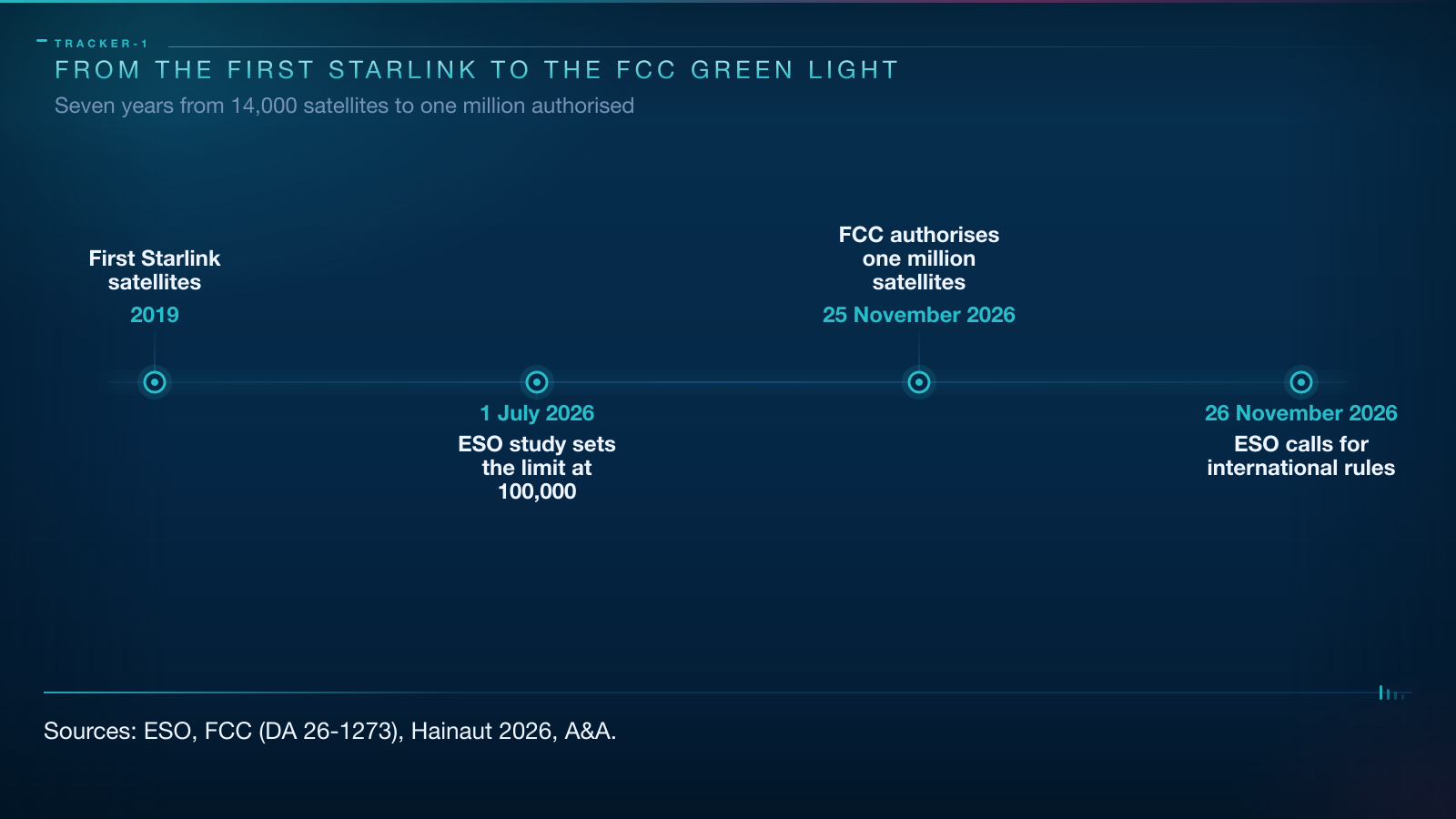
On 25 November 2026, the US Federal Communications Commission gave SpaceX permission to deploy one million satellites as orbital data centres. ESO answered the next day. Europe's ground-based observatory does not dispute the procedure. It points out that a million objects will change the night sky for everyone, and that no one currently has the tools to decide whether that is acceptable.
What the FCC approved, and what it set aside
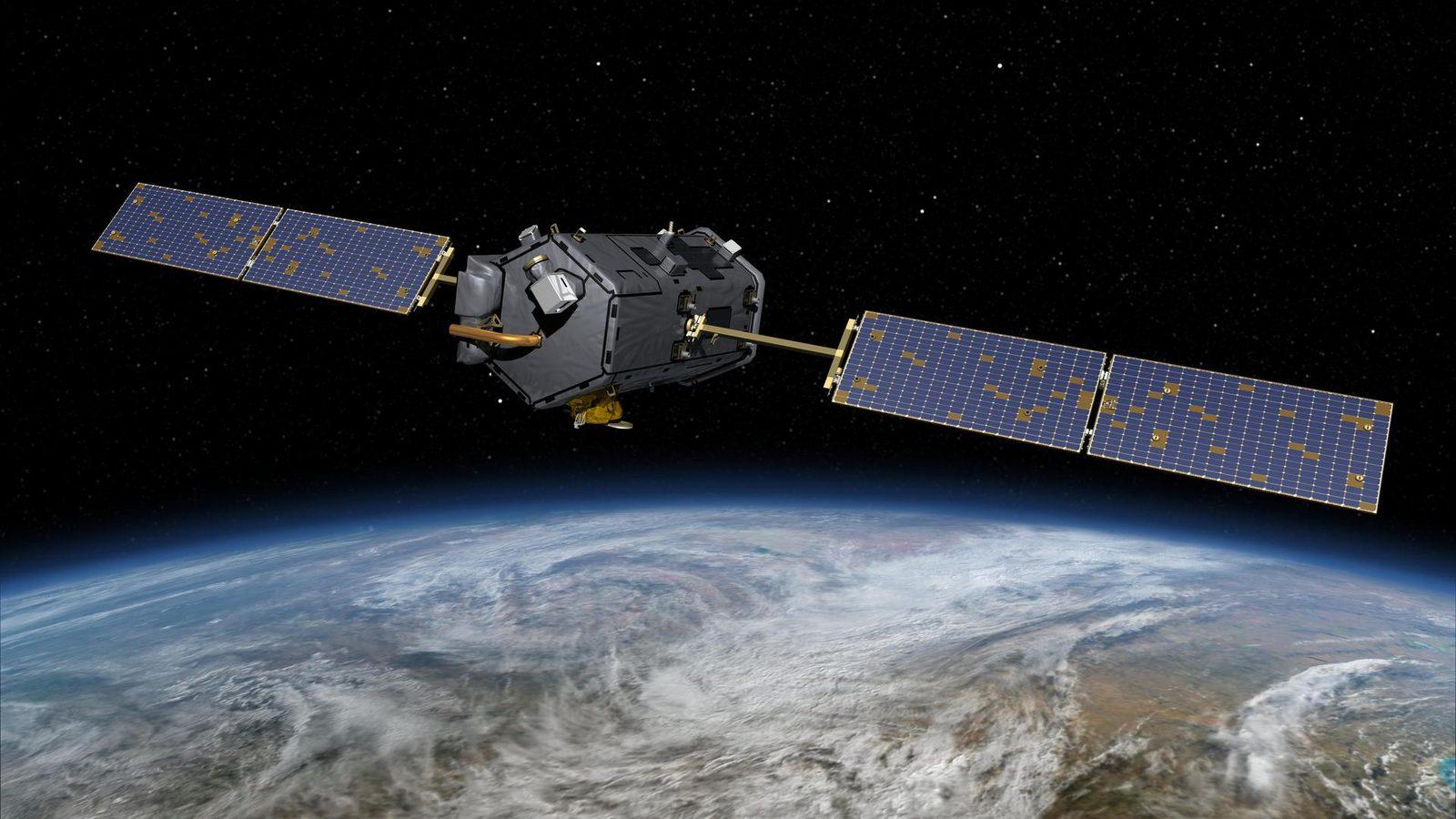
The order is DA 26-1273. It was adopted and released on 25 November 2026 by the FCC's Space Bureau. SpaceX gets authority to deploy one million satellites in low Earth orbit, in 50 km-thick shells between 500 and 1,002 km altitude, at inclinations from 26 to 99.4 degrees. The project is called Starmind.
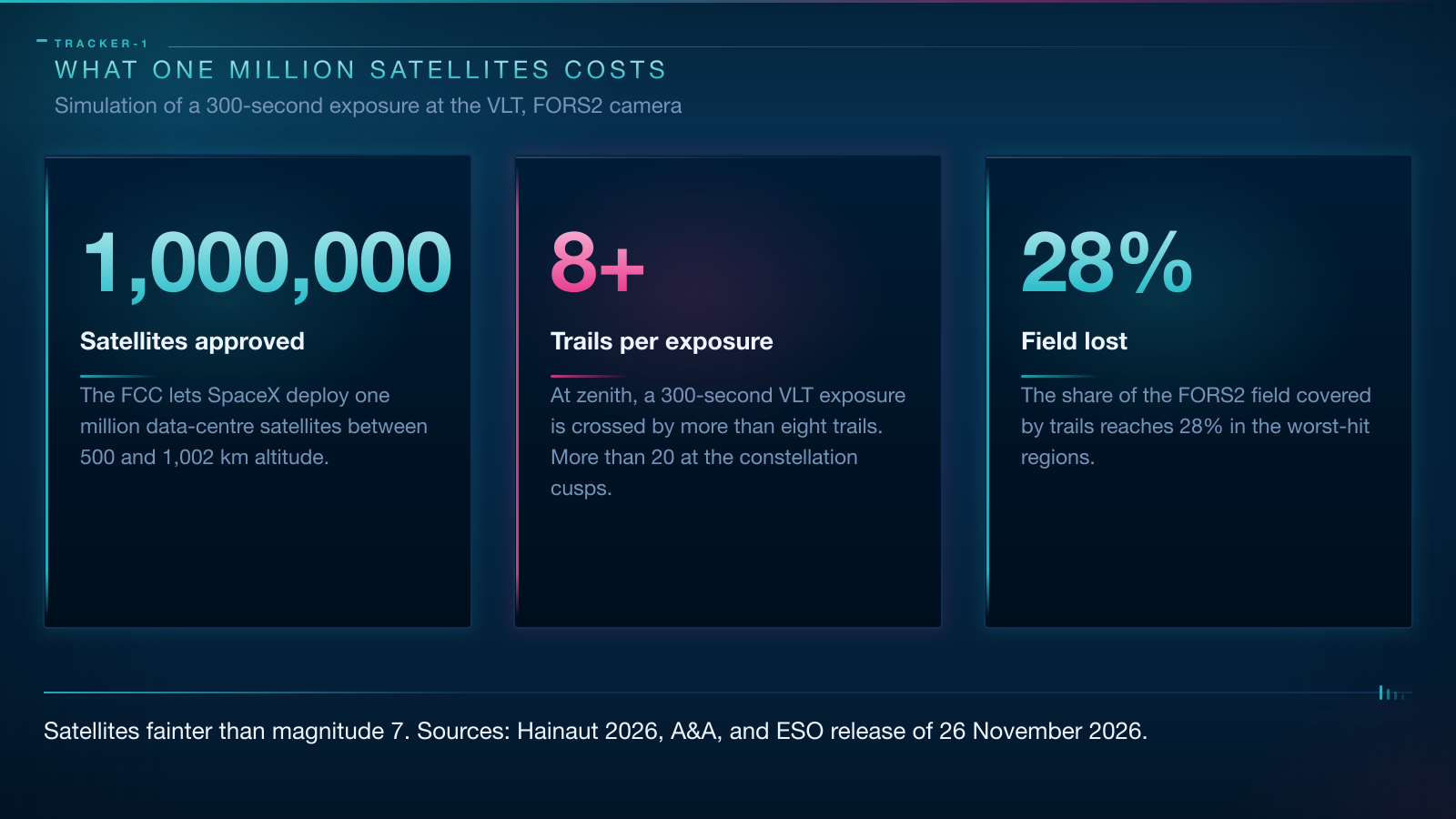
What the FCC actually licenses is radio spectrum. The satellites would mostly talk to each other, and to SpaceX's Starlink fleet, through laser links. The Ka-band, 18.8 to 19.3 GHz down and 28.6 to 29.1 GHz up, would only serve as a backup for telemetry, tracking and emergency commands. The licence runs 15 years. The schedule requires one satellite by 2033, 10% of the constellation by 2035, half by 2038 and all of it by 2040.
The idea is simple enough. A data centre is a building full of servers that compute and give off heat. SpaceX wants to put that building in orbit and send results back to the ground. The US regulator looks at the radio channel used to command the spacecraft, and at the debris plan. It says nothing about their brightness, or about what they do to the sky.
Everything else is pushed elsewhere, and that is where ESO's statement lands. On the environment, the FCC recalls that its October 2026 doctrine treats space activities as extraterrestrial, outside the reach of US environmental law. On optical astronomy, the order is blunter still: the Commission's rules, it says, do not address the protection of optical astronomy, and SpaceX's commitment to coordinate with the National Science Foundation is enough. On re-entry pollution, the concerns, in its words, remain speculative and are not supported in the record.
Amazon, Viasat and the American Astronomical Society had filed petitions to deny. The FCC rejects them on this point. It also notes that its rules set no cap on the number of space stations authorised with similar orbital parameters. Nothing in US communications law limits the constellation to a smaller size.
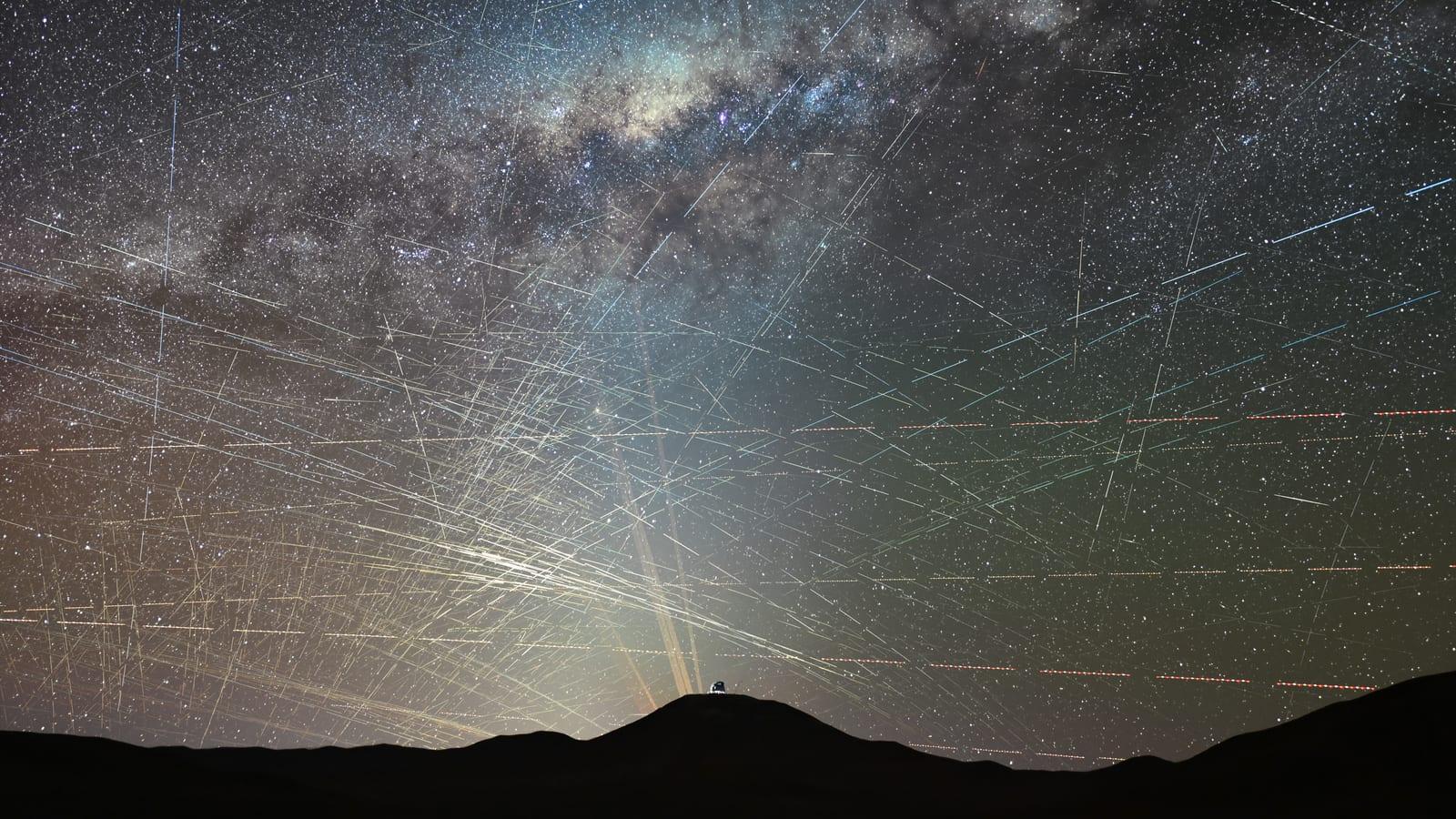
More than eight trails per exposure at the VLT
To grasp the scale, you need a simulation. ESO astronomer Olivier Hainaut published one in Astronomy & Astrophysics in 2026. It computes the position, speed and brightness of every satellite in a constellation, then asks what crosses a telescope's field of view.
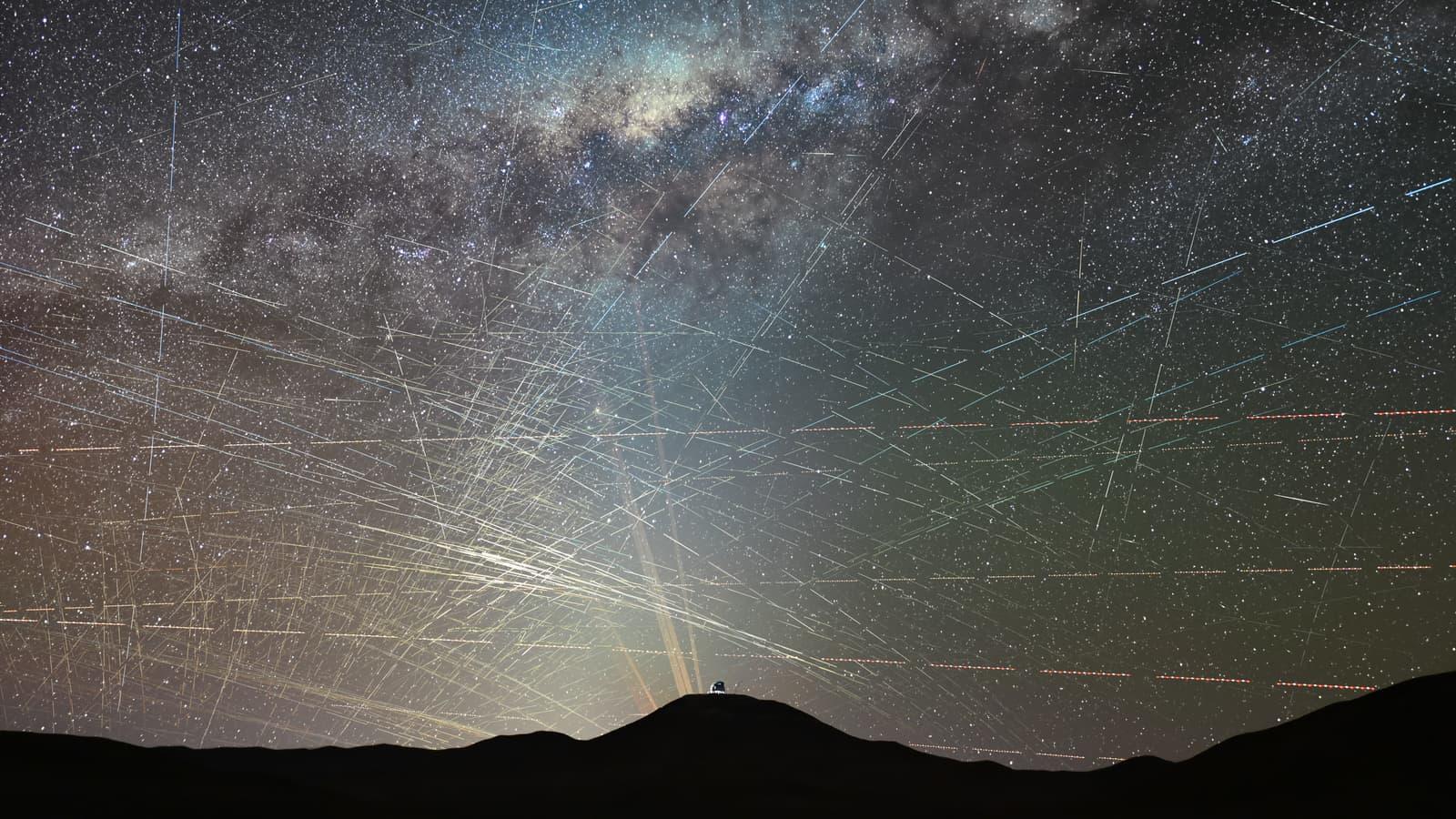
Take the VLT in Chile and its FORS2 camera: a 6 by 6 arcminute field, a 300-second exposure. With one million satellites all fainter than magnitude 7, the faintest star visible to the naked eye under a dark sky, the model finds on average more than eight trails per image at zenith. Where the orbital planes cross, at the constellation cusps, more than 20 trails cut through a single frame. The field loss reaches 5.9% at zenith and up to 28% there.
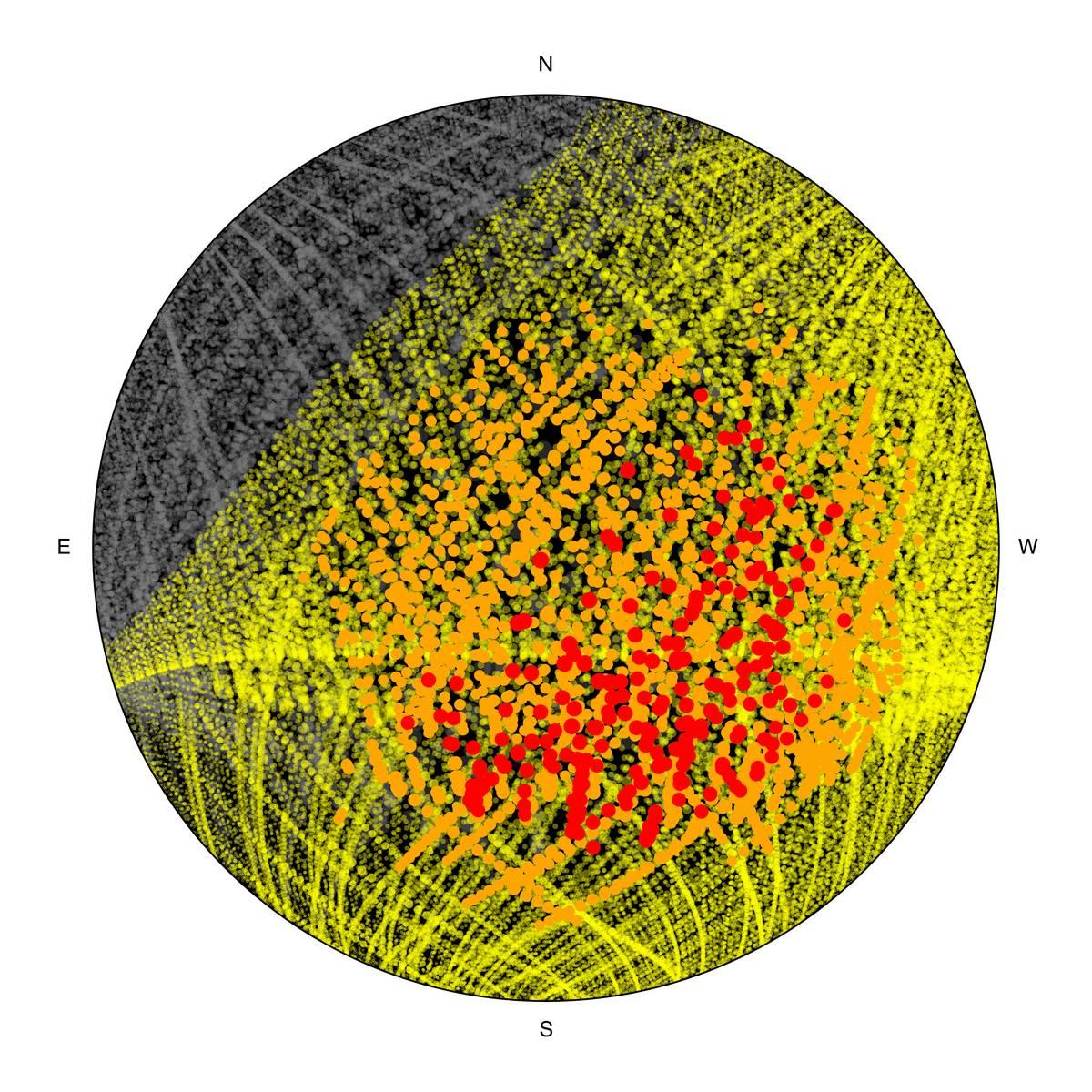
A 300-second exposure is a photograph whose sensor collects light for five minutes. A satellite crossing the field during that time leaves a sharp line, like a passer-by walking through a night photographer's shot. The line does not fade. You throw away the pixels it covers, or you throw away the frame. When trails come by the dozen, the faintest objects go first, and those are often the reason an 8-metre telescope was pointed at that patch for hours.
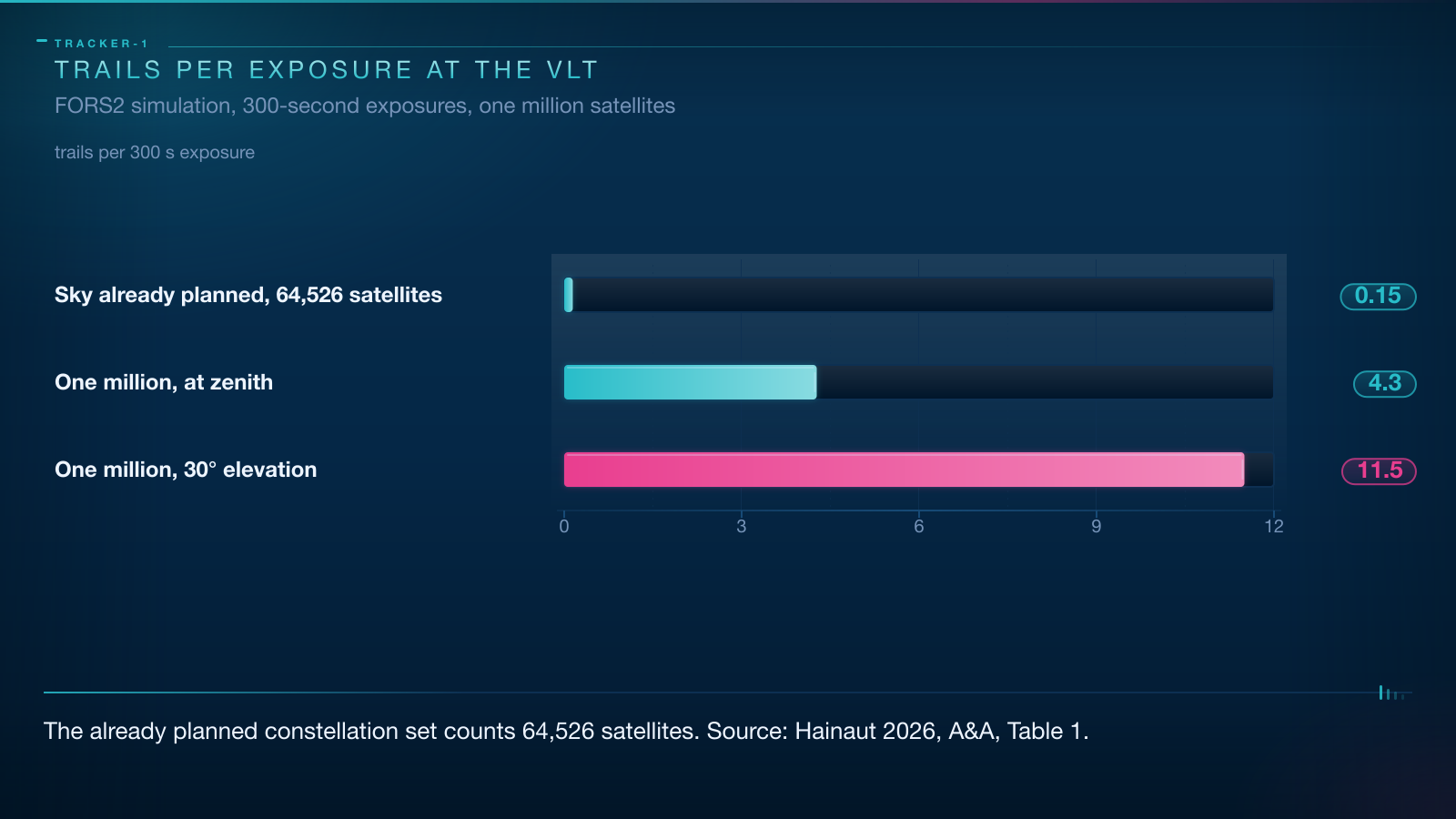
Rubin Observatory works differently: 15-second exposures, a far wider field. The same simulation counts 11.6 trails per frame at zenith and 31.3 at 30 degrees elevation. Field loss stays below 3%, but Rubin's camera is prone to saturation. A bright enough trail leaves a row of echoes, the so-called ghost trails, that can spoil much of the image. One over-bright satellite does not just cost a strip of pixels. It can cost the whole exposure.
Even invisible, every satellite adds a veil
A trail is not the only effect. A satellite too faint to be seen still sends light. That light scatters in the atmosphere and in the optics, and adds to the sky background. For one million satellites at magnitude 7, it amounts to 0.5 to 1.5% of the natural background, depending on time and direction. That is not huge, but the upper end of the range exceeds the 1% threshold set for prime astronomical sites.
The number gets more telling if satellites are slightly brighter. At magnitude 5, about 2,000 of them would be visible to the naked eye an hour after sunset. A dark sky usually shows 4,000 to 5,000 stars. The sky would then hold one satellite for every two stars or so.
Then there is radio noise. ESO writes that one million satellites would generate radio noise, impacting radio astronomy. The FCC answers that the Ka-band is for backup only, on an unprotected basis, and that SpaceX must stop any emission causing interference. The two arguments barely meet. One is about the power of a transmitter, the other about how many transmitters there are.
Launches and re-entries come next. One million satellites means launch after launch to get them up, then as many returns through the atmosphere at end of life. Rocket exhaust and particles, then the residue of satellites burning up, add to the upper atmosphere. ESO calls it atmospheric pollution from launches and re-entries. The FCC calls the concern speculative.
Then there is congestion. One million objects between 500 and 1,002 km, in a region already busy, raise the risk of chain collisions. Each impact makes debris, and debris makes more impacts. ESO names the risk without putting a number on it. The FCC approves the debris plan below 600 km and defers any decision above that altitude to a modification filed before deployment.
The 100,000 limit
ESO's study offers a yardstick. To keep field losses at the level of ordinary technical downtime, the total population should stay below 100,000 satellites, all fainter than magnitude 7. In July 2026, the study counted about 14,000 satellites in orbit. One million is ten times the limit and roughly 70 times today's fleet.
The number is not a law. Hainaut says so himself: this is not a hard number, like 99,999 is good and 100,001 is bad. He would prefer 50,000. But the yardstick makes the debate readable. The question is not only whether a satellite is too bright. It is how many there are.
No one settles that question globally today. The FCC says optical astronomy is not its business. No agency issues a permit for the sky. ESO Director General Andreas Kaufer sums it up: the approval highlights the urgent need for international mechanisms capable of assessing activities whose impacts extend far beyond national borders and affect a global common good.
ESO had already answered the FCC consultation, together with the Royal Astronomical Society and the International Astronomical Union. The FCC received nearly 1,500 comments on SpaceX's application and more than 1,800 on Reflect Orbital, a separate mirror-satellite project. The record was substantial. It ended with an order that sends astronomy to other forums.
What changes for skywatchers
For amateur astronomers, the change is already here. Trails cluster at dusk and dawn, when the Sun still lights the orbit while the ground is in darkness. That is the window for long exposures, the frames that collect the most light. One million satellites do not erase the sky. They remove its most useful hours.
The most fragile targets are the faintest. Distant galaxies of the kind Euclid hunts, Earth-sized planets around other stars, near-Earth asteroids. All need a dark background and a long exposure. That is exactly what a trail interrupts, and exactly what a veil of scattered light degrades.
Our light pollution map tracks low-Earth-orbit satellites and their positions in near real time. The sky map shows what remains observable night after night. Neither tool replaces a rule, but together they give the scale of the problem, one Earth orbit at a time.
The next steps sit on the FCC's calendar. One satellite by 2033, half the constellation by 2038, all of it by 2040. Before then, the debris plan above 600 km must be filed, and the NSF coordination remains to be spelled out. ESO keeps asking for an international rule. The sky, it says, is a common good. No one has written that into a licence yet.
Further reading
- ESO's statement: ESO statement on approval of launch of one million space data centres.
- The technical study: Large or bright satellite constellations, Hainaut, A&A, 2026.
- The FCC order: DA 26-1273.
- The July analysis: Beyond the limit.
- Site tools: the light pollution map, the sky map and the observing guide.