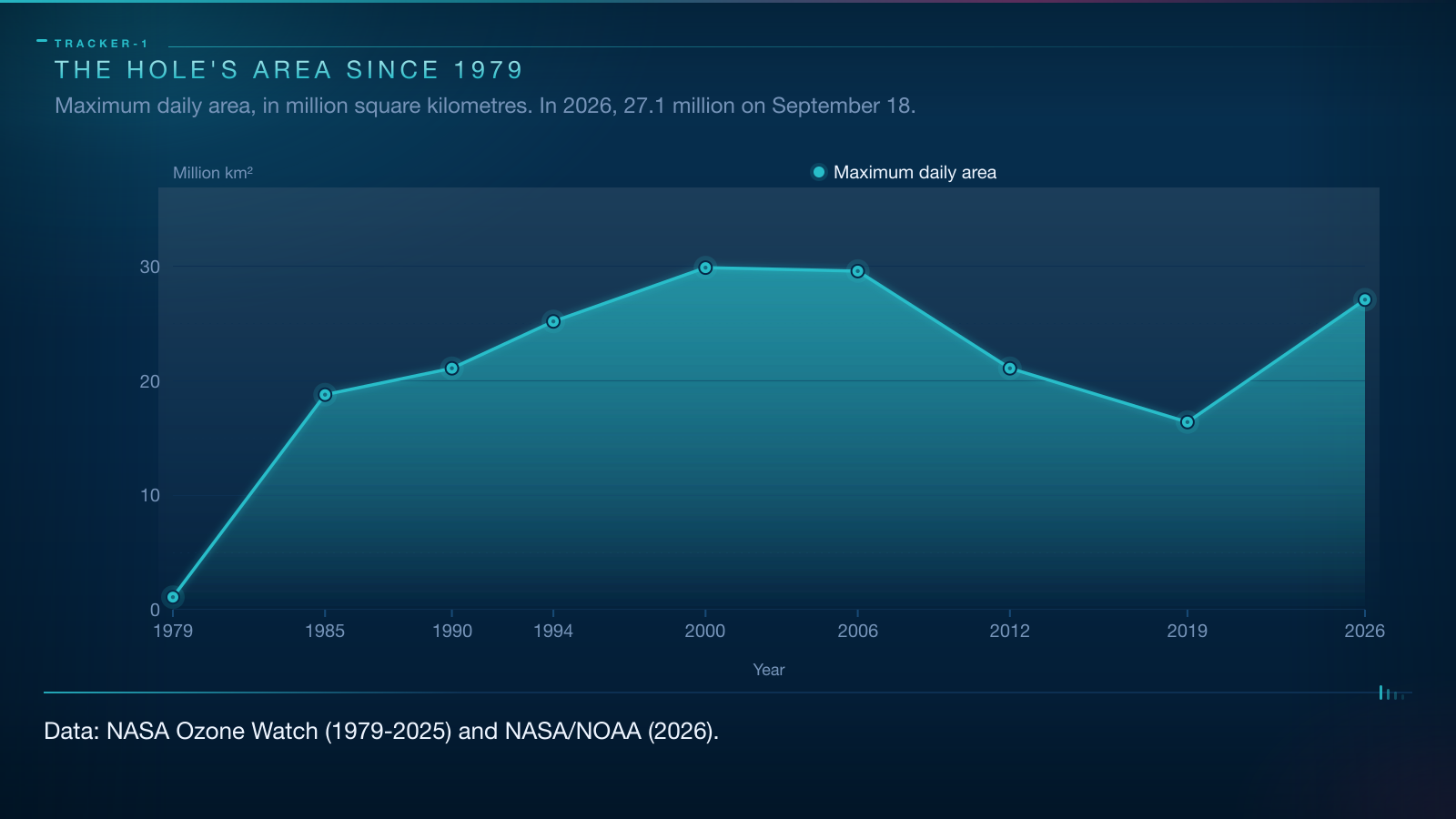
On September 18, 2026, the ozone hole above Antarctica spread across 27.1 million km², the seventh largest area in 48 years of satellite monitoring by NASA and NOAA (the US National Oceanic and Atmospheric Administration). It was also less deep than the great holes of the past. A remarkably strong polar vortex explains how both can be true, and in 2026 the measurements came from a NOAA satellite.
The biggest day: 27.1 million km²
Start with the number that made the rounds. On September 18, 2026, the area where ozone falls below the historical threshold of 220 Dobson units covered 27.1 million km². That is the largest single-day extent of the year. Across the peak of the destruction season, from September 7 to October 13, the hole averaged about 25 million km².
By area, the 2026 hole ranks seventh in 48 years of monitoring. NASA and NOAA published that ranking in their November 4, 2026 release, and it carries a caveat that is easy to miss: the hole was not as deep as other large ones on record. Two NASA pages even look like they disagree, since one ranks 2026 seventh while the other recalls that the largest hole dates from 2006. Both are right, because they measure different things.
One measure is the single-day maximum. There, September 2000 holds the record at 29.9 million km², according to the annual table of NASA Ozone Watch. The other measure is the mean area across the whole destruction season. There, 2006 leads with 26.6 million km². The 2026 hole slips between the two, with 27.1 million km² at its peak and about 25 million on average. In 1979, the first year of the series, the maximum daily extent was just 1.1 million km². The hole is big. It breaks no record.
The vortex that stretched the hole
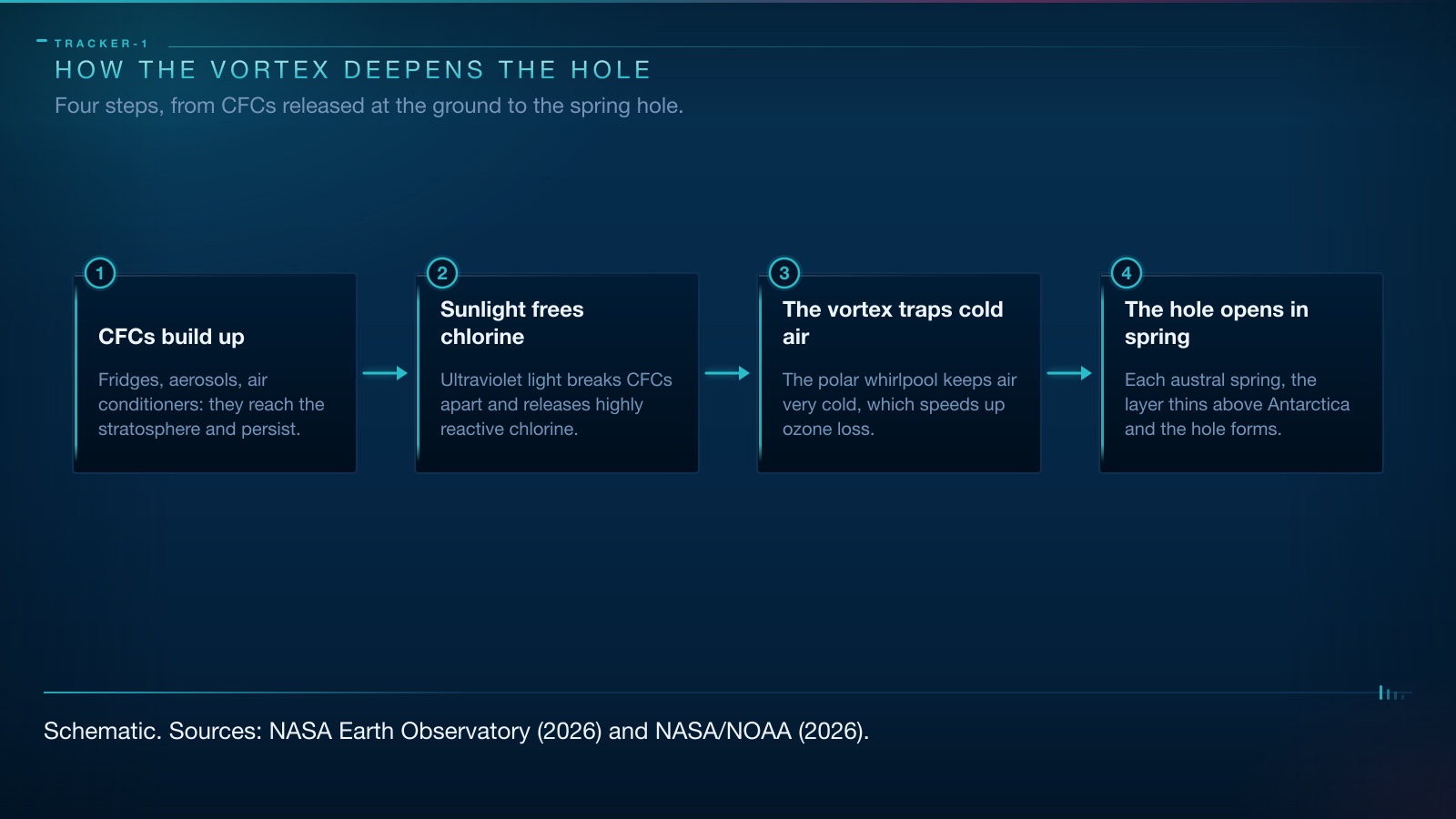
A polar vortex is a whirlpool of winds that settles over each pole in winter. It seals off a mass of very cold air from the rest of the atmosphere, like a lid on a pot. The firmer the lid, the colder the trapped air, and the faster the chemistry that destroys ozone runs.
The Antarctic vortex helps create the cold conditions that allow chlorine and bromine from human-made compounds to deplete stratospheric ozone. In 2026 the lid fit with unusual firmness. "An unusually powerful polar vortex has extended ozone depletion in the Antarctic this season, allowing the hole to grow to proportions we haven't seen in a decade," said Paul Newman of the University of Maryland, Baltimore County (UMBC) and NASA Goddard.
The reason sits lower down. Planetary-scale weather systems normally push up from the lower atmosphere and break the vortex apart. In August and September 2026, those systems were especially weak. "That weak wave action kept the strongest polar vortex winds further from the pole by several degrees of latitude, creating a larger area for conditions ideal for ozone depletion to occur," said Amy Butler of NOAA's Chemical Sciences Laboratory.
The result: the vortex covered more ground, and the cold zone where destruction runs best grew with it. The 2026 hole is not the sign of a layer collapsing. It is the sign of a year with the weather on its side.
A wide hole with a shallow core
The second measurement tells a different story. At the core of the hole, ozone concentration over the South Pole fell to 105 Dobson units on October 17, 2026, the lowest value of the year. The figure comes from balloon-borne instruments at NOAA's South Pole Baseline Atmospheric Observatory.
That is well above the record low at the same site, 92 Dobson units in October 2006. It is also far above the deepest point of the series, 73 Dobson units on September 30, 1994.
The unit is abstract, so here is what it means in practice. A Dobson unit measures the total amount of ozone in a column of atmosphere. One unit equals a layer of pure ozone 0.01 millimeter thick at 32 °F and the pressure of one atmosphere. Earth's average layer holds about 300 Dobson units, or 3 millimeters, roughly the thickness of two stacked pennies. At the core of the hole, concentration drops to around 100 Dobson units, about 1 millimeter. The hole is not a void. It is a dramatic thinning of a layer that was already thin.
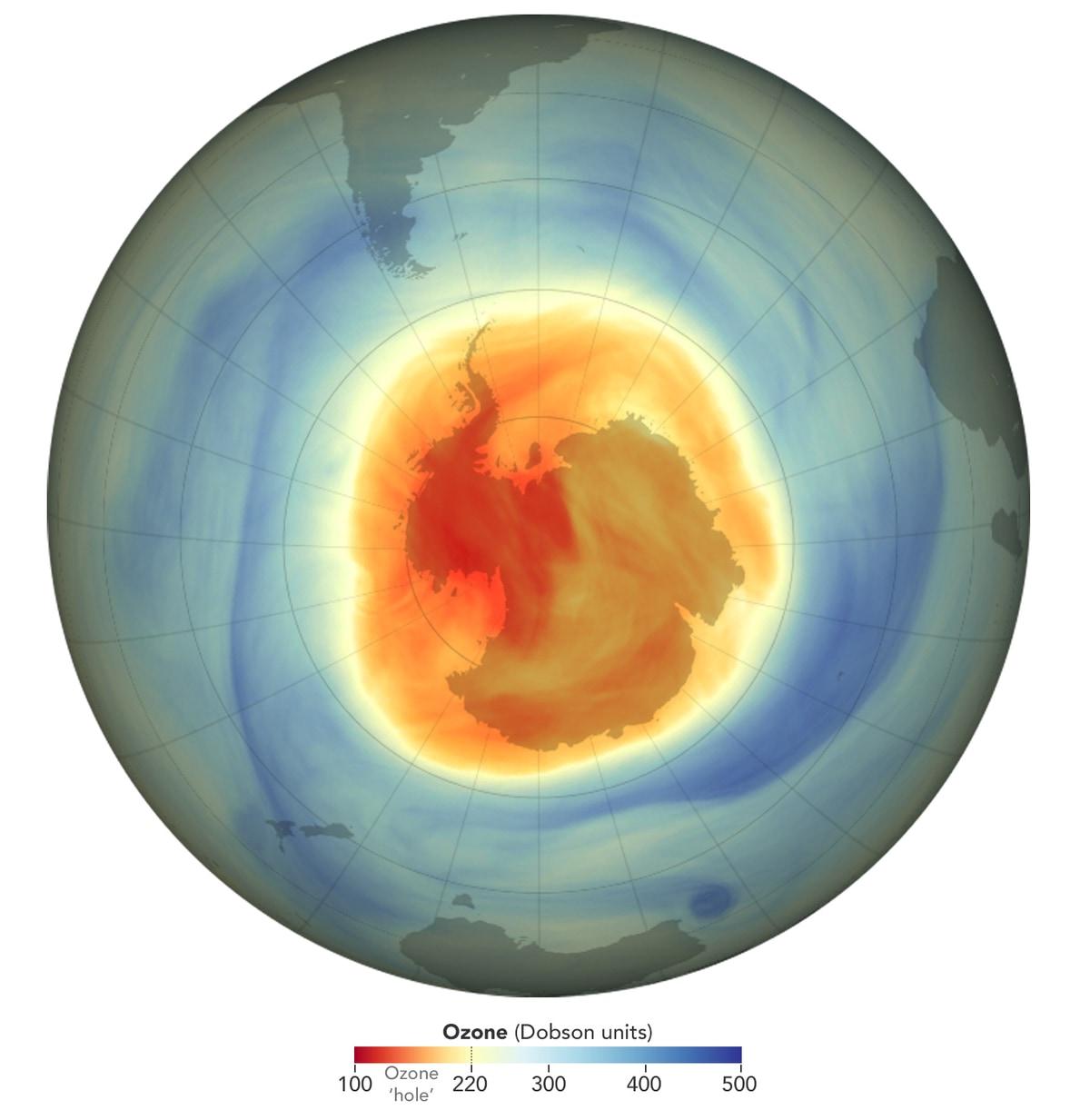
The gap between area and depth is good news. It fits with the slow decline of human-made chlorine. The hole stayed wide because the vortex was exceptional, but its core is less depleted than it once was. The layer is healing slowly, and the weather decides the shape of the hole each year.
The measurement chain that goes back to 1979
This ranking would not exist without 48 years of uninterrupted measurements. Since 1979, instruments have handed off to one another in orbit. TOMS (Total Ozone Mapping Spectrometer), on Nimbus-7 and several other satellites, covers 1979 to 2004. OMI (Ozone Monitoring Instrument) on Aura follows from 2005 to 2011. OMPS (Ozone Mapping and Profiler Suite) on Suomi NPP measures from 2012 to 2025. In 2026, the data come from OMPS on NOAA-20.
One year is missing from the annual series: 1995 has no data. The record also starts at a turning point. Before 1979, scientists had never observed atmospheric ozone below 220 Dobson units.
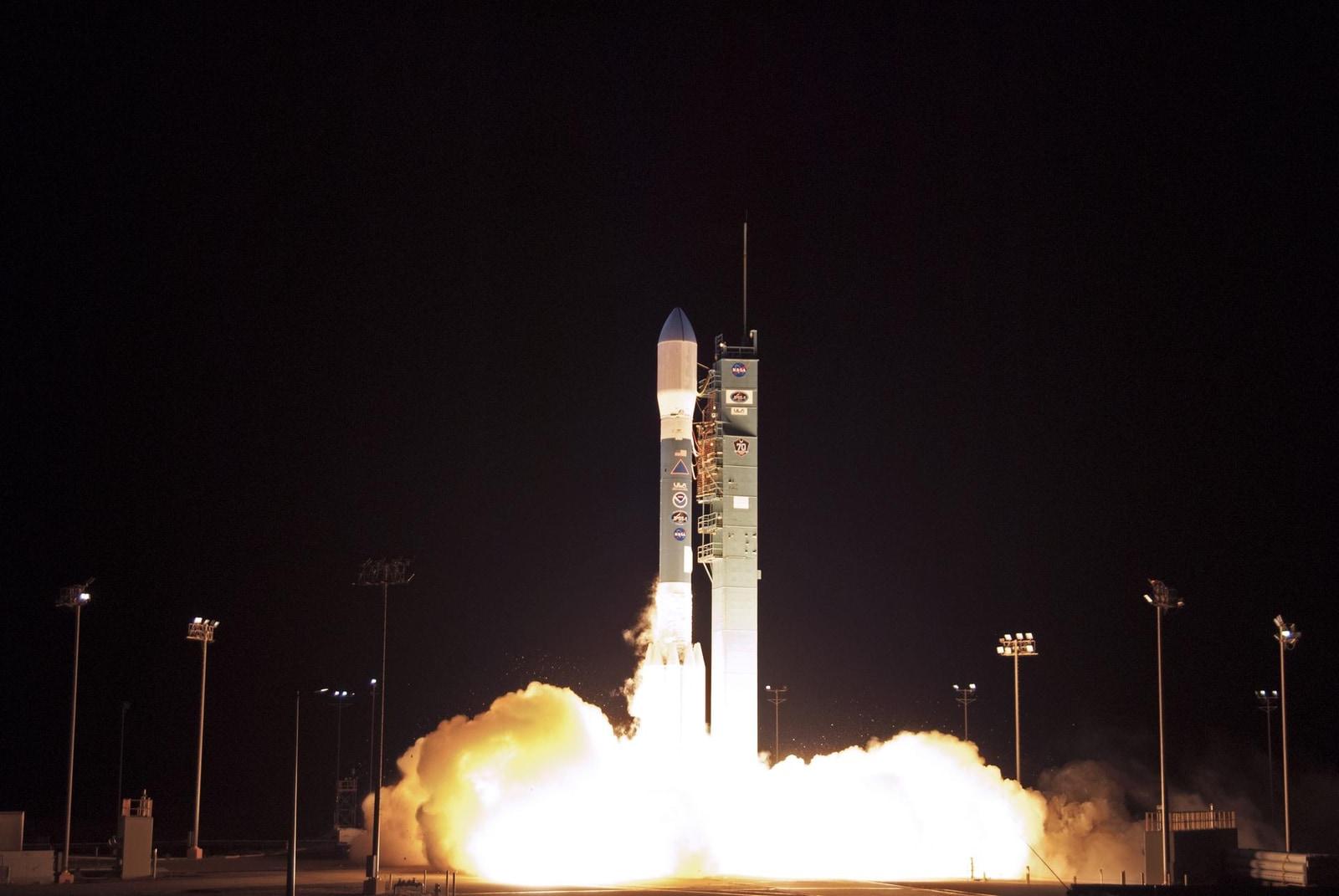
NOAA-20 is a US weather satellite in the JPSS (Joint Polar Satellite System) series, formerly known as JPSS-1. It launched on November 18, 2017, on a Delta II rocket from Vandenberg Air Force Base in California. Like its siblings, it circles Earth from pole to pole 14 times a day, which gives full global coverage twice daily. Each JPSS satellite carries at least four state-of-the-art instruments, and OMPS is one of them.
OMPS has two sensors that look straight down at the ground and one that scans the atmosphere edge-on. Its main job is to track the concentration of ozone, which matters because the ozone layer blocks harmful ultraviolet light from the Sun.
Handing over from one sensor to the next is a job in itself. No two instruments see the atmosphere in exactly the same way, so teams overlap their records and cross-check them before the official switch. Without that bridge, the seventh place of 2026 could not be compared with 2000 or 2006 at all.
What Montreal already took off the table
The ozone hole was the first planetary environmental problem that humanity saw coming and then acted on. In 1985, scientists from the British Antarctic Survey, working from ground measurements at Halley Research Station, reported that the ozone layer was thinning sharply over Antarctica every spring.
The chemistry behind it starts on the ground. CFCs (chlorofluorocarbons) are long-lived chemicals that were used in refrigerators and aerosol sprays since the 1930s. They drift into the stratosphere, where ultraviolet light breaks them apart and releases chlorine, a very reactive atom that repeatedly catalyzes ozone destruction. About 80% of the chlorine in the stratosphere today comes from human sources, not natural ones. CFCs can linger in the air or leak out of old products and landfills for decades.
In 1987, recognition of what CFCs could do led to the Montreal Protocol, a treaty that phases out the consumption and production of ozone-depleting chemicals. The effect is measurable. Chlorine from ozone-depleting substances in the Antarctic stratosphere has declined by about a third relative to 1980s levels. In 2018, scientists reported the first direct satellite evidence of recovery, with a 20% decrease in ozone depletion during the Antarctic winter months between 2005 and 2016. In 2019, unusual weather in the upper atmosphere produced the smallest hole since 1982.
Without Montreal, 2026 would have been worse. By NASA's estimate, the hole could have been 3.5 million km² larger if ozone-depleting substances were still at their peak of 2000. Scientists estimate the hole will recover by the 2070s. Until then, the weather will keep moving its size from one year to the next.
Going further
- Track the planet from orbit: our live Earth page gathers the indicators measured by satellite, and the observing guide explains what you are looking at.
- Another story where the weather decides everything, seen from orbit: our article on Arctic winter sea ice.
- Useful concepts: the atmosphere, which holds the ozone layer, ultraviolet light, which ozone absorbs, and Earth orbit, where the measuring satellites travel.
- Earth observation is not limited to dedicated satellites. The International Space Station also carries instruments pointed at the ground.
- Sources for this article: the NASA and NOAA release of November 4, 2026, the NASA Earth Observatory note of November 9, 2026, the NASA Ozone Watch annual table, the Dobson unit explainer and the NOAA page on JPSS and its instruments.