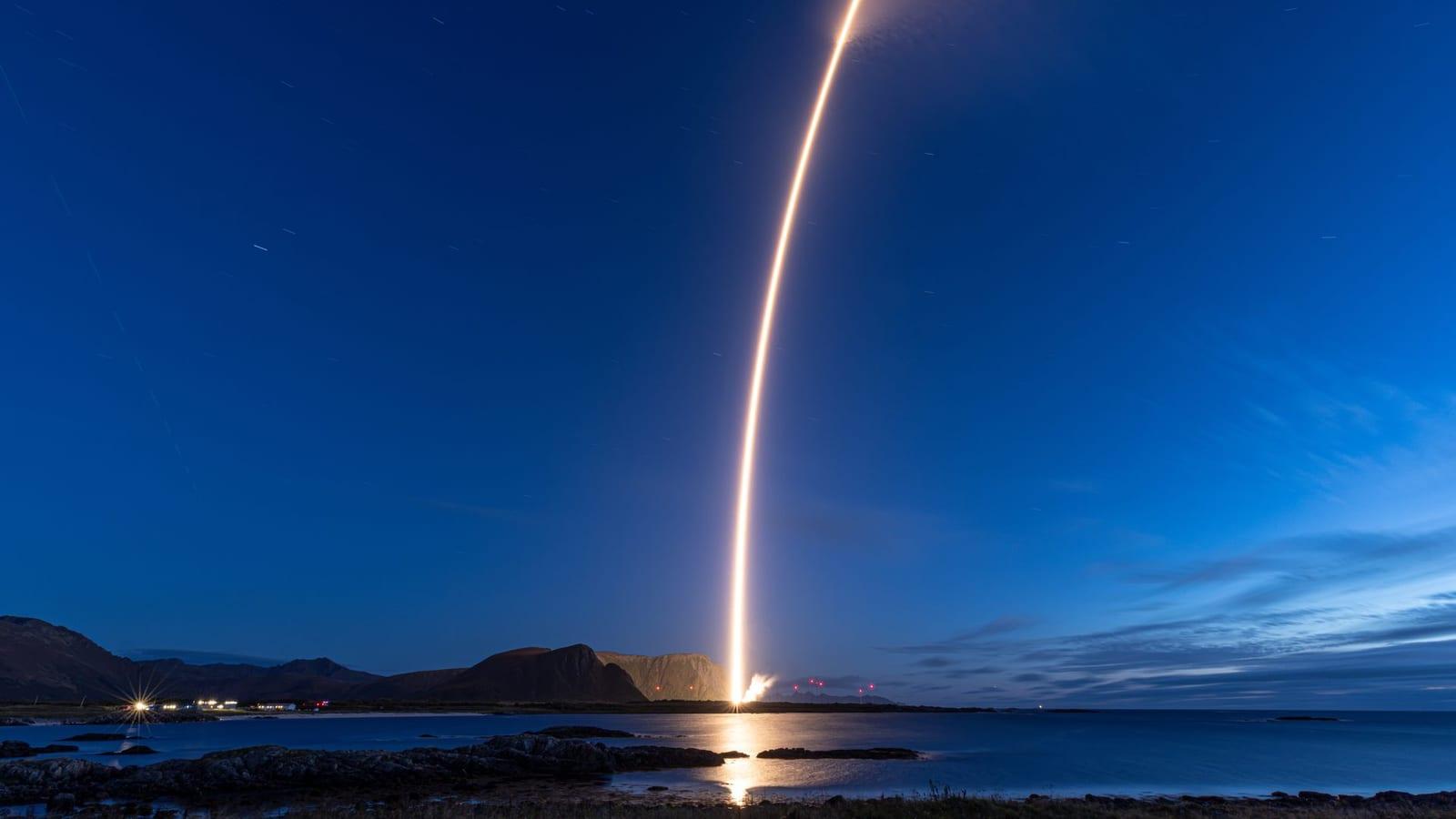
At 22:12 local time on September 5, 2026, Isar Aerospace's Spectrum rocket lifted off from the Norwegian island of Andøya, above the Arctic Circle. Minutes later, its satellites were coasting on an Earth orbit. A first for continental Europe. Here is the flight, the rocket, and why it matters.
From the Norwegian Sea to orbit, step by step
The launcher left its pad at 22:12 sharp, 20:12 UTC, from the launch complex Isar Aerospace operates exclusively within the Andøya Space site, officially opened in late 2023 as continental Europe's first operational orbital spaceport. Under the first stage: nine Aquila engines, fed by propane and liquid oxygen, the fuel of our camping stoves paired with an oxidizer, the substance that lets it burn where there is no air. The rocket headed north over the Norwegian Sea, a marine trajectory that never flies over populated areas.
The first trial of the flight is called MaxQ: the moment when air pressure on the structure peaks, while the rocket keeps accelerating through air that is still thick. Spectrum sailed through it. Then the first stage engines shut down and the stage detached, like a relay runner handing over the baton. The second stage carries a single Aquila, and it took over.
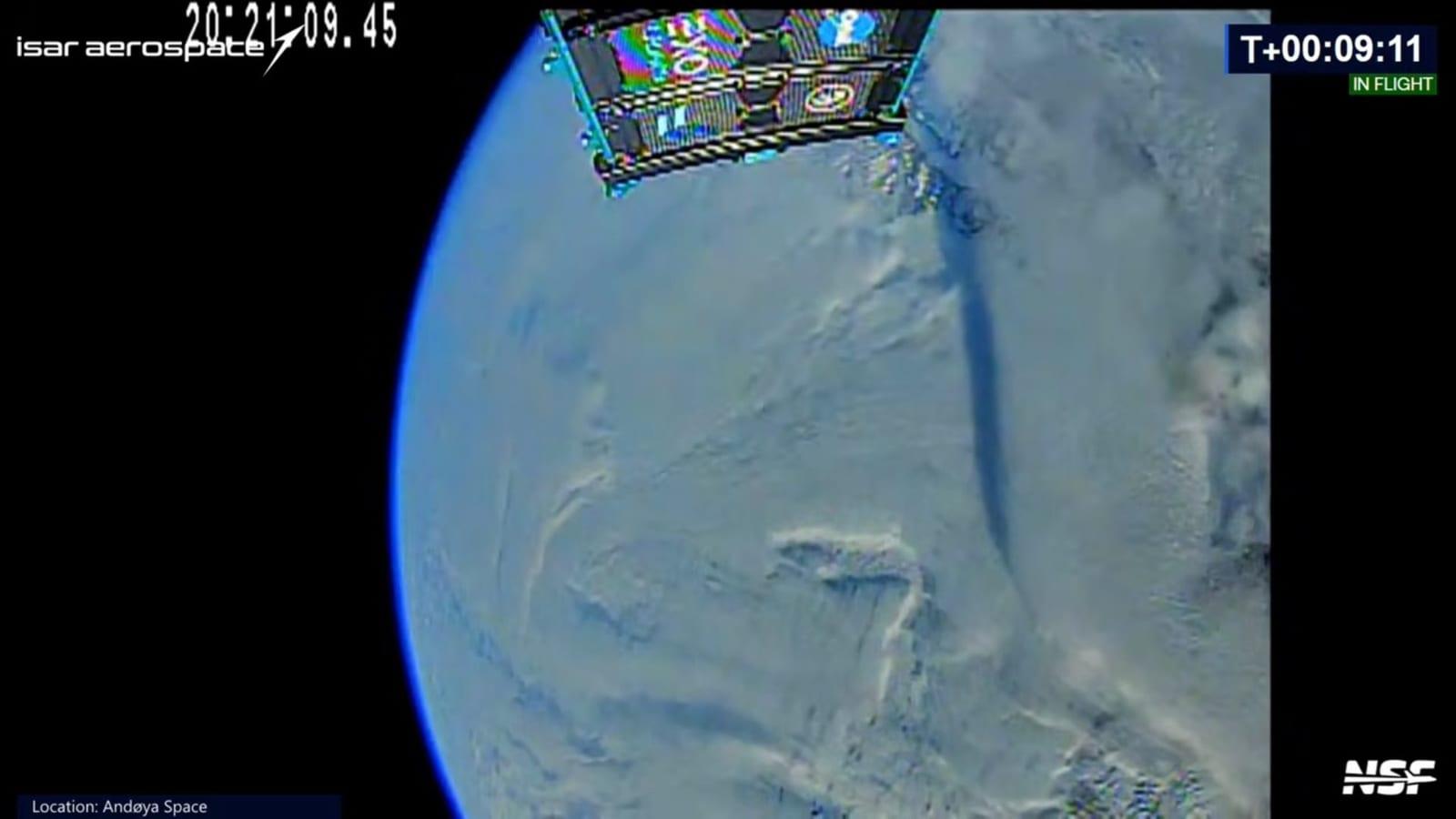
Next came the Kármán line at 100 km altitude: the conventional boundary of space, where air grows too thin to support an aircraft. Up in the vacuum, the fairing, the protective nose cone that sheltered the satellites during the climb through the atmosphere, has no more job to do: it is jettisoned. The second stage pushed on to orbital velocity, then performed a circularization burn, the short maneuver that rounds out the trajectory the way you steady a hoop. Payload deployment closed out the sequence, with every milestone confirmed in Isar Aerospace's press release.
At the end of the run, the German space agency DLR confirmed it: the five satellites and the experiment made it to their target orbits.
Spectrum by the numbers
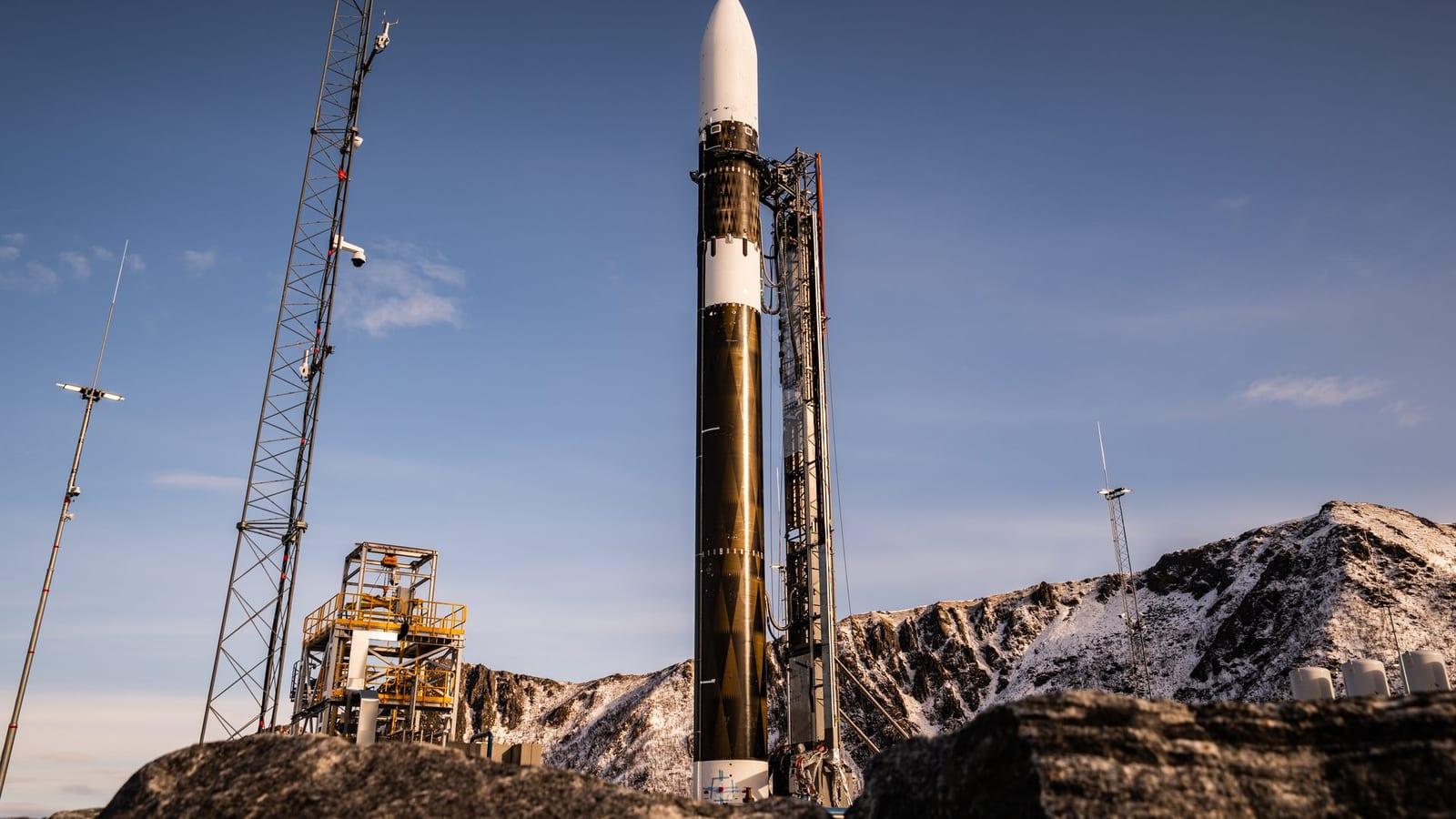
- Height: 28 m, roughly a nine-story building.
- Diameter: 2 m.
- Engines: nine Aquila on the first stage, one on the second, all designed in-house.
- Propellants: liquid oxygen and propane.
- Capacity: up to 1,000 kg to low Earth orbit, 700 kg to sun-synchronous orbit.
30 seconds of flight in 2025, eighteen months to learn
This success is only the rocket's second flight. The first test, named "Going Full Spectrum," lifted off on March 30, 2025 at 12:30 CEST. The flight lasted about 30 seconds: after a clean liftoff, the flight termination system, the safety mechanism that shuts the engines down to prevent an uncontrolled fall, ended the launch, and the rocket dropped into the sea in a controlled manner. The pad survived intact, and Isar Aerospace called its objectives met: liftoff validated, flight data collected, termination system proven in real conditions.
For a test flight, 30 seconds is already a harvest: every sensor sent back what engineers cannot measure anywhere but on the pad, when everything shakes, heats up and pushes at once.
The road back to the launch pad took eighteen months. The 2026 campaign was interrupted repeatedly, always out of caution: components replaced and requalified, stage tests, and a wet dress rehearsal, where the tanks are filled as if for a real launch without lighting the engines. The last standdown, in June, followed off-nominal behavior in the rocket's fluid systems, documented by the company on its Mission Updates page.
Why you must hit 28,000 km/h to fall into orbit
Orbit is an apparent paradox: a satellite in orbit falls constantly, and it never touches the ground. Picture a cannon on top of a mountain, firing horizontally. The faster the ball flies, the farther it lands. At roughly 28,000 km/h, its falling curve matches the curvature of the Earth: it falls "around" the world without ever reaching it. That is exactly what a satellite does, and that is the speed Spectrum had to reach, about thirty times that of an airliner.
At that speed you live in low Earth orbit, the band of altitude stretching up to about 2,000 km, home to the International Space Station and the Hubble telescope: the ISS shares the same neighborhood as the satellites deployed this September 5. The glossary breaks the concept down: Earth orbit.
Why launch from the Arctic Circle? Because geography serves polar orbits, the paths that pass over the poles. Heading north over the sea, a launcher never overflies populated zones, and the trajectory leads to sun-synchronous orbits, the favorite orbit of Earth-observation satellites: they cross every region at the same solar time, which makes images comparable from day to day.
Five CubeSats, five countries: the cargo that counts
A word first: this launch was a qualification flight, the graduation exam of a rocket, the launch that proves the vehicle can carry real payloads. Spectrum had already flown, but it was its first time with customers on board.
Six payloads in total: five CubeSats and one technology demonstration experiment. A CubeSat is a miniature satellite built to a standardized format, the smallest version fitting inside a 10 cm cube, now the standard for universities and space startups. They come from Germany, Norway, Austria, Slovenia and Bulgaria, according to DLR, and test innovative technologies and components for tomorrow's satellites. ESA describes the cargo as commercial and educational CubeSats, carrying experiments that also give learning opportunities to students across Europe. Isar is equally proud to fly a Norwegian student satellite.
How was this small cargo selected? Isar Aerospace won the first edition of the Microlauncher Competition, the contest run by the German space agency DLR for new small launchers: the payloads of that contest took the seats under the fairing.
Behind that choice lies a deliberate European strategy: the company was incubated at an ESA Business Incubation Centre, the agency's network of incubators for space startups, then co-funded repeatedly under the Boost! program, which backs commercial space transportation services. The "Onward and Upward" mission itself is supported by that program. With ESA, Europe is betting on the private sector to widen access to orbit.
What this launch changes for Europe
Until now, putting a European satellite into orbit meant lifting off from Kourou, in French Guiana, outside the continent, or relying on foreign rockets. A private company born in Munich now offers an alternative dedicated to small and medium satellites, launched from European soil. "Today, Isar Aerospace opened space from Continental Europe," summed up Daniel Metzler, CEO and co-founder of the company, who reminds everyone that launch remains "the largest bottleneck" of the global space industry (quotes translated by us). The company even speaks of sovereign access to space for Europe.
The date is no coincidence: Isar Aerospace was selected in 2025 for the European Launcher Challenge, the ESA program that contracts launch services from Europe's new providers. The contract was signed recently, with a first milestone attached: reach orbit no later than 2027. On September 5, Isar became the first provider to validate it, ahead of the deadline.
On the industrial side, the machine is already running: Spectrum units 3 to 7 are in production, a 40,000 m² integrated factory, presented as the largest in Europe for launch vehicles, is nearing completion, with a target capacity of 40 launchers per year. And to cover other kinds of orbits, a second launch complex is under construction in Nova Scotia, Canada, aimed at mid- and high-inclination orbits, the ones used for Earth observation and communications.
The next step remains: turning this qualification flight into a steady cadence. One successful launch does not make a production line. But it took one rocket to open the door.
Going further
- Feel like looking up tonight? Track the International Space Station and bright satellites with our sky map, then plan your nights with our observing guide.
- The definitions to follow launcher news: launch, Earth orbit and ESA.
- The sources of this article: ESA launch page, DLR release, European Commission note, Isar Aerospace press release.
- The launch video: Isar Aerospace on YouTube.
- Your best shots of the sky: share them in our astrophotography gallery.