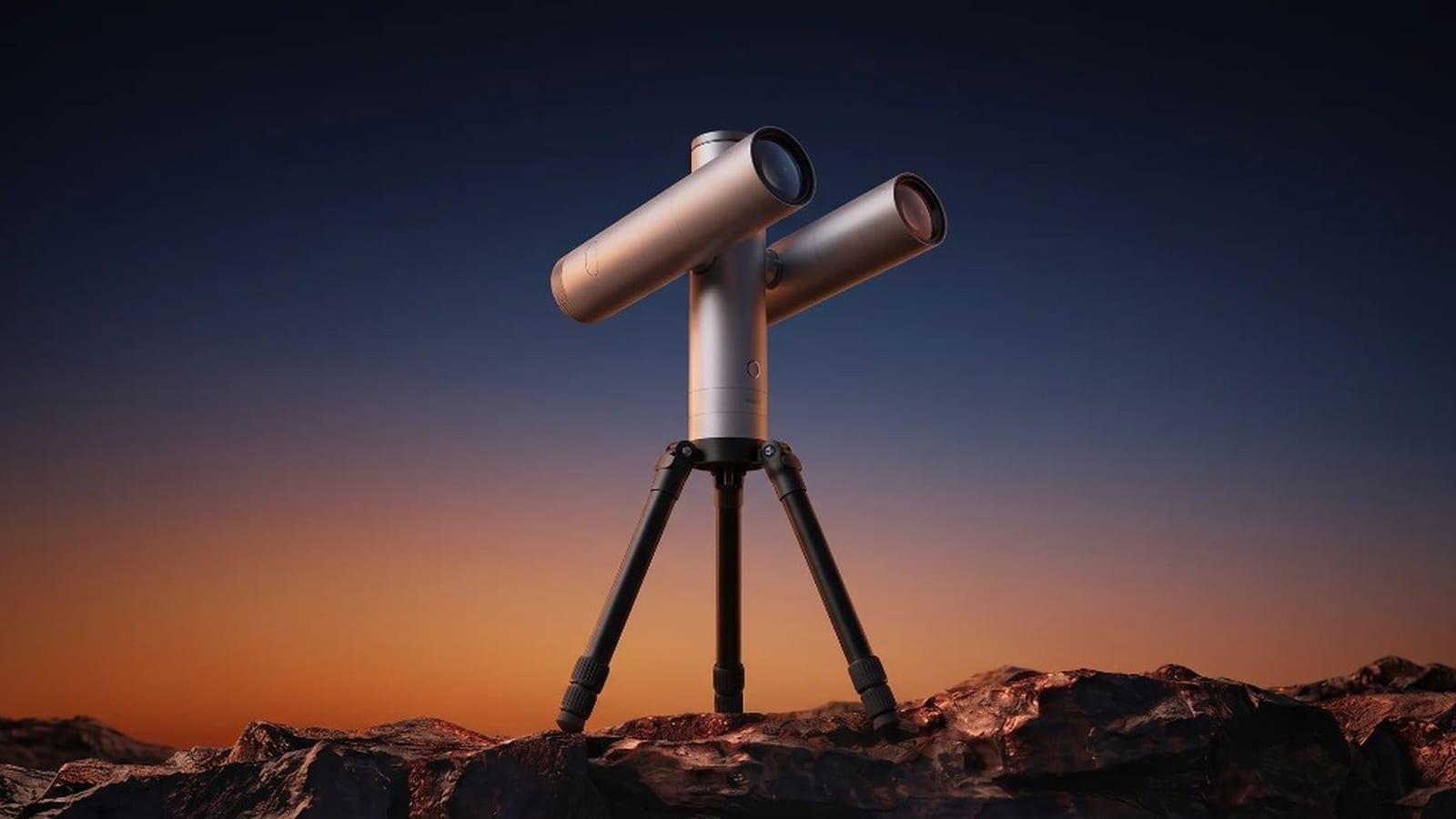
On October 15, 2026, French company Vaonis pulled the cover off Atlas, its new smart telescope. The idea fits in one sentence: split the mount, the part that carries the instrument and tracks the turning sky, from the imaging modules that sit on top. Keep the mount for ten years and more, swap the optics in seconds. With Atlas, France pushes forward the shift it started a decade ago, bringing astrophotography into the living room.
One mount for ten years, modules that swap in five seconds
Nothing is bolted together on a classic telescope, and that is the trap. The mount, the optics, the guide camera, the filter wheel and the control software are separate parts, picked one by one and assembled to measure. That freedom costs time and technical skill: choosing compatible pieces, balancing the load, performing the polar alignment that squares the mount with Earth's axis, then correcting the drift throughout the exposure. A good imaging rig takes weeks, sometimes months, to build. That demand is why a large share of telescopes bought ends up in a closet.
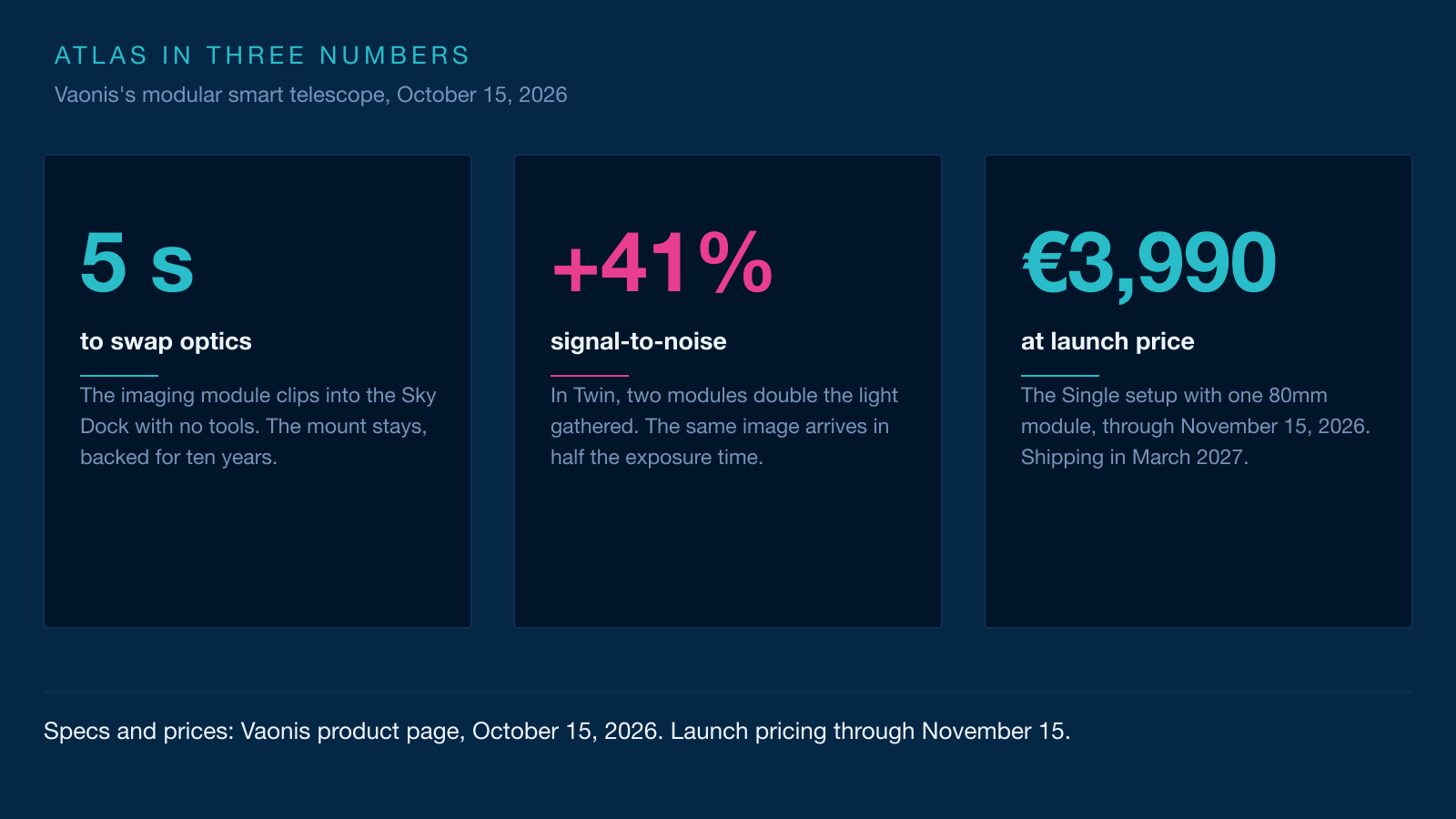
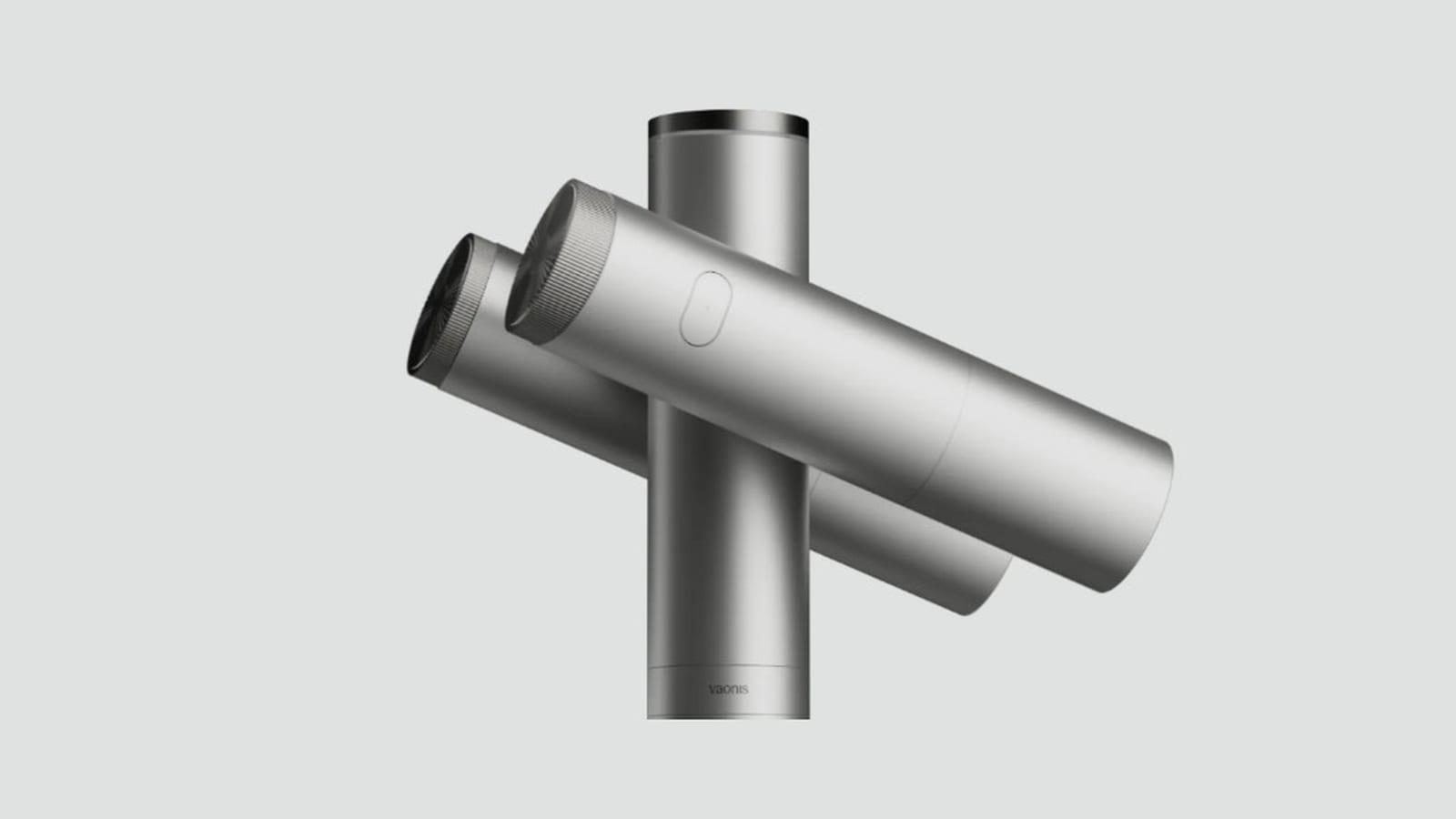
Atlas flips that logic. At the heart of the mount sits Sky Dock, a proprietary interface. The imaging module, the part that holds the lenses and the sensor, clips into it with no tools in under five seconds. The mount stays, only the module changes. Vaonis says a single mount can carry up to two imaging modules at once, each fed by this interface at up to 3 Gbit/s.
The launch module measures 80mm across and 360mm in focal length. Two terms worth unpacking. Aperture is the diameter of the lens that gathers light: the wider it is, the more photons the instrument catches, the way a bigger window lets in more daylight. Focal length sets the magnification, so the patch of sky you frame. The ratio between them is called the f-number, which here comes to 4.5. A small number after the f means a bright optic, built for photography.
The native field, the patch of sky captured in a single photo, is 1.78° by 1.00°. To picture the scale, the Moon spans about 0.5°: Atlas frames nearly three and a half Moons side by side. When a nebula spills past the frame, the CovalENS software stitches several panels together live, like a phone panorama, and hands back a single image of up to 3.5° by 2.00°.
Why a classic telescope can frustrate, and what Atlas changes
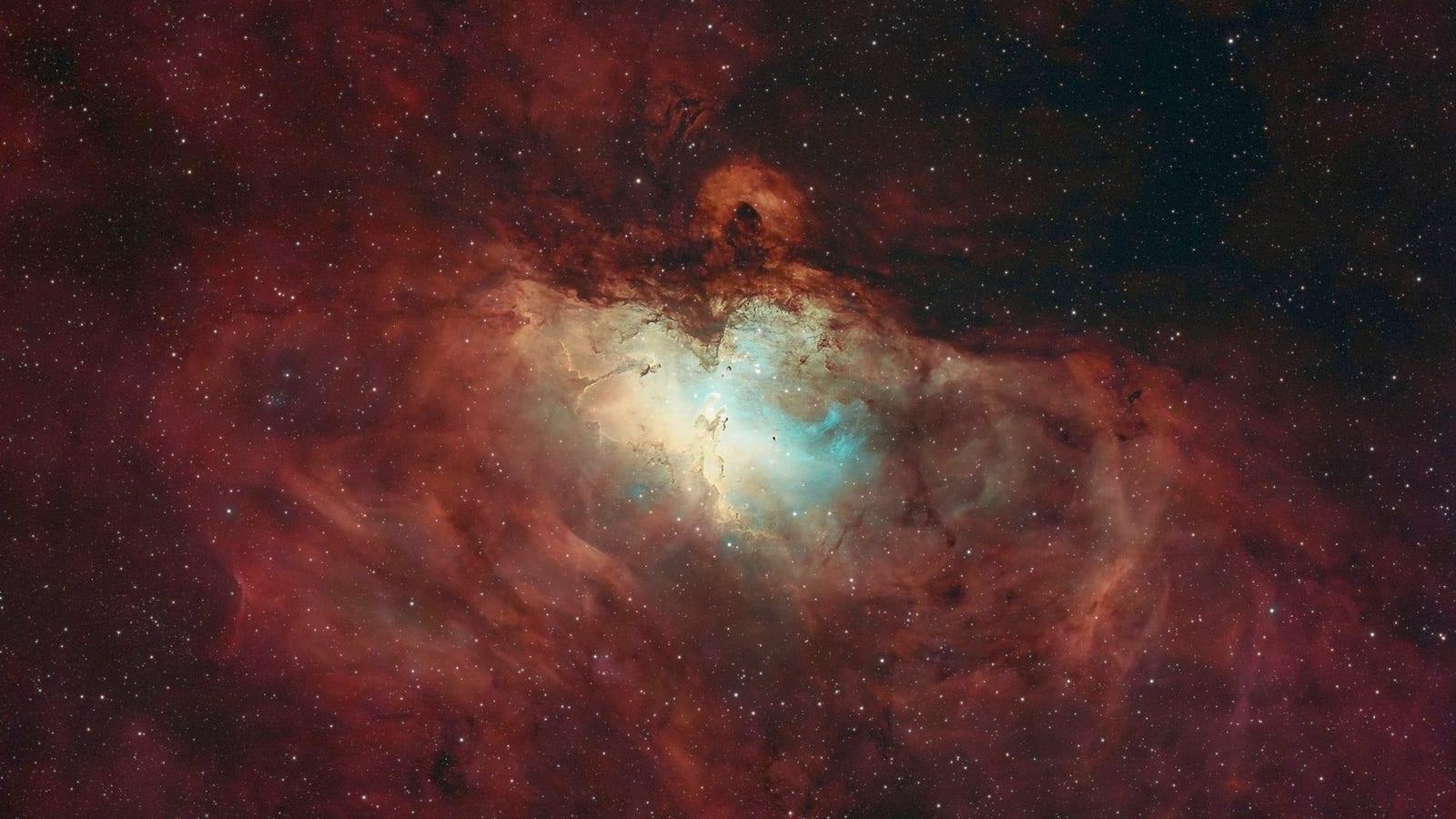
Amateur astronomy carries a reputation for disappointment, and the reason is biological. The human eye works like a camera whose shutter stays open for a twentieth of a second. It sees the instant, it does not bank light. Nebulae and galaxies are so faint that a large traditional telescope shows them at the eyepiece as a greyish haze. The striking image from a magazine never comes out of the eyepiece. Add the complexity of the build described above, which often puts people off before the first photo is even taken.
The smart telescope turns the chain around. It replaces the eyepiece with an electronic sensor, which banks light minute after minute, and with an app. The sensor plays the part of an eye that never blinks: each second of exposure adds to the last, and faint detail emerges steadily on screen. The mount aims by itself, tracks by itself, stacks by itself.
Atlas pushes the pitch a step further with Sky Guard, a wide fisheye camera fitted to the mount. It films the whole sky above you, 360°, day and night, and picks out stars down to magnitude 6. Magnitude is a brightness scale that runs backwards, like a counter ticking down: the smaller the number, the brighter the object. Magnitude 6 marks the limit of what the naked eye can make out under a dark sky. In other words, Atlas sees what you see, and you simply tap a point in the sky on screen for it to aim.
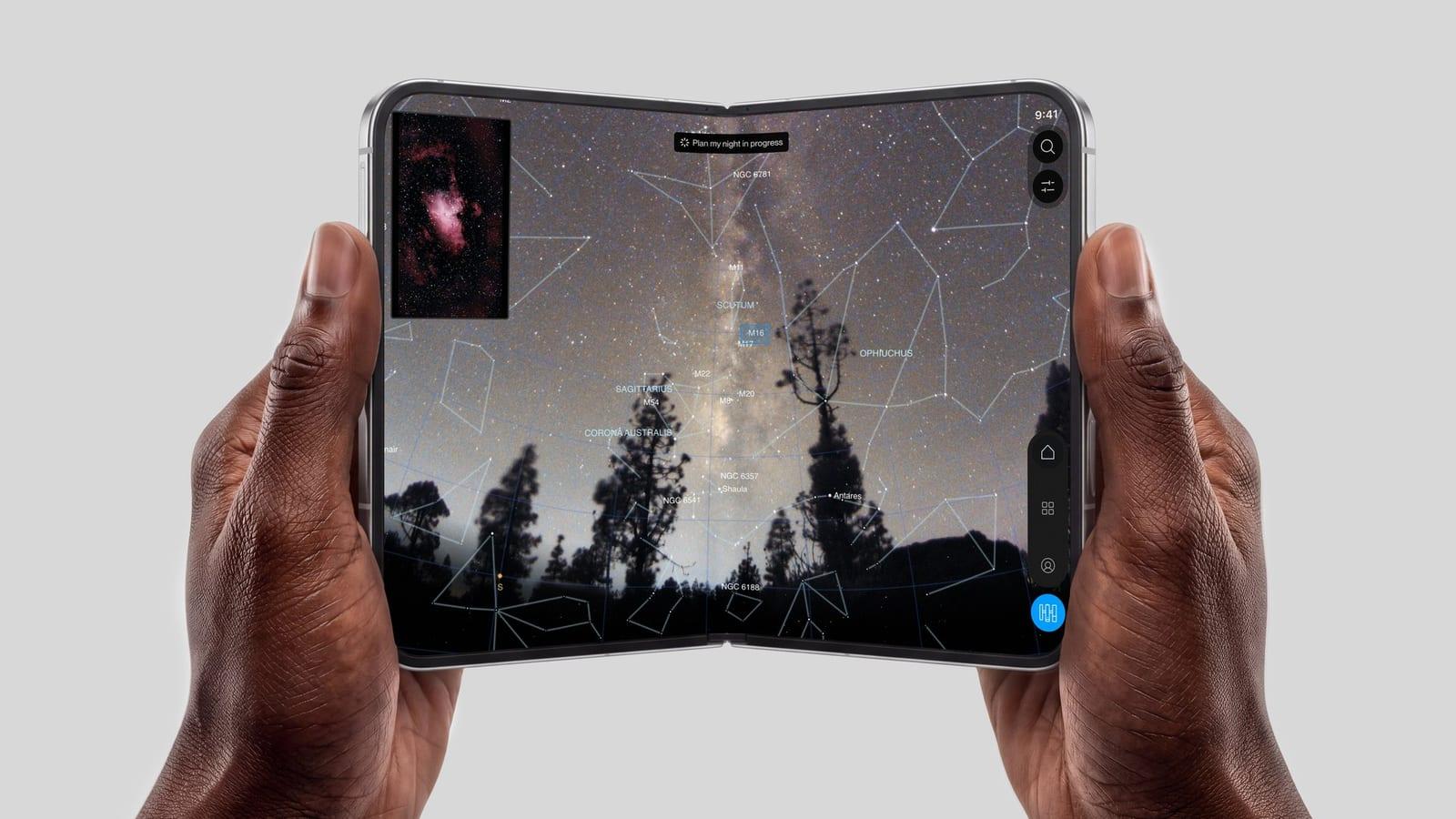
Beyond the image, the Gaia app gathers the useful functions. Plan My Night lines up the night's targets in advance, and the telescope works through them on its own. Multi-night mode resumes the same target from one session to the next and adds up the exposure time, letting the faintest detail surface night after night without starting over. More than ten people can log in at once and watch the image build on their own phones. And for anyone going further, raw files export as FITS and 16-bit TIFF, the working formats of astrophotographers, into standard processing software.
Are two imaging modules better than one
The question matters, since the Twin version costs €1,500 more than the Single. The answer comes down to a property of light. Two identical optics aimed at the same target, across two sensors, gather twice the photons at every instant. Noise, though, does not double the same way: it only grows with the square root of the number of frames. Since the signal doubles while the noise climbs more slowly, the ratio between them improves by roughly 41%.
Put into practice: the same result arrives in half the exposure time. For a faint object, that can mean the difference between an hour and thirty minutes under a sky that is closing in. Vaonis sums up the effect in a telling phrase: the module pair gathers light like an f/3.2 optic, brighter than the f/4.5 of a single module. Stacking the two images is automatic from the moment the sequence starts, and both modules always point at the same target.
One honest caveat, spelled out by Vaonis: watching two different objects side by side is not a feature of the product. The two modules are built to reinforce each other, not to split the sky.

From Montpellier to Marseille, France invents the people's telescope
Atlas did not come out of nowhere. It extends a movement two French companies kicked off at almost the same time, about 125 miles apart. Vaonis was founded in Montpellier in 2016 around Cyril Dupuy, an aerospace student who left university at 24 to start the company. Its first product, Stellina, landed in 2018: a compact U-shaped body, no eyepiece, driven by an app. It was the first smart telescope to reach the market.
Unistellar came to life in Marseille in 2015, co-founded by Arnaud Malvache, who holds a doctorate in optics, and Laurent Marfisi, a former Airbus engineer. Their first instrument, the eVscope, was born from a crowdfunding campaign in 2016. Its amplification technology, called Enhanced Vision, boosts the light signal from objects in real time, while its algorithms strip noise and city light pollution out of the image.
Both companies started from the same diagnosis. Through the 2010s, a quality telescope stayed a product for insiders, bulky, complex, and often abandoned. They picked the same answer: gather the optics, the motorized mount, the sensor and the app into one object, so that observing takes a few minutes and happens from a balcony. Unistellar showed its eVscope at CES in Las Vegas as early as 2017, while Vaonis earned recognition there in 2018, then again in 2021.
Today, Vaonis says its instruments have shipped to more than 60 countries, and its new Atlas mount carries a ten-year warranty. The thinking behind that warranty is as much ecological as commercial: by measuring the life cycle of its instruments, Vaonis found that a telescope's footprint comes mostly from making it, not from the years of use. An instrument built to be kept, where only the imaging module is replaced, spreads that manufacturing footprint over a longer span.
When amateurs feed real science
The shift rewards more than personal pictures. It also opens a door to research. Unistellar has a partnership with the SETI Institute, the American institute known for the search for extraterrestrial life and the study of small bodies in the Solar System. Out of it grew citizen-science campaigns where thousands of amateurs watch the same object, each from a backyard, at different hours.
The trick leans on a strength professional astronomers lack: numbers. A satellite like NASA's TESS finds exoplanets, planets orbiting other stars, by catching the tiny eclipse they cast as they cross in front of their star. But a single observer, under a moody sky, often misses those transits. A network spread across the planet multiplies the odds of catching them, and sharpens the length of the orbits.
In 2025, that network delivered more than 15,000 observations, up from about 10,000 the year before. It helped confirm an exoplanet, TOI-4465 b, credited to 24 observers from 7 countries who became co-authors of the study. It also measured the size and shape of asteroids through occultation, the method of timing a star's disappearance behind a Solar System body for a few seconds. One star blinking out briefly, seen by several telescopes, traces in negative the outline of the asteroid that just crossed in front of it. Part of that telescope fleet is exactly the consumer gear France has championed.
How to observe tonight
Atlas will not arrive before March 2027, but nothing forces you to wait to look up. A few tools on the site make it easy:
- Pick the moment: our sky map shows what is visible from your location at the chosen time, and our observing guide brings together the weather, local light pollution and the upcoming events calendar.
- Decode what you see: the ideas behind a nebula, a galaxy and star formation are laid out in our glossary, with a word on the missions that study them.
- See the result: the astrophotography gallery gathers deep-sky and lunar shots, with the gear and the acquisition conditions.
- Compare the hardware: our telescopes page maps the major observatories and their webcams, a handy way to place amateur instruments against professional setups.
Going further
- The official product page: Atlas, the modular smart telescope, source of the specs and prices in this article.
- The company and its founder: about us and the presentation of Stellina, the first smart telescope.
- The citizen-science side: the UNITE program, Unistellar Network Investigating TESS Exoplanets on NASA's site, and the network's 2025 roundup published by the SETI Institute.
- The site's catalogue: the TESS entry, the NASA satellite that supplies the exoplanet targets for the amateur network.