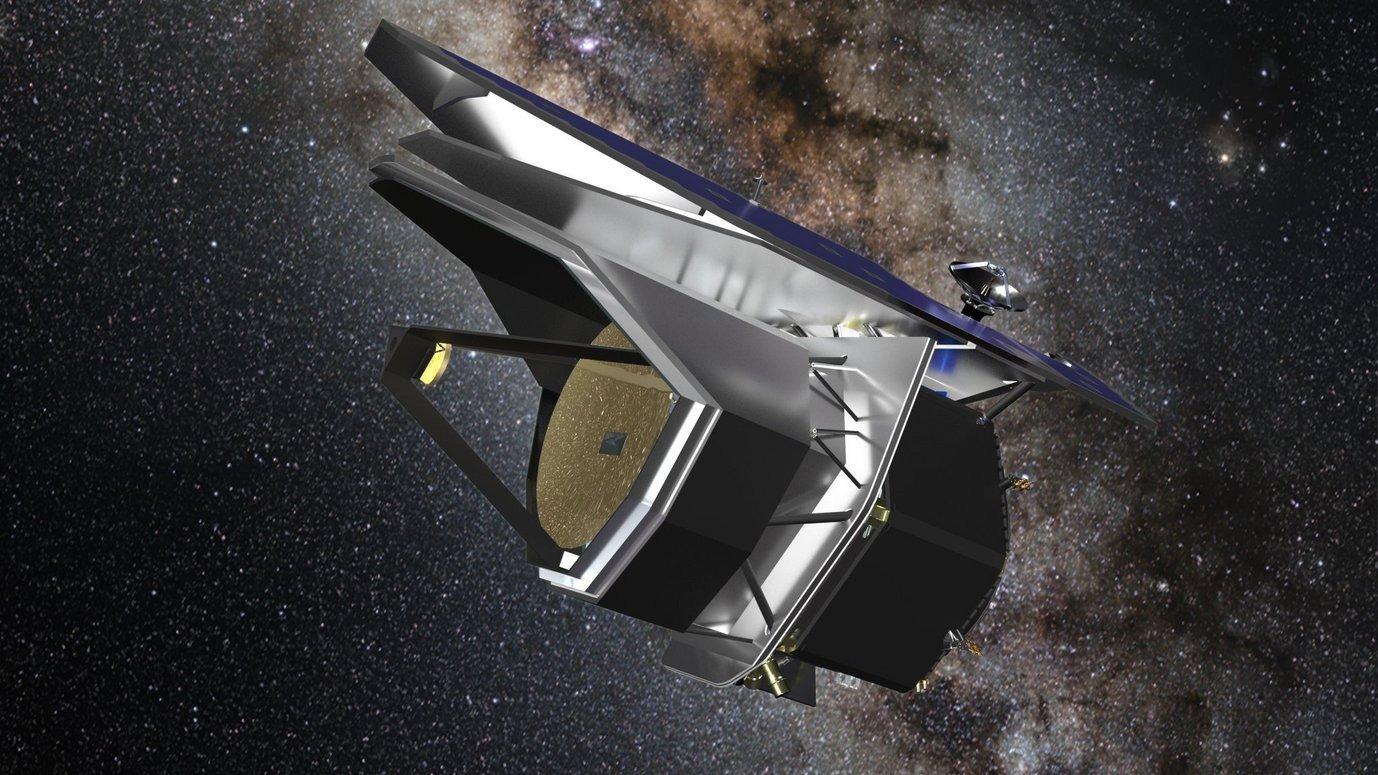
On September 23, 2026, NASA selected a new space telescope: PRIMA, short for PRobe far-Infrared Mission for Astrophysics. Led by the Jet Propulsion Laboratory, the observatory will study the universe in far-infrared light, a band that neither Hubble, nor Webb, nor the large radio telescopes capture well. Launch is targeted for 2033. Here is what the choice changes.
A class of mission that did not exist yet
NASA's release, published Wednesday, September 23, 2026, says one simple thing: PRIMA is moving to the next stage of development. Behind that administrative phrasing sits a real decision. The mission becomes the very first in a new category, the Probe Explorers, part of the Explorers Program that has launched more than 100 missions since 1958.
To grasp the point, think of U.S. astrophysics as a three-tier lineup of machines. At the bottom sit Explorer missions, small, fast and cheap, such as SPHEREx, which maps the entire sky. At the top sit the flagship observatories, such as the James Webb Space Telescope and the Nancy Grace Roman Space Telescope, capable of almost anything but very costly. Between the two, a middle rung was missing, more ambitious than an Explorer but more contained than a flagship.
That is exactly what Astro2020, the decadal survey published in 2021 by the U.S. National Academies, recommended. Reports of this kind set the priorities of U.S. astronomy once a decade, and this one called for creating the intermediate class. NASA created it, then weighed the candidate projects on three criteria: scientific value, technical and budget feasibility, and how well each could pave the way for larger missions later.
In practice, PRIMA now enters Phase B. In engineering language, these phases slice a project's life like the steps of a construction job: first the sketch, then the detailed drawings, then the build, then the tests. Phase B is the detailed design and technology development stage. The project must then clear a confirmation review, an examination that checks whether performance, schedule and budget hold together, before it is cleared to begin implementation.
The Jet Propulsion Laboratory in California takes the lead, having designed and run many infrared missions before. NASA's Goddard and Marshall centers add their expertise, and seven international partners are on board: the French (CNES), Italian (ASI), German (DLR), Canadian (CSA) and UK space agencies, along with Korea's KASI and Japan's JAXA. A project at this scale is rarely built alone.
Why far-infrared was a blind spot
Now to PRIMA's reason for being. The light we see fills only a sliver of the spectrum, between 0.4 and 0.7 micrometers, with one micrometer equal to a thousandth of a millimeter. Just beyond that lie the infrared wavelengths, longer, and beyond what the eye can detect. The James Webb Space Telescope works in that zone, from roughly 0.6 to 28 micrometers. Farther out still, from a few hundred micrometers on, radio telescopes such as ALMA take over.
In between lies a poorly covered stretch, the far infrared, from 24 to 235 micrometers. For scale, 24 micrometers is about a third the thickness of a human hair, and 235 micrometers roughly the thickness of two stacked sheets of paper. Since Europe's Herschel mission ended in 2013, no space observatory has treated this band as its core purpose. That is the gap PRIMA is built to fill.
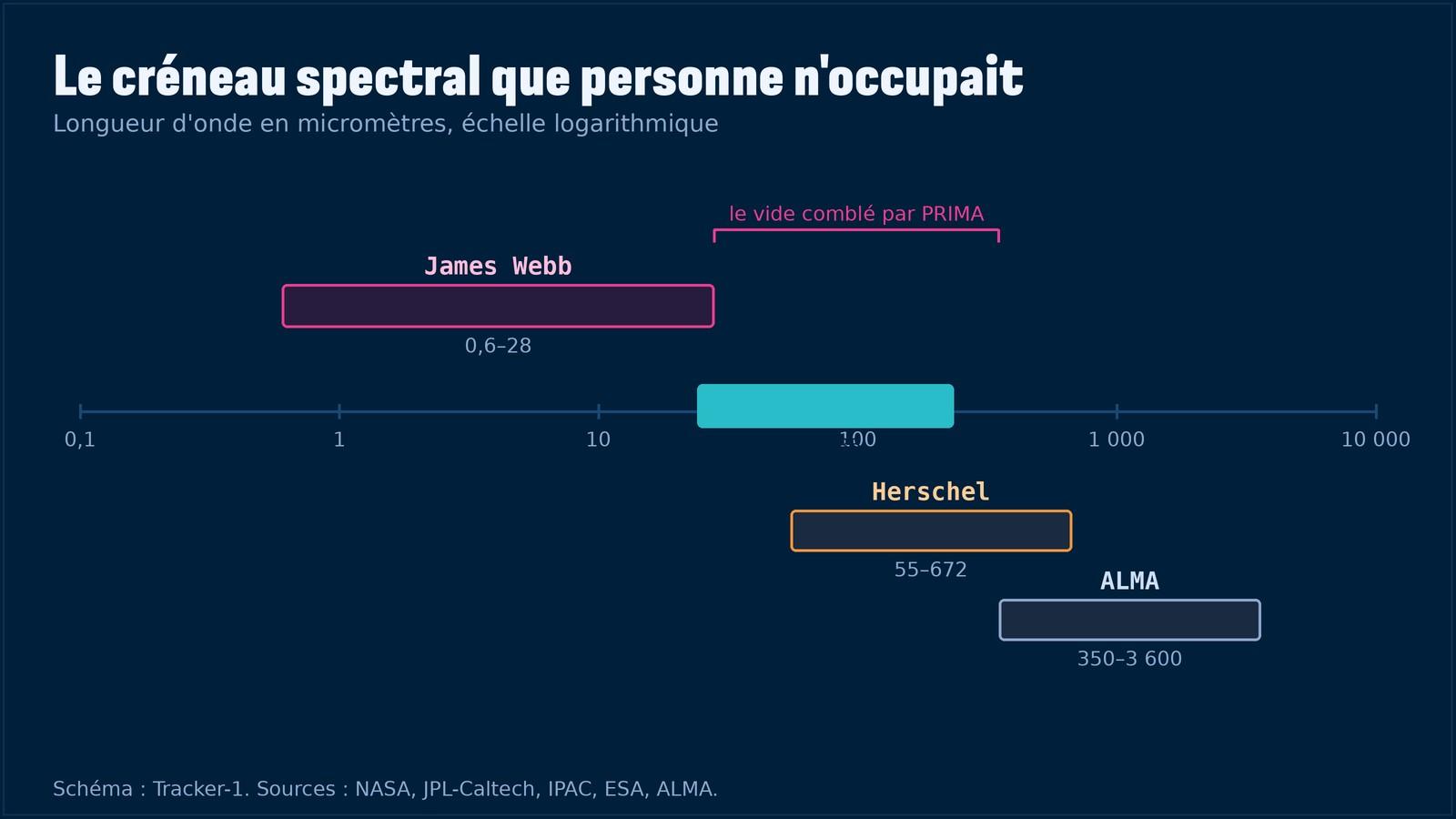
That band matters for a simple reason. The coldest objects in the universe, icy dust, molecular clouds, the disks where planets take shape, glow mainly in the far infrared. Their light does not pierce Earth's atmosphere, which absorbs these wavelengths because of water vapor. Observations therefore have to be made from space. The trouble is that any warm instrument also glows in the infrared, hiding faint signals.
Hence PRIMA's fix: chill the telescope. Its 1.8-meter mirror, made entirely of aluminum, drops to 4.5 K, about minus 269 °C, just four degrees above absolute zero, the floor temperature of the universe (minus 273 °C). Picture a photographer trying to capture a candle in a room. Under floodlights, the flame vanishes. In the dark, it stands out. PRIMA's cold switches off the floodlights.
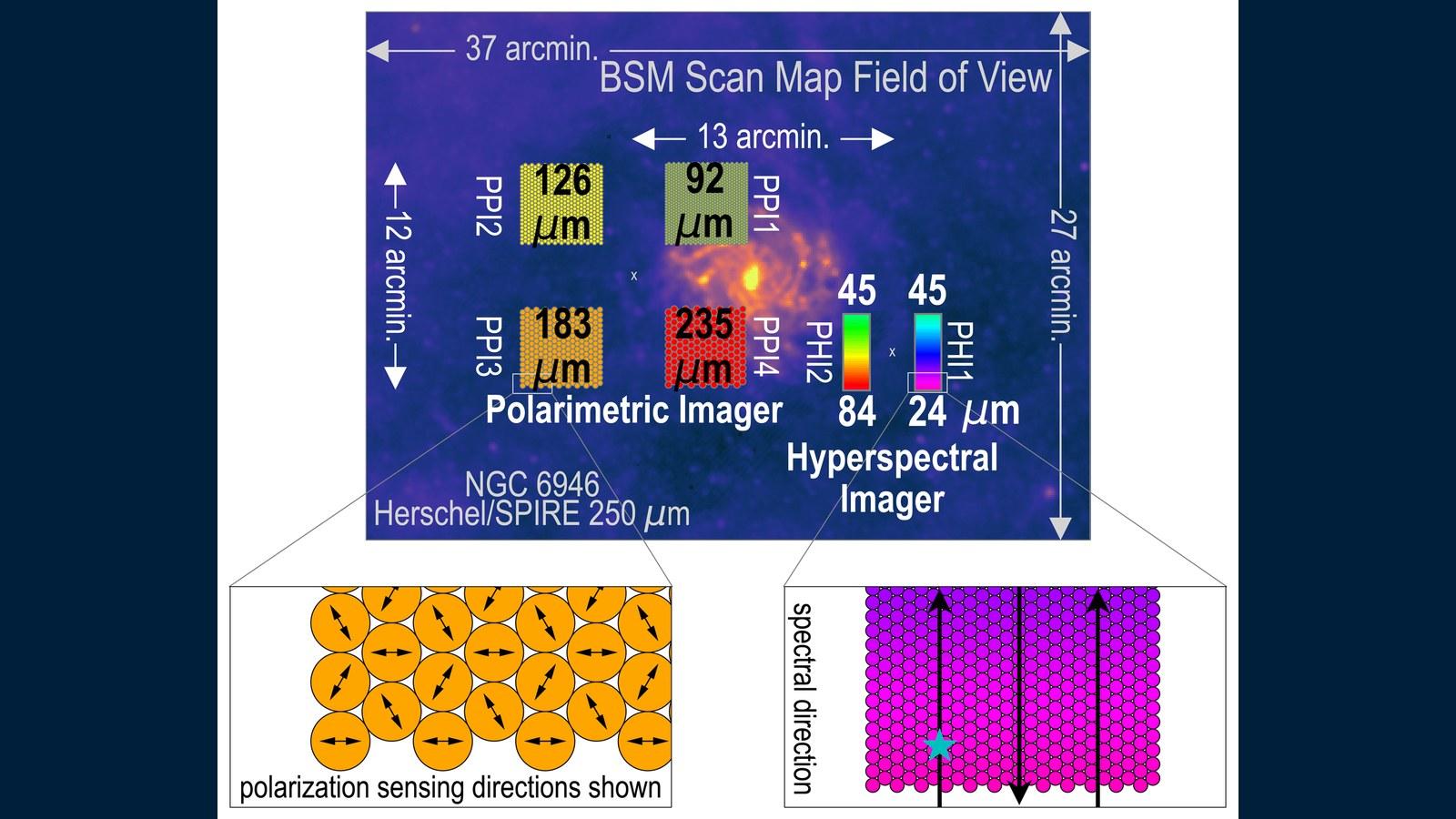
Two instruments will share the work. The first, PRIMAger, is an imager that photographs wide patches of sky from 24 to 235 micrometers and measures the polarization of the light, meaning the direction in which its vibrations are aligned. The second, FIRESS, is a spectrometer: it splits incoming light into its wavelengths to identify which molecules are present, much as a prism separates the colors of a rainbow. Both rely on superconducting detectors called KIDs, cooled to 0.1 K and spread across roughly 12,000 pixels, against only a few thousand on previous far-infrared space missions.
What PRIMA is meant to find
Once in orbit around the L2 Lagrange point, 1.5 million kilometers behind Earth, PRIMA will tackle three big questions, the ones that earned it the selection.
The first concerns how planets and their atmospheres are born. Around young stars, matter flattens into a disk of gas and dust where planets form. PRIMA will measure what those disks are made of, especially water and carbon-bearing molecules, to work out where the air that planets breathe comes from. It will also trace the ratio between two forms of hydrogen in comets, ordinary hydrogen and its heavier cousin deuterium. That ratio is a fingerprint: it tells whether comet water resembles the water in Earth's oceans. Project estimates suggest a 1,200-hour campaign could measure the ratio across a representative set of comets.
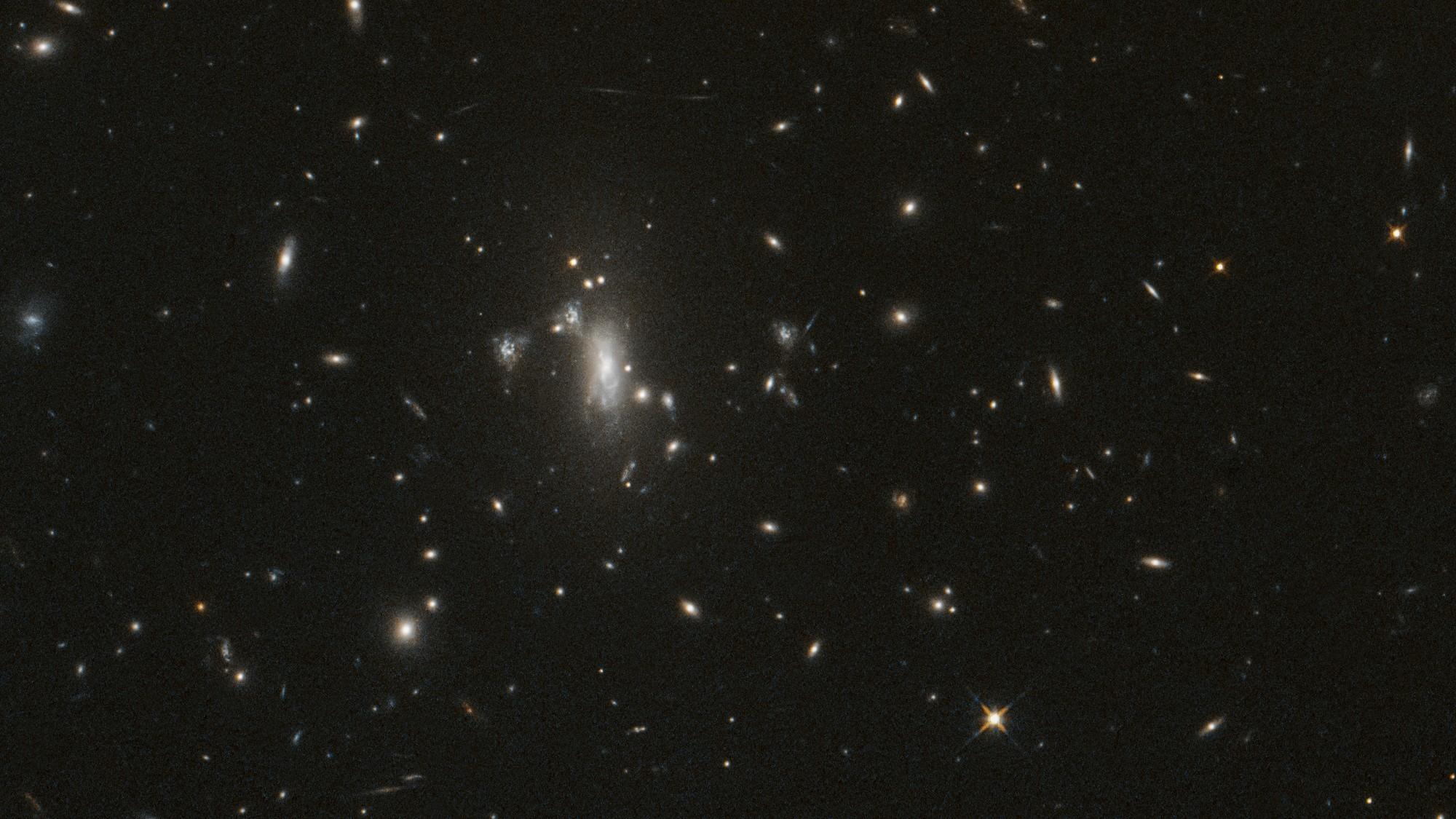
The second question is how galaxies and the supermassive black holes at their centers grew together. The two seem to grow in step, though no one knows which drives the other, or how black holes sometimes hold back star formation. PRIMA will look back to a time when the universe was about a quarter of its current age, a stretch when these giants swallowed the most matter.
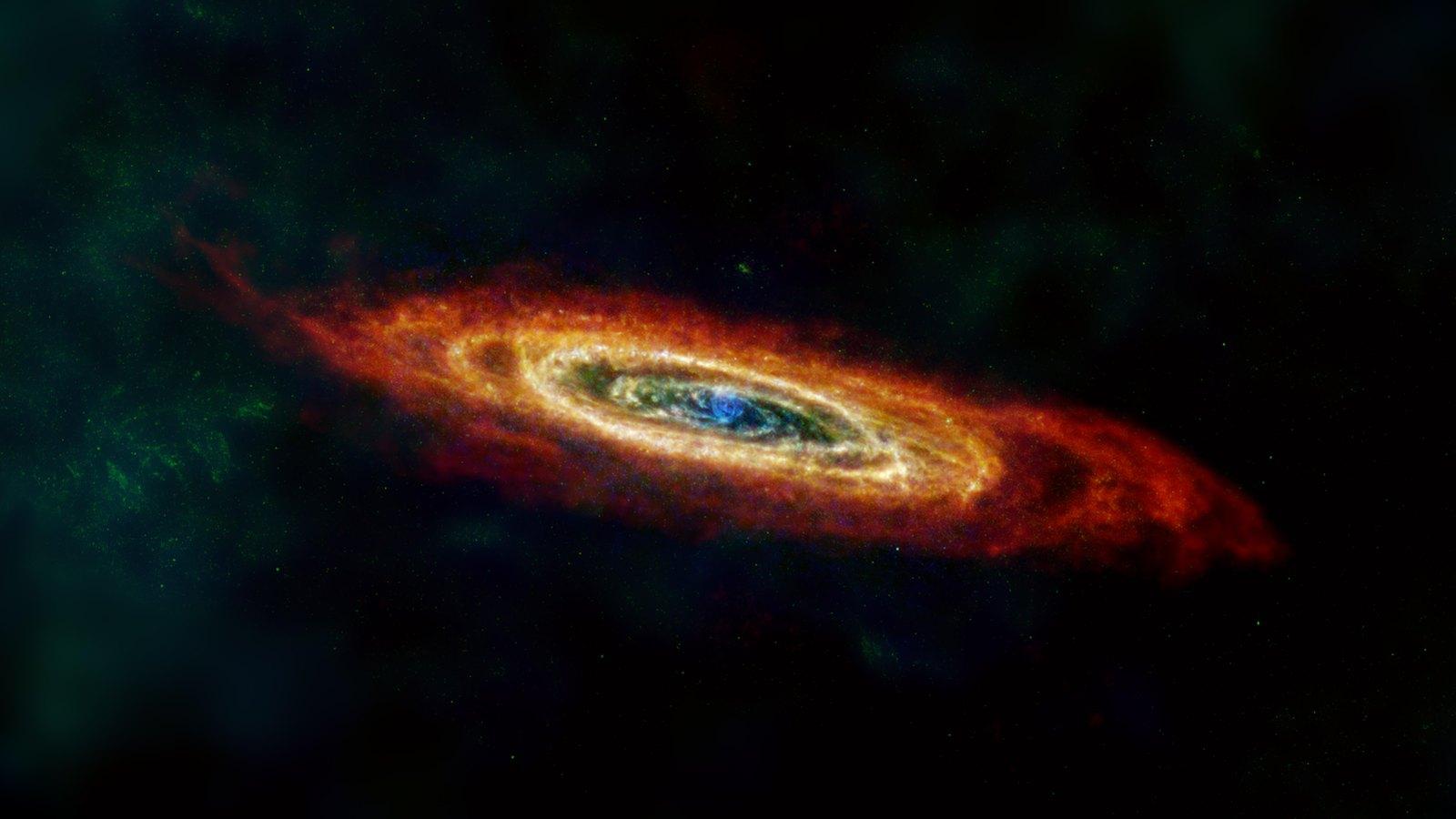
The third goal is dust and heavy elements, which astronomers lump under the name metals, meaning everything heavier than helium. Forged inside stars and later scattered into space, they are the raw material of planets and of life. PRIMA will measure how they piled up in galaxies, from the earliest ones to our own.
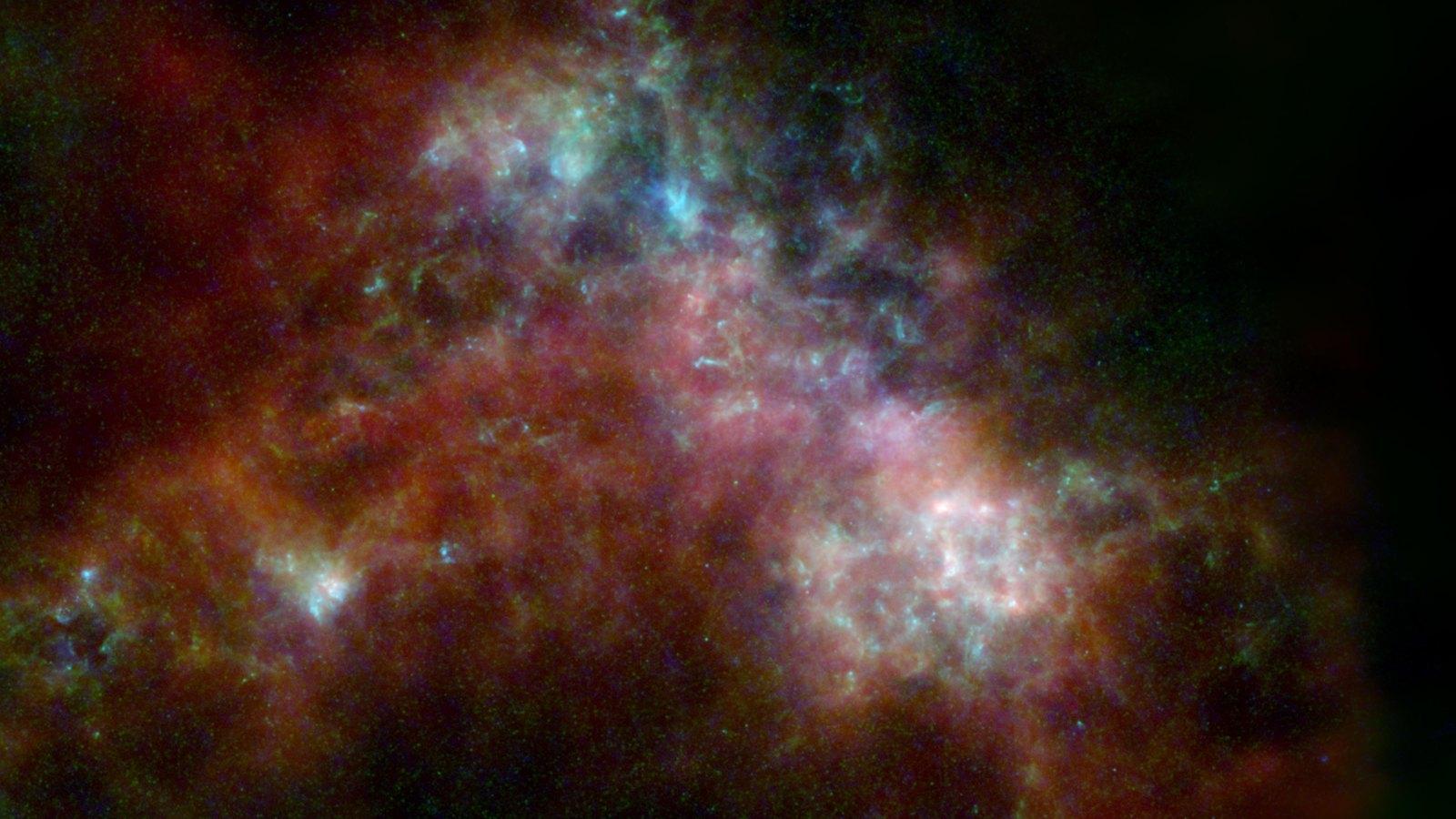
The mission's reach goes beyond those three goals. In polarimetry, PRIMA will chart the magnetic fields of galactic clouds, the regions where gas clouds collapse to give birth to stars. And the sensitivity of its surveys shifts the scale: according to the project's fact sheet, PRIMA could sweep the entire sky 100 times deeper than the IRAS and Akari missions in 5,000 hours of observing time. Part of the time, 75%, will be opened to the international science community through calls for proposals, as happens on Hubble and Webb. The rest goes to the mission science team's programs.
The calendar is still unwritten
A note of caution on dates. NASA's release of September 23, 2026 states a targeted launch in 2033. The IPAC science center's page, updated earlier, still lists 2032. At this stage a one-year slip is common, and the gap between the two documents is a reminder that a mission's schedule during its study phase is a target, not a promise.
Nicky Fox, associate administrator for NASA's Science Mission Directorate, sums up the ambition: "The PRIMA mission is humanity's next window into the deep universe. It will unveil the obscure across cosmic time to better understand the formation of planets, stars, black holes, and even how water on Earth came to be."
Shawn Domagal-Goldman, director of NASA's Astrophysics Division, puts the decision in context: "A single mission alone can't probe all the universe's mysteries. But by extending the survey capabilities of our fleet into far-infrared wavelengths with PRIMA, we're enabling an incredibly comprehensive look at the cosmos." He adds that NASA intends to keep that pace and open the next decade with PRIMA.
The end of Phase B and the confirmation review will show whether the mission holds its budget and schedule. Until then, one thing is already settled: NASA has opened an intermediate rung in its lineup of space telescopes, and PRIMA will be its first occupant.
Going further
- The missions that bracket PRIMA in the lineup: the flagship James Webb Space Telescope, whose infrared range stops short of this band, the Nancy Grace Roman Space Telescope for wide-field surveys, and the lightweight SPHEREx mission.
- Key ideas to follow the story: infrared light, which slips through dust and reveals cold objects, the space telescope, shielded from the atmosphere, and the supermassive black holes PRIMA will track inside galaxies.
- To observe for yourself the kinds of targets PRIMA will study, such as galaxies and dust nebulae, the interactive sky map and the observing guide are the place to start. The astrophotography gallery shows what amateurs capture of those same objects.
- Official sources: the NASA release on PRIMA's selection, the IPAC overview of the PRIMA observatory and the Caltech note on the roles of JPL and IPAC.