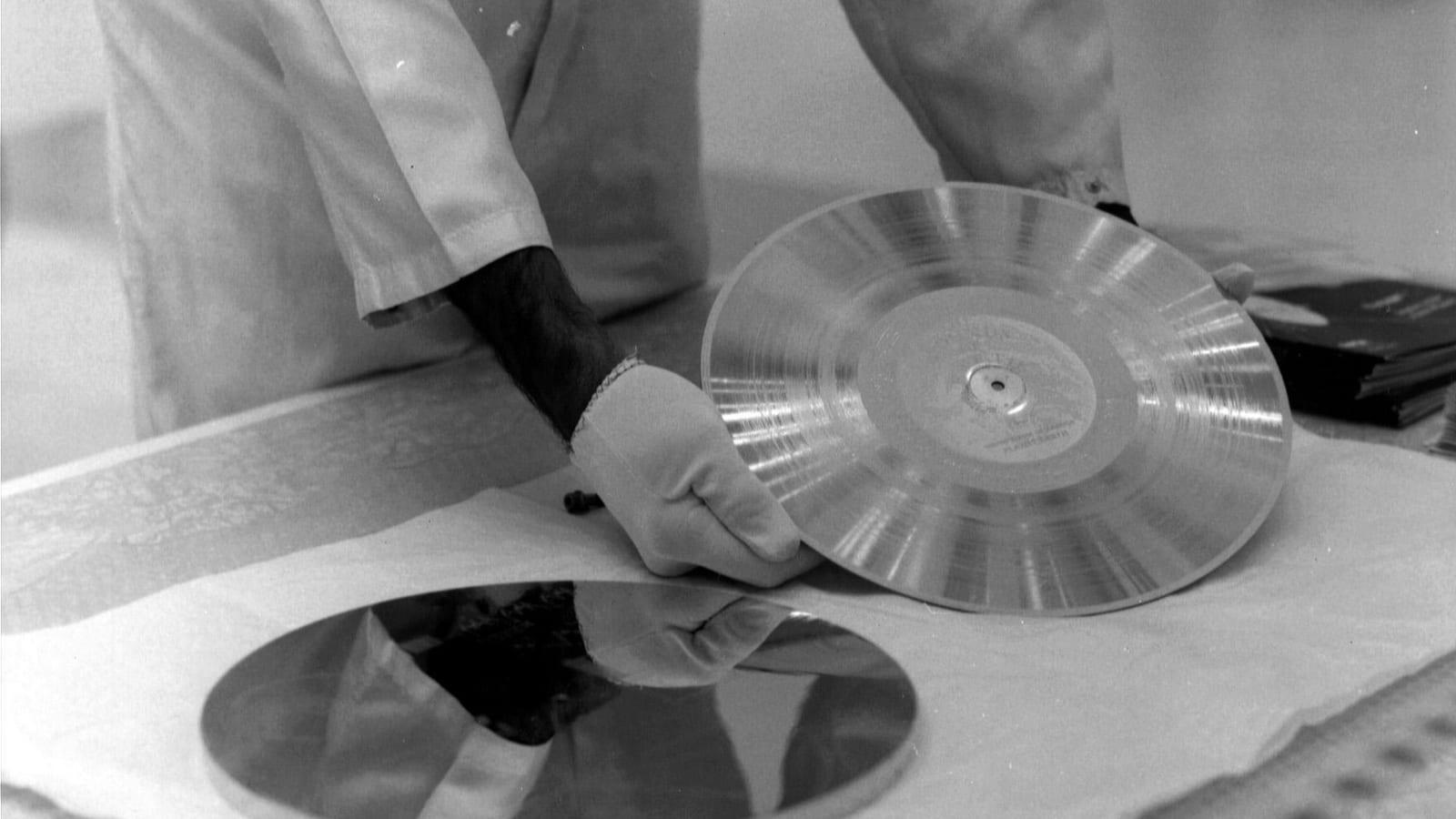
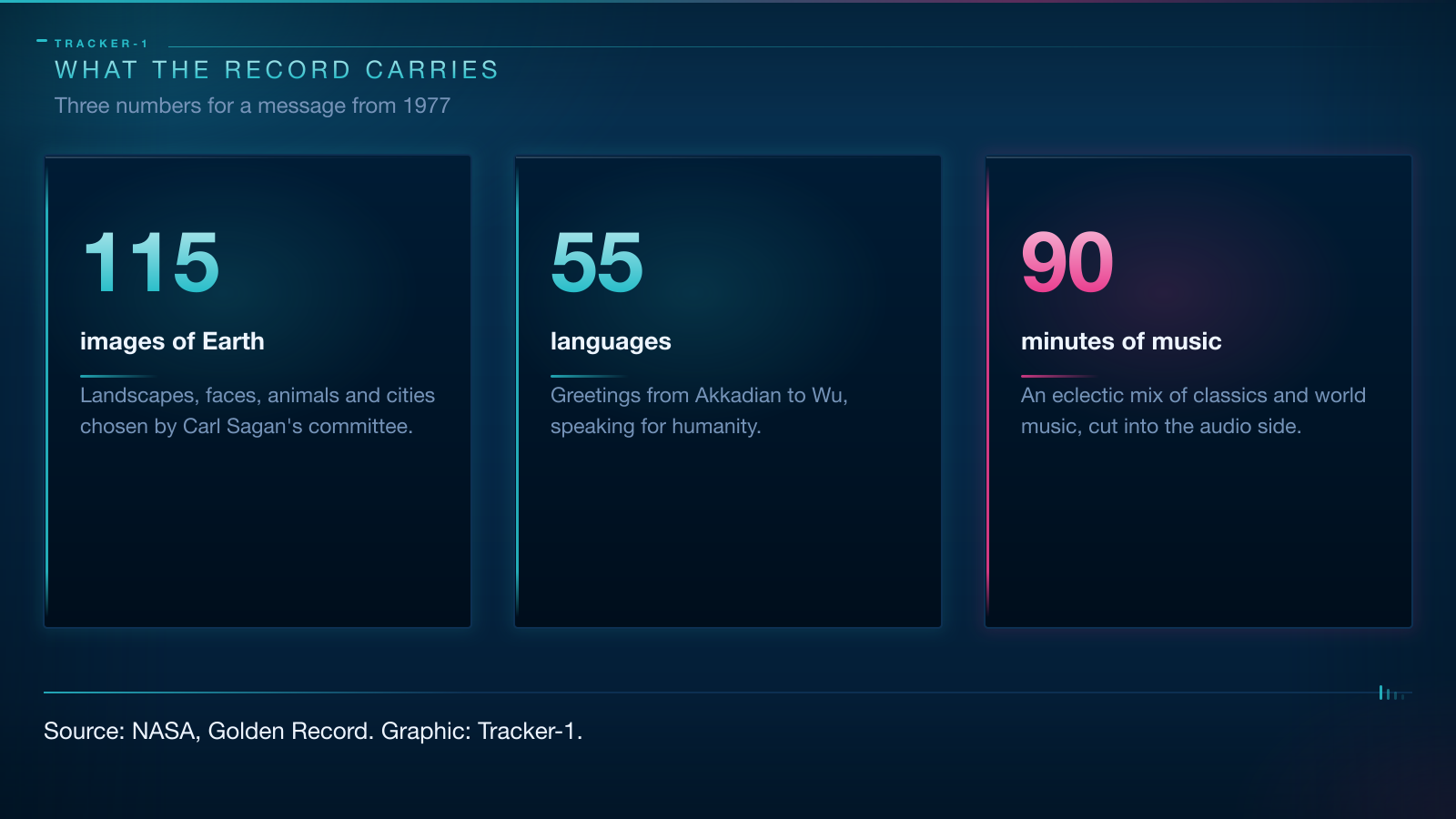
In 1977, two spacecraft left Earth with a 12-inch gold-plated copper disk. On its face: 115 images, 55 languages, sounds of Earth and 90 minutes of music. On its cover: diagrams that teach how to play it and how to find Earth. Carl Sagan, who chaired the committee, called it a bottle thrown into the cosmic ocean.
This is the fourth article in Tracker-1's special week. It looks at what the record carries, how its cover works, and turns the question around: what would we put on a record launched today?
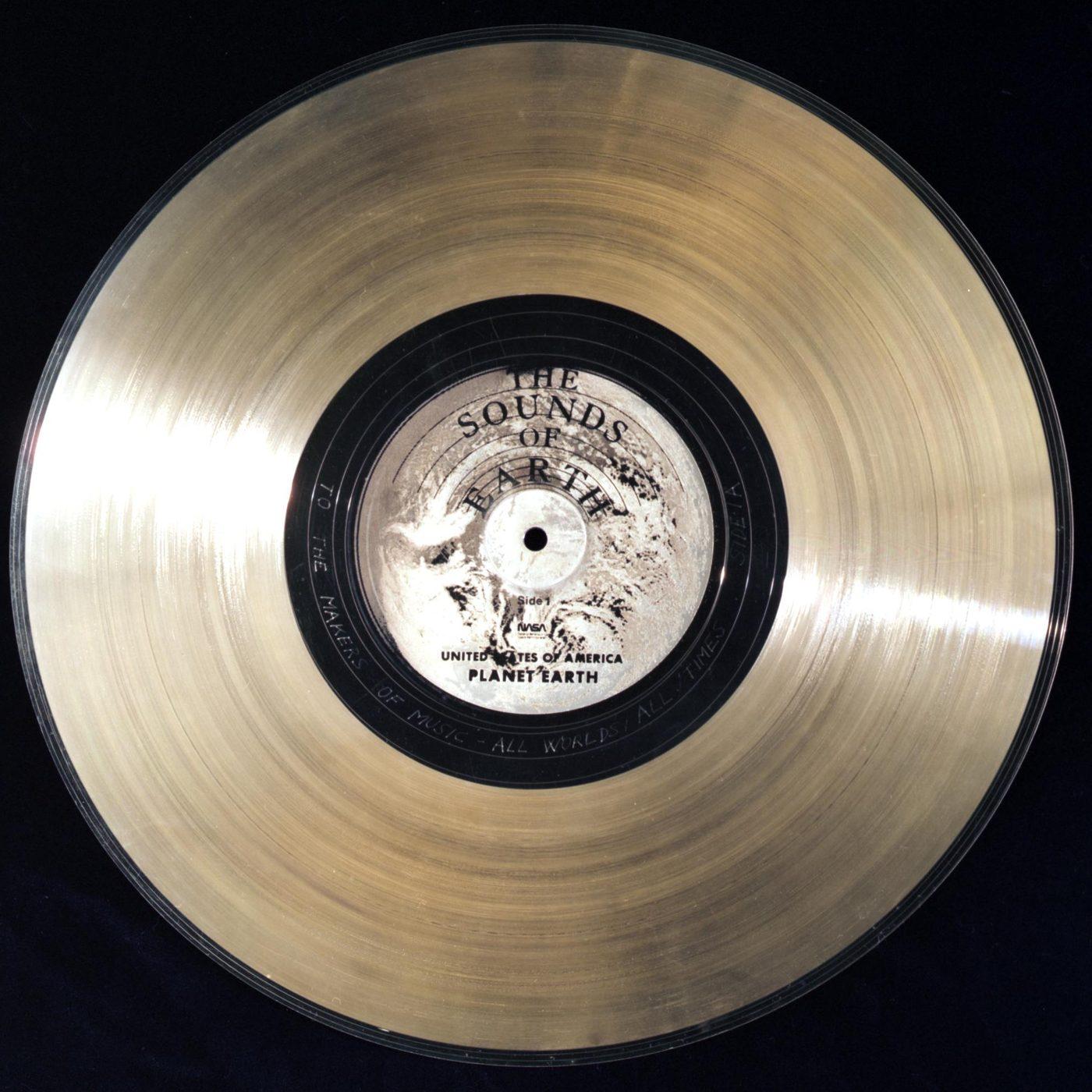
A disk in a cosmic bottle
The object is simple: a 12-inch gold-plated copper disk, about 30 centimeters across. It sits inside a protective aluminum jacket with a cartridge and a needle. Symbolic instructions explain where it comes from and how to play it. The audio side runs at 16 and two-thirds revolutions per minute. The greetings run from Akkadian, spoken in Sumer about six thousand years ago, to Wu, a modern Chinese dialect.
A committee chaired by Carl Sagan of Cornell University chose the contents. With him, Frank Drake, Ann Druyan, Timothy Ferris, Jon Lomberg and Linda Salzman assembled 115 images, natural sounds such as wind, thunder, birds and whales, musical selections from different cultures and eras, greetings in 55 languages, and messages from President Jimmy Carter and U.N. Secretary General Kurt Waldheim.
The record will probably never be played. Sagan knew it: it will be encountered and played only if an advanced spacefaring civilization crosses its path in interstellar space. The gesture is no less serious for that. It says something very hopeful about life on this planet, in Sagan's words, and it turns an object 30 centimeters wide into a portrait of an entire species.
The cover, a user's manual
The cover is the cleverest part. In the upper left, a drawing shows the record and its stylus in the correct position to start playing. Around it, in binary arithmetic, is the time of one rotation, 3.6 seconds, expressed in units of 0.70 billionths of a second, the period of a fundamental transition of the hydrogen atom. The drawing also shows that the record plays from the outside in, and gives the length of one side, about an hour.
In the upper right, the cover explains how to rebuild the images. The recorded signal traces each picture as 512 vertical lines, like the horizontal lines of a television, with an interlace that gives the correct rendition. The duration of one line, about 8 milliseconds, is given. An extraterrestrial who understands the drawing can turn sound back into an image.
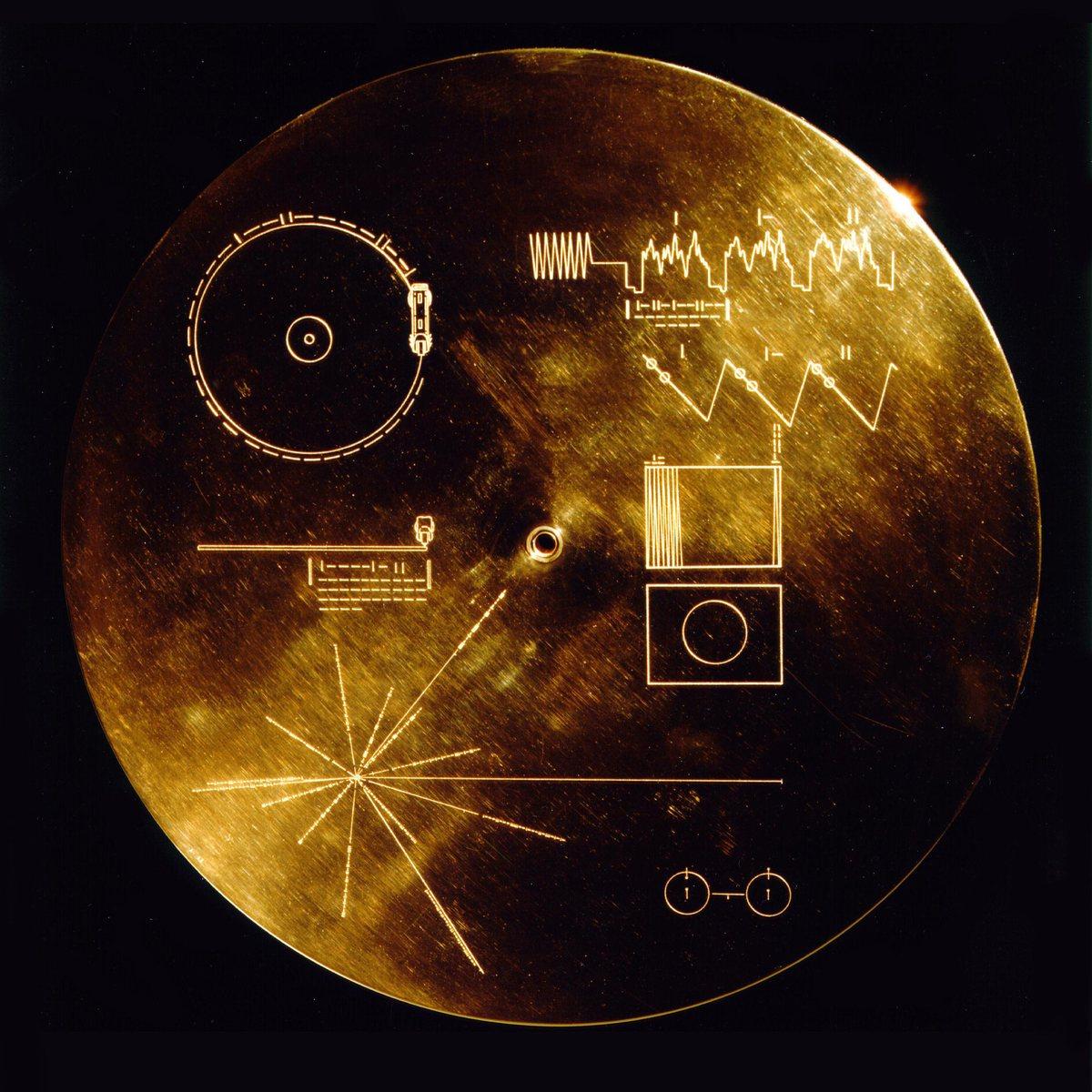
In the lower left, the pulsar map repeats the one sent on the Pioneer 10 and 11 plaques. It locates the solar system relative to 14 pulsars whose precise periods are given. In the lower right, the hydrogen atom in its two lowest states provides the fundamental time scale used both on the cover and to decode the images.
The cover goes further. A thin layer of uranium-238, electroplated onto the protection, acts as a radioactive clock. Its decay is steady, and half of the material is gone after 4.51 billion years. By measuring the ratio of remaining uranium to its decay products, a reader can calculate how much time has passed since launch. The pulsar map gives the epoch, the uranium gives the elapsed time.
What the record says about us
The record is a time capsule. It does not describe Earth so much as a certain idea of Earth, the one a committee assembled in 1977. The images show landscapes, faces, animals, cities, gestures. The sounds carry wind, water, animals, machines. The music crosses cultures. The official messages speak for humanity.
That portrait has gaps. It says almost nothing about conflict, inequality, pollution, or the diversity of everyday lives. It could not include the internet, which did not exist, or smartphones, or the climate data of later decades. It is a product of its time, with its hopes and its blind spots. That is also what makes it moving.
Sagan and his team documented the project in "Murmurs of Earth", published in 1978. The book tells the story of the choices, the refusals, the trade-offs. It reminds us that the record is not an objective sample of humanity but a selection, made with an intention. The intention is simple: say hello, explain where we come from, leave a trace.
What would you put on it?
The question matters even more today. In 1977, the record was 30 centimeters wide and held 115 images. A smartphone holds millions of photos, videos, books, maps, conversations. A record launched in 2026 could hold the web, a genome, a climate map, recordings of biodiversity, voices from around the world. It could also hold too much, and lose what gave the original its force: the choice.
The record is less a message to extraterrestrials than a mirror. What we decide to send says what we believe is important, beautiful, representative. An image of Earth, a song, a laugh, an explanation. The 1977 committee chose optimism and diversity. What would we choose today, with more means, more data and fewer illusions?
The Golden Record does not only speak to extraterrestrials. It asks us what we would choose to say. That may be its most current message.
Going further
- The mission pages for Voyager 1 and Voyager 2, tracked live on the site dashboard.
- The key concepts behind the story: space probe, exobiology and the solar system.
- The official sources: NASA's Golden Record overview, its contents and its cover.
- The record's portrait: PIA14113 in NASA's image catalogue.
- The rest of the special week: Tracker-1's latest stories.