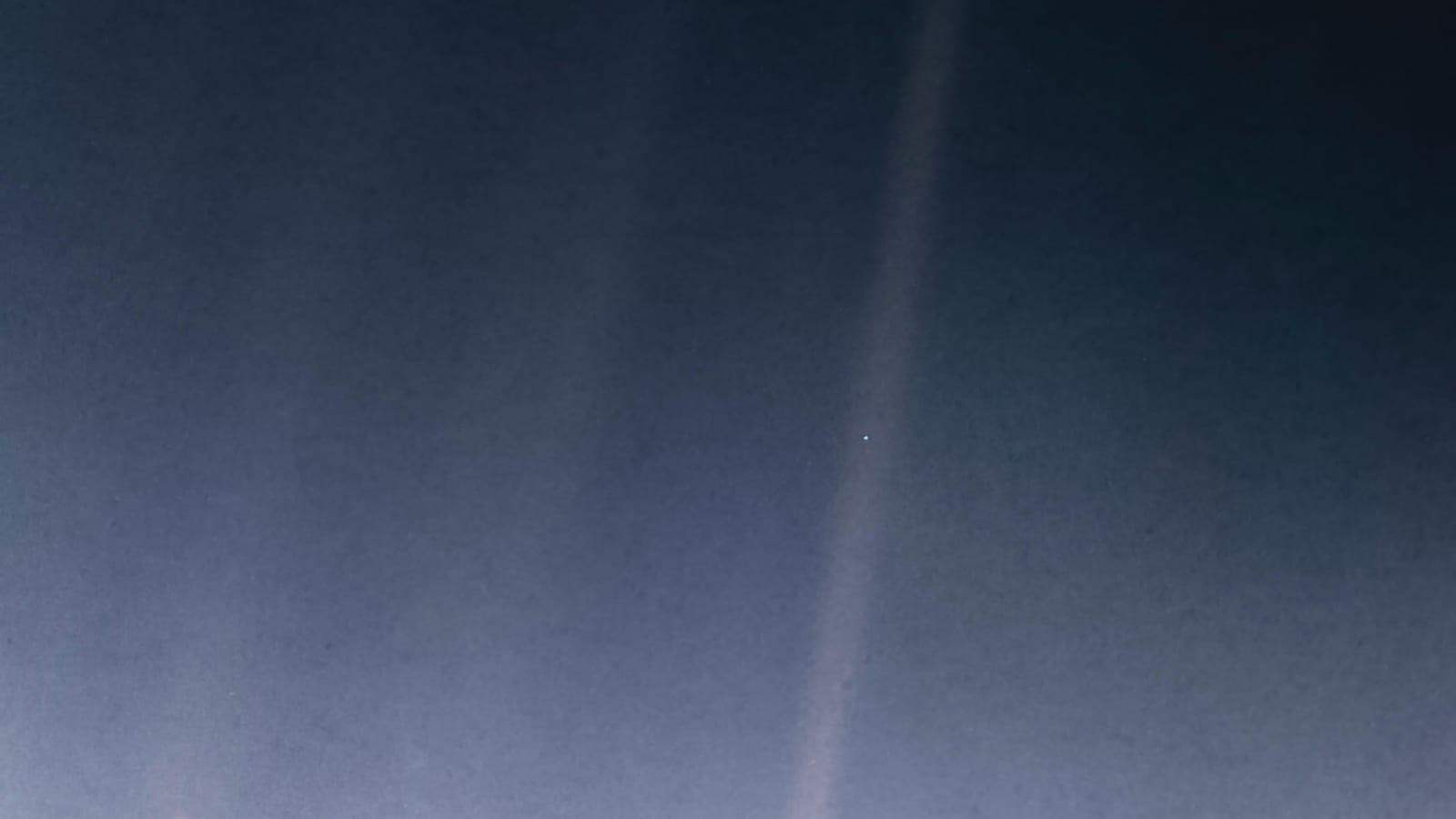
On February 14, 1990, at 04:48 GMT, Voyager 1 turned around and took a picture. Six billion kilometers from the Sun, Earth was a pale blue dot 0.12 pixel wide, lost in a beam of light. Thirty-four minutes later, the cameras shut down forever.
This is the fifth article in Tracker-1's special week. It tells the story of the image, the family portrait, what Carl Sagan saw in it, and why NASA reprocessed it in 2020.
February 14, 1990
The idea goes back a long way. In 1981, Carl Sagan proposed turning Voyager 1's cameras back toward Earth. At that distance, Earth would be just a point, and that was exactly what he wanted to show. The mission waited for the end of the imaging program to make the family portrait, just before shutting the cameras down to save power.
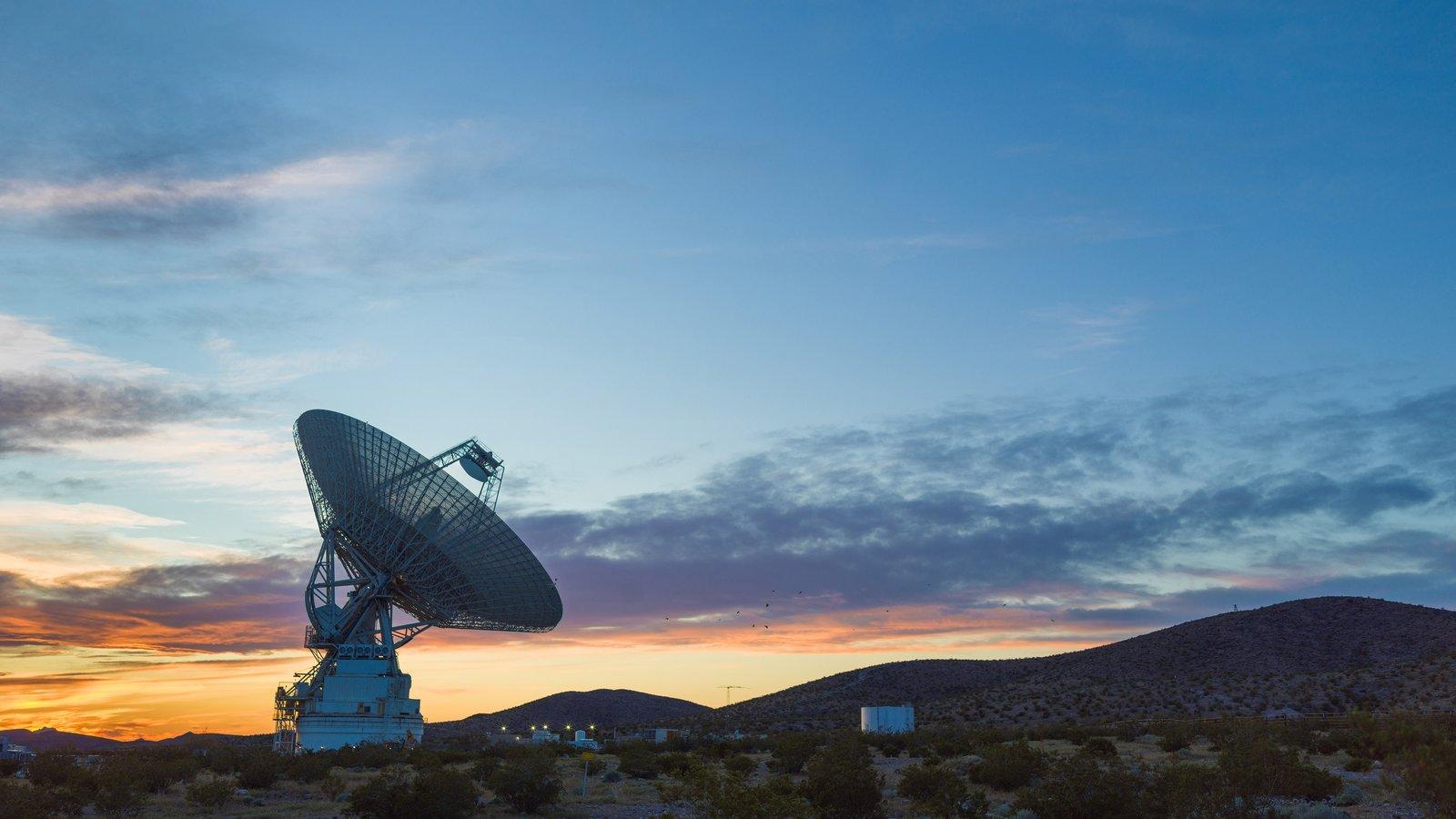
On February 14, 1990, the probe took 60 images. It photographed Neptune, Uranus, Saturn, Mars, the Sun, Jupiter, Earth and Venus. Earth's image was taken at 04:48 GMT. At 05:22, the cameras were off, 34 minutes later. The data took until May 1, 1990 to arrive, after four communications passes with the Deep Space Network.
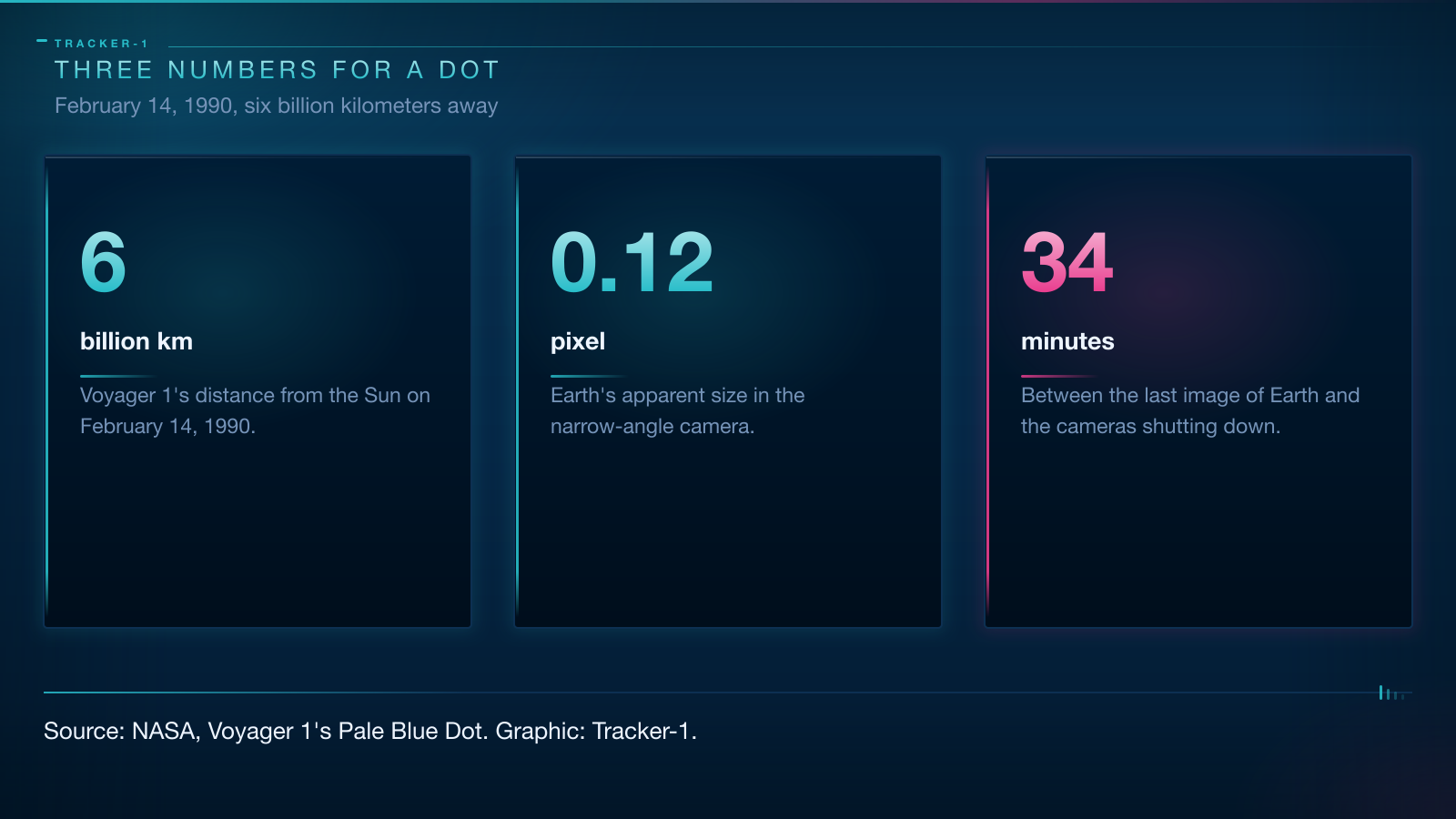
In the image, Earth covers only 0.12 pixel. It sits at the center of a scattered sunbeam, an artifact of being so close to the Sun. The planet is smaller than a pixel, and yet everything happens there. That disproportion is the image's power.
The family portrait
The family portrait is a mosaic of 60 images. It was meant to show the whole solar system from the outskirts of Neptune. Six planets appear, along with the Sun. Mars is hidden by light scattered inside the camera, Mercury is too close to the Sun, and Pluto is too small, too distant and too dark to be detected.
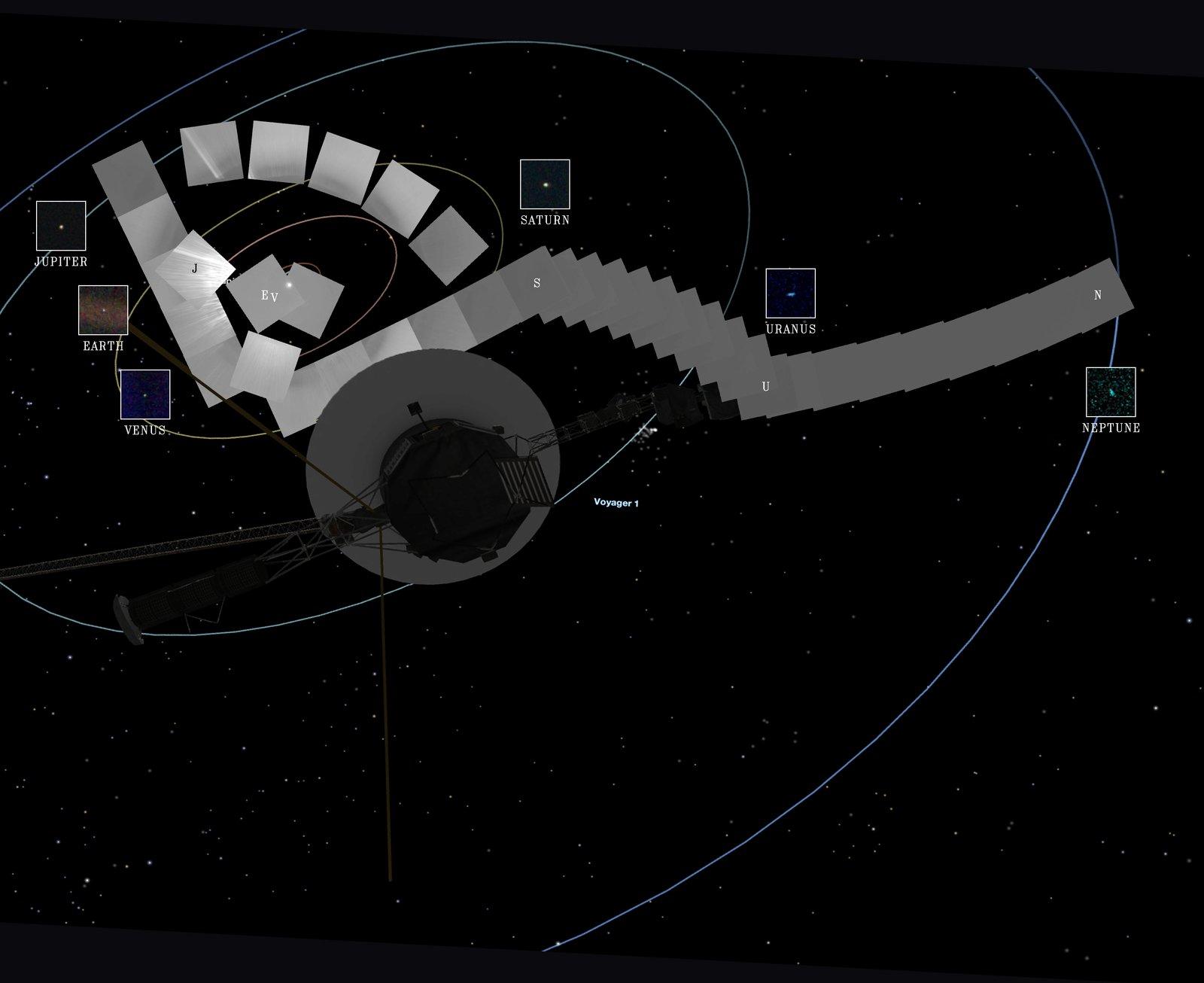
At JPL, the mosaic was mounted on a wall in the Theodore von Kármán Auditorium. It covered more than 20 feet. Members of the imaging team said Earth's image had to be replaced often because so many people touched it. The pale blue dot became a place of pilgrimage before it became a famous photograph.
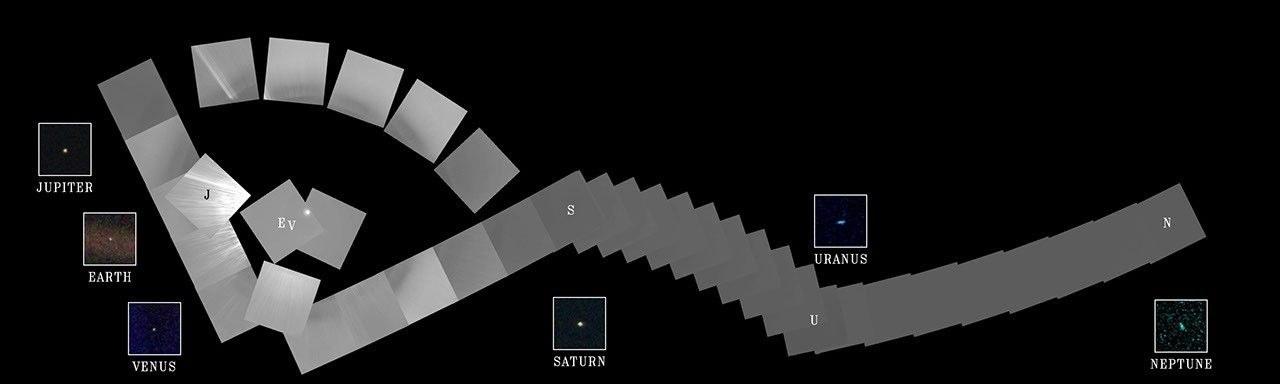
The portrait remains the first and only time a spacecraft has photographed the whole solar system. Only Voyager 1, Voyager 2 and New Horizons could do it from such a distance. No other mission has repeated the gesture.
What Sagan wanted to see
Sagan was not looking for a beautiful image. He was looking for a point of view. He wanted humanity to see itself from far away, tiny, without the borders and certainties of daily life. In his 1994 book "Pale Blue Dot", he wrote:
"That's here. That's home. That's us. On it everyone you love, everyone you know, everyone you ever heard of, every human being who ever was, lived out their lives... on a mote of dust suspended in a sunbeam."
Carl Sagan, Pale Blue Dot, 1994.
The rest is familiar. Sagan speaks of the folly of human conceits, of the responsibility to treat one another more kindly, and of the only home we have ever known. The pale blue dot is not an image of Earth. It is an image of us, seen from afar.
The image does not say that Earth is small. It says that we are small, and that this excuses nothing. That may be why it returns whenever we talk about climate, war or fragility. It does not preach. It provides a scale.
2020: looking again
Thirty years later, NASA published a new version of the image, "Pale Blue Dot Revisited". The processing was done by Kevin M. Gill, with help from Candy Hansen and William Kosmann, two of the original planners. The data are the same. The software is not.
The 2020 version is brighter and less grainy. The colors were rebalanced, and the sunbeam crossing the scene appears whiter. The original image, a false-color composite made from green, blue and violet filters, was 666 by 659 pixels. The new version does not change the distance, the dot or the beam. It changes the way we see them.
Why reprocess an image from 1990? Because looking again is a way of not forgetting. The 2020 version does not replace the original. It extends it. The pale blue dot has not finished telling us what we are.
Going further
- The mission pages for Voyager 1 and Voyager 2, tracked live on the site dashboard.
- The key concepts behind the story: space probe and the solar system.
- The official sources: NASA's Pale Blue Dot page, the 1990 Earth image and the family portrait.
- The reprocessed version: PIA23645, Pale Blue Dot Revisited.
- The rest of the special week: Tracker-1's latest stories.